What's the difference?
How much of a vehicle’s personality is determined by its tech? I’m pretty certain a Porsche 911 is still a 911 despite now being turbocharged, liquid-cooled and fitted with electric power-steering.
And surely a Toyota Corolla is still the spiritual equal of the original Corolla of the 1960s, despite the current car being front-drive, roughly the same size as an early Camry and fitted with a hybrid driveline and CVT transmission.
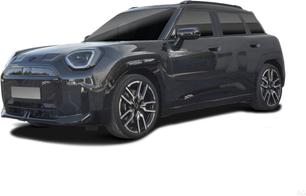
But what about our old friend the tiny, two-door Mini first seen in the late 1950s? Specifically, can the new Aceman variant still claim all (or, indeed, any of) its Mini-ness?
Okay, it’s still front-wheel drive and retains a few crucial visual clues. But let’s be clear here, it’s not only built in China as part of a joint venture between parent company BMW and Great Wall Motors, it’s also now a five-door hatchback and uses nothing but volts to get around. Can there be any Mini left in it?
Mini also claims the Aceman is part of a spearhead attack to take the brand towards an EV stance. Fitting in between the Mini Cooper two-door EV and the Countryman EV in both front and all-wheel-drive form, the Aceman theoretically broadens that range but, in reality, is more or less a replacement for the discontinued Clubman badge.
And despite the five-door layout, Mini is also happy to maintain that the original Mini’s genius in rewriting the book on interior-space-to-footprint ratio still shines through here. Maybe. At least it’s smaller than the hulking (by Mini standards) Countryman.
So here’s how it pans out: If you want a five-door, electric Mini that isn’t as big as a Countryman, the Aceman is your, er, man.
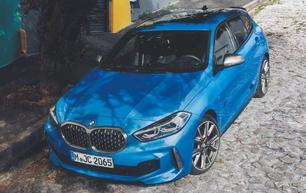
There was a big kerfuffle a few years back when BMW made the decision to switch its entry-level 1 Series hatchback from a rear-drive platform to a newer, more efficient front-wheel drive architecture, shared with its Mini sister brand.
Despite the concerns of a few enthusiasts and motoring writers, the impact of the change in driven wheels hasn’t harmed the 1 Series’ reputation or sales.
As with the equivalent entry-level small car models from BMW’s premium rivals, the entry grade 118i is an expensive car for what you get.
But does the 118i hatch have enough charm to transcend the price and spec concerns?
In many ways - range, performance and purchase price, for instance - the Mini Aceman is decent value, somewhat par for the course and would give its logical competition a proper marketplace run. But it’s better than that. The car’s big point of difference is its retro charm and the fact that it’s been tuned to be a fun drive rather than the non-confronting experience some carmakers strive for.
The performance is strong and the handling and steering serve up a bit of entertainment as well as giving the car a particular flavour. Which, as electric drivelines threaten to homogenise cars even further, must count for something.
Yes, some of what you’re paying goes towards that arguably nebulous notion of 'driving-spice' but once you’ve driven it, you’ll probably know what we’re talking about. A new car purchase is always special, so why not make that specialness last a bit longer with a car that will still be an entertainer long after the showroom thrill has worn off.
Meantime, it’s easy to see why Mini has already begun to run-out stocks of the cheaper E model. The SE still manages to play on that cheeky charm, but offers a more mature vehicle into the bargain. Not a bad trick, really.
Note: CarsGuide attended this event as a guest of the manufacturer, with accommodation and meals provided.
The 118i has restored my faith in entry-level models from premium brands. Could it do with more standard gear? Absolutely, especially at $50K, and given what you could get in a higher-grade variant from a mainstream manufacturer, like the Mazda3 or VW Golf.
But the 118i is a cut above the mainstream hatchbacks in terms of performance, driver engagement and how the car makes you feel.
If value is the priority, look elsewhere. But if your budget stretches this far and you can live without some of the luxo features, there’s little to complain about with the 118i hatch.
Though vaguely retro on the outside, the real nostalgia hit comes when you step inside the Aceman.
The huge, round central display that’s been associated with the Mini brand since day one, returns, but this time in 240mm, OLED screen form.
The display is also where you get to choose how the instrumentation and information looks, with configurable display incorporating a total of eight modes that alter the colours, sounds and visuals of the screen. Is it cool? Er, yes, actually.
There’s also the Mini personal assistant at your service to crank up the heat when you’re cold and switch on the air conditioning when you’re not (all voice activated) and the personal assistant can also learn stuff such as knowing particular navigation co-ordinates mean you’re at the entrance to an underground car-park, at which point the car will wind down the driver’s window so you can flash your credit card. If you think about it too hard, that’s going to be more creepy than cool for some of us.
The move to electrification, of course, is environmentally driven, so the Aceman’s ethos leans into that, too. There is, for example, a complete absence of leather or chrome, the alloy wheels contain as much as 70 per cent recycled material and are produced with renewable energy.
The floor mats, floor structure and interior surfaces are made from at least 90 per cent recycled polyester, and Mini claims a 98 per cent reduction in greenhouse gases compared with the same stuff made from leather.
Since the first-generation model arrived on the scene in the early 2000s, the 1 Series has had a slightly awkward design, partly due to the rear-wheel drive underpinnings. But this latest third-gen model, that debuted in 2019, is by far the most sleek and stylish yet.
This is helped by the slimline tail-lights, rising shoulder line and well-executed front-end design with the signature BMW quad headlights and wide 'kidney' grille.
In Australia the 118i comes as standard with 'M suspension' that lowers the ride height by 10mm, which gives it even more of a hunkered down look. The 'Black Sapphire' paintwork of the test car also upped the sexiness of the little hatch.
The 1 Series, and its competitors from Benz and Audi, are all visually appealing in different ways, ensuring they will each appeal to different buyers.
The interior design is unmistakably BMW, which hasn’t evolved significantly for about 15 years. Although new-generation models like the iX and the soon-to-launch X1 SUV prove that BMW can evolve.
BMW’s overall dash design and layout isn’t a million miles away from the edgy angular look of the new Audi A3 - and that’s no criticism.
The mixed synthetic leather and cloth trim on the seats has a cool blue cloth motif to break up the grey and add a small splash of colour to the cabin. Matching blue stitching on the dash and doors is a nice touch.
Perhaps it’s the packaging designed to play the retro card, but I can’t help feeling the door openings on this car are pretty tight. The rear doors, in particular, seem designed for someone smaller than I, and even once I’m in the news doesn’t really improve.
The Aceman’s rear pew seems tight for both foot and legroom and should you have an adult in the back seat, they’re only going to fit by having somebody smaller in the front seats. The chances of a six-footer (183cm) sitting behind a driver of similar stature are pretty slim (over a distance, anyway).
This is all to do with Mini keeping the overall length of the car to just over four metres, and stuffing a compact SUV into that space.
Perhaps that also explains the giant blind spot formed by the thick B-pillar. Either way, taller drivers will find themselves peering around it when crossing or tuning into intersections.
The seats themselves, however, are quite charming. They look a bit small with their cloth trim, but in reality, they’re comfy and supportive. The pleated John Cooper Works front seats that are standard in the SE are phenomenally good. The only thing missing is that distinct smell of leather we’d normally associate with a 60-grand car.
The traditional row of toggle switches under the central screen remains… sort of. These days, they’ve been modified to act as the starter button for the keyless start system and also the gear selector. The problem is that they’re gloss black on a black background, so they can seem a bit indistinct.
The gear selector has also been reinvented – again – with a separate Park button now to the side of the toggle. The other ergonomic glitch I noticed was every time I went for the interior door handle to leave the car, I fumbled for a second till I located it, tucked up under the armrest.
The clean, uncluttered dashboard means a couple of items have moved to the space between the front seats. So, there’s a pair of cupholders, a small, lidded compartments and a pair of USB charge-points all living in the real estate between the front chairs. That’s in the SE, anyway, because the cheaper E retains only the cupholders.
The luggage space is deeper than a lot of EVs manage and the rear seat folds 60/40 to open up a huge area if you don’t need the seats. With the rear seat up, there’s 300 litres of capacity and, with the seat folded, that leaps to 1005 litres.
There are three child restraint tether points, and the luggage space is served by a 12 volt socket.
There’s also a luggage cover that can be quickly removed for taller items. The tailgate is manually operated.
There are also three ISOFIX attachment points for child seats; two on the rear seat and one on the front passenger seat.
Up front the 118i’s sports seats offer unbelievable levels of lateral support, and despite the bolsters being adjustable, it might be a little too snug for some. It’s expected for a pricey hot hatch but not the lower grade 1 Series. And given how much side support there is, it could do with a touch more under-thigh padding. The driver’s seat is power adjustable while the front passenger has to adjust their seat manually.
The typically chunky BMW M leather steering wheel looks and feels expensive and offers good grip. The minimal steering wheel controls are well labelled with text or clear icons. I appreciated the analogue air conditioning controls instead of them being buried in a multimedia screen menu.
The multimedia system menu is unfussy and while it’s not as tech heavy as some other systems, I don’t see that as a negative. It just means there are fewer functions you’re forced to remember. You can control the system via the 'iDrive' controller in the centre console or it can be used as a touchscreen. I like the way users are given both options. The 10.25-inch screen is nice and wide but quite narrow. Overall, BMW’s operating system is easy to use and functions well.
In terms of devices, the 118i has a wireless charging pad, as well as a USB-A and USB-C port, and a 12-volt charger up front.
It has a smallish central bin, but it’s fine for a number of smaller items. Tall bottles fit easily in the door storage bin and there’s a secondary slot for other items. The 118i comes with a decent sized glovebox, and two front cupholders with a nook for phones just behind it.
The 118i is more spacious than anticipated, especially in the second row. The back of the front seats are scalloped, allowing for a little extra knee room, but there is a good amount of legroom generally, and plenty of headroom, despite the lower roofline.
The rear seats are on the flat side but still comfortable, and there are ISOFIX points on the two outboard seats.
Rear seat occupants have access to map pockets, two more USB-C ports, and storage for big bottles in the doors (just), but there are no rear air vents. The seats fold 60/40 and there’s no central armrest.
Open the hatch and you’ll find a reasonably sized boot that can swallow 380 litres, expanding to 1200L with the rear seats stowed. There is plenty of under-floor storage because there’s no spare tyre on account of the run-flats favoured by BMW. There are, however, a couple of tie-down anchors and shopping bag hooks.
Like the electric Mini Cooper launched last year, the Aceman is available in two versions with some important technical differences beyond the usual trim and equipment stuff most carmakers rely on to locate their models on the price totem.
The E (Electric) model is the most affordable five-door Mini EV with a price-tag if $51,990, driveaway. For that you get plenty of kit including adaptive cruise control, augmented reality navigation, heated front sports seats, a panoramic sunroof, sports steering wheel, 100-watt stereo and a cabin with splashes of nostalgia and piano black in equal measures.
There are also 19-inch alloy wheels and two-tone paint which teams a metallic body colour with a black roof. Wireless Apple CarPlay and Android Auto are included, too. So is dual-zone climate control, keyless entry and start, digital radio and folding exterior mirrors
The SE (Sports Electric) gets a different 19-inch alloy wheel, and adds an extra exterior colour as well as the lovely John Cooper Works front seats with electric adjustment, tinted glass, silver interior highlights, a Harman Kardon stereo upgrade and a different trim grade for the upholstery. All yours for $60,990 which sounds like quite a bit of extra money for those add-ons.
Until, that is, you realise the SE also packs a bigger punch with a bigger battery for more range and a perkier motor for better performance. Ah, so that’s where the money goes.
The catch is the E model is not long for the Australian market (I have never, till now, been invited to the launch of a car that was already in run-out). Local customers have voted with their feet and told Mini the more expensive SE is the one they want for a variety of reasons.
So, the E will continue to be sold here until stocks run out, probably around the end of 2025. And for that reason, the model we’ve driven here is the SE.
The 118i kicks off the BMW 1 Series range from $49,900, before on-road costs. From there you can step up into the warmed over 128ti from $58,900, and the range is topped by the spicy all-wheel drive M135i xDrive in Pure ($67,900) or regular guise ($72,900).
The 118i’s circa-$50K price tag is a lot for an entry-level small hatchback, but it seems BMW has become better at including standard gear in its base variants. But it’s still not what you’d call generous.
Standard equipment in the 118i includes single-zone climate control, a head-up display, LED headlights and fog lights, an 'M aerodynamics' package, leather steering wheel, sports seats, a six-speaker audio system, auto-dimming rear-view mirror, rain-sensing wipers, 'M Sport' suspension, wireless smartphone charging, a 10.25-inch digital instrument cluster, and a 10.25-inch multimedia screen with satellite navigation, digital radio and Apple CarPlay.
The only option fitted to the test car was premium paint ($1308) which brought the price-as-tested to $51,208, before on-road costs.
So there’s some good tech on the list, but there could be more premium features, you know, given it’s a premium brand, and all. Heated seats would be nice, for example.
Unsurprisingly, BMW offers a number of different options packs ranging in price from $1700 to more than $4000, depending on what you want.
Its two closest rivals are of course from the other big Germans - the Mercedes-Benz A180 (from $49,890) and Audi A3 35TFSI ($47,100) hatchbacks. The level of standard gear is relatively even across the three, although the Audi has the lead when it comes to safety (more on that below), hardly surprising given it's the newest of the three.
There’s also the question of value, especially when you compare with high-grade small hatchbacks from mainstream brands. Models like the Mazda3 X20 Astina ($43,190 BOC), or Honda Civic VTi-LX ($47,200 drive-away) could be good alternatives, or for similar money you could get into something sporty like a Hyundai i30 N Premium (from $48,000 BOC) or for a few grand more there’s the Volkswagen Golf GTI ($54,990 BOC).
Things kick off the with the E model’s 135kW electric motor that also produces 290Nm of torque. That, says Mini, is enough to get it from rest to 100km/h in just under eight seconds. The motor is powered by a 38.5kWh battery living under the floor
The SE gets more battery and more power; 49.2kWh and 160kW, respectively, with 330Nm of torque on tap as well. The claimed 0-100km/h time falls almost a second to 7.1sec.
A single-speed reduction transmission is fitted and the electric motor in both models is a single one, driving the front wheels in true Mini tradition.
Of course, the other aspect of a Mini’s driving experience is its go-kart handling. To that end, the Mini EV is tuned for handling and response and features a MacPherson strut front end and a multi-link suspension arrangement at the rear. Potentially offsetting that sidestep, however, is the car’s heft which, at 1.6 tonnes, is very un-Mini.
The 118i is powered by a three-cylinder turbocharged petrol engine, offering up 103kW of power and 220Nm of torque. It’s the same unit found in the Mini Cooper, albeit uprated by 3kW for the BMW.
It is front-wheel drive and the engine is paired with a seven-speed dual-clutch automatic transmission.
BMW says the 118i can cover the 0-100km/h sprint in 8.5 seconds.
If you’re after a quicker 1 Series, then the 180kW i28ti or 225kW Mi35i xDrive could be a better pick.
Mini claims a power consumption figure of 14kWh per 100km for the E and 14.4 for the SE. Theoretically, that should give the E a (WLPT) range of 310km and the SE a claimed maximum of 406km.
In reality, you’ll be looking for a power-point before that, because those are both maximum range projections and, in highway conditions, without the regeneration potential of suburban running, you’ll use more power per 100km travelled.
Both version of the Mini EV can use fast chargers, the E model capable of 75kW DC charging, and the SE’s bigger battery able to handle 95kW. Charging at home on an 11kW AC outlet is also possible but, obviously, takes a lot longer to reach full charge.
For DC charging, the Mini uses a CCS Type 2 charging plug.
Speaking of which, on that 75kW fast charger, the E’s battery will go from 10 to 80 per cent charged in 28 minutes, while the bigger battery in the SE will take 31 minutes, its faster charging offset by its larger battery capacity.
At 11kW AC, the Aceman E can go from discharged to fully charged in four hours, 15 minutes, while the SE will take five-and-a-half hours.
According to BMW, the 118i consumes 5.9 litres of fuel per 100 kilometres. During my week of mixed driving with the hatch, I recorded a much higher average figure of 10.8L/100km. This was exacerbated by the fact I did my main test drive shortly before returning the car. It was much more efficient around town.
It has a 50-litre fuel tank and does require premium 95 RON petrol. In terms of CO2, the 118i emits 135g/km.
Much is made by Mini of its tradition of go-kart-like handling. And fair enough, it’s one of the things that allows the Mini brand to justify a premium price-point. And the good news is that this version, electric driveline notwithstanding, continues that theme. Position the manually-adjustable steering column to the right spot and suddenly, you’re in a car that encourages you to enjoy the drive.
The steering is light but accurate and is actually one of the better calibrated modern, electrically-assisted set-ups we’ve sampled for a while.
The only thing it doesn’t do is give the feeling that you’re sitting right over the physical point in the car that it rotates around when it corners.
Instead, you get the impression of there being a fair bit of Mini nose jutting out in front of you, with the driver’s seat positioned well back in the cabin.
Given the extra length of the five-door layout, that’s not completely unexpected, but it’s something drivers of short-wheelbase Minis will perhaps note.
What that doesn’t affect is the way the car feels tied down pretty well, but never degenerates into a crashing, buck-board. Despite the flat cornering, there’s always some suspension travel left, it seems, and the damping is clearly spot on as it arrests wheel movement without interfering with the fun.
There’s plenty of grip, too, and if you play the Mini game and hustle it through a few corners, the Aceman quickly reveals its fun side, which is precisely the point here.
The instant urge of an electric drivetrain is also very much in evidence and flooring the throttle pedal results in an instant surge of Newton-metres. I could do without the Warner Brothers soundtrack (and I did, by turning it off) but the acceleration itself is pretty impressive without being confronting (as some EVs with their brutal delivery can feel).
The only other thing we’d comment on is a level of tyre and road noise that is far from best in class. Okay, so a bit of tyre roar is okay, and it’s only audible at all because silence from traditional mechanical sources is such an EV thing.
To be honest I wasn’t particularly hopeful of an engaging driving experience with the 118i given I have been underwhelmed by the base Mercedes-Benz A-Class. But after a week with the 1 Series, I reckon it might well be the pick of the premium players in this segment.
The 118i is also a much more enjoyable car to drive than the entry-level version of the outgoing X1 SUV with which it shares a powertrain. If you don’t need the extra cargo space or the ride height of the X1, then please test drive the 118i just to see what you’d be missing if you opted for the X1.
BMW has always excelled when it comes to building punchy powertrains for driver’s cars, and that continues to be true, even for its smallest internal combustion unit.
The 103kW/220Nm turbocharged three-pot is smooth yet responsive, offering linear power and torque delivery and acceleration that will bring a smile to your face.
Obviously it’s not as quick as its sportier 1 Series siblings, but make no mistake, you can still have fun in a 118i.
There’s a little bit of lag when taking off and some hesitation from the seven-speed dual-clutch transmission during shifts, but neither are deal-breakers.
That obsession with driver engagement has paid off with the steering which is quick and direct.
The suspension is geared towards dynamism and as a result of that, and the sharp steering, you’ll be seeking out the nearest twisty section of road every time you get behind the wheel. It’s planted in corners with excellent road-holding characteristics.
Unfortunately that dynamic tune, and the low-profile tyres, means the ride is on the firmer side and a little jiggly around town, but it settles at speed.
In terms of visibility, the 118i has huge B- and C-pillars, small rear side windows and a narrow rear windscreen, so you’ll be relying on the parking sensors and camera. The 11.4m turning circle feels large for a small car, too.
The cabin is well insulated from some outside noise but coarse chip roads will make their presence felt.
Driver assistance packages abound in the Aceman, starting with adaptive cruise-control, parking assistance, rain sensing wipers and auto headlights, lane-keeping assistance, tyre pressure monitoring and a driver-attention monitor.
There’s autonomous emergency braking that works from 5.0km/h up and can detect cyclists and pedestrians. There’s also blind-spot monitoring, cornering brake control, stability control, rear collision prevention and rear cross-traffic alert and braking.
Inside, you’ll find front, side and head airbags as well as a centre airbag to prevent head clashes in the case of a side impact. There’s also a surround view camera system and rain-sensing wipers.
The Mini Aceman hasn’t been locally crash tested, but other variants of the same platform have been tested in Europe according to Euro NCAP protocols, in which they scored the full five stars for safety.
The 1 Series range was awarded the maximum five-star rating from crash safety watchdog, ANCAP, in 2019.
The 118i comes with front and rear parking sensors, reversing camera, cruise control, low-speed auto emergency braking, forward collision warning, rear cross-traffic alert, lane departure warning, driver fatigue detection, and six airbags.
It is not fitted with a front centre airbag to help mitigate against injury between the driver and front passenger in a side collision. Only the Audi A3 has this out of the three Germans in this segment.
In this grade, the 1 Series is fitted with regular cruise control, rather than the adaptive system that moderates speed according to the speed of the vehicle ahead. It is a surprise to see the more old-school system in a BMW.
The lane keeping aid works well, smoothly centring the vehicle in the lane when required.
The Mini factory warranty was extended a couple of years ago to five years/unlimited kilometres. That’s an improvement on the three years the brand previously covered, but it’s still well short of the seven, eight and even 10 years of some competitors. In the fully electric Aceman’s case, there’s also eight years/160,000km worth of cover for the high-voltage battery. There’s also five years of roadside assistance thrown in.
There are no set service intervals for the Aceman, Mini instead preferring to use the concept of condition based servicing which involves the car telling you when its ready for maintenance. There’s capped price servicing available which costs $1371 for the first four years.
Beyond that, running costs will depend heavily on where and how your charge the car. Charging at home form a solar array will be the cheapest, while using commercial fast-chargers will inevitably ratchet up your running costs.
BMW continues to offer a three-year/unlimited kilometre warranty for its models, which is disappointingly a couple of years off most rivals these days.
The German giant also does things a little differently when it comes to servicing. Instead of service schedules, it has ‘condition-based servicing’, which is when the vehicle’s computer will inform you when the car needs a service.
BMW’s Service Inclusive pre-paid plan runs for five years or 80,000km for the 1 Series, and costs $1700 up front when you buy the car. That averages out to about $340 per service, which isn’t bad for a premium marque.