What's the difference?
If, like just about everybody, you’re a bit concerned that an electric car might not be able to travel as far as you need to go, then the new MG ZS EV Long Range could be the small, fully-electric SUV for you.
We’ve tested the ZS EV Long Range here and can tell you how far you’ll get on a full charge and how much extra you’ll have to pay in price over the standard range version, along with what it’s like to drive, its features, practicality, ownership costs and of course its safety systems.
Be sure to watch the video above, where I’ll take you for a ride and show you my Big Foot tattoo. Yes, seriously.
Throughout its history Volvo has been known for a lot of things. Being a safety leader, dorky but endearing station wagons, ‘bloody Volvo drivers’, and more recently, a trailblazer in minimalist premium design.
The C40 is the first step in a next chapter for Volvo, with the brand wanting to be known next for its leadership in the electric space. For the first time for Volvo, it’s a fully electric offering
But in a world of Teslas, Polestars, and Mercedes Benz EQs, where does the C40 sit, and is it worth considering in an increasingly congested premium small SUV space?
We went to its Australian launch to find out.
The MG ZS EV Long Range is a practical small SUV that's easy to drive and the 440km it can travel on a full charge makes it the better choice over the standard range ZS EV. The extra 120km offered by the Long Range version reduces anxiety and is truly useful in covering more ground between charging.
The asking price may seem expensive but electric vehicle batteries are extremely costly to produce and will remain so for years to come.
Remember, too, that the MG4 electric car has an even great range for the same money - the only catch is, it's a hatch and not an SUV.
The C40 becomes a compelling option in the electrified small SUV space, offering a premium look and feel, great range and tech inclusions at the price, as well as awesome on-road dynamics.
Its main downsides are the rear seat, which is compromised by its platform and design-led roofline, and the overwhelming power and added traction of the dual-motor makes the single motor less attractive on the value front.
Still, regardless of variant chosen, the C40 looks to offer a stand-out balance of price, range, and performance, against its traditional rivals and newcomers alike.
The ZS EV Long Range has a traditional SUV shape but with a very futuristic looking face thanks to its grille-less nose. That’s because with no radiator needed to cool a combustion engine there’s no need for an open vent or grille for air flow.
MG has used a textured plastic to subtly imitate an old-school grille to lessen the visual impact of a sheet of plastic between the headlights.
I think the effect works although the obvious charging flap could have been cleverly and seamlessly integrated into the nose, in the same way Genesis has done with the GV80 Electric. But the attempt has failed.
The ZS EV Long Range’s cabin looks premium with the sporty seats and red stitching, the landscape screen and digital driver display.
But, while the interior looks great, it feels a little low quality in places such as the vinyl upholstered seats.
There are some ergonomic issues with the high centre armrest and the raised seating position, too.
Volvo has become a brand with a distinctive and consistent design language which embodies the kind of beautiful minimalism normally associated with Scandinavian brands.
I have always liked how Volvo says more with less design elements, with only gentle touches of chrome or gloss black, and a lack of over-the-top sporty pieces avoiding the temptation to over-sell the sporty potential of the brand’s range.
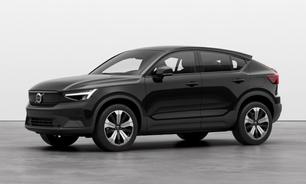
The C40 takes the small SUV formula, well established by its XC40 relation, and gets a bit weird and experimental. It’s slightly lower and has a more coupe-styled rear, with a strongly raked rear window giving it a sportier and more aggressive look than the rest of Volvo’s SUV range.
The styling is sold by an angular spoiler piece running atop the boot, and the rear light clusters have gone all minimalist, constructed of individual pieces rather than a single transparent housing, and they give a nod to the C30 hatchback which this car is the spiritual successor to, by name and nature.
The interior offers up no surprises, sticking to the formula Volvo has established across all of its current models. An effortlessly premium space with, again, a minimalistic dash dominated by the portrait touchscreen, the C40’s premium nature is confirmed by its finely patterned inlays, simple chrome pieces, and abundance of soft-touch surfaces.
The big upright vent fittings with clever rhomboid patterns on their adjustment dials are always a highlight piece of modern Volvos, and the pattern work is continued on the central volume adjust dial and even on the little rotating pieces of the light and wiper stalks. Clever.
Even the software is paired back on the multimedia suite and digital dashboard, with easy to use shortcuts and simple menus which suit the car.
Volvo might turn off some buyers with the more unconventional shape of the C40. But for those looking for a more traditional SUV it also offers the XC40 in the same two variants, and the Polestar 2 caters to those not looking for an SUV at all.
The ZS EV Long Range is a practical small SUV and it fit my little family of four, although my kids are both under 10 years old and not at the lanky teenager point yet.
Space on board is good, offering ample legroom for even me (at 188cm) in the second row and adequate headroom back there, too.
I like the large door pockets, the wireless phone charger, and there are two USB ports for the back seats and another two up front.
The second row also has directional air vents and dark-tinted windows. I liked the panoramic sunroof's retractable shade, too.
SUVS like the MG ZS offer easier access than sedans and hatches thanks to the elevated ride height which means people of my height don’t need to crawl in and out on their knees.
Boot capacity is decent at 359 litres, but not enormous.
The C40 is essentially a XC40 with a cropped down roofline, and there are some obvious downsides which this new shape brings.
The front seat throws no surprises, though, offering plenty of room for two adults with a welcome level of adjustability for the seat and wheel. The seats could be more comfortable, though, with a notable lack of padding in the base compared to some luxury (or even non-luxury) rivals.
I’m a fan of the fabric trim which comes on both grades, bucking the trend of needing to have leather or leather-like trim for a car to feel ‘premium’.
The ample window space up front, including the massive glass roof helps the C40’s cabin feel spacious, but the view out the rear with its aggressive design is all but a very limited letterbox aspect, particularly if the rear seat headrests are in the upright position.
While some controls are exclusively via touch interface, there is a physical volume dial, and shortcut buttons for the defogger functions.
Temperature is controlled by touch, however, and the detail settings have some smaller toggle adjustments. Tricky to jab at when you’re on the move.
The digital dash is refreshingly simple, but minimally adjustable, with the choice of either a nifty navigation screen, a blank screen, or trip details being the only options.
Cabin storage is good but not stellar. There are bottle holders and big pockets in the doors, a set of two cupholders in the centre (beats the Polestar 2’s single cupholder), a small tray with a wireless charger under the multimedia screen, and a smallish console armrest box.
The rear seat is where the real problem exists. Unlike the XC40, the C40’s cropped roofline means my head was hard up against the roof (I’m 182cm tall).
I did have decent knee room behind my own seating position, however the seat comfort in the back still isn’t as good as some rivals.
The middle position is also compromised, thanks to the raised centre floor piece the C40’s platform needs to facilitate all-wheel drive in its combustion relations.
A bottle holder appears in each door pocket, and in a rare inclusion, there are heated outboard rear seats, adjustable air vents, and USB-C charging ports.
The boot has a quoted capacity of 413 litres with the rear seats up. The floor is comparatively high suggesting a smallish space when loaded with luggage cases, for instance. Stay tuned for a follow-up review so we can see how well it holds our three-piece demo set.
The floor itself has an adjustable, pop-up divider and multiple luggage hooks, making it quite versatile, and there is a cavity beneath which can hold your charging cables as well as the inflator kit in place of a spare wheel.
The MG ZS EV Long Range lists for $55,990 which is about $11,000 more than the standard range ZS in the Essence grade.
The features on this Long Range are almost identical to the Essence, too.
Coming standard are LED headlights and running lights, then there are those 17-inch alloy wheels (which have aerodynamic covers on them), proximity unlocking, roof rails, the rear spoiler and a panoramic sunroof with a retractable cover.
Inside, the seats are a combination of polyurethane and PVC, plus there’s a 10.1-inch media display with sat nav, Apple CarPlay and Android Auto.
You can see the battery status from the screen as well along with the energy efficiency.
Climate, phone and media are all accessed through the screen, but fortunately there are physical buttons for volume, temperature and fan speed.
There’s single-zone climate control and tinted rear windows.
A 360-degree camera view is also standard, but the quality of the picture is pretty murky.
How does that cost compare to rivals? Well, you could buy an MG4 electric vehicle for about the same price with 530km of range, but it’s not an SUV.
You can even get a Tesla Model 3 for about $61K, but again, that’s not an SUV. The Tesla Model Y is an SUV and lists for $69,300 and has 455km of range.
The closest competitor would be the BYD Atto 3 Extended Range which can travel 420km and lists for $51,011.
There are more affordable EVs coming from brands like BYD and GWM, too, and they’re all competing for your money.
Compared to the MG ZS EV Essence the Long Range has exactly the same features, apart from the tinted rear windows, but you’re paying $11,000 more. What you’re paying for is a bigger battery which will allow you to drive 120km further.
The MG4 Long Range offers more distance and represents better value, but it’s not an SUV and therefore not as practical as the ZS EV.
When it comes to electric vehicles, it’s impossible to consider price alone, as you also have to consider driving range, and the C40 manages to impress on both fronts.
Its refreshingly simplified range consists of just two highly-specified variants, a single motor which starts from $74,990, offering a 434km driving range, or a dual motor starting from $82,490 which offers a 420km driving range.
There’s much more devil in the detail, but to set the scene there are now quite a few direct rivals in this price-bracket, including everything from the Tesla Model Y (from $72,300), Mercedes-Benz EQA (from $78,513), Polestar 2 (from $63,900) and even the Kia Niro which is similarly sized and specified (from $65,300).
Interestingly, the C40 is closely related to the Polestar 2, but has a much higher base starting price. Volvo says this is because it carries a higher standard specification, and offers the C40 without option packs.
Standard gear on the base single motor C40 includes 19-inch alloy wheels, a 9.0-inch portrait multimedia touchscreen (running a Google-based always-online software suite), LED headlights, dual-zone climate control, a fixed panoramic sunroof, electrically adjustable front seats, heated seats for the front two and outboard rear seats, a powered tailgate, as well as keyless entry with touch-free ignition.
Interestingly, Volvo also told us some 90 per cent of customer interest so far has been for the more expensive dual-motor variant, which is particularly impressive for doubling the power output while adding 20-inch alloy wheels, a 360-degree parking suite, premium Harmon Kardon audio, and an alternate interior trim.
Both variants score safety equipment and items which are otherwise part of expensive option packs in the Polestar 2 range. We’ll take a look at the full safety gear later in this review.
Overall, the C40 impresses on the premium car value front compared to rivals, bolstered by solid range and impressive performance.
The MG ZS EV has one electric motor driving the front wheels and it makes 115kW of power and 280Nm or torque.
That’s the same power as the petrol MG ZS, but more torque, so it accelerates faster. We’re talking 0-100km/h in 8.5 seconds.
Sure, that’s not Tesla quick, but being an electric car the acceleration is instantaneous with none of the lag petrol cars have due to turbos or changing gears.
How much can the ZS EV tow? Not much. The braked towing capacity of the ZS EV Long Range is 500kg. But think of it like this: a box trailer can weigh about 250kg and a fully grown Sumatran tiger can also weigh up to 250kg.
So an ZS EV Long range can tow a box trailer carrying a fully grown tiger. That sounds impressive.
For more on what the ZS EV Long Range is like to drive, keep reading.
Great news here, the C40 can be chosen with two powerful layouts, either a front-wheel drive 170kW/330Nm set-up, or a dual-motor all-wheel drive arrangement, able to make use of nearly double the power at 300kW/660Nm. The dual-motor is capable of sprinting from 0-100km/h in just 4.7 seconds.
The front-drive is backed by a 69kWh battery allowing it a 434km range, while the dual motor ups the battery size to 78kWh to allow a 420km driving range.
The ZS EV Long Range has a larger battery than the standard range ZS EV and this gives it the ability to travel further on a full charge.
The regular version is fitted with a 51.1kWh battery and the Long Range has a 72.6kWh battery which is pretty big - and that gives this an official range of 440km.
The standard range ZS EV has a range of 320km. So the Long Range will get you 120km further which could make all the difference in whether you make it to your destination or not.
So, is 440km a lot compared to other electric cars? Well, it’s more range than the Nissan Leaf (385km) or Mini Electric (233km), but not as much as the Kia Niro (460km) and 50km less than the entry-grade Tesla Model 3 (491km).
Put it this way, the 320km offered by the standard ZS EV falls short of what I think is enough. But anything with more than 400km is truly useful and I find anything less than this can bring on range anxiety pretty quickly.
The ZS EV Long Range is fully electric and that means you’ll have to plug it in to charge it.
You can charge up using a household power point, but it’ll take more than 24 hours to get to 100 per cent. So, a much better idea is to use a fast public charger.
A 50kW charger will take the battery from empty to 80 percent in 63 minutes using a CCS Type 2 port/plug.
As for energy efficiency, MG says that after a combination of open and urban roads the ZS EV Long Range will use 17.7kWh/100km.
I drove our ZS EV Long Range every day and used it for school drop offs, city commutes and some motorway running. And while most of the 156km I travelled was urban-based the trip computer was reporting an average of 20.0kWh/100km.
Surprisingly, energy consumption is quite high for both C40 variants. The single motor is the more efficient of the two, consuming 16.8kWh/100km on the more lenient ADR testing schedule, while the dual motor officially consumes 22.2kWh/100km to the same standard. I saw around 23kWh/100km overall in my short test of the dual-motor variant.
Energy consumption could be better for both, as I have achieved more consistently impressive results particularly from Hyundai and Kia electric cars.
Where the C40 is more impressive though is its charging specs, which are exactly where they need to be for a car this size. On a rapid DC charger, the C40 can charge at a rate of 150kW meaning a 10 - 80 percent charge in 40 minutes for the dual motor, or 32 minutes for the single motor.
On the slower AC standard, the C40 charges at a rate of 11kW. Expect a 10 - 80 percent charge time of around five or six hours on this standard.
The C40 uses a European-standard Type 2 CCS charging port, although it misses out on the handy two-way charging feature offered by some rivals.
At first, the driver’s seat felt overly high and the lack of reach adjustment in the steering wheel made finding a good driving position harder.
But, the ZS EV Long Range is comfortable and easy to drive, while its size and ‘electric zippiness’ makes this little SUV perfect for narrow city streets and tight car spaces.
Some EVs have break-neck acceleration and minimalist cabin controls which can feel weird, but the ZS EV Long Range’s cabin looks just like a regular combustion engine car’s and the motor has the same power as a petrol ZS’s engine.
That said, the instant acceleration of their ZS EV Long Range is fun and great for moving quickly out of car space, merging and overtaking when needed.
As with all EVs, passengers who are prone to motion sickness might find the acceleration and heavy deceleration a bit much. My family didn’t complain but the photographer who filmed the video above found it a bit much while looking down at his screen.
If you’ve driven any kind of XC40 or even a Polestar 2 before, the C40 will offer no surprises. It’s pretty much exactly the same from behind the wheel with a few subtle tweaks.
This is a very good thing. The C40 is quiet, easy to drive, and its electric motor and regen system offer a smooth single-pedal experience.
It is also alarmingly, overwhelmingly, rapid. While its massive set of batteries under the floor make it feel heavy off the line in stop-start traffic, sticking your boot into the accelerator will remove any doubt, particularly in the dual-motor variant, that this Volvo means business.
The dual-motor also has an incredible torque-vectoring system, making it extremely difficult to elicit so much as a squeak from its tyres. It also feels as though torque is distributed quite evenly between its two driven axles, making it feel neither prone to over- or understeer.
This has the effect of making the C40 feel somewhat indestructible in the corners, with absurd levels of grip.
The same feeling is present in top-spec versions of the Polestar 2, only the feeling of ever-present weight is more noticeable in the higher-riding C40, which can make it unsettling to take corners at the kinds of speeds it is capable of.
The steering tune is interesting. Volvo offers two software-controlled modes, either heavy or standard, and the standard mode is heavy enough.
Despite its electrical assistance, the wheel does continue to offer some organic feedback, making the C40 a pleasure to steer on countryside roads.
The ride is also surprisingly good, despite massive wheel options. I was impressed how easily the C40 handled most bumps and undulations, communicating little to the cabin.
The ride can approach its limits with such big wheels and the weight of its batteries, generally these are communicated via unsettling thuds from underneath the car. Regular undulations at higher speeds also had the C40 bouncing around a little.
On the whole, though, the cabin is kept relatively insulated and serene, adding an element of total confidence, similar to that offered by Teslas, whilst offering better ride quality with a softer edge. At higher speed, at least on the 20-inch wheels, road noise does pick up, however.
In terms of electric driving, there is a single adjustable setting for regen. The car either offers a full single pedal mode with maximum regenerative braking to bring the car to a halt with the motor alone, or a ‘standard’ mode which tones the regen down and offers it blended in via the brake pedal.
Single pedal mode is more efficient. I suggest you stick to it if you want to make the most of this car’s efficiency.
I was surprised to have so few complaints about the C40’s drive experience. This is a balanced and capable EV which is yet another example of how even vehicles which use combustion platforms are improved out of sight by full electrification.
The ZS EV Long Range has yet to be given an ANCAP rating, but it is equipped with AEB, rear cross-traffic alert, lane keeping assistance and blind-spot warning. There are front and rear parking sensors and six airbags.
For child seats there are two ISOFIX points and three top tether anchor mounts across the second row.
Sticking to its brand promise, Volvo offers the full range of active safety equipment on the C40 regardless of variant.
This includes freeway-speed auto emergency braking, rear auto braking, lane keep assist with lane departure warning, blind spot monitoring with rear cross-traffic alert, and one of the best adaptive cruise control systems on the market.
The only item the single motor misses out on is a 360-degree parking camera, which is exclusive to the dual motor variant.
It is notable how the adaptive cruise control, blind spot monitoring rear cross-traffic alert, and rear auto braking are on the options list for the Polestar 2.
These active systems combined with eight airbags (the standard dual front, side, and curtain, as well as a driver’s knee and centre airbag) make for a five-star ANCAP safety rating to the latest 2022 standards.
The ZS EV Long Range is covered by MG’s seven-year/unlimited kilometre warranty. The battery is covered by a seven-year unlimited kilometre warranty, too.
Servicing is recommended by MG at 40,000km/24 month intervals.
According to MG the first service costs $295, then the next is $810, then $295 for the third, $810 for the next and so on. That’s about $233 a year over six years which is excellent value.
The C40 is covered by Volvo’s five year and unlimited kilometre warranty, with a separate eight-year, 160,000km warranty for the battery. There is also eight years of roadside assistance attached.
It is pleasing to see the service intervals for the C40 are long, as they should be for an electric car with so few moving parts, set at two years or 30,000km.
The first 24 month service is free of charge, and Volvo tells us service pricing after this period will average out to around $100 a year ($200 per visit).