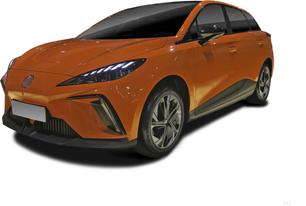
What's the difference?
MG has been one of the fastest growing brands in the Australian market in the past five years, carving a spot for itself amongst the best-selling names.
But now it’s about to take on arguably its toughest challenge yet - selling a performance car.
MG’s success until now has been built largely on value, with its affordable MG3 and ZS SUV leading the way. The arrival of the all-new, all-electric MG4 XPower means the brand will try its luck at selling cars based on performance, dynamics and an emotional connection.
It’s not the first electric hot hatch in Australia, that distinction arguably belongs to the Cupra Born. But, MG has achieved much higher sales locally than Cupra, making it the first electric hot hatch from a mainstream brand, and that’s why it has the potential to be a game changer for the market.
If the XPower succeeds it will likely reshape the hot hatch market, which until now has been dominated by long-time players and big-name brands, including the Honda Civic Type R, Hyundai i30 N, Toyota GR Corolla and Volkswagen Golf R.
Citroen is a brand in a state of flux as it, once again, finds itself fighting to find a distinct identity from its Peugeot sister brand under its new Stellantis parent company.
It’s also had a shocker of a year in Australia, racking up just over 100 sales in 2021, but the brand is promising new beginnings, and a new crossover-y identity as it heads into 2022.
Leading the charge is the new-generation C4, which has morphed from a funky hatchback to a funkier SUV-like shape that it hopes will set it apart from related cars like the Peugeot 2008.
Other Citroens are set to follow in its footsteps in the immediate future, so is the Gallic marque onto something? We took the new C4 for a week to find out.
The MG4 was a game changing electric car, resetting the price benchmark while also being a very good small car in its own right. But as we discovered when we tested the rest of the range, the MG4 is a car that gets more compelling the cheaper it is. The $38,990 MG4 Excite 51 is arguably the pick of the range given its value equation.
But that’s not to say the MG4 XPower isn’t a good car. It’s a very quick car that will play the role of daily driver and weekend fun machine well. Just not quite as well as its petrol-powered rivals.
It’s weird, wonderful and fun, in more ways that one. I think every segment could use an oddball alternative like the C4. Citroen has successfully transformed it from a hatch to a small SUV with a difference. It’s not going to be for everyone – few Citroens are – but those who are willing to take a chance will be rewarded with a surprisingly competitive little package that stands apart from the crowd.
What really stands out about the design is… that not much stands out about the design. At least in differentiating the XPower from the rest of the MG4 line-up.
There are no pumped out wheel arches or a bigger, sportier spoiler that makes it look different in the same way a GR Corolla won’t be mistaken for a regular Corolla hatch.
Instead, the XPower has the same 'Energetic Agile' silhouette and includes the same ‘Active Intake spoiler’ at the front and the ‘Twin-Aero’ rear spoiler that’s the same as the Essence models.
There are some differences though, including more pronounced styling on the sides of the doors. It doesn’t add any performance benefit but creates a slight visual difference between the models in the range.
Surprisingly, there is very little to signify that this is the sportiest XPower model, with a distinct lack of badging - inside and out. In fact, the only visual clue that this is the XPower is on the bright orange brake calipers. Or, to be more accurate, brake caliper covers.
These are just lightweight metal covers that make the MG4 braking hardware look bigger than it really is, so it’s a bit of visual trickery from the MG designers.
It’s really hard to stand out in Australia’s busy marketplace, especially in this small SUV space, where there doesn’t really seem to be as much of a design rulebook as there is in other segments.
Rooflines are wildly different, as are beltines and light profiles. While some may decry the fall of the hatchback to these more high-riding options, at least some of them are bringing fresh design ideas to the car world.
Our C4 is a great example. An SUV perhaps in profile only, it sports a slinky descending roofline, tall, contoured bonnet, a frowny-face LED profile, and characterful plastic claddings, which are a continuation of Citroen’s ‘Airbump’ elements, which gave cars like the previous-generation C4 Cactus such a unique look.
The rear is this car’s most confronting angle, with a post-modern approach to the light profile, and in reference to C4s past, a spoiler integrated into the rear tailgate.
It looks cool, contemporary, and I think is successful in its aim to blend the sporty elements from the hatch world with the sought-after high-riding elements of an SUV.
It certainly caught a few eyeballs in my time with it, and if nothing else, a bit of attention is something the Citroen brand desperately needs.
In the past you could rely on this brand to give you a funky interior, but one that sadly also came with its fair share of sub-par plastics and strange ergonomic. So I’m pleased to report that the new C4 dips into the better looking and feeling Stellantis parts catalogue for a still interesting yet more coherent experience this time around.
The modern look and feel of this car continues with interesting seat designs, a high-riding dash with a higher degree of digitization than before, and improved ergonomic features (even over some notable Peugeots). We’ll talk more about those in the practicality section, but the C4 feels as weird and different from behind the wheel as you’d hope , with an odd dash profile, a fun and minimalist steering yoke, and attention-to-detail elements, like a detail strip that runs through the door trims and across the seats.
These elements are welcome and help separate this Citroen from its Peugeot siblings. It will need this going forward, as it also now shares much of its switchgear and screens with its sister brand.
This is largely a good thing, with the 10-inch screen looking and feeling good and slotting into this car’s design nicely.
As with the exterior, there’s not a lot to differentiate the XPower from the rest of the line-up. No bright red Civic Type R style interior treatment here. MG has opted to carry over the minimalist design that no doubt contributes to the sharp pricing.
Probably the only notable difference is the seat trim, with the XPower model getting a combination of synthetic leather and suede for a sportier look and feel. But the rest is largely the same, which detracts slightly from its hot hatch credentials.
On the plus side, the MG4 cabin is generally a well-designed interior space, which is a positive for the XPower’s hot hatch argument, as the idea behind the ‘hot hatch’ is that it can be a practical car during the week and fun on the weekends.
There’s good room for passengers and luggage, in large part thanks to the relatively slim battery design that frees up more cabin space. Front seat occupants will enjoy the space and good visibility on offer.
Small item storage is very good in the MG4, with a pair of cupholders, a large, flat lidded tray (with one USB-C and one USB-A outlet just above) and the centre console box all fitting between the front seats.
There’s also a wireless smartphone charging pad that sits halfway up the centre fascia, next to the rotary gear selector, but it’s a shallow space so your phone will almost certainly fly out as soon as you begin cornering vigorously.
However, once again highlighting the ways MG has saved money to keep costs down, the back seat accommodation isn’t anywhere near as well appointed.
While the space is adequate for a small hatch, there are no cupholders, no air-conditioning vents and no fold down armrest for those in the back. All they have access to are some pockets on the back of the front seats, including a pair of small ones high on the seat, seemingly designed to accommodate your smartphone.
In another positive for its hot hatch practicality, there are ISOFIX points on the outer rear seats, neatly covered by leather pieces for a cleaner look when you don’t have kids.
As for the boot, the XPower measures the same 363 litres with the seats up which is unchanged from the rest of the MG4 line-up.
Disappointingly, there’s no obvious place to stow the charging cable, even though it comes in a small, neat bag. This is a worryingly common trend with these early generation EVs that shows a lack of practical thinking from the designers.
The MG4 has no under-bonnet storage either, so it feels like a few wasted opportunities for what is a bespoke EV design.
The C4 brings some interesting practicality elements. There are a few areas where it’s even better than the improved layouts of recent Peugeot models.
The cabin feels spacious, with the C4’s relatively long wheelbase providing ample room in both rows. Adjustability is good for the driver, although it is worth noting that the seats have an odd blend of manual adjust for sliding fore and aft, contrasted with electrical adjust for seat height and tilt.
Comfort is superb from the memory-foam stuffed and thick synthetic-leather-clad seats. I don’t know why more cars don’t adopt this approach to seat design. You sink into these seats and are left feeling like you’re floating above the ground rather than sitting on something. The feeling here is unmatched in the small SUV space.
The massage function is a wholly unnecessary addition, and with the thick seat cladding, it didn’t really add much to the experience.
The seat bases aren’t too high either, unlike some cars in the SUV class, but the dash design itself is very tall, so people shorter than my 182cm height might find extra adjustment is required to see over the bonnet.
There are large bottle holders in each door with a very small bin; dual cupholders in the centre console, and a small armrest console box.
There’s also an odd little two-tiered shelf under the climate unit, with a removable base for extra storage underneath. It seems to me that the top shelf is a missed opportunity to place a wireless charger, although connectivity is handy with the choice of USB-C or USB 2.0 to connect to the wired phone mirroring.
A big win is the presence of a full dial set for not just volume but the climate unit too. This is something the Citroen scores over some of the new Peugeots, which have moved the climate functions to the screen.
Somewhat less wonderful are the digital dash cluster and holographic head-up display. These seem to be a bit redundant in the information they display to the driver, and the digital dash has no customisation, leaving me wondering what the point of it is.
The C4 also has some interesting innovations on the front passenger side. It has an unusually large glovebox and a neat little sliding tray, which looks like something from a Bond car.
It also has a slide-out tablet holder. This odd little thing lets you securely mount a tablet to the dash to provide a multimedia solution for the front passenger, which may be good for entertaining larger kids on longer journeys. Or adults who don't want to talk to the driver. It’s a neat inclusion, but I’m not sure how many people will use it in the real world.
The back seat offers a remarkable amount of room. I’m 182cm tall and had heaps of knee room behind my own driving position. The nice seat trims continue, as does the patternwork and detailing, which is the kind of attention to detail you don’t always get from rivals.
Headroom is a little limited, but you also score dual adjustable air vents and a single USB port.
The boot comes in at a hatch-sized 380-litres (VDA). It’s a neat, square shape with no little cutaways at the sides and is just big enough to fit our full CarsGuide demo luggage set, but leaves no room to spare. The C4 features a space-saver spare wheel under the floor.
While we’ll dive into performance and the headline figures of the XPower soon, there’s another number that’s arguably more impressive - the price.
The MG4 XPower is priced from $59,990 (plus on-road costs), making it only $4000 more expensive than the range-topping MG4 Essence 77.
More importantly, when compared to the likes of the $72,600 Honda Civic Type R, $68,990 Volkswagen Golf R, $64,190 Toyota GR Corolla and $57,990 Subaru WRX tS Sport the XPower is arguably one of the first EVs to achieve true price parity with its internal combustion engine rivals (although the Cupra Born starts at $59,990 so it can argue the same).
Beyond the performance upgrades we’ll detail below, that price brings a well-equipped car.
The XPower comes with 18-inch alloy wheels, LED headlights and tail-lights as well as vehicle-to-load (V2L) functionality.
It also comes with a six-speaker sound system, Bluetooth, navigation, Apple CarPlay and Android Auto, a wireless smartphone charging pad and synthetic leather and Alcantara trim.
There’s the 'MG Pilot' safety package included as standard as well, but we’ll detail that below.
The 'Hunter Green' hero paint colour is exclusive to the XPower in the MG4 range, and is reportedly inspired by an MG land speed record car the legendary Sir Stirling Moss drove in the 1950s.
In recent memory, Citroen’s offerings (the smaller C3 hatch in particular) have decidedly missed the mark on value. It’s not enough to be a niche player in Australia anymore – we have too many brands for that - so Citroen has had to have a re-think of its pricing strategy.
The resulting C4 that launches in Australia comes in a single, highly specified trim level, at a price that is remarkably competitive for its segment.
Wearing an MSRP of $37,990, the C4 Shine is positioned to compete with rivals like the Subaru XV (2.0i-S $37,290), Toyota C-HR (Koba hybrid - $37,665), and equally funky Mazda MX-30 (G20e Touring - $36,490).
For the asking price you also get the full list of available equipment, including 18-inch alloys, full LED exterior lighting, a 10-inch multimedia touchscreen with wired Apple CarPlay and Android Auto connectivity, built-in navigation, a 5.5-inch digital dash cluster, a head-up display, dual-zone climate, full synthetic leather interior trim, and a top-down parking camera. This leaves only a sunroof ($1490) and metallic paint options (everything but white - $690) as available extras.
The Citroen also packs some unusual items that represent surprising value – the front seats have a massage function and are stuffed with a very nice memory foam material, while the suspension system packs a set of hydraulic dampers to iron out the ride.
While the C4 faces tough competition in the small SUV segment, I think it represents pretty solid value at the price, so long as you’re chasing a virtue like comfort over hybridisation. More on that later.
This is arguably the biggest single difference between the XPower and the rest of the MG4 line-up. Unlike the others that have a single, rear-mounted electric motor, the XPower adds a second motor on the front axle.
This has an obvious impact on the performance, boosting it from the previous best of 180kW to an impressive 320kW/600Nm.
Having motors on each axle also means the XPower is all-wheel drive, so it has little trouble transferring all that grunt to the road.
So much so that the MG4 XPower is the equal quickest hot hatch on the market (at the time of publication), taking just 3.8 seconds to run 0-100km/h; matching the Audi RS3, with its turbocharged five-cylinder engine.
The C4’s single trim level has a single engine, and it’s a good one; a peppy 1.2-litre three-cylinder turbo.
It appears elsewhere in the Stellantis catalogue and has been refreshed for the 2022 model year with a new turbo and other small refinements. In the C4 it produces 114kW/240Nm and drives the front wheels via an Aisin-sourced eight-speed torque converter automatic transmission.
No dual-clutches or CVTs to be found here. This sounds good to me, but is it good to drive? You’ll have to read on to find out.
Interestingly, the XPower is not fitted with the biggest battery in the MG4 range, forgoing the 77kWh version in favour of the 64kWh option.
In the ‘standard’ rear-wheel drive MG4 Excite 64 model this battery can provide up to 450km of range (on the WLTP cycle) but in the XPower that figure is reduced to 400km.
While that’s well short of the 530km offered by the long-range Essence 77 model, it’s still a respectable amount of driving range and should suit your typical hot hatch buyer, who knows performance typically comes at the expense of efficiency.
Our test drive was limited to just two days, so we didn't have the chance to live with the XPower for an extended period, but it managed to make it this reviewer’s preferred hot hatch playground on the edge of the city and back again to home with more than 50 per cent of the battery charge remaining.
This was a trip that included a lot of urban driving, some highway and then some ‘spirited’ running on the twisty road, so there’s enough range from the XPower to meet most buyers' needs.
Across almost seven hours of driving, the MG’s trip computer was claiming an average energy use of 18.6kWh/100km. To replenish the batteries, a 140kW DC charger will take just 30 minutes to take them from 10 to 80 per cent.
The V2L is another nice addition, which allows you to draw power from the battery, if needed, to run small electrical appliances.
The XPower is hardly a car for camping but, for example, if you decided to take it to a track day and want to plug in a kettle to make a hot drink, you can literally plug it into the car. Handy!
Despite the little turbocharged engine and the abundance of ratios in that transmission, the Citroen C4 disappointed me a little bit when it came to real-world consumption.
The official/combined consumption sounds reasonable at just 6.1L/100km, but after a week of driving in what I would consider realistic combined conditions my car returned 8.4L/100km.
While it’s not terrible in the wider context of small SUVs (a segment that is still packed with naturally aspirated 2.0-litre engines), it could be better.
The C4 also needs at least mid-shelf 95RON unleaded fuel and has a 50-litre fuel tank.
The real question about the XPower is not if it’s quick, because all EVs and especially those with dual motors tend to be very rapid in a straight line, but how it handles itself on a twisty road.
That’s what separates a good hot hatch from a great one, but it’s also an area EVs have struggled in, because the combination of silence, weight and just the fact they’re new and different tends to mean they lack the driving engagement of more established competition.
Hot hatches also need to play a dual role, as daily transport and weekend fun machine, so that’s another factor to consider.
So, how does the MG4 XPower stack up? Well, the unsurprising news is it’s very, very quick. The acceleration is ferocious and really shoves you back in your seat, leaving you in no doubt that it will leave most of its hot hatch rivals (with the exception of the Audi RS3) in its dust.
When the going gets twisty though the XPower feels like it lets its rivals catch back up. There are different driving modes and switching to ‘Sport’ and reducing the regenerative braking makes a notable difference to the way the XPower handles.
The steering gets heavier and it will roll and coast into corners more like a petrol-powered hatch. It makes for a very competent car, with direct steering and good road holding… but not a great hot hatch.
It lacks the engagement and excitement that the best hot hatches offer. For example, the steering gets heavier in Sport mode, but doesn’t provide any more feedback to the driver. The Bridgestone Turanza tyres do a fine job but they lack the grip of a Michelin Pilot Sport.
The lasting impression on the driver is a car that feels quick but doesn’t leave you wanting more. The best hot hatches make you want to keep on driving and driving, that’s not the case in the XPower.
As a daily driver it’s arguably better than its rivals, though, with quiet, effortless commuting potential thanks to its electric powertrain.
Driving the C4 is an interesting experience because it approaches the road a little differently from most of its rivals.
It really leans into Citroen’s newfound comfort-focused niche with the seating and suspension. This results in an overall experience that is a bit unique in the market, and quite pleasant, too.
The ride really is quite good. It’s not a fully hydraulic system but has dual-stage dampers that essentially smooth out corrugations and much of the nasty stuff that comes into contact with the tyres.
It’s odd because you can hear the big alloys crashing about on the road, but ultimately you feel little of it in the cabin. What’s more impressive is Citroen has managed to imbue the C4 with this floating-on-the-road feeling, while maintaining enough of a ‘real’ driving position to make it feel like you’re sitting in the car and not on it.
The overall result is impressive. The comfort extends to the seats, as mentioned, which really do still feel floaty and supportive even after hours on the road. It also extends to the steering, which has a very light tune. This is a bit unsettling at first, as it feels like it has a large dead-zone in the centre, but it is also speed dependent, so once you’re cruising it regains a significant amount of feel. You can also manually bring back a bit of firmness by setting this car to its Sport drive mode, which is unusually good.
This means you can have an ease of operation in tight quarters while maintaining enough feel to make it fun to drive when you need to ask more of it. Clever.
Speaking of fun, the revised 1.2-litre three-pot is a hoot. It has a distant but entertaining gruff tone under pressure, and surges forward with just enough urgency to not leave you really wanting for power.
It’s not what I would call quick, but it has a raucous attitude paired with a well-behaved torque converter auto to make it truly entertaining. When you push it, there’s a moment of turbo lag followed by a lump of torque, which the transmission lets you ride out before decisively snapping into the next gear. I like it.
Again, it's not quick, but it punches just enough above its weight to leave you with a smile when you stick your boot in. To have that in a car otherwise so focused on comfort is an unexpected pleasure.
The dash cluster could use some work, as could visibility out of the cabin. The small aperture out the rear and tall dash line could leave some drivers feeling a bit claustrophobic. While the engine is fun to engage with, the turbo lag could potentially be a source for annoyance at times, too.
Brief negatives aside, I think the C4's drive experience really brings something unique, fun, and comfortable to the small SUV space.
There’s the usual passive safety features, including six airbags as well as the required stability controls, anti-lock brakes and the like, however the XPower also comes equipped with the MG Pilot suite of active safety features as standard.
MG Pilot includes autonomous emergency braking, lane keeping assist, lane departure warning, adaptive cruise control, blind-spot monitoring and rear cross-traffic alert.
Thanks to all of this safety gear, the MG4 range was awarded a maximum five-star ANCAP assessment, when it was tested in 2022.
There's not such a good story to tell here. While the C4 comes with today’s expected suite of active-safety items, it just fell short of a five-star ANCAP rating, scoring just four stars upon its launch.
Active items on the C4 Shine include auto emergency braking, lane-keep assist with lane-departure warning, blind-spot monitoring, adaptive cruise control, and driver-attention alert.
Some active items are notably missing, like rear cross traffic alert, rear auto braking, and more cutting-edge items like junction alert for the AEB system.
What cost this car its five-star rating? ANCAP says the lack of a centre airbag contributed, but the C4 also fell short on protection for vulnerable road users in the event of a collision, and its AEB system also had marginal night-time performance.
Like every MG sold in Australia, the MG4 XPower is covered by the brand’s seven-year, unlimited kilometre warranty, which is industry standard for high-volume brands these days.
As for servicing, the intervals are also the same as the rest of the MG4 range, which means a lengthy two years or 40,000km, whichever comes first, between visits to the dealership.
That’s much longer than your typical petrol-powered hot hatch, which has more moving parts that need servicing.
In terms of costs, the XPower is ever-so-slightly more expensive compared to the rest of the MG4 line-up.
A minor service is the same $296 but a major service (which comes every second service) will cost you $962.
But even so, for the first six years you’ll only be up for $1554 in servicing costs, which is comparatively cheap amongst its hot hatch rivals, and only $76 more than you’ll pay for any other MG4.
Ownership has always been a tough topic for unusual Euros like the C4, and that seems to continue here. While Citroen offers a competitive five-year and unlimited-kilometre warranty for all its new products, it’s the service costs that will hurt the most.
While most Japanese and Korean brands are competing to really keep these numbers down, the C4’s average yearly cost, according to the provided schedule, comes in at an average of $497 for the first five years. That’s nearly double the cost of Toyota’s C-HR!
The C4 Shine will need to see a service centre once a year or every 15,000km, whichever occurs first.