What's the difference?
Driving a whopping great SUV down the straight on a race track at more than 200km/h sounds like fun, but it actually feels a bit wrong, like entering a baby elephant in a dog show.
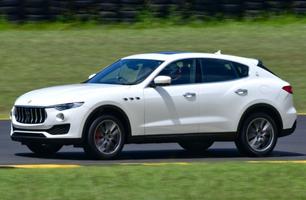
These are strange times, of course, and the Maserati Trofeo Levante is a suitably strange vehicle - stylish, classy, expensively appointed family hauler that also has the heart and soul of a race car.
Indeed, while performance SUVs are an increasingly commonplace vehicle, the Levante - which was actually getting along in the tooth as a model before this significant upgrade - has higher performance credibility than most.
That's because it has a big Ferrari V8 driving all four of its wheels and delivering a properly supercar-like 433kW and 730Nm.
It's not what you might call a typical Maserati buyer's car, but then only those who know what the Trofeo badge stands for - shouty insanity, basically - will be interested in this end of town. It is a lot of car, but is it worth the large load of money on the sticker ($330,000)?
You might not think right now is the best time to buy a Holden, what with the announcement from General Motors about closing down its Aussie operations at the end of 2020.
That’s understandable but side-stepping around the Equinox could see you miss out on what is a practical, comfortable and safe mid-sized SUV.
You can also bet on some heavily discounted deals on the final Holdens which could see you pick up a huge bargain if you buy an Equinox.
I’ve tested the top-of-the-range Equinox LTZ-V in this review and along with taking you though its features and what the SUV is like to drive, I’ll cover what type of support you can expect to have after Holden closes down. The company has promised to take care of its customers with parts and services for at least the next decade.
Explore the 2020 Equinox LTZ-V in 3D below
https://my.matterport.com/show/?m=RnCngGtbQHx
Maseratis are built for a fairly specific niche buyer; someone with a lot of money, someone slightly older and certainly someone who likes the finer things in life and appreciates Italian style, quality and heritage.
They are not, typically, the kind of buyers who want to tear around race tracks like fiends in big, shouty SUVs. But apparently there is a niche within the niche of Maserati fans who do, and they are willing to invest big dollars in vehicles wearing the Trofeo badge, like this Levante.
It might seem a slightly strange creation, a track-mad SUV with a screaming Ferrari engine, but surprisingly, it really does work.
Overlook the Holden Equinox LTZ-V and you could miss out on a practical, spacious and value-for-money mid-sized SUV. Concerned about Holden’s exit from Australia and how this affects servicing and parts? Well Holden has assured us that it will provide servicing support for 10 years following its closure at the end of 2020. If anything, you could be picking up a bargain and one of the last cars to wear a Holden badge.
While the other two Maseratis to get the Trofeo treatment - the Ghibli and Quattroporte sedans - are undeniably lovely, the Levante is not quite as pretty.
Admittedly, for an SUV, it looks very good, and the Trofeo touches - that big, nostrilled bonnet, the red gills on the sides, the carbon, the badges - really do lift its game to another level.
Overall, though, the Levante has just never felt beautiful enough to me to be a Maserati. These guys really do style well, as you'd expect from a premium Italian brand, but making an SUV sexy is beyond even them.
I'll grant you, it does look good from front on, but at the rear they just seem to have run out of ideas.
Credit is due for feeling properly special inside, however.
Big cheesy grin grille? Check. Flowing curves? Check. Sharp creases? Check. Irregular shapes? Check.
The Equinox is a bit of a mishmash of design elements which doesn't win this reviewer over.
The sloping, broad grille bears more than a passing resemblance to the Cadillac family face, and hints at the Equinox’s American origins. In the United States the SUV wears a Chevrolet badge, although ours is built in Mexico.
The shape of the rear-side window is also a little jarring to me. If you want to see something you’ll never be able to unsee, take a look at my video above where I turn this mid-sized SUV into a small sedan. That sounds ridiculous but, trust me, watch it and be amazed.
How big is the Equinox? Just when you thought the design of the Equinox couldn’t get any more peculiar it does. The Equinox is longer than most of its rivals at 4652mm end-to-end but about the same width at 1843mm across (2105mm to the ends of the wing mirrors).
Telling the LTZ and the LTZ-V apart is tricky, but you can spot the top-grade Equinox by its sunroof and a metallic window garnish around the widows of the rear doors.
Inside is a premium and modern cabin. There’s a high quality feel here from the materials used on the dash, seats and doors, to the display screen which sits at an angle that’s perfect for my reach, although others in the CarsGuide office aren’t quite as enamored with it.
Many cars are dressed up at the front of the cabin, but lack the same treatment in the rear, and the Equinox is a case in point, with hard plastics used around the window sills and the back of the console.
If you've got to move five people in a genuine hurry, the Levante is a pleasant way to go about it.
There's plenty of head and shoulder room, the seats, while firm in the front, are pleasant to the touch and supportive and there's a 580-litre boot with an electric tailgate and split-folding seats.
The boot feels properly spacious, too, with a 12-volt power outlet and four tie-down points. You won't, however, find a spare wheel out there, so serious off-roading is out (although it probably was already if you look at those expensive wheels).
There are huge door pockets with room for bottles and two big cup holders in the front. The centre-console bin looks lovely, it's all carbon fibre, but is quite small.
There are also three USB points, one in the front and two in the rear, and Apple CarPlay and Android Auto connectivity.
The Equinox’s greatest strength is its spaciousness and much of that comes down to its wheelbase.
See, the longer a car’s wheelbase the more room there is for the passengers inside. The Equinox’s wheelbase is longer than most of its rivals (25mm longer than a CX-5’s) and that goes some way to explaining how, at 191cm tall, I can sit behind my driving position with plenty of knee room.
The longer wheelbase also means the rear wheelarches don’t cut far into the back doors, which allows for a wider aperture and easier access.
So, if you have young kids like me, they’ll find it easy to climb in, but if they’re really little the large opening will make it easy for you to put them into their car seats.
Headroom, even with the LTZ-V’s sunroof, is good in the back seats, too.
Cabin storage is excellent: the centre console bin is enormous, the door pockets are large; there are four cupholders (two in the back and two up front),
Even with all this extra room, however, the Equinox is only a five-seater SUV. Still, that leaves you with a large boot with cargo capacity of 846L when the rear row is up and 1798L with the second-row seats folded.
The Equinox has power outlets galore: three 12-volt sockets, a 230-volt power point; five USB ports (including one type C); and a wireless charging bay. That’s more outlets than any mid-sized SUV I’ve tested.
A flat floor in the second row, large windows and comfortable seats complete a well-appointed and practical cabin.
Really, the only reasons the Equinox doesn't score 10-out-of-10 here is the lack of a third-row seat, and sunshades or privacy glass for the rear windows.
I'm sorry, but $330,000 for an SUV, of any kind? Personally I can't see the value, but then personally, as we'll discuss below in the Design section, I can't see the attraction.
This is one of the most expensive SUVs money can buy, well above things like Range Rover Sport SVR ($239,187) or even Porsche Cayenne Turbo Coupe ($254,000), although a pricier Ferrari one is surely on the way.
You'd want a lot for that, and the way it drives and sounds, thanks to that Ferrari engine, accounts for quite a few dollars.
There's also an undeniably high-quality feel to everything you touch on the car, inside and out, and a vast quantity of carbon fibre everywhere as well.
Other highlights include the 21-inch machine polished wheels, an 8.4-inch touchscreen with Navigation and DAB radio, full matrix LED headlights, and incredible Pieno Fiore natural leather, “the best the world has ever seen”, as Maserati says.
The lovely if firm front seats are heated and ventilated, sporty and 12-way adjustable, with Trofeo logos stitched into the headrests. The rooflining is lovely Alcantara, the steering wheel is sporty and features carbon-fibre shift paddles, ad the stereo system is Harman Kardon Premium and has 14 speakers.
And even the rear seats are heated. It feels expensive, and it should. But still, $330K?
The Holden Equinox LTZ-V is the fanciest version you can buy with its list price of $46,290. That may sound expensive, but the standard features list is massive.
There’s an 8.0-inch screen with Apple CarPlay and Android Auto, sat nav, heated leather seats, dual-zone climate control, a Bose sound system with digital radio and also wireless charging.
Then there are the roof rails, the front fog lights and LED headlights, heated wing mirrors, and 19-inch alloy wheels.
But you get all that on the grade below it, too - the LTZ for $44,290. So, adding the V to LTZ along with an extra $2K adds the panoramic sunroof, ventilated seats up front, and a heated steering wheel. Still great value, but not as good as the LTZ.
Also, as Holden gets closer to the 2021 finish line you can expect the prices of it cars and SUVs to be heavily discounted - after all, everything must go
If you’re considering an Equinox, you could do a model comparison with the Mazda CX-5 or Honda CR-V. The Equinox is a five-seater, mid-sized SUV, so, if you’re looking for seven seats but roughly the same size and price there’s the Hyundai Santa Fe.
This will be the last time Maserati gets a proper Ferrari engine like this a 3.8-litre twin-turbo V8 shouty monster, which is good for 433kW and 730Nm.
The future, as is the case everywhere, is going to be more electric and less noisy. For now, anyone who can should enjoy this V8 masterpiece, which drives all four wheels through Maserati's Q4 on-demand all-wheel drive system via a limited-slip rear differential and uses an eight-speed automatic transmission.
Its claimed 0 to 100km/h time is 3.9 seconds, which puts it in what used to be super-car territory, and is still very quick indeed, while top speed is an unimaginable 304km/h.
The Equinox LTZ-V has the most powerful engine in the Equinox line-up – a 188kW/353Nm 2.0-litre four-cylinder turbo-petrol engine.
The only other grade in the line-up to have this engine is LTZ, although it doesn’t have the LTZ-V’s all-wheel drive system.
It’s a powerful engine, especially considering that it’s just a four cylinder. Only a bit more than a decade ago V8s were making less power.
The nine-speed automatic transmission shifts slowly, but I found it to be a smooth unit at all speeds.
The official claimed fuel economy for the Maserati Levante Trofeo is 13.5 litres per 100km, but good luck with that.
A more realistic number would probably sit somewhere above 17 litres per 100km, and we would have easily exceeded 20 litres while driving it like lunatics around a track.
But you just paid $330K for an SUV, what do you care about fuel economy?
Holden says the Equinox LTZ-V all-wheel drive with the 2.0-litre turbo-petrol four-cylinder and nine-speed auto transmission will use 8.4L/100km over a combination of open and urban roads.
My fuel test covered 131.6km, with 65km of that being city and suburban roads, while 66.6km were on the motorway almost entirely at 110km/h.
At the end of that I brimmed the tank with 19.13L of 95 RON premium unleaded which works out to be 14.5L/100km.
The trip computer disagreed and reported 13.3L/100km. Either way that’s a thirsty mid-sized SUV and it hadn’t even been carrying a full load of people or cargo.
We got to drive all three Trofeo-fettled Maseratis on track at Sydney Motorsport Park, and before that on the road, where the Levante felt very pleasant, and pleasantly expensive at all times.
As you might expect, a vehicle with 433kW is difficult to fully appreciate on public roads, although there was the occasional and exciting change to give it a quick, loud blat between gears.
It only takes hearing that engine note, and feeling that torque surge, a few times to see why someone might fall in love with this car, or at least this engine.
Out on the track, the rear-driven Ghibli and Quattroporte, which share the Levante's engine, were surely the more fun and frenetic things to drive, but there were those who chose the Levante as their best of the three, even for circuit driving.
There's no doubt that its on-demand all-wheel-drive system, which is biased towards the rear but asks the front wheels for help when required, made it feel the most planted, and the safest, through fast and slow bends.
There's a definite sense that its engine is being asked to work the hardest, though, to push all that bulk through the air (although its brakes never seemed to fade, which is impressive with more than two tonnes of SUV to stop).
While the big, deafening V8 is willing and keen to rev all the way to 7000rpm (where it bangs on the redline waiting for your upshift, if you're driving in manual mode - I do like that), it started to make large sucking sounds towards the top of each gear, as if it was desperately trying to get more oxygen in.
It genuinely sounded different to the other two Trofeo cars, which is odd, but perhaps they just weren't as near their limits. That bulk also slowed it slightly in terms of top speed down the straight, but it still exceeded 220km/h with ease.
What should be said is that I was genuinely shocked at how good the Levante Trofeo was around a track. So much so I asked to have a second go, just to make sure I wasn't going mad.
Sure, it makes no sense to me personally, and I don't know why anyone needs an SUV that's good on a track, but if you do, I can recommend the Levante for sure.
That hugely enjoyable engine is just too much fun, although it's even better in a sedan like the Ghibli...
The Equinox’s handling isn’t superb and the ride could be more comfortable, but this is an SUV with far more good points than bad.
Such as impressive power from that four cylinder engine, and an all-wheel drive system which provides excellent traction, to the good visibility, and a stack of safety features.
But while I can excuse the average dynamics, the 12.7m turning circle proved annoying in car parks. Not knowing you can make U-turns in the space provided is an anxiety you should only experience when driving a bus.
Five-point turns aside, the LTZ-V is easy to drive, with accurate steering providing good road feel.
Maserati's safety offering on the Levante includes six airbags, a reversing camera and 360-degree overhead camera, parking sensors front and rear, adaptive cruise control and Blind Spot Detection, Forward Collision Warning Plus, Pedestrian Detection, Lane Keep Assist, Active Driver Assist and Traffic Sign Recognition.
There is no ANCAP rating for the Levante as it's not been crash tested here.
The Holden Equinox was given the maximum five-star ANCAP rating when it was tested in 2017.
Coming standard is advanced safety technology such as AEB with pedestrian detection, blind spot warning, rear cross traffic alert, lane keeping assistance and adaptive cruise control.
For child seats there are two ISOFIX mounts and three top-tether points. There’s also a rear-seat alert to remind you there are children sitting in the back, when you park and switch off the vehicle. Don’t scoff… it’s happened to parents before.
Front and rear parking sensors are standard, but in the media menu you can swap the ‘beeps’ for ‘buzzes’ that vibrate the seat to let you know when you’re getting close to objects.
The driver’s seat that is, if everybody’s seat buzzed that’d be weird. Actually, who am I kidding – it’s weird that even the driver’s seat buzzes.
The rear-view camera is good, and the LTZ-V comes with a 360-degree view, as well – great for when kids are running around the car.
A space saver spare wheel sits under the boot floor.
Maserati offers a three-year, unlimited kilometre warranty, but you can choose to buy 12-month or two-year warranty extensions, and even a sixth or seventh-year drive-train warranty extension.
When much, much cheaper Japanese and Korean cars are offering seven and even 10-year warranties, this is so far off the pace that such a fast vehicle should be embarrassed. And if you're buying something Italian, a better, longer warranty would seem like a must. I'd be negotiating at sale for them to throw the longer warranty offer in.
Maserati says servicing for the Ghibli has a "ball park costing of $2700.00 for the first three years of ownership" with a service schedule of every 20,000km or 12 months (whichever occurs first)
Also, "please note that the above is indicative only of the manufacturers basic routine service maintenance schedule and does not include any consumable items such as tyres, brakes etc or additional dealership charges such as environmental levies etc."
The Holden Equinox is covered by a five-year, unlimited kilometre warranty. At the time this review was published Holden was offering seven years’ free scheduled servicing.
But normally, the Equinox is covered by a capped price servicing program which recommends servicing annually or every 12,000km and costs $259 for the first visit, $339 for the second, $259 for the third, $339 for the fourth and $349 for the fifth.
So, how will servicing work after Holden closes down? In Holden’s February 17, 2020, announcement that the company will cease trading by 2021 it said that it would support Australian and New Zealand customers in honouring all existing warranties and guarantees, while providing servicing and spare parts for at least 10 years. The current seven-year free servicing offer will also be honoured.