What's the difference?
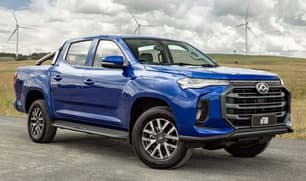
This is it: Australia’s first fully electric ute.
It is telling of the times that the eT60, a dual-cab, no less, doesn’t come from a traditional titan of Australia’s car market like Ford, Nissan or Toyota.
Instead, it comes from Chinese upstart, LDV. The brand has already made a name for itself importing affordable alternatives to these mainstream rivals.
The combustion version of the T60 is chipping away at the market share of established names, commanding nearly six per cent of the light commercial market, placed fifth behind Mitsubishi.
Can the brand be more than a cut-price option, though? Does it have what it takes to be a first-mover with its all-electric dual-cab? We drove a pre-production example at its Australian launch to find out.
The Ineos Grenadier Quartermaster is the dual-cab ute version of the Ineos Grenadier wagon, which arrived a few years ago to much fanfare.
It’s a body-on-frame / ladder-frame 4WD with live axles, a dual-range transfer case, front, centre and rear diff locks, and plenty of features – onboard and optional – intended to turn you into an off-road expert.
The Quartermaster is a purpose-built work-and-play ute aimed at taking on the likes of the Toyota LandCruiser 70 Series and it’s a real breath of fresh air in a dual-cab ute market that’s increasingly looking same-same – although admittedly the Kia Tasman has also rattled the cage, but that’s another story.
So how does this Land Rover Defender-inspired ute perform off-road?
The eT60 presents as an electric vehicle clearly converted from a combustion vehicle to take advantage of being first in our market.
It comes with some significant downsides, from the lack of key specifications and safety equipment to the downright average drive experience, but in other areas it’s specified right, with decent charging specs, and surprisingly good software on that centre multimedia screen.
In some ways, these impressions are a reflection of how far the ute market has come in Australia in the last few years, with many commercial offerings now feeling just as complete as passenger cars in terms of specification and driving prowess.
LDV has left open the door for future tweaks and improvements to the eT60’s spec, ride, and features, and we’re keen to get it in for a longer test in the near future. Either way, though, the brand says it has no shortage of buyers lining up to be a part of the zero emissions future of commercial vehicles.
The Ineos Grenadier Quartermaster is best regarded as a charming old-school oddity in an increasingly cookie-cutter dual-cab ute market.
In the same vein as the Suzuki Jimny, Jeep Gladiator, and Toyota LandCruiser 70 Series, this ute is for those of us who really like driving to be a fully immersive experience and don’t mind a few sacrifices and some discomfort along the way.
Good on Ineos for giving it a crack.
The eT60 is hard to tell apart from its combustion equivalents from the outside. If you were expecting a blanked-out grille, aerodynamic wheels, or some other special EV-specific design flair, you’ll be surprised to find there are none.
To that end, the eT60 shares the exterior appeal of the combustion range, with a big, tough-looking grille, modern LED DRLs, sturdy looking alloy wheel designs, and enough chunky personality from the wide stance and additional bits like the sidesteps and sports bar.
Peeking underneath reveals the housing for the batteries, notably no spare wheel, and the tray is utilitarian with the spray-in tubliner. At least the ute scores colour-matching bodywork all around.
The same goes for the inside, which certainly feels like a commercial offering. Again, all the items in there mirror its base combustion equivalent, with the only giveaway of its electric nature being the dial-shifter which replaces the lever on the centre console.
The cabin surroundings are largely hard-wearing plastics, including the steering wheel, making the swish touchscreen with surprisingly fast software look somewhat out-of-place.
The analogue dash cluster, for example, looks a bit old-school for an EV, and in terms of look and feel, the T60 generally feels a bit behind the pace compared to its traditionally more expensive rivals.
While it lacks in some areas, though, it is worth something that this dual-cab flies under-the-radar. Fleet operators won’t need to worry about a strange-looking ute with unnecessary frills, and common body panels with combustion versions will make repairs easy, too.
The Quartermaster is 5400mm long (with a 3227mm wheelbase), 1943mm wide, and 2019mm high. It has a listed kerb weight of 2718kg and a 14.5m turning circle.
I’m always reluctant to talk about any vehicle’s design but it’s easy with something like this ute.
The Quartermaster has a distinctive look. It’s blocky, hard lines everywhere, and it’s straight up and down, old school.
Substantial side steps/runners, exterior utility belt (a integrated feature by which you can attach accessories, tools, or cargo to the Quartermaster’s exterior), and BFGoodrich All-Terrain KO2 all-terrain tyres on 17-inch alloy wheels add to this ute’s presence.
It certainly catches everyone's attention, for better or worse because some people like it, some people don't. I happen to be part of the mob who actually like the look of the Quartermaster and its sibling, the Grenadier station wagon, and the design pretty much works overall.
Extras like the black contrast roof, safari windows and raised air intake further set this Quartermaster apart from most other modern dual-cab utes on our roads.
The interior is somewhat spartan but well laid-out and comfortable. It has lots of controls and quirky styling to keep everyone inside occupied and while, at first, it’s all a confusion of buttons, knobs and dials, it soon takes on a more familiar feel as you become accustomed to everything.
Your burning question here will be how much the eT60 can tow and haul. With the same suspension set-up as the Pro version, this ute is capable of carrying a 1000kg payload, or tow 1000kg braked.
This is limited, but when you consider its 2300kg kerb weight due to the addition of those batteries, reasonable.
Operators should keep in mind that the 330km driving range is unladen, so you can expect half of that or less when loaded to capacity.
Tray dimensions come in at 1510mm wide (1129 between the arches), 1485mm long, and 530 high. Axle load capacity at the rear is 2100kg, and the eT60 has a GVM of 3300kg.
The approach and departure angles, as well as the clearance are mostly the same as the combustion version, coming in at 27 degrees, 24 degrees, and 187mm respectively.
Technical stuff aside, the cabin is as hard-wearing and practical as you would hope for a working ute, with a total of six cupholders and four bottle holders, a glove compartment, and sunglass holder, two USB 2.0 ports, two 12V outlets, and the welcome addition of a full-size 220V household power outlet.
The synthetic seat trim is so-so for comfort, and the seat bases are quite high, leaving someone at my 182cm height quite close to the roof.
The lack of telescopic adjust for the steering wheel is a shame, but not unusual for products from LDV’s SAIC parent company (this problem is shared with the MG ZS, for example).
The rear seat continues to offer comparatively good space for this segment, even behind my own driving position, although it would be predictably quite tight with three abreast.
As this was a brief test, we can’t tell you what it looks or feels like when loaded up, but the spray-in tubliner is better than offering the eT60 with simply a painted tray, as it’s good-to-go from day one.
In terms of practicality, it's pretty good news inside the Quartermaster cabin when you first climb in. As mentioned, there is a confusion of dials, buttons, knobs, everything in front of and above you. But give yourself some time to locate controls and understand how to best use them, and you'll be absolutely fine.
As alluded to in Design, the cabin looks really good but it also functions quite well as a work or travel space. Once you are underway and you have a firm understanding of everything, it all feels comfortably familiar.
There are hard plastic surfaces in the cabin, leather accents, as well as plenty of quirky styling cues around the cabin, including port and starboard markings, aircraft cockpit-style controls and more, and you'll have fun discovering those.
The floor has drain plugs and the buttons and switches have an IP54K rating (protected from limited dust ingress and water spray from any direction) with the idea being that, worst comes to the worst, you can always hose out the interior if it gets really dirty.
The Recaro seats, front and rear, are very comfortable. There's not a whole lot of room in the rear seat. You don't get much leg and knee room, especially if you are tall, but the seats are raised for optimised visibility to the front and otherwise, with big glass everywhere and safari windows, it’s an airy and useable space.
The auxiliary battery is under the rear seat.
All in all, it's a functional and comfortable interior.
Anyway to the business end. The tub is 1564mm long, 1619mm wide (1137mm between the wheel arches) and 485mm deep. It has a sturdy tub liner, four-tie-down points, a load-space light, power socket.
The full-sized spare was located in the rear left-hand corner of the tub and while that’s not ideal and certainly doesn’t optimise the load space, it can be shifted elsewhere – on the roof perhaps – and it’s not as much of an eye-sore as the spare in the GWM Cannon Alpha PHEV tub.
The spare tyre also has the optional lockable storage box ($490) attached to it, so you can throw a bit of gear inside there and keep it secure during your travels.
The eT60 is expensive. Shockingly expensive. The single variant which will initially arrive in Australia wears a before on-road costs price tag of $92,990.
To put that in perspective, its specification is equivalent to that of the base-model ‘Pro’ combustion version, which now wears a price-tag of $43,148.
Do the math. You could literally have two T60 Max Pros for the same cost as one of these electric versions, given the latter's price premium of $49,842.
To make matters worse, the eT60 is rear-drive only, and with its nearly 90kWh battery pack offers just 330km of driving range, and that’s without being loaded-up.
This price is puzzling for more than one reason, however. For a start, 90kWh of batteries certainly doesn’t cost nearly $50,000 (if you take the average price of a lithium cell per kWh in 2022, the battery should cost closer to $20,000).
In fact, even the electric Mercedes-Benz Vito van with a similarly-sized battery comes in at $85,353 before on-road costs.
To this you could argue many things, but perhaps the most salient point is the fact that big corporate commercial fleets with zero emissions targets are seemingly obliged to pay up given the eT60 has become the only zero-emissions option in the ute space.
Standard gear is mostly shared with the Pro grade of the combustion T60, but there are some real oddities.
Good things include 17-inch alloy wheels and a slick 10.25-inch multimedia touchscreen with Apple CarPlay connectivity, synthetic leather interior trim with six-way electric adjust for the front passengers, LED DRLs, and a sports bar over the tray, which itself has a spray-on tub liner pre-applied, and side-steps to make it easier to hop in and out.
A big bonus is the household-sized 220V power outlet on the back of the centre console, which can be used to power tools and charge devices.
Then things get a bit strange. For example, this is the only fully electric car I’ve ever driven which has a turn-key ignition (as opposed to a push-start system).
It also has an analogue dial cluster, a plastic steering wheel with no telescopic adjust, halogen headlights (in 2022, really?), a manual handbrake, and the example we drove didn’t even have a dedicated park gear. To exit the vehicle, you leave it in drive or neutral, rip the handbrake on, and turn it off. Very odd.
There’s some welcome items here, and it’s also nice that despite LDV’s clear focus on commercial buyers, the eT60 is a dual-cab, so you can actually use it for more than just hauling stuff, but there are just some things (the lack of a park gear in particular) which make it feel a bit pieced together on a tight budget. Rough for a vehicle which costs nearly $100K.
This ute is available in three different spec levels: the base-spec Quartermaster, the Fieldmaster and, this, the Trialmaster.
It’s available with one of two BMW-sourced engines: a 3.0-litre inline-six turbo-petrol engine (producing 210kW at 4750rpm and 450Nm at 1750-4000rpm) or a 3.0-litre six-cylinder turbo-diesel engine – producing 183kW at 3250-4200rpm and 550Nm at 1250rpm-3000rpm.
I tested the diesel-powered variant.
The Trialmaster has a starting price of $118,000 before on-road costs, but our test vehicle has $15,386 worth of accessories onboard pushing its as-tested price up to $133,386.
Standard features onboard the Trialmaster include a 12.3-inch touchscreen multimedia system (with wireless Apple CarPlay and Android Auto), permanent four-wheel drive, centre diff lock, and front and rear skid plates.
Other noteworthy features inside this test vehicle include leather trim (black, $3405), heated front seats ($715), Nappa Leather Driver’s Pack, as well as auxiliary battery, auxiliary charge points, high load auxiliary switch panel and electrical preparation, 400W Inverter, and load bay utility rails.
Other features on the outside of this Trialmaster include a contrast roof – Inky Black ($2460), front and rear diff locks (standard on the Trialmaster), raised air intake, privacy glass ($770), safari windows ($2720), 17.0-inch alloy wheels ($1165), Class III 1-7/8” NAS tow hitch and electrics, a load bay liner, and a spare wheel lockable storage box ($490).
Exterior paint colours include the standard Britannia Blue (solid) or you can choose from Scottish White (solid, $1155), Magic Mushroom (solid, $1155), Eldoret Blue (solid, $1155), Sela Green (solid, $1155), Inky Black (solid, $1155), Devil Red (solid, $1315), Shale Blue (metallic, $1520), Queen's Red (metallic, $1520), Donny Grey (metallic, $1520), or Sterling Silver (metallic, $1520).
But what you want to know is how is it off-road and is it a replacement for the 70 Series, so let’s keep punching on through this yarn.
The eT60 is rear-wheel drive only, with an electric motor producing 130kW/310Nm. That’s nowhere near as punchy as the 160kW/500Nm outputs of its punchy twin-turbo 2.0-litre combustion equivalent.
There are three driving modes - 'Power', 'Normal', and 'Eco', and driving performance seems tame. Again, as this was a quick spin in what was described as a pre-production vehicle, we didn’t have a chance to try it out with extra weight in the tray.
Suspension is the same as the combustion T60 Pro, consisting of ‘heavy duty’ coils at the front, and a leaf-sprung set-up in the rear. There are disc brakes all-round.
The Ineos Grenadier Quartermaster is available with either a 3.0-litre inline-six turbo-petrol engine (producing 210kW at 4750rpm and 450Nm at 1750-4000rpm) or a 3.0-litre six-cylinder turbo-diesel engine – producing 183kW at 3250-4200rpm and 550Nm at 1250rpm-3000rpm.
Both engines are from BMW. Our test vehicle has the diesel.
This Quartermaster has an eight-speed ZF automatic transmission and a dual transfer case (high- and low-range 4WD), as well as a front, centre and rear diff lock.
This is a nicely refined engine-and-auto combination, offering up a decent punch of power and torque across a broad rev range when it’s needed.
The eT60’s WLTP-rated energy consumption figure comes in at 21.3kWh/100km, which for a passenger car wouldn’t be great, but seems about right for a commercial vehicle of its size and aerodynamics. As already mentioned, this gives it an official driving range of 330km.
LDV says the fleet buyers it has lined up for the eT60 understand its range is “more than adequate for their daily requirements”.
There is some good news on the charging front, with the eT60 being sensibly specified from the factory. The DC charge rate maxes out at 80kW, for a claimed 20-80 per cent charge time of 45 minutes on a compatible charger, while the slower AC charging rate (important for back-to-base operators) is 11kW, meaning a nine-hour 5.0-100 per cent charge time.
On a single-phase charger (maxing out at 7.2kW, but cheaper to install) the 5.0-100 per cent charge time is a claimed 13 hours. Expect more like a 40-hour charge time on a standard wall socket.
Official fuel consumption is 10.5L/100km on a combined cycle.
On this test, I recorded 12.3L/100km.
The Quartermaster has a 90-litre fuel tank so, going by that fuel figure, you could reasonably expect a driving range of about 730km from a full tank. However, long-range fuel tanks are available, so there’s always that option.
I said some of the standard equipment on this car is odd. This continues through to the drive experience. Keep in mind that LDV reminded us that there were some pre-production quirks about the vehicle we briefly drove on this launch.
Setting off, the eT60 emits a rather unappealing artificial buzzing sound to alert nearby pedestrians of its presence. While the audible aid is welcome, particularly for a commercial vehicle which may be frequently operating in areas shared with pedestrians, does it have to be so grating?
Even the Mifa 9 electric people mover makes a more appealing science-fiction-inspired noise. Perhaps the eT60’s noise was designed to mirror the tone of a diesel engine?
The seating position leaves a lot to be desired for someone of my height and I would also love to have telescopic wheel adjust, although visibility out of the cab is good all-around, and the reversing camera is relatively high-quality.
Manoeuvring at low-speeds is only tarnished, then, by heavy steering, which annoyingly, also gets a bit vague at higher speeds.
Higher speeds also reveal this ute’s main weakness which appears to be its ride. Keep in mind we’re driving a completely unladen pre-production example. But the ride was harsh, busy, and unsettled in our short drive, which covered a portion of freeway and some bumpy side roads.
The suspension from the combustion T60 Pro appears to struggle with the additional weight of the batteries in the eT60. Harsh bumps were easily transmitted to the cabin, whilst undulations had it jiggling and bouncing around side-to-side.
Power from the electric motor seemed sufficient, but not exciting, with tame acceleration off-the line. The obvious benefit being instantaneous response without the need for a transmission.
It is hard to tell whether the 310Nm on offer will feel too heavily burdened when the ute is loaded up. In some instances, electric motors don’t feel additional heft at all, so stay tuned for a follow-up load test.
Unlike this car’s Mifa 9 or eDeliver 9 relations (which use an electric motor with identical outputs), the eT60 does not have adjustable regenerative braking, with a single strong tune, which cannot even be turned off.
While it is welcome for extending the ute’s range and reducing the stress on the disc brakes, it is not a single-pedal driving mode.
The three driving modes don’t alter the experience much, with the Power mode making the electric motor more responsive, and Eco mode taking the wind out of its sails.
Its maximum speed is limited to 120km/h which is more than can be said for the eDeliver 9 which is limited to 90, a recipe for freeway frustration.
We’re keen to spend more time with the eT60 in the future to better evaluate its range claim and how it deals with more commercial duties. Hopefully it can shape up a little better than it did our quick and less-than-ideal testing environment.
First things first, just to put your mind at ease – the Quartermaster is not absolutely terrible to drive on road, in fact it’s actually quite nice: planted, comfortable (on coil-spring suspension), and refined (for a ute).
It’s no surprise that a long four-wheel-drive ute does really well on-road, even if it is a heavy solid axle vehicle and not particularly dynamic.
What's also not surprising – because on paper this is an off-road beast – is that the Quartermaster is very capable off-road.
It has three diff locks (front, centre and rear), off-road mode, hill descent control and more, so it's an effective mix of traditional mechanicals and driver-assist tech. That's the dual range transfer case, but it also has electronic traction control. The 3.0-litre turbo-diesel engine and the eight-speed automatic transmission work well in on-road situations and it's also a clever smooth combination in off-road scenarios.
So there's plenty to like about this ute when it comes to 4WDing.
Be aware though: this is a big, heavy vehicle with a long wheelbase, so it takes considered driving to steer around – it has a big turning circle at 14.5 metres – but that's not to say those dimensions and those characteristics ruin it off-road because they don't. The Quartermaster simply requires a bit more thought when you're driving it.
If you haven't spent a lot of time or any time in vehicles like this, such as the Toyota LandCruiser 70 series or of that sort of ilk – big long old-school four wheel drive utes – then you may have a bit of an issue with the steering. It is slow, and there is a lot of play to it, especially off-centre. It does feel floaty and it takes a lot of effort and constant micro-corrections when you're driving to keep it on track and to keep it going where you want to. Put it this way: it’s not self-centred so you have to work at getting it back on track once you’ve taken on a turn.
But I like that, because four-wheel driving should be an entirely immersive experience, you should be always directly involved in the process and in this ute you are.
There’s plenty of power and torque across a nice rev range, with plenty of torque down low, which is crucial when off-roading.
And while the stretched wheelbase makes the underbody vulnerable to knocks and scrapes, especially over more severe 4WD-only terrain, the Quartermaster actually manages quite well.
Its approach, ramp breakover and departure angles – 36.2, 26.2 and 22.6 – are reasonable for something of this size and with 264mm of ground clearance and 800mm of wading depth, this ute has the measurements to cope with most off-road challenges you could throw dirt at.
Another thing I like about the Quartermaster is the fact it retains an old stubby stick, that’s working off the dual-range transfer case, to put the vehicle into low range and that's a welcome touch and a practical nod to the past, rather than a button or a dial.
As mentioned earlier, it has live axles, so there’s flex through the front and rear, although it'd be even better with a swaybar disconnect system onboard (as in the Jeep Gladiator).
This Trialmaster gets the BFG KO2s and where the standard tyres on a contemporary ute may not be up to scratch in off-roading terms, the KO2s work really well. It’s impressive what a difference decent all-terrains make, and if you want to get into the sloppy stuff, then you might consider getting some mud-terrain tyres.
So the Quartermaster is a very capable four-wheel-drive ute and there's a lot to like about it, but the issue with a vehicle like this is that people may come into it not understanding exactly how it rides, how it drives and how involved you actually have to be and the fact that there are lots of compromises, indeed some sacrifices.
You're not getting as much driver-assist technology as you get in other utes, and it doesn't drive as precisely or perhaps as comfortably as some other utes – but that's missing the point.
The Quartermaster is about that all-encompassing off-roading experience. And if you get in one of these things, you have to be all-in, ready for the bumps and the discomfort and the effort it requires but all of those things add to the appeal of this ute, rather than detract from it.
And that's a major point of difference with this ute over others in the market: in being faithful to the spirit of old-school 4WDing, Ineos has been willing to forgo those things which people have come to expect and as a result it may only draw the faithful, the committed, who are all-in for off-road adventure.
Where the Quartermaster falls short, however, is in terms of practical use because its payload is 832kg in the diesel version and that’s disappointing, especially when a 2.8-litre LC70 GXL dual-cab can cope with 1325kg.
It is rated to tow 750kg unbraked, and 3500kg braked and with a kerb weight of 2718kg it has a GVM of 3550kg and a GCM of 7000kg.
The eT60 lags behind the competition here with a notable lack of active safety equipment, now considered industry-standard.
There’s no auto emergency braking, lane support equipment, active cruise, or blind spot support. Instead, this ute has the standard array of six airbags, electronic stability and traction controls, with the addition of hill start assist, roll movement intervention, and hill descent control.
While combustion versions of the T60 have a five-star ANCAP rating from 2017 (before active items like AEB were considered necessary), don’t expect the same from the eT60.
The Ineos Grenadier Quartermaster does not have an ANCAP safety rating because it has not been tested.
As standard, it has six airbags, electronic stability and traction control, rear park assist, a tyre-pressure monitoring system, and trailer-stability assist.
It does not have auto emergency braking (AEB), adaptive cruise control, blind-spot monitoring, lane-keep assist, or traffic sign recognition.
The Quartermaster does have a rear-view camera, but the screen is quite small.
Front and rear parking sensors are standard on the Fieldmaster and Trialmaster, but optional on the base-spec Quartermaster.
Ownership is a better story. The eT60 is offered with an industry competitive five-year/160,000km warranty, with five years and 130,000km of roadside assist. There is also a separate eight-year and 160,000km warranty for the battery (supplied by CATL).
The service intervals might be the most appealing attribute, with the eT60 only needing to visit a workshop once every 24 months or 30,000km.
Even better is the cost, which will set owners back an approximate average of just $145.80 per year for the first 10 years of ownership.
The Ineos Grenadier Quartermaster is covered by a five-year/unlimited km warranty, not the best in terms of years of coverage, but on par with the likes of the LC70.
A 12-year anti-perforation warranty – covering body sheet metal panels and chassis frame against inside-to-outside corrosion caused by defective materials or workmanship – applies to this ute.
No capped-price servicing is available and service intervals are scheduled for every 12 months or 15,000km, whichever occurs soonest, and total cost for the five years is $4626 for the diesel and $4896 for the petrol.
At the time of writing, Ineos has 25 sales and service centres, two sales-only centres and 55 service-only centres spread throughout Australia with a focus on regional and rural areas.