What's the difference?
Make no mistake, you are looking at the biggest challenge the all-conquering Tesla Model Y has ever faced in Australia.
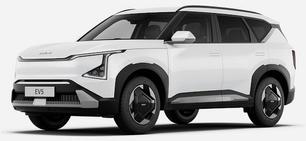
It’s the Kia EV5, a mid-size, all-electric SUV the Korean brand thinks will be its best-selling EV by some margin.
Oh, and it’s cheaper than the Tesla, by more than a little bit.
So, is this the electric SUV that might finally put an end to Tesla’s winning run in Australia?
BYD has made a big impact in a short space of time in Australia and the arrival of this all-new mid-size SUV opens the door for an even bigger future.
BYD has taken the fight to Tesla in the electric vehicle contest, and while still some margin behind the American brand the Atto 3 and Seal remain amongst the most popular rivals to the Model 3 and Y, respectively.
At the same time it has out-sold established brands including Honda, Skoda and Renault, as well as fellow Chinese newcomers LDV and Chery.
Now BYD has its sights set on upsetting the established order in one of the biggest segments in the Australian market - mid-size SUVs.
The Sealion 6 is not a name that rolls off the tongue but it does leave an impression, as does the car, as we discovered when we drove it.
The size is right, the price is right and the drive is right – three things that make the Kia EV5 a pretty formidable foe, and the kind of vehicle that might finally be able to break through the wall of the temple of Tesla in Australia.
Note: CarsGuide attended this event as a guest of the manufacturer, with accommodation and meals provided.
So, should Toyota, Tesla, Hyundai and others be worried about the arrival of the Sealion 6 and BYD’s new DMi powertrains? Yes, but not because it represents any major breakthrough in technology or dynamic prowess.
Instead, the strength of the Sealion 6 is how average it is. It may not be the obvious class-leader in any particular area, but it does a good job in almost every measurable aspect and doesn’t possess any major flaws.
Yes, there are still questions about the long-term dependability of BYDs but that’s a risk any new owner will need to accept. But the very sharp pricing should tempt plenty of buyers to take that chance and continue BYD’s steady upwards trajectory in the Australian market.
If you’re familiar with any of Kia’s EV designs, and specifically the EV9, you’ll already know the Kia EV5, which looks a lot like a shrunken version of the company’s biggest electric 4WD.
But this one looks a bit smaller, a bit more familiar looking, and maybe a bit more accessible than the hyper-modern EV9.
Honestly, it looks like a contemporary, mid-size SUV that could be powered by anything.
There are a couple of EV5 design elements I really like. The first is the combination of hard edges and subtle curves, which combine really well. I also love the lighting treatment up front, which gives the EV5 a bold and unique light signature, especially at night.
Inside, it’s another story of familiarity, with a clean, high-tech cabin and Kia’s common twin-screen set-up. Actually, it’s more a triple screen, with two 12.3-inch screens, and a 5.0-inch climate monitor between them.
The materials are all nice, and they look great, but they don’t exactly melt under the touch, and that gives the EV5’s cabin a hard edge I don’t love.
I do, however, love the inclusion of some physical buttons, so you’re not pawing through the screen to access every in-car function.
And one final design quirk. I know it looks like it has an old-school bench front seat, but you can’t use it as a third seat in front. Kia says it’s just a design flourish. But it is also somewhere safe to pop your phone or other small valuables to stop them sliding about when you're on the road.
This is one area where BYD has a mixed record. Not to be unkind or create an international incident, but the Chinese car industry has a history of not being totally original with all of its automotive designs.
However, things are improving and the Sealion 6 is a good example of the Chinese industry learning to develop its own style. While there are some subtle hints from European models, overall it’s a smart-looking mid-size SUV with some character to it - rather than being a bland imitation of something else.
One area where the Sealion is a cut above its competition is its size, being longer than and wider than the RAV4, Mitsubishi Outlander and Nissan X-Trail.
At 4615mm in length, 1875mm in width, 1715mm in height, and with a wheelbase of 2750mm, the Kia EV5 is roughly the same size as a Tesla Model Y, so if you’re ever sat in the back of the Tesla, you’ll have a fair idea of what to expect here.
Sitting behind my own 175cm driving position, I found I had a heap of knee room, more than enough headroom, and I reckon you could fit three adults across the back seat pretty easily, too.
There are a couple of design flourishes I really like, too. The pull-down divider that separates the backseat is home to two cupholders, which isn’t unusual, but what is new to me is the unique positioning of the USB charge ports, which are in the middle-back of the front seats, right above the storage pocket, so you have somewhere to pop your phone and cable when you're charging.
There is also a deep storage draw between the two front seats. It’s just for extra storage in the Air and Earth, but in the GT-Line it’s heated and cooled, which means hot pies or cold drinks when you’re on the move.
The EV5 might be an all-electric vehicle, but it’s still a mid-size SUV, which means there are certain standards it has to hit to be taken seriously, and one of those is boot space.
Up front there’s 67 litres of space in the fruit, or frunk, while the boot holds 513L with the rear seats in place – that number obviously growing as you begin folding them flat.
It is also a hugely customisable space. There’s heaps of under-floor storage below the removable panels. There’s also vehicle-to-load capability, which takes the form of a standard power point in the boot that can use the vehicle’s battery to power pretty much whatever you want.
Finally, there are adjustable luggage hooks, so you can carry bigger or smaller bags as you wish.
That external size translates to a roomy cabin, which also has some flair to the design but thankfully a bit more restrained than the smaller Atto 3 - which is a bit over-the-top in this reviewer’s opinion.
The element that sticks out immediately is the large central touchscreen which, like other models in the range, can rotate either vertical or horizontal, depending on your preference.
I don’t understand the point of this, because when rotated vertically it impacts your forward vision and can interfere with the air conditioning vents; and I can’t even see it with my polarised sunglasses.
It simply makes more sense horizontally, but I guess all carmakers are looking for catchy gimmicks these days. But while it may seem like a cool party trick it remains somewhat confusing to me, like one more thing to go wrong. But maybe I’m just getting old and grumpy.
What I do like and think is a great idea is double smartphone charging pads in the centre console. And overall the design of the cabin feels well thought out and has plenty of useful storage areas.
The seats are fine, a little flat and the fixed headrests are irritating, but overall they’re soft and supportive enough.
The key in the second row seating is the amount of space, with the extra length of the Sealion 6 compared to its rivals showing up with more knee room in the back for families with growing teenagers or those who need to carry their adult friends.
There’s also a pair of USB ports in the back too, so everyone can keep their electronics charged.
The boot is a good size, measuring 425 litres on paper, and has a nice long and wide floor. But some of that space is thanks to the lack of a spare - so that counts against it in my book.
The cheapest EV5, the Air, arrives in two guises, Standard Range or Long Range, and the former is something of a bargain.
It’s the only EV5 to get included on-road costs, and Kia is asking $56,770, on the road. That puts it well below the Tesla Model Y. As of right now, the single-motor Tesla is $60,868, on the road, in NSW.
Next is the Air Long Range, which lists at $61,170, before on-road costs. The EV5 Earth occupies the middle rung, at $64,770, before on-roads, while the yet-to-arrive flagship, the GT-Line, is a considerable $71,770, before on-road costs.
Air models get 18-inch alloys, LED lighting all around, roof racks and power mirrors, while inside there are cloth and synthetic leather seats, with a massage function for the driver, along with a synthetic leather steering wheel and LED interior lighting.
Tech is covered by twin 12.3-inch screens, with a smaller 5.0-inch climate screen sandwiched between them, and there’s in-built nav, a six-speaker stereo and Apple CarPlay and Android Auto.
The Earth then adds 19-inch alloys, gloss black exterior design flourishes and privacy glass, while inside, the seats are now entirely synthetic leather. You also get a second V2L connection, as well as a powered tailgate.
Finally, the GT-Line gets pretty much everything Kia could throw at it, including 20-inch alloys, auto-flush door handles, a panoramic sunroof, two-tone seats which are now billed as offering "premium relaxation", wireless phone charging, fingerprint recognition, a heated steering wheel and an augmented-reality head-up display.
Price is key to BYD’s success in Australia. Quite simply, the Chinese brand has undercut its rivals and consumers have responded to that, unsurprisingly in these tough economic times. The Sealion 6 follows the same path blazed by the Atto 3, Dolphin and Seal, offering plenty of vehicle for your money.
BYD Australia has kept it really simple, offering just two models - Dynamic and Premium - with very similar specification and separated primarily by powertrains.
The Dynamic is a less powerful, two-wheel drive option, while the Premium gets more grunt and all-wheel drive; but we’ll detail that later.
Both the Dynamic and Premium come with 19-inch alloy wheels, power-operated tailgate, a panoramic sunroof, powered front seats that are heated and cooled, a 15.6-inch touchscreen, Infinity premium audio, two wireless phone chargers and wireless Apple CarPlay and Android Auto.
The only non-powertrain difference between Dynamic and Premium is a head-up display on the latter model.
One noticeable absence from the Sealion though is a spare tyre. There’s not even a space-saver, just a tyre repair kit, which is disappointing and out of touch with the unique demands of the Australian market.
The Dynamic is priced from $48,990 (all prices exclude on-road costs), while the Premium starts at $51,990.
To put that into context with its competition, the Toyota RAV4 Hybrid range begins at $42,250 for the GX and stretches to $51,410 for the range-topping $51,410.
While, if you’re looking at an electric alternative, the Tesla Model Y currently starts at $55,900. The most direct rival, however, is the Mitsubishi Outlander PHEV which is only available with all-wheel drive and stretches from $57,290 to $73,790 across five variants.
The entry-level EV5 Air is available in Standard Range or Long Range guises, both powered by a single front-mounted electric motor, producing 160kW and 310Nm.
The Standard Range will clip 0-100km/h in 8.5 seconds, while the extra weight of the bigger battery slows down the sprint in the Long Range, taking around 8.9 seconds.
The Earth is a twin-motor AWD offering, with a motor at each axle, lifting outputs to 230kW and 480Nm, dropping the sprint to a brisk-feeling 6.1 seconds. The incoming GT-Line gets the same powertrain.
While BYD has made its name in Australia as an all-electric brand it has always referred to itself as a 'new energy' company, and the Sealion 6 (and upcoming Shark ute) are why.
That’s because these feature BYD’s new 'Dual-Mode Intelligence' (DMi) powetrain - a hybrid system to you and me.
As mentioned above, the biggest difference between the Dynamic and Premium models is the powertrain, with two reasonably different systems.
The Dynamic is powered by a 78kW/135Nm 1.5-litre four-cylinder petrol engine, paired with a 145kW/300Nm electric motor - making for a combined system output of 160kW/300Nm. Notably, this powertrain only drives the front wheels.
In contrast, the Premium has an all-wheel drive set-up, combining a turbocharged version of the petrol engine (good for 96kW/220Nm) with a pair of electric motors, one on the front axle and one on the rear to produce a combined output of 238kW and 550Nm.
Both models get the same 18.3kWh ‘Blade’ battery, which is BYD’s proprietary technology underpinning all of its models and is attracting attention from other brands.
For reference, the Outlander PHEV has a 20kWh battery, Nissan’s X-Trail e-Power has a 2.1kWh battery, while the more conventional RAV4 Hybrid has just a 6.5Ah battery.
The Air Standard Range gets a 64.2 kWh lithium iron phosphate battery, weighing in at a hefty 428kg, which delivers a claimed driving range of 400km. The Air Long Range, the Earth and the incoming GT-Line all share the same 88.1kWh battery, upping the range to 555km, 500km and 470km, respectively.
So, if driving range is at the very top of your must-have list, the Air Long Range is the car for you.
All cars can take 7.0kW home AC charging, while the dual-motor versions are set up for 11kW AC charging. Fast charging. When it comes to fast charging, all models can plug into a 350kW charger, taking them from 10 percent to 80 per cent in less than 40minutes.
There are multiple modes to drive it in, including electric only, with the Dynamic able to go up to 92km on a single charge, while the Premium manages a claimed 81km.
However, it's important to note these are the NEDC standards and not the more real-world like WLTP, so you may not achieve those in practice.
The claimed fuel consumption is an impressive 1.1L/100km for the Dynamic and 1.4L/100km for the Premium although again achieving those in the real world will take some effort.
With a 60-litre fuel tank BYD claims the Dynamic has a driving range of just over 1000km, while the Premium can manage around 960km.
It's also worth noting the Sealion 6 comes equipped with vehicle-to-load charging which means you can draw power from the batteries to run small electronic devices if you need to.
It’s a bonus feature that may or may not be of use, but is one of those things that may come in handy one day to get you through a camping trip or a BBQ at the park.
First things first – I spend most of my time behind the wheel of the EV5 Earth, which though it shares its dual-motor powertrain with the GT-Line, is actually the fastest of the lot owing to the extra weight of Kia's flagship.
That means zero to 100km/h in just over six seconds, and trust me when I say this, that is more than fast enough. I know you read about EVs knocking off the sprint to 100km/h in supercar-besting times, but you don't need that sort of crazy acceleration in a family-focused mid-size SUV.
Actually, forget needing, you don't want it. The EV5 feels more than punchy enough, without shaving years off your life every time you plant your foot.
Fit for purpose, then, which is exactly how I'd describe the rest of the EV5's very good drive experience. Kia's Australian ride and handling wizards have once again had their way with the EV5, and the result is an EV that handles most everything Australian road surfaces can throw it at it with ease.
Surprisingly, it's maybe not quite as dynamically sharp as the bigger EV9, but it's always comfortable, without feeling floaty or disconnected, and it will happily grip its way around tighter corners without tipping from side to side, either.
There are a couple of small quirks, though. The first is the steering, which is definitely responsive and confidence inspiring, but it also has a kind of artificial weight or heaviness at times that feels a bit disconnected from what's happening beneath the tyres. And the cabin can be a little noisy through wind, too.
But these are small beans, really. The EV5 is comfortable and capable, and without the harsh ride or too-sharp steering that can be found in some of its rivals.
We drove it for hours across all sorts of road surfaces, and in all sorts of conditions, and found very, very little to complain about.
We drove the Sealion 6 Dynamic and despite having the less powerful powertrain it feels good on the road. The DMi system offers good performance, with quiet acceleration off the mark and a good integration between the petrol engine and electric motors. We haven’t driven the Premium yet, so we can’t make any comment on how different it feels.
It’s hard to make a definitive call on the Sealion PHEV powertrain because, like every plug-in hybrid, its greatest strength relies on how the owner operates it.
If you don’t charge the battery every day or so, you’ll just end up lugging around a battery and electric motor for little benefit. However, if you do keep the battery topped up, you can do most of your urban commuting without needing to turn the petrol engine on, which should result in some very low fuel consumption figures.
The company clearly knows this, which is why BYD Australia is offering a complimentary home charger to the first 3000 customers who order a Sealion 6.
Not only will that encourage sales but it will also help owners become evangelists for PHEVs in the future, because they’ll have the best possible experience.
So, a large part of its strength or weakness rests on the owner’s behaviour and that’s something we can’t assess.
As for the rest of the driving experience, the ride comfort is fine. It can’t match the class-leaders for compliance or dynamics, but the Sealion feels pleasant to drive around the urban environment and on the freeway at speed.
Biggest criticism is the steering is very, very light. While that makes parking easier, it feels so light you get very little feedback from the front wheels so it can feel vague at times.
Overall the driving experience is best described as fine. It doesn’t have any major vices but neither does it set any new benchmarks.
Every EV5 gets a comprehensive safety offering, including 'Advanced AEB' that includes junction crossing, lane oncoming and lane changing alerts. There’s rear-cross-traffic alert, semi-autonomous highway cruising and a whole heap more.
If you want a blind-spot view monitor, surround-view monitor or remote park assist, you’ll need to spring for the GT-Line.
The EV5 hasn’t been crash-tested yet, but Kia will be shooting for the maximum five-star ANCAP rating.
Both Sealion 6 variants come equipped with autonomous emergency braking, front and rear cross-traffic alert/braking, 'Forward Collision Warning', 'Rear Collision Warning', lane departure warning/prevention, blind-spot detection, traffic-sign recognition, door-opening warning, trailer stability control, auto high beam, a 360-degree monitor, adaptive cruise control as well as front and rear parking sensors. Plus, it can even detect if you’ve left a child or pet inside the car.
ANCAP had not crash-tested the Sealion 6 at the time of publication, but with its comprehensive list of safety items it should tick most of the boxes when it comes to protecting its occupants and pedestrians.
The EV5 is covered by Kia’s seven-year, unlimited-kilometre warranty, and you can prepay your servicing costs, too.
Three years will set you back $980, five years is $1535 and the full seven years will set you back $2431 ($347 per workshop visit), which is category competitive.
BYD is a small company but has partnered with mycar service centres to make maintaining your Sealion 6 easier. The Sealion is covered by BYD's six-year/150,000km warranty as well as its 10-year capped price servicing plan.
Service intervals are every 12 months/20,000km and prices range from $265 up to $1184 for the major eight year/160,000km tune up. Over the first five years, in keeping with most of its rivals, you’ll be paying $1648.
As I’ve written in previous BYD reviews, the biggest question mark hanging over the brand is arguably its long-term prospects. Quite simply, the brand is still too new to know how well it will perform on the used car market.
We also can’t tell you how it will hold up from a reliability point-of-view. We’re not suggesting there’s any doubt over its quality, but each car brand must prove itself reliable and dependable over time, and BYD hasn’t had that time yet.