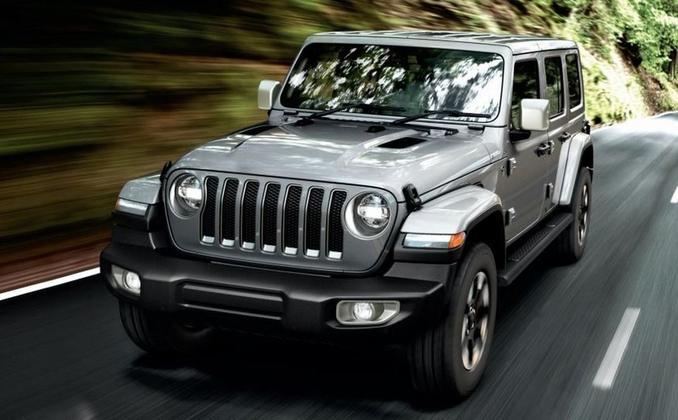
The 2024 Jeep Wrangler range of configurations is currently priced from $65,990.
Carsguide Contributing Journalist Marcus Craft had this to say at the time: The Jeep Wrangler Rubicon is a hardcore purpose-built 4WD with very few concessions to comfort, safety and common sense.
You can read the full review here.
This is what Marcus Craft liked most about this particular version of the Jeep Wrangler: Fun to drive, Very capable off-road, New engine well suited to Rubicon
The 2024 Jeep Wrangler carries a braked towing capacity of up to 2495 Kg, but check to ensure this applies to the configuration you're considering.
The Jeep Wrangler is also known as Jeep YJ, Jeep TJ, Jeep JK, Jeep JL, Jeep J8 (Military version), Jeep Saharam, Jeep Willys (Iceland), Jeep CJ5, Jeep CJ7, Jeep Wrangler Unlimited in markets outside Australia.
Exterior paint colours include 'Bright White' and black (both standard), and optional colours such as 'Silver Zynith', 'Sting Grey', 'Firecracker Red', 'Punk’n' (orange), 'Earl' (blue-ish grey), 'Hydro Blue' and 'High Velocity' (yellow).
The 2.8-litre turbo-diesel engine fitted to the Jeep Wrangler (and some Cherokee models) in the earlier part of this century seems to be a decent proposition in terms of reliability and ability to go the distance. The engine is made in Italy by VM Motori, a diesel engine specialist that was owned by Jeep’s parent company, Fiat Chrysler (as it was then).
A large capacity four-cylinder engine, the basics seem well engineered and inherent problems are uncommon. As such, Jeep Wrangler 2.8 diesel problems are more likely to come from the engine’s ancillaries including the turbocharger unit, intercooler and some of the emissions-control equipment.
Turbochargers have a shelf life in pretty much any vehicle and, depending on how hard a life the vehicle has had, these can require replacement when the bearings begin to wear or the internal components become damaged by carbon deposits.
Intercoolers can fail over time, and the car’s emission controls, which see it consume a proportion of its own exhaust gases as well as its own crankcase fumes, can lead to black, sticky deposits in the intake system which can require manual cleaning.
The engine is also a common-rail design, so injector and fuel-pump life can be shorter than for older, conventional diesel-engine designs.
The key to any engine’s longevity, of course, is its service history. Even the best design will be a source of ongoing grief if a previous owner has not followed the correct servicing regime. A complete service history is an absolute must when buying any second-hand turbo-diesel.
Show more
Without more information like the variant, year etc its hard to say. Often a cheap automotive locksmith will save you money, but sometimes a trip to the dealer will be necessary. You can read more about how to replace your car keys here.
Show more
A Jeep Wrangler Unlimited is rated to tow up to 750kg of unbraked trailer or a theoretical maximum of 2300kg if the trailer has brakes.
Show more
The list of standard features in the Wrangler line-up is extensive, and in the Overland variant includes an 8.4-inch multimedia touchscreen unit, Apple CarPlay and Android Auto, a nine-speaker Alpine Premium audio system (with subwoofer), as well as premium touches like heated steering wheel and front seats, black leather trimmed seats (with ‘Overland’ logo), leather-wrapped gear-shifter knob and parking brake handle and more.
The Wrangler sports 17- or 18-inch alloy wheels depending on the variant you opt for.
The Jeep Wrangler 2024 prices range from $70,400 for the basic trim level SUV Sport S (4X4) to $98,230 for the top of the range SUV Rubicon (4x4).
The Jeep Wrangler line-up has the naturally aspirated 3.6-litre Pentastar V6 petrol engine – producing 209kW at 6400rpm and 347Nm at 4100rpm – and an eight-speed automatic transmission.
Storage volume figures for the five-door Wrangler are 898 litres in the rear cargo space and 2050 litres with the rear seat stowed away.
The three-door Wrangler has 365 litres in the rear cargo area, and 898 litres when the rear seat is folded flat.
Depending on your choice of Jeep Wrangler, there may be four or five seats. Chapear variants have cloth seats; higher-spec Wranglers have leather trim.
All seats are comfortable and supportive without being overly so.
The Jeep Wrangler's interior – whether it's an Overland or Rubicon – is a basic, comfortable and functional space with fabrics, durable surfaces, and soft-touch areas where required.
It's obvious Jeep designers know their stuff when it comes to fitting out a vehicle to cope with a fun, dirty, rough-and-tumble life in the great outdoors.
All dials, knobs and switches are easy to locate and operate while traversing rough terrain.
There's not a lot of storage space, but there are a few small, deep, and textured receptacles – ideal for stopping bits and pieces bouncing around the cabin – as well as solid grab handles.
There are tensioned net pockets on the doors for maps etc.
Rear cargo space is listed as 898 litres; with the rear seat stowed away, there is a claimed 2050 litres of room.
The Jeep Wrangler can accomplish the 0-100km/h sprint in between 7.5 and 7.9 seconds (depending on model).
Top speed is a listed 180km/h.
Official fuel consumption is listed as 9.7L/100km on a combined cycle.
The Wrangler Overland Unlimited has an 81-litre tank so, going by that listed fuel figure, you could reasonably expect a driving range of about 835km from a full tank.