What's the difference?
Honda has refreshed the CR-V, with more than half the line-up now featuring a hybrid powertrain. It’s a clear move to stay competitive against rivals like the Toyota RAV4, Hyundai Tucson and Kia Sportage.
After a week behind the wheel, the question is simple - does this hybrid deliver on the family-friendly practicality the CR-V is known for, while also meeting its efficiency claims?
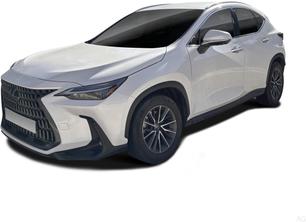
The Lexus NX 450h+ F Sport is a well-specified and plush-looking medium SUV that has a plug-in hybrid powertrain - a first for the brand.
On paper, it seems to tick the boxes for size, luxury and efficiency but we've been testing the flagship grade to see if it's a winning combo in real life.
The Honda CR-V RS hybrid has plenty going for it. It’s a well-rounded package with good levels of comfort and practicality, and a driving experience that’s easy to live with day to day.
There are a few areas that hold it back from leading the segment. The multimedia system feels behind the curve for a flagship grade, and the engine can become vocal under load. Some rivals also edge ahead when it comes to outright equipment.
Even so, the CR-V still delivers where it counts. It’s efficient, spacious and comfortable.
The Lexus NX450h+ F Sport is a gorgeous mid-size SUV that combines great specs and a fairly efficient plug-in hybrid powertrain. It’s a comfortable and easy ride which should appeal to a wide range of driving styles. It also looks good parked at the kerbside of a city street and with it ticking most of the boxes, it may become your new best friend.
The CR-V hasn’t changed much since this generation launched in 2023, but it remains a purposeful-looking SUV for the segment. A slightly longer body and 198mm of ground clearance give it a bit more presence on the road than some of its rivals.
The silhouette is clean and confident, lifted by black 19-inch alloy wheels, matching door handles and a sharply styled honeycomb grille.
Inside, the cabin reflects the RS grade nicely. The embossed leather seats with red contrast stitching add a sporty edge, while the dashboard design feels cohesive and well thought out. The honeycomb air vents tie in nicely with the grille and look modern. There's a satisfying tactility throughout, with plenty of soft-touch materials and clicky buttons. The panoramic sunroof and black headliner also give a subtle sense of sophistication.
As far as flagship grades go, it looks the part.
The NX simple looks like a scaled-down version of its larger RX cousin, so if you like that you’ll like what the NX.
It looks sweeter, though, with its smaller proportions being only 4660mm long and 1670mm high but there’s enough sharp pleating in the panelling and rear LED lights to give it a sporty edge. It’s a design that should appeal to a wide range of people.
The interior helps the NX compete against some of its flashier rivals, but the BMW X3's interior beats it hands down with the wow factor. Still, the dual-toned leather upholstery and fabrics of our test model scream understated luxury.
The perforated leather of the seats is supple underhand, but even the robust synthetic leather on the backs of the seats and some door panelling feels like the real stuff most of the time.
The dashboard components – like the air vents, displays and accents – are well integrated and seem well-built. The cockpit is intimate and plush overall, and it always reminds you that you're in the cabin of a luxury vehicle.
Up front, there’s plenty of space and the seats are comfortable over longer drives, helped by the extra adjustment and functions on offer. The seat bases are on the shorter side though, so I would have liked to see extendable under-thigh support for added comfort.
Storage is well thought out, making it easy to keep things tidy. There’s a deep centre console, two cupholders and decent door bins, along with a large tray that houses the wireless charging pad and two USB-C ports.
In the back, legroom is generous and the seats themselves are comfortable, especially with the heat function on the outboard seats. The transmission tunnel is also not too high for middle seaters. Headroom is a touch tighter, due to the panoramic sunroof, but it’s not a dealbreaker. The wide-opening rear doors also make access easy.
Features in the backseat are a little more modest than expected for a flagship. You get directional air vents and a couple of USB-C ports, but miss out on extras like separate climate controls and device pockets. There are two ISOFIX points and three top-tether anchors, though realistically two child seats will fit best.
Around the back, the 581L boot capacity means it easily handled luggage for four adults along with a weekend shop. This grade also includes a powered tailgate, though it makes do with a tyre repair kit rather than a spare, which won't suit everyone.
From the driver’s seat, the tech experience is a bit of a mixed bag. The multimedia system feels dated, both in size and graphics, and some settings can be fiddly to locate and adjust, including the head-up display. Wireless Apple CarPlay is a welcome inclusion, though it did take a few attempts to connect initially. Once paired, it’s been reliable.
On the plus side, Honda has kept physical buttons and dials for key functions, which makes a big difference to everyday usability. Very little is buried in menus, and it all feels intuitive to operate on the move.
The cabin of the NX is spacious where it needs to be for four adults to be comfortable on a longer journey, and features enough equipment to satisfy most.
Access is best at the front because of the wider door apertures and while still easy enough to get in and out of from the back, the rear wheel arch cuts into the aperture a bit.
The front seats are very comfortable with thick padding, tall side bolsters that lock you into place in a turn as well as heating and cooling functions.
The back seats are almost as comfortable as the front! However, the outboard seats offer the best under-thigh support. It is a shame that they miss out on heat functions for its grade level, though.
Storage is fairly good for the class, with lots of small item cubbies up front like a sunglasses holder, a mini drawer next to the drivers' knee and a dedicated phone holder and two cupholders. The large glove box (that can hold more than just a manual) and mid-size middle console shoulder most of the storage burden, though.
In the back you get a couple of map pockets, small storage bins and two cupholders. which is most than enough for this size of SUV.
The boot offers an impressive 520L of capacity and a level loading space makes it an easy car to slide larger gear in and out of. The little storage compartment under the floor is handy for charging cables and the hands-free powered tailgate is always handy to have.
The technology is a nice mix of easy-to-use and high-end with a responsive touchscreen on the 14-inch multimedia display. The system has built-in sat nav, wireless Apple CarPlay and Android Auto. The CarPlay was simple to set up and has maintained a steady connection with my iPhone this week.
Charging options are decent with two USB-C ports and a 12-volt socket per row, as well as a wireless charging pad up front.
There are six grades in the CR-V range, split across petrol and hybrid powertrains. We’re testing the flagship e:HEV RS hybrid here, priced from $64,400 drive-away. That puts it toward the upper end of the segment. The Hyundai Tucson Hybrid Premium undercuts it at $58,350, while the Toyota RAV4 Cruiser Hybrid AWD sits at $60,340 and Kia Sportage GT-Line Hybrid is $60,370.
However, Honda's pricing is drive-away and includes on-road costs, whereas those rivals do not. When you consider that, the pricing isn't that much different.
For the money, the RS presents as well-specified and you'll enjoy a panoramic sunroof, heated and ventilated electric front seats, heated outer rear seats, leather upholstery and a heated steering wheel. It covers the comfort brief without issue.
Where it loses a tiny bit of ground is in the tech. There’s a strong base with a 12-speaker Bose sound system, wireless Apple CarPlay and Android Auto, built-in satellite navigation and a head-up display. But the 9.0-inch touchscreen feels undersized for a flagship in this segment, especially when rivals have moved to 12.3-inch (and above) displays as standard.
Practical touches are solid, with dual-zone climate control, four USB-C ports and a powered tailgate. However, the hybrid's switch to a tyre repair kit instead of a temporary spare is another area where competitors have the edge.
While the CR-V RS hybrid ticks plenty of boxes on paper, it doesn’t quite match the breadth of equipment offered elsewhere, though it remains competitive overall for the segment.
With a price hike of almost $6K, our flagship NX sits at $95,900 before on-road costs, but it's still slightly more affordable than its top-grade plug-in hybrid rivals.
The Volvo XC60 Ultra is priced from $101,390 and the outgoing BMW X3 xDrive30e sits at $102,500.
In the flagship variant, the standard features list is well-rounded to include both practical and luxury equipment. There are electric front seats with heating and cooling, an F Sport steering wheel with heating and touch controls, a sunroof, rear privacy glass, and a power-adjustable steering column.
Other items include a powered tailgate with a kick-to-open function, dual-zone climate control with a humidity sensor, parking assist, keyless entry/start, a digital key, Lexus Connected services app, a digital rearview mirror and 20-inch alloy wheels.
The technology looks gorgeous with the 14-inch touchscreen multimedia display taking centre stage with built-in satellite navigation, Bluetooth and wireless Apple CarPlay and Android Auto.
You also get a 10-speaker Lexus premium sound system, which has AM/FM radio, MP3 and WMA (Windows Media Audio) compatibility. There are four USB-C ports (2/2), a 12-volt socket and a wireless charging pad.
So while our test model misses out on some of the items you might expect to see for a top-model grade – like three-zone climate control and heated rear outboard seats – it still feels well-specified.
The CR-V RS hybrid is all-wheel drive and pairs a 2.0-litre four-cylinder Atkinson-cycle engine with two electric motors, delivering up to 135kW and 355Nm. Both figures are a bit lower than its Kia and Hyundai rivals, which both produce up to 173kW/367Nm, but for the most part, there’s enough punch for both city driving and longer highway runs.
The electronic continuously variable transmission (e-CVT) can get a bit vocal under load though, particularly on hills where it tends to hold higher revs.
The NX450h+ F Sport is the first attempt at a plug-in hybrid powertrain for Lexus. It pairs a 2.5-litre four-cylinder petrol engine with two electric motors, one located at each end of the car for all-wheel drive. Together they produce up to 227kW of power, but Lexus doesn’t quote the combined torque figure (cheeky).
The flagship model can do a 0-100km/h sprint in 6.3 seconds and features a smooth continuously variable transmission.
Overall, it moves quickly and the shift between the electric and engine components is barely noticeable.
The CR-V hybrid has a claimed combined fuel consumption of 5.7L/100km. Paired with a 57-litre fuel tank, that gives it a theoretical driving range of around 1000km, which is strong for a mid-size SUV.
In the real world, I saw 6.7L/100km over the week. That’s still a solid result, especially considering how much highway driving was involved, where hybrids typically aren’t at their most efficient.
The flagship NX has a smallish 18.1kWh lithium-ion battery and a Type 2 charging port but no CCS enhancement, which means you can’t hook it up to a fast DC charger.
On a standard AC 240-volt domestic plug port, you can charge this from 0-100% in around 7hrs 30mins. You get a great electric-only NEDC-rated driving range of up to 87km and that means you really only have to charge it every other day, which I appreciated.
The official combined fuel cycle usage is 1.3L/100km, but you won’t really see that in the real world. After doing some longer trips mixed in with city slicking, my average real-world usage popped out at 6.5L/100km, and I averaged 20.2kWh/100km when in pure EV mode. They’re not the best hybrid figures I’ve seen for the class, but they're not too bad either.
On the road, the RS hybrid has enough power to keep things moving, even on winding hills, though you do need to lean into the throttle to get the most out of it. The engine can sound quite strained under load, but it’s more noise than anything, with performance still holding up.
Through corners, it feels more dynamic than you might expect. The suspension and steering lean firm and responsive, which makes it a capable tourer. That said, road noise does creep into the cabin, particularly on longer drives, and takes a bit of the shine off.
To maximise energy recovery, you can switch from Drive to B mode to increase regenerative braking. It’s especially useful in stop-start traffic or on hilly roads, though it does mean you can’t use cruise control in this setting.
Around town, visibility and parking are made easier with a 360-degree camera. The image is clear, although the slight fish-eye effect takes a little getting used to. Once you’re familiar with it, though, it’s a straightforward car to manoeuvre.
This NX feels like it has lots of power in reserve when you put your foot down and never struggles going up big hills. When it’s in pure EV mode, it’s very quiet but there’s no big fanfare when this kicks over to the traditional engine. You barely notice it until you’re on the open road travelling at higher speeds, and that’s when the engine starts to sound more growly like its non-hybrid siblings.
The steering is forgiving without feeling too light and around town, the NX is nimble and sure of itself. The suspension is on the firmer side, so you’ll hear and feel the bigger bumps, but it never feels rough.
Visibility is decent with the largish windows, and the pillars that aren’t too wide from my driving position. I do like having the digital rearview mirror, though, because when you have a big car seat or tall adult in the back seat, the vision back there is hindered.
It’s pretty hard to find a modern car that’s terrible to park, especially in the mid-size SUV segment, and the NX is no different. Even in a small car space, you still have good clearance around you, which hopefully translates to less dings from neighbouring cars!
The 360-degree view camera system is top notch with its quality, and I like that the car disappears and you can see the ground underneath.
The CR-V holds a four-star ANCAP safety rating from testing conducted in 2023. While that’s not class-leading, it’s backed by a solid list of safety equipment.
There are 10 airbags in total, including side chest airbags for both rows, which is a nice inclusion given many rivals reserve these for the front seats only. You do miss out on features like emergency call functionality and side exit assist, though.
The broader safety suite includes blind-spot monitoring, lane keeping aid, lane departure warning, traffic sign recognition, rear cross-traffic alert, a driver attention monitor and tyre pressure monitoring.
On the road, most of these systems operate unobtrusively. The adaptive cruise control can be a little slow to respond when accelerating, but otherwise it doesn’t interfere with everyday driving.
For families, there are two ISOFIX points and three top-tether anchor points in the rear. The RS also includes a forward collision warning and autonomous emergency braking, which operates between 5.0 and 195km/h and can detect cars, pedestrians and cyclists.
The NX comes with a maximum five-star ANCAP safety rating from testing done in 2022 and scored very highly across its individual assessment scores; 91 per cent for adult protection, 89 per cent for child protection, 83 per cent for vulnerable road user, and 92 per cent for its safety assist systems.
Eight airbags are standard which includes a front centre airbag and driver's knee airbag.
Other safety equipment includes emergency steering assist, blind-spot monitoring, lane departure alert, lane-keeping aid, emergency lane keeping, traffic sign recognition, safe exit assist, rear cross-traffic alert, LED daytime running lights, LED cornering lights, tyre pressure monitoring, and an emergency call button.
The only safety item which can feel intrusive when driving is the adaptive cruise control as it has a feature that scans for bends in the road and will slow the car down in anticipation of them. On paper, this isn’t a bad thing but in practice, it was sporadic when it activated and sometimes slowed the car dramatically on bends you wouldn’t even call bends!
AEB with car, pedestrian, cyclist, motorcyclist, backover and intersection turning assist is standard and operates from 5.0 - 80km/h (up to 180km/h for car detection).
There are two ISOFIX child seat mounts and three top-tether anchor points in the rear row. The seat isn't wide enough to accommodate three child seats side by side, so two will fit best.
The CR-V is covered by Honda’s five-year, unlimited kilometre warranty, which is below average now for the segment. However, it can be extended by a further three years if you service exclusively through Honda.
Ownership costs are where it stands out positively. You get five years of complimentary roadside assistance, along with a capped-price servicing program where visits are just $199 each. That’s one of the more affordable offerings in this class. For context, the Toyota RAV4 comes in at $325 per service over the same period, followed by $458 for the Hyundai Tucson and $583 for the Kia Sportage.
Service intervals are set at every 12 months or 10,000km, whichever comes first.
The NX is offered with a five-year/unlimited-kilometre warranty, which is on par with its European rivals.
It comes with a five-year capped price servicing program, where services are competitively priced at $595 each.
Servicing intervals are reasonable at every 12 months or 15,000km, whichever occurs first.