What's the difference?
Honda has refreshed the CR-V, with more than half the line-up now featuring a hybrid powertrain. It’s a clear move to stay competitive against rivals like the Toyota RAV4, Hyundai Tucson and Kia Sportage.
After a week behind the wheel, the question is simple - does this hybrid deliver on the family-friendly practicality the CR-V is known for, while also meeting its efficiency claims?
You’re not alone if you’re struggling to grasp the sheer number of new names from China popping up in the Australian new-car market. There’s more than ten and the list is only growing.
Geely is yet another marque with an ambitious plan to break into Australia's top-10 auto brands. It might have a leg-up on rivals, though, because Geely has been dabbling in international marques for some time.
Volvo, Polestar, Lotus and Zeekr are either majority or entirely owned by Geely, and the father brand — like Volkswagen in its eponymous group — therefore benefits from years of engineering know-how from other brands. Clever.
The first car launching here Australia is the EX5, an electric mid-size SUV pitched at families. Think of it as a direct rival to the Tesla Model Y, Kia EV5 and XPeng G6 but (yet unconfirmed) sharp pricing might see buyers cross-shopping with Toyota RAV4s and Mazda CX-5s.
Geely even proclaims Australian-tuned suspension, something Ford, Toyota, Hyundai and Kia have used to huge success. But does that mean the 2025 Geely EX5 is top-10 material? A spin in an early production model should give us some answers.
The Honda CR-V RS hybrid has plenty going for it. It’s a well-rounded package with good levels of comfort and practicality, and a driving experience that’s easy to live with day to day.
There are a few areas that hold it back from leading the segment. The multimedia system feels behind the curve for a flagship grade, and the engine can become vocal under load. Some rivals also edge ahead when it comes to outright equipment.
Even so, the CR-V still delivers where it counts. It’s efficient, spacious and comfortable.
The Geely EX5 has good bones. It’s well packaged, sturdily built, efficient and jam-packed with technology. But questions remain. The EX5 really needs work on its safety systems and another round of chassis revisions to be competitive.
Pricing, too, will be crucial for the EX5 to succeed in today’s savage new electric car market.
If the list of nagging complaints can be fixed and Geely is able to back up its product with solid aftersales support, it could be a winner. The jury is still out on the EX5.
Note: CarsGuide attended this event as a guest of the manufacturer, with meals provided.
The CR-V hasn’t changed much since this generation launched in 2023, but it remains a purposeful-looking SUV for the segment. A slightly longer body and 198mm of ground clearance give it a bit more presence on the road than some of its rivals.
The silhouette is clean and confident, lifted by black 19-inch alloy wheels, matching door handles and a sharply styled honeycomb grille.
Inside, the cabin reflects the RS grade nicely. The embossed leather seats with red contrast stitching add a sporty edge, while the dashboard design feels cohesive and well thought out. The honeycomb air vents tie in nicely with the grille and look modern. There's a satisfying tactility throughout, with plenty of soft-touch materials and clicky buttons. The panoramic sunroof and black headliner also give a subtle sense of sophistication.
As far as flagship grades go, it looks the part.
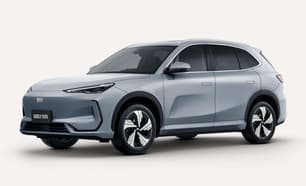
The Geely EX5’s exterior design is conservative verging on anonymous. Perhaps that’s because the brand is unknown here, but forgettable details like the six-rectangle badge rear and haphazard ‘Geely EX5’ badge placement aren’t the height of fashion.
Inside, though, the EX5 improves. The two screens are presented well, as is the cabin with upholstery that isn’t just boring black. The design language is more conventional — in a good way — than, say, a BYD Atto 3 or Tesla Model Y and doesn’t seem to unashamedly copy elements from established carmakers.
Key touch points, such as the rotary volume control, the (wrong way around) window switches and door handles appear to be made of real metal, with knurling in some cases. The dash and door tops are all encased in squishy rubber, too.
As for sizing, the EX5 is the exact same length as a Toyota RAV4, at 4615mm long, though being wider (1901mm) and riding on a longer 2750mm wheelbase should mean more cabin space.
Up front, there’s plenty of space and the seats are comfortable over longer drives, helped by the extra adjustment and functions on offer. The seat bases are on the shorter side though, so I would have liked to see extendable under-thigh support for added comfort.
Storage is well thought out, making it easy to keep things tidy. There’s a deep centre console, two cupholders and decent door bins, along with a large tray that houses the wireless charging pad and two USB-C ports.
In the back, legroom is generous and the seats themselves are comfortable, especially with the heat function on the outboard seats. The transmission tunnel is also not too high for middle seaters. Headroom is a touch tighter, due to the panoramic sunroof, but it’s not a dealbreaker. The wide-opening rear doors also make access easy.
Features in the backseat are a little more modest than expected for a flagship. You get directional air vents and a couple of USB-C ports, but miss out on extras like separate climate controls and device pockets. There are two ISOFIX points and three top-tether anchors, though realistically two child seats will fit best.
Around the back, the 581L boot capacity means it easily handled luggage for four adults along with a weekend shop. This grade also includes a powered tailgate, though it makes do with a tyre repair kit rather than a spare, which won't suit everyone.
From the driver’s seat, the tech experience is a bit of a mixed bag. The multimedia system feels dated, both in size and graphics, and some settings can be fiddly to locate and adjust, including the head-up display. Wireless Apple CarPlay is a welcome inclusion, though it did take a few attempts to connect initially. Once paired, it’s been reliable.
On the plus side, Honda has kept physical buttons and dials for key functions, which makes a big difference to everyday usability. Very little is buried in menus, and it all feels intuitive to operate on the move.
Finding a comfortable driving position is easy in the EX5 Inspire with the octagonal steering wheel tilting and telescoping through a broad range of motion. The seats are supportive and well-bolstered, too — not a given in this class.
While we wish the front passenger seat was height adjustable, the Inspire’s leg rest and ability to lie the seats fully flat while charging is appreciated. The massage function has six modes, three intensity levels and is remarkably powerful.
Between the EX5’s front seats is a floating centre console as gear selection is done via the right-hand stalk. It has two small cup holders on top, while under that is a generous, rubberised storage space perfect for handbags, cameras, or the like. It’s where the USB-A, USB-C and 12-volt socket are located for device charging.
There is a wireless charging pad that sits ahead of a large central storage box cooled by the air-conditioning. The Geely EX5’s door cards will easily accept a 600mL camping bottle.
Where the Geely EX5 falls down is the control layout. It is nice to have four physical switches beneath the touchscreen as shortcuts to switch the air-conditioning on or off, engage air recirculation and the front demister, but where’s the hazard light switch? It's on the ceiling.
Then there’s the large rotary dial which generally functions as a volume knob. Press it down and you can choose to have it adjust the temperature, fan speed, or — for some reason — one of several desktop backgrounds, including a computer-generated kitten playing with some wool. In this mode it also works as cursor for the multimedia screen, but never at any other time. Peculiar.
The convoluted menu structure has a strange control hierarchy. There's a shortcut target for the rear fog light, for example, yet to disable the lane-keep assist or adjust the regenerative braking power you need to jump through at least three sub-menus. And some of the text in the Geely EX5’s digital driver’s display is so small it’s almost illegible.
Then there are the typos and grammatical errors that should have been an easy pre-launch fix. A few include: ‘Distractive. Drive carefully’, ‘Keep safety distance’, ‘Driver is facial detection is missing’ and, a personal favourite: ‘The current battery is low, whether to enable super battery life?’ None of this inspires much confidence. At least the EX5’s processor is responsive for smooth tapping between the many menus.
The Geely EX5’s 1000-watt 16-speaker sound system is punchy and has presets – borrowed from Volvo and Polestar — which promise to emulate the sound quality of a recording studio, concert hall and other locations. Gimmicky in practice, plus, with the volume over 30 per cent, the EX5’s sound quality is disappointingly muddy.
Connectivity promises to be strong in the EX5 but the cars we drove were not fitted with 4G sims for live navigation, app downloads and remote smartphone control. Apple CarPlay will be added via a software update in July and Android Auto before the end of the year, says Geely.
The Geely EX5’s back seat is very generous, at 188cm tall I had plenty of leg room, respectable toe room and excellent head room even underneath the standard panoramic sunroof. The floor is totally flat and, rarely, the middle seat is usable for adults.
Two more USB chargers can be found along with air vents, door pockets and a fold-down central armrest. There’s even a hidden sliding draw for storing valuables out of sight.
The Geely EX5 has ISOFIX child seat connectors on both outboard seats and three top tether anchors on its 40/60 split-fold backrest.
The EX5 Inspire has a standard power tailgate which opens up to a total of 410 litres of boot space. If it looks a little shallow in pictures, that’s because the total space accounts for the large under-floor area (108L on its own) where Geely skipped a spare tyre.
There is one LED boot light, two shopping bag hooks and a wet storage area off to the side but, curiously, no parcel shelf.
There are six grades in the CR-V range, split across petrol and hybrid powertrains. We’re testing the flagship e:HEV RS hybrid here, priced from $64,400 drive-away. That puts it toward the upper end of the segment. The Hyundai Tucson Hybrid Premium undercuts it at $58,350, while the Toyota RAV4 Cruiser Hybrid AWD sits at $60,340 and Kia Sportage GT-Line Hybrid is $60,370.
However, Honda's pricing is drive-away and includes on-road costs, whereas those rivals do not. When you consider that, the pricing isn't that much different.
For the money, the RS presents as well-specified and you'll enjoy a panoramic sunroof, heated and ventilated electric front seats, heated outer rear seats, leather upholstery and a heated steering wheel. It covers the comfort brief without issue.
Where it loses a tiny bit of ground is in the tech. There’s a strong base with a 12-speaker Bose sound system, wireless Apple CarPlay and Android Auto, built-in satellite navigation and a head-up display. But the 9.0-inch touchscreen feels undersized for a flagship in this segment, especially when rivals have moved to 12.3-inch (and above) displays as standard.
Practical touches are solid, with dual-zone climate control, four USB-C ports and a powered tailgate. However, the hybrid's switch to a tyre repair kit instead of a temporary spare is another area where competitors have the edge.
While the CR-V RS hybrid ticks plenty of boxes on paper, it doesn’t quite match the breadth of equipment offered elsewhere, though it remains competitive overall for the segment.
The EX5 joins a new Chinese competitor set that’s bringing electric car prices down to — and below — size-equivalent combustion and hybrid-powered cars.
Problem is, we still don’t know the exact price, but Geely has at least provided a guide. The Geely EX5 will be priced between $49,000 and $55,000. It has either 430km (Complete) or 410km (Inspire) WLTP-rated driving range and enough power to get out of its own way.
When you consider high-spec combustion-engined mid-size SUVs like the Toyota RAV4 Cruiser ($51,410, before on-road costs), the Geely EX5 is shaping up to offer stellar on-paper value.
The entry grade EX5 Complete features 18-inch alloy wheels, privacy glass, full LED exterior lighting with auto high-beam, rear parking sensors and roof rails that accommodate up to 50kg.
Inside, a huge 15.4-inch touchscreen with built-in navigation and 10.2-inch digital driver’s display should embarrass any combustion-engined rival. The upholstery is artificial leather, the front seats are heated and power-adjustable, the sound system has six speakers and there’s keyless entry with pop-out door handles.
Moving up to the tested Inspire brings larger 19-inch alloy wheels, a power tailgate, front parking sensors and a sunroof. Cabin niceties improve with illuminated vanity mirrors and 256-colour ambient lighting, though it notably lacks dual-zone climate control.
Veritable luxury features include driver’s seat memory and an ottoman for the front passenger, ventilation and massaging for both front seats, a 16-speaker sound system putting out 1000 watts, 13.4-inch head-up display and optional ‘Cloud’ cream upholstery colour.
With exact pricing still to be revealed, it’s impossible to say whether the Geely EX5 is better value than the Leapmotor C10, Deepal S07, Kia EV5, BYD Sealion 7 or XPeng G6, but it certainly shapes up well against the updated Tesla Model Y that has climbed north of $60,000.
Five paint colours are available; Arctic White is no cost, while Shadow Black, Volcanic Grey, Moonlit Silver and Aquatic Green attract an extra charge.
The Geely EX5 is capable of outputting electricity either to a load like hairdryer, coffee machine or power tools at 3.3kW and to another vehicle at 6kWm adding 40km of driving range in an hour.
The CR-V RS hybrid is all-wheel drive and pairs a 2.0-litre four-cylinder Atkinson-cycle engine with two electric motors, delivering up to 135kW and 355Nm. Both figures are a bit lower than its Kia and Hyundai rivals, which both produce up to 173kW/367Nm, but for the most part, there’s enough punch for both city driving and longer highway runs.
The electronic continuously variable transmission (e-CVT) can get a bit vocal under load though, particularly on hills where it tends to hold higher revs.
Geely claims the EX5’s front axle-mounted 11-in-one motor, transmission and power unit is the lightest and most compact in class. Though power and torque outputs of 160kW and 320Nm are nothing groundbreaking it was perfectly adequate for the EX5’s 1765kg tare mass.
In Eco, Standard and Sport modes the tip-in response is intentionally dulled to minimise wheel spin. Three are three regenerative braking levels; medium felt most natural, though High was acceptable. There’s no one-pedal drive mode in the Geely EX5.
The front-drive Geely EX5 Inspire's claimed 0-100km/h time is 7.1 seconds and its top speed is limited to 175km/h.
The CR-V hybrid has a claimed combined fuel consumption of 5.7L/100km. Paired with a 57-litre fuel tank, that gives it a theoretical driving range of around 1000km, which is strong for a mid-size SUV.
In the real world, I saw 6.7L/100km over the week. That’s still a solid result, especially considering how much highway driving was involved, where hybrids typically aren’t at their most efficient.
Real-world efficiency is one of the EX5’s most impressive attributes, with the Inspire’s WLTP-range being 410km dependent on returning energy consumption of 14.7kWh/100km.
Over a 100km distance taking in suburban, motorway and country roads, the EX5’s dash showed a lower-than-rated energy consumption of 13.5kWh/100km, representing nearly 460km of real-world range from Geely’s 60.22kWh ‘Aegis’ lithium-iron phosphate (LFP) battery pack.
Along with the motor, some of the efficiency can be put down to the Geely EX5 Inspire’s quality 235/50R19 Goodyear EfficientGrip tyres.
Charging is middling for this pack, with the EX5 using a 400-volt architecture that allows DC power up to 100kW. Rejuicing from 20-80 per cent takes 28 minutes, says Geely, which is faster than the Deepal S07 and Leapmotor C10 but a long way short of the XPeng G6 and Model Y.
Three-phase AC charging caps out at 11kW, meaning you can take the EX5 from flat to full in around five and a half hours at home.
On the road, the RS hybrid has enough power to keep things moving, even on winding hills, though you do need to lean into the throttle to get the most out of it. The engine can sound quite strained under load, but it’s more noise than anything, with performance still holding up.
Through corners, it feels more dynamic than you might expect. The suspension and steering lean firm and responsive, which makes it a capable tourer. That said, road noise does creep into the cabin, particularly on longer drives, and takes a bit of the shine off.
To maximise energy recovery, you can switch from Drive to B mode to increase regenerative braking. It’s especially useful in stop-start traffic or on hilly roads, though it does mean you can’t use cruise control in this setting.
Around town, visibility and parking are made easier with a 360-degree camera. The image is clear, although the slight fish-eye effect takes a little getting used to. Once you’re familiar with it, though, it’s a straightforward car to manoeuvre.
Underpinning the Geely EX5 is the new Global Intelligent Electric Architecture, or GEA for short. It is a newer and lower-cost version of the group’s SEA platform as used in Volvo, Polestar, Zeekr and Smart products and the bones are good.
The Geely EX5’s body doesn’t rattle, creak or shimmy over nasty road surfaces. Some solid knowhow has made its way into the brake pedal calibration which is light but delightfully smooth. It’s impossible to detect where regenerative slowing ends and hydraulic begins.
It has allegedly undergone Australian suspension localisation but don’t expect outright handling excellence, the EX5’s ride is still pillowy — verging on melted marshmallow — soft. Some will find this acceptable, however there’s plenty of potential for improvement.
Over large bumps both in town and at speed it takes the Geely EX5’s rear end between two and four rebound cycles to settle. There’s also a large amount of lateral ‘head toss’, with both attributes key ingredients in making back seat passengers car sick.
I also experienced a low-frequency boom in the EX5's cabin over concrete and rough coarse chip surfaces common on Sydney roads. Otherwise, the EX5’s is a mostly quiet car.
The sharp steering is light around town but weighted up unnaturally through corners. With high quality tyres and stability control that intervenes very early, you’re unlikely to get out of shape in the EX5 on a twisty road at least.
That said, with good bones like McPherson struts up front and multi-link rear suspension we would love to see Geely revise the EX5’s chassis to bestow the sort of fluency that makes the Kia EV5 and combustion equivalents like the Toyota RAV4 and Mazda CX-5 so much more pleasant to drive. Doing so would provide the EX5 a clear point of difference from the XPeng G6, BYD Sealion 7, Deepal S07 and Leapmotor C10.
The CR-V holds a four-star ANCAP safety rating from testing conducted in 2023. While that’s not class-leading, it’s backed by a solid list of safety equipment.
There are 10 airbags in total, including side chest airbags for both rows, which is a nice inclusion given many rivals reserve these for the front seats only. You do miss out on features like emergency call functionality and side exit assist, though.
The broader safety suite includes blind-spot monitoring, lane keeping aid, lane departure warning, traffic sign recognition, rear cross-traffic alert, a driver attention monitor and tyre pressure monitoring.
On the road, most of these systems operate unobtrusively. The adaptive cruise control can be a little slow to respond when accelerating, but otherwise it doesn’t interfere with everyday driving.
For families, there are two ISOFIX points and three top-tether anchor points in the rear. The RS also includes a forward collision warning and autonomous emergency braking, which operates between 5.0 and 195km/h and can detect cars, pedestrians and cyclists.
The Geely EX5 is yet to be tested by ANCAP or other relevant safety testing body.
The EX5 has seven airbags including a front centre one, a Short Blade battery that has been extensively tested to minimise fire danger along with 16 advanced driver assistance features including auto emergency braking, driver attention monitoring, blind-spot monitoring, lane-keep assist and more.
It is all well and good to tick the safety aid boxes but in practice, the EX5 leaves a little to be desired. Various mysterious beeps and bongs are semi-constant but more soothing than some rivals.
The EX5’s lane-keep assist worked well enough in the morning but was flummoxed by brighter afternoon light and shadows, once grabbing control of the wheel and pointing the car at an upcoming vehicle, another time towards the grass. Sometimes the system simply didn’t work to keep the EX5 in the lane at all.
The adaptive cruise control has an ‘Intelligent’ program that convincingly changes lanes by itself when prompted by the indicator. Unfortunately, like the lane-keep system, shadows on the road caused a few phantom-braking episodes.
Activating the adaptive cruise control is not intuitive because the steering wheel controls are poorly labeled. It’s the left directional and ‘ok’ button set, if you’re wondering, and you cancel cruise by hitting the cross button below the similar looking asterisk customisable hot key.
The standard surround-view camera is high quality with plenty of different angles to minimise kerb strikes.
Like the suspension tuning, Geely ought to send out engineers with a fine tooth comb to iron out issues with the safety systems before hitting start on public sales.
The CR-V is covered by Honda’s five-year, unlimited kilometre warranty, which is below average now for the segment. However, it can be extended by a further three years if you service exclusively through Honda.
Ownership costs are where it stands out positively. You get five years of complimentary roadside assistance, along with a capped-price servicing program where visits are just $199 each. That’s one of the more affordable offerings in this class. For context, the Toyota RAV4 comes in at $325 per service over the same period, followed by $458 for the Hyundai Tucson and $583 for the Kia Sportage.
Service intervals are set at every 12 months or 10,000km, whichever comes first.
Geely is doing its best to ensure smooth parts supply from launch, having run around for 12 months stocking inventory and partnering with DB Schenker for logistics.
To promote the EX5, Geely’s launching with three years complimentary servicing and one year (or 1000kWh) of free charging on the Evie network for those who order an EX5 before February 28.
Geely has yet to announce warranty details. The brand will want to aim for more than five years, as seven years is fast becoming the minimum standard for new vehicles.
Service pricing is also yet to be confirmed, though maintenance will be due every 12 months or 20,000km.