What's the difference?
Ford has introduced what is being touted as an adventure-type van to its Transit Custom line-up and it’s called the Trail.
The Trail is based on the long-wheelbase Transit Custom Trend and it’s equipped with a suspension lift, on-demand all-wheel drive, 'Trail' drive mode, LED headlights and daytime running lights, a variant-specific grille, black wheel arch moulding and side strip, yellow exterior decals and 16-inch matt black twin-spoke alloy wheels.
With all that in mind, maybe a van is your next adventure vehicle?
Read on.
The current generation Mahindra PikUp has been with us since 2007, which is a long time given major players in this market tend to introduce a new generation every decade, or close to it.
However, with Mahindra reportedly developing an all-new ute, based on the underpinnings of its latest Scorpio SUV, the budget-priced PikUp is destined for retirement within a few years.
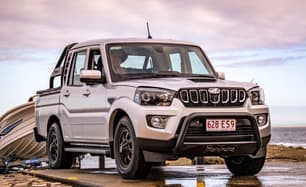
Better late than never, the latest MY23 version of the S11 dual-cab has for the first time been equipped with an automatic, which is sure to increase buyer appeal in a market in which self-shifting transmissions rule.
We recently revisited this Indian-built dual cab to see how it measures up for tradies in such a competitive market.
The Ford Transit Custom Trail has plenty of appeal as a work van or a camper fit-out candidate. It’s a well-packaged, comfortable and contemporary van that’s nice to drive and as a bonus, with all-wheel drive it’s given the scope of capability to be able to tackle mild off-roading situations with confidence.
It’s built for work and play and though it’s limited to two-up for travels, the Trail offers so much potential as a camper conversion for adventure seekers its few niggles are easily forgotten when you’re busy making memories.
Its sub-$40K pricing undercuts the cheapest Ford Ranger or Toyota HiLux 4x4 equivalents by $10-15K and it’s backed by a decent warranty and 60-strong dealer network (mostly regional). It’s also largely absent from the federal government’s vehicle-recall listings, which suggests solid build quality.
However, it’s also short on safety, has relatively high servicing costs and numerous design quirks. Fact is, such low pricing comes with compromises, so, if you can learn to live with those, this sturdy and willing auto-equipped workhorse could represent good value for those shopping on a budget.
It looks like a van but with some striking yet low-key flourishes that all kind of work as a whole. Those include a Trail grille and the matt black alloy wheels. The yellow sticker-pack is a neat touch.
The Trail has more presence than a regular Trend with its 30mm-taller raised suspension and overall adventure-ready look with strong front end and chunky wheel arches.
The striking but low-key theme continues inside with a neatly laid-out yet spartan cabin. The two synthetic leather seats are topped with Trail embossing and lined with yellow stitching.
The cabin is separated from the rear cargo area by a bulkhead, which incorporates a small wired window.
The PikUp has a 3040mm wheelbase and 5175mm length, 1820mm width and 1915mm height.
So, compared to a Ford Ranger XL equivalent, it’s 230mm shorter in wheelbase, 195mm shorter overall and 98mm narrower, so it’s relatively compact for a dual cab ute.
Built on a traditional ladder-frame chassis, its twin-wishbone front suspension uses torsion bars instead of the more common coil springs, while under the tail is a leaf-spring live rear axle. Brakes are front discs and rear drums.
With 210mm of ground clearance, its steep 34-degree approach angle is excellent but its 15-degree departure angle is less than half that figure, so it's prone to tail-dragging in the rough stuff.
And its bafflingly large 13.4-metre turning circle (kerb-to-kerb) demands numerous three-point turns.
The interior appears to have a good standard of finish and provides a visually-pleasing mix of black and grey surfaces with satin chrome highlights throughout. Driver controls are easy to see and operate and the front bucket seats are comfortable.
The rear bench seat is quite firm with good lumbar support, but it’s a squeeze for three adults given its relatively narrow width.
Even so, there’s adequate kneeroom and heaps of headroom even for tall adults, which is no doubt appreciated by hat-wearing farmers and tradies.
It’s a van so there are two distinct sections to the Trail, the cabin and the load space.
Firstly, the cabin. More a work-friendly than family-friendly interior, this Trail is a two-seater with plenty of durable plastic everywhere – ready for work and life – as well as charging (with USB-A and -C ports) and storage (including a van-favourite dash-top slot for logbooks etc, outboard moulded cupholders and a nifty pop-out cupholder), all amenities enough to cope with most daily van-related duties.
The seats are comfortable, supportive and have a fold-down lock-in-place armrest.
Now for the load space. There are no seats back there and as such it has plenty of potential as a work van or touring vehicle.
Access to the rear load space is via a barn door at the back and this Trail has a sliding door on both sides.
The cargo area is substantial – 3002mm long (to the bulkhead; 3450mm long if load-through hatch is used), 1392mm wide (between wheel arches) and 1425mm high (floor to roof). Easily big enough for work equipment or recreational gear. It can cope with four Euro pallets (each measuring 1200mm x 800mm) and it has a listed maximum load volume (with the bulkhead) of 6.8 cubic metres.
Load height through the rear barn doors is 531-585mm, depending on how much weight is already onboard.
The load space has the aforementioned metal bulkhead (with window and load-through hatch), load area protection kit (full height walls and moulded floor), LED lights and eight tie-down loops.
Otherwise, this is a load area ripe for customisation. Maybe a plethora of shelves for a tradie, or some bedding and extra storage for an adventurous person or couple.
With its 2115kg kerb weight and 3150kg GVM, the S11 PikUp offers a 1035kg payload rating so it’s a genuine one-tonner.
It’s also rated to tow up to 2500kg of braked trailer but given Mahindra doesn't publish a GCM rating (or how much it can legally carry and tow at the same time) we don’t know if it can retain its maximum payload while towing that weight.
Strangely, the load tub does not have any internal load-anchorage points. The only option for securing ropes or straps are external hooks, which are located along both upper sides of the tub and across the tailgate.
However, these would be ineffective in securing loads that are lower than the tub sides.
Front cabin storage is limited, as there are only narrow bins and no bottle holders in the front doors and you won’t find any cup/bottle holders or storage for small items in the dash, either. However, there is a single glove box and an overhead glasses holder.
The centre console has an open storage tray at the front and single cup and bottle holders in the centre, which are fine for one occupant but not two.
In contrast to the front doors, there are no bins in the base of each rear door, but they do get a large-bottle holder and what looks like a phone holder at mid-height.
There are also pockets on each front seat backrest, but the fold-down centre armrest does not have any cup/bottle holders.
The rear bench seat’s base cushion is fixed, so it can’t swing up and be stored vertically (like many dual cabs) if more internal cargo space is required.
However, it does at least provide some open storage space underneath for soft items like jackets etc.
The 2025.75Y Ford Transit Custom Trail has a MSRP of $61,990 (excluding on-road costs).
Standard features onboard include a 13-inch multimedia touchscreen (with wireless Apple CarPlay and Android Auto), a 12-inch digital instrument display and synthetic leather upholstery with Trail logos on the seats.
Other gear includes an eight-way manually adjustable driver’s seat, keyless entry and start, front and rear parking sensors, climate-control air and automatic LED headlights.
It also has all-wheel drive, LED headlights and daytime running lights, a variant-specific grille, black wheel arch moulding and side strip, yellow exterior decals and 16-inch matt black Trail twin-spoke alloy wheels.
The standard no-cost exterior paint is 'Frozen White'. Anything else – 'Agate Black Metallic', 'Grey Matter', 'Magnetic' or 'Moondust Silver' – will cost you $700.
Our S11 PikUp test vehicle is available only with a 2.2-litre four-cylinder turbo-diesel engine and new Aisin-sourced six-speed automatic, for a list price of $38,500, drive-away.
Our example is also equipped with a Mahindra genuine accessory winch-compatible steel bull-bar which adds $3500 (fitted).
The S11 comes standard with 16-inch alloy wheels and 245/75 R16 tyres with a matching spare.
There’s also LED daytime running lights and dusk-sensing halogen headlights with static bending (which automatically illuminates inside kerbs when cornering at night), front fog lights, rain-sensing wipers, side-steps, rear sports bar, load tub-liner, automatic rear diff-lock, reversing camera and more.
There’s fabric-trimmed seating for up to five occupants, with the front bucket seats equipped with unusual but welcome fold-down inboard armrests.
There’s also a USB port, two 12-volt outlets, centre console air-vents for rear passengers and a multimedia system controlled by a 7.0-inch touchscreen with multiple connectivity options, including links for Apple and Android devices.
Mahindra also offers a genuine accessories range, from towbars, nudge bars and bullbars to engine snorkels, wheel options and lots more.
The Ford Transit Custom Trail has a 2.0-litre four-cylinder turbo-diesel engine producing 125kW at 3500rpm and 390Nm at 1750-2500rpm.
The Trail has a clever eight-speed automatic transmission and an on-demand all-wheel drive system.
It all works rather well, but it’s a van afterall and as such it is less dynamic and more dependably driveable than perhaps a cross-shopped SUV wagon. However, as an AWD van the Trail can be trusted to keep its grip on wet bitumen, soggy grass and loosely-gravelled tracks and that’s a strong part of its appeal over a 2WD van.
The latest version of the S11’s 'mHAWK' 2.2-litre four-cylinder turbo-diesel meets tough Euro 6b emissions standards using AdBlue.
Armed with an intercooler and common-rail fuel injection, it produces a modest 103kW at 3750rpm. Its 320Nm, available across a 1300rpm-wide torque band between 1500-2800rpm, highlights good flexibility particularly under load.
It’s coupled with an equally refined Aisin-sourced six-speed torque converter automatic transmission, driving the rear wheels and offering the choice of sequential manual-shifting.
There’s also a Borg Warner part-time dual-range 4x4 transfer case and an Eaton automatic rear diff-lock.
The Ford Transit Custom Trail has an official combined cycle (urban/extra-urban) fuel consumption figure of 8.5L/100km. On this test I recorded 8.8L/100km.
The Trail has a 70-litre fuel tank so going by my on-test fuel figure you could reasonably expect a driving range of about 795km from a full tank of diesel. However, as with any vehicle, once you’ve loaded the Trail with real-world burdens (e.g kids, dogs, camping gear, etc) you’ll soon see that fuel consumption increase.
Mahindra claims an official combined average of 9.3L/100km. At the conclusion of our 265km test, which was conducted without a load and in mostly city and suburban driving, our ‘real world’ figure based on fuel bowser and trip meter readings came in at 9.4 which is lineball.
So, it should deliver an excellent driving range of around 850km from its 80-litre tank.
It’s easy to get in and out of the Trail’s driver seat with a wide-opening door and a big step to help you inside.
The seats are comfortable and it’s simple enough to dial-in your driving position via the tilt-and-reach adjustable steering wheel and manually-adjustable seat.
Word of warning: the auto transmission is operated via a stalk mounted on the right-hand side of the steering wheel column, which takes some getting used to.
Once underway, the Trail is punchy enough around town and in the suburbs with its 2.0L 'EcoBlue' turbo-diesel engine offering a more-than-adequate amount of power and torque (125kW and 390Nm) and its clever auto helping out with nifty moves through traffic (for a van, anyway).
Visibility is impressive from the cabin and you’re afforded a convenient vantage point with the Trail standing a bit taller than its regular Transit Custom stablemates as it’s on lifted suspension, but feeling composed on most surfaces.
The Trail has a listed kerb weight of 2046kg and a turning circle of 12.1m, pretty standard for a long wheelbase van, so this is not an insubstantial vehicle and it’s a bit tricky to 'flip a u-ee' if the situation demands it.
It has six drive modes – 'Normal', 'Eco', 'Slippery', 'Tow/Haul', 'Sport', 'Trail' – which each adjust engine torque, throttle response and traction control, among other things, to suit the road surface and conditions.
But we’re all here to see how it goes off-road, aren’t we?
Well, obviously this is no rock-crawling machine and it’s not intended to be. It’s best thought of as having an all-wheel drive system that gives this van mild off-road capabilities, as in it can tackle wet bitumen, soggy grass, lightly corrugated bush tracks and very shallow mud puddles with more confidence than the Transit Custom Trend it's based on.
In a nutshell, the AWD Trail will be able to handle most low-level traction-compromised scenarios. But it does not have enough ground clearance, wheel articulation, grip or underbody protection to tackle any terrain beyond modest off-roading.
Speaking of grip, the Trail as standard rides on Bridgestone Duravis R660 (215/65 R16) rubber, a van/light truck commercial tyre and they are not so well suited to dirt tracks and the like. Grippier all-terrain tyres would help this van perform slightly better off-road than on its showroom rubber.
In its favour, the Trail has a front skid plate and underbody protection in case it cops some knock from the ground during its adventures.
Not in its favour, however, especially as a potential touring vehicle, is the fact it has a space-saver spare wheel and tyre.
If you’re thinking of using your Trail as a tourer, it’s worth knowing payload is listed as 1179kg, maximum braked trailer towing capacity is 2500kg, Gross Vehicle Mass (GVM) is 3225kg and GCM is 5725kg.
The fold-down inboard armrest combined with the door’s armrest allows the driver to evenly rest both elbows, which reduces strain on shoulders and arms particularly during long highway hauls.
This set-up could work even better if the wheel had reach adjustment in addition to its adjustable height.
There’s no rake adjustment in the seat’s base cushion, either, but fortunately there’s a big left footrest to help the driver to maintain a comfortable posture.
The driving position is high relative to the bonnet and the tops of the doors, which is ideal for vehicle placement when off-road driving as it provides commanding views over the front and out the sides.
Unladen ride quality is quite firm, as you’d expect of a 4x4 designed to carry one tonne of payload, but is supple enough to provided acceptable comfort.
The steering weight is linear with easy turning effort; handling and braking response is satisfactory and engine and tyre noise are pleasantly low.
Our only major gripe is the huge turning circle, which is nudging that of a full-size American pick-up. The need to often do three-point turns, in situations that you really shouldn’t have to in a vehicle of this size, is annoying (and in some situations embarrassing).
Although its 2.2-litre diesel has modest outputs, it provides decent performance in city and suburban driving with its smooth-shifting auto.
It’s also a low-stressed highway cruiser, requiring less than 2000rpm to maintain 110km/h which is comfortably within its peak torque band.
We didn’t get to do our usual GVM test due to a hiccup with our weight supplies, but we have previously tested a cab-chassis PikUp with just under one tonne of payload (990kg) which it hauled with an all-round competence that belied its relatively small engine output.
The Ford Transit Custom was tested as part of ANCAP’s Commercial Van Safety Comparison in 2024 and received a Platinum score “achieving a near-perfect score in safety assessments”, according to ANCAP.
The Trail has all of the Custom’s driver-assist tech and safety features, including six airbags (driver, front passenger, front side curtain and front side seat), as well as AEB, adaptive cruise control (with stop and go), traffic sign recognition and lane centering, blind-spot monitoring and assist, rear cross-traffic alert, forward collision warning, hill launch assist, side wind stabilisation, front and rear parking sensors, a rear view camera (with 180-degree split view) and on-board tyre pressure monitoring.
ANCAP only awarded it three out of five stars - and that was back in 2012. There are dual front airbags for driver and passenger, electronic stability control and ABS plus a reversing camera and LED daytime running lights.
There are also ISOFIX child seat anchorages and top tethers on the two outer rear seating positions.
Ford’s five-year/unlimited kilometre warranty applies to the Trail.
Servicing is set down for every 12 months or 30,000km and capped-price servicing is offered. Four scheduled services will set you back $2000 (including a brake fluid change at year three) which isn't over the top for a vehicle of this type.
Ford Australia has about 195 independent Ford dealers in Australia, with many located in metropolitan or suburban areas.
Warranty is five years/150,000km. 12 months roadside assist is renewable with each scheduled service at Mahindra dealers.
Service intervals are 12 months/15,000km whichever occurs first.
Capped-price servicing for the first four years or 55,000km totals $2296, or a pricey average of $574 per service.