What's the difference?
There aren’t as many Ferraris on the road in Italy as you might think. There’s the purchase price, per-kW taxes and poisonously expensive fuel. So, usually, they’re a rare sight, except around Maranello in the northern province of Modena.
Because that’s Ferrari’s home and in getting to grips with the subject of this review - the twin-turbo V8 Roma - I enjoyed a smile-inducing moment with a local milk truck driver.
On a narrow section, part way into a road test drive through local villages and twisting B-roads to the west of Maranello, the tanker pulled over to let me through.
Gave a thank you double blink of the hazard lights on passing and received a quick headlight flash in return. They almost certainly thought I was putting kays on a test mule in the same way camouflaged prototypes so often do on the same stretch of road.
Maybe I’d inadvertently sipped some Prancing Horse Kool-Aid, but it felt special. Ferrari is so close to Italian hearts and the Roma is such a sleek and engaging example of its current output.
But is this ‘iron fist in a velvet glove’ 2+2 capable of tearing you away from its well-credentialled high-end competitors? Stick with us to find out.
Lotus - it’s one of the most iconic names in the history of automobiles and was once Great Britain’s answer to Ferrari - on the road and the Formula One circuit.
But that was a long time ago, in the 1960s and ‘70s. Since then Lotus has been on a rollercoaster ride through various owners who put in various levels of investment, resulting in various degrees of success.
But through it all, Lotus has stayed true to the ethos of company founder, Colin Chapman - ‘simplify, then add lightness.’ It’s obviously a playful saying, but it spoke to the core elements of Lotus cars, agility and driving purity.
Lotus rarely worried about big, powerful engines and instead focused on creating the best-handling cars.
That was the past, though, because Lotus Cars is now owned by Geely, the Chinese automotive giant that also counts Volvo, Polestar, Zeekr and more under its control.
Geely’s vision for Lotus is very different to what has come before, with a future focused on building electric SUVs and sedans; such as the already released Eletre and Emeya.
All of which is a very long way to get us to the car we’re actually testing - the MY24 Lotus Emira.
This is the last petrol-powered sports car from Lotus, and while it has been available already with a V6 engine, it has recently arrived with a Mercedes-AMG four-cylinder turbo.
Given its place in the grand scheme of things, the Emira not only needs to live up to the legacy of the iconic models that came before it, but also needs to lay the foundations for the brand’s electric future. Which is a lot of pressure for one car to carry…
The Ferrari Roma is like a trained assassin in a Zegna suit - capable and clinical yet stylish and effortlessly superior. We believe there’s a replacement coming later this year and it will have to be doing well to top this superb machine.
If this really is the final petrol-powered Lotus sports car then it’s a sad day for fans of the brand and its history. But it’s also worthy of celebration because they have made a car that is genuinely impressive.
It may not be perfect, and it will have to fight hard to lure buyers away from Porsche, BMW and co. but for anyone who enjoys a dynamic, engaging and incredibly fun sports car the Emira should be on your short-list.
Alternatively, if you’ve always dreamed of buying a traditional Lotus sports car and haven’t got around to it until now, this is your last chance so don’t wait too long.
If you’re looking for a flash Fazza with spoilers and vents at all points of the body, you’ve come to the wrong coupe.
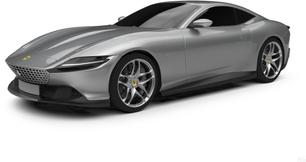
The Roma is a subtle, beautifully balanced and delicately detailed two-door inspired by all-time Ferrari classics like the 250 GT Lusso and 275 GTB.
Its proportions are impeccable with complex curves and sweeping lines combining to produce an exquisitely pure shape.
Slimline LED headlights are divided by horizontal DRL strips, the broad bonnet incorporates a quietly muscular power bulge and the minimalist ’egg crate’ grille sits below a sharply chiseled nose.
I’m a particular fan of the split wedge-shaped tail-lights, seamlessly incorporated into the upper deck of the rounded rear end. The active rear spoiler is also neatly hidden away in the leading edge of the boot lid. No shoutiness here, even the exterior badges are works of art.
Crack open the bonnet and the engine sparkles like a jewel in a display case. Scarlet red crackle finish on the intake plenums and cam covers make it pop like a firecracker.
The interior follows a dual cockpit theme with twin curved sections divided by a flying buttress style console between them housing the gear selection gate and central media screen.
Flashes of carbon-fibre and chromed alloy add a touch of overt raciness, Alcantara on the dash and doors echoes the ‘mouse fur’ of Ferraris past and the contrast stitching around the cabin is flawless.
The sleek front seats feel as good as they look, the typography of the Roma badge on the passenger side of the dash is super cool, and overall the interior is snug and ultra classy.
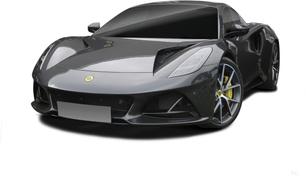
As mentioned earlier, the Emira is meant to be a bridge between Lotus’ past and its future - combining elements of its previous sports cars while also laying the visual tone for future models.
The design does a good job of that, because there’s clearly a link to the Exige and Evora of the recent past, but it also takes heavy influence from the limited-run Evija hypercar.
In turn, this new design language will spread out across the all-new electric models, including the Eletre SUV and Emeya sports sedan.
The styling does a good job of making the Emira look and feel like a premium sports car, without the need for any flashy wings or similar. It’s a simple, compact but stylish sports car.
This trend carries over to the cabin, with the more premium finish with the carpets, leather and good quality switchgear, as well as the digital instrument display and 10.2-inch multimedia touchscreen. Gone are the days of a Lotus having a minimalist, exposed aluminium interior with only the bare necessities. This is a proper premium sports car.
At close to 4.7m long, the Roma isn’t compact but its supercar stance comes courtesy of a close to 2.0m width and low-riding 1.3m height (with a 2670mm wheelbase).
The cabin is cozy, as intended, but at 183cm I still have ample headroom in the front. The rear is a different story with the two ‘+2’ seats serving as occasional emergency spots only or a handy option for smaller kids.
For storage there are slim but long pockets in the doors, a surprisingly generous glove box, a wireless charging pad under the centre console, phone-size slits on either side of that console, a single cupholder between the front seats with a lidded box (containing 12V and USB-A outlets) behind it.
There’s a recess for oddments on the transmission tunnel between the rear seats, and armrests either side in the back.
The boot holds 272 litres, which is enough for several soft bags, rising to 345 litres with the 50/50 split-folding rear seatbacks lowered. There are tie-down anchors, which is handy but be aware there’s no spare, only a repair/inflator kit.
Overall, not exactly SUV-like in terms of day-to-day practicality but at least on par with its key competitors.
While it’s a more luxurious Lotus, it remains a compact and impractical sports car - and that’s very much on brand. In terms of storage inside the cabin, there are two cupholders and a small lidded console box, but the size of the cabin means everything is quite narrow and feels a little tight for space.
There is a decent sized, although not very deep, shelf behind the seats, so you can put smaller, softer items there and hope they don’t slide around too much.
In terms of actual luggage space, there isn’t much. There’s a small boot behind the engine, and while deep, it’s pretty narrow so you’ll only get soft bags in there if you plan on taking your Emira on a road trip.
At $453,000 before on-road costs, the Roma Coupe lines up almost directly with a trio of well-credentialled, well-equipped and ultra-fast 2+2 supercars - the Aston Martin DB12 ($455,000), Maserati GranTurismo Trofeo ($450,000) and Porsche 911 GT3 ($446,700).
If you prefer a roofless experience, the Roma Spider convertible will set you back $520,300 (BOC).
And as you’d expect, the standard features list is impressive; the options list even more so.
Aside from the safety and performance tech covered a little later, highlights include 18-way power front seats, full-grain Frau leather trim, eight-speaker JBL audio (with digital radio), dual zone climate control, an 8.4-inch hi-definition central media display, a 16-inch (highly) configurable instrument cluster, adaptive cruise control and 20-inch forged alloy rims.
There’s also LED exterior lighting (including auto dusk-sensing headlights), Android Auto/Apple CarPlay connectivity, rain-sensing wipers and built-in nav, as well as Alcantara, chromed aluminium and carbon-fibre trim details. There’s more, but you get the idea.
And when it comes to options, the sky’s the limit with the likes of carbon-fibre everything, beefier audio as well as custom colour and trim options available through Ferrari’s ‘Tailor Made’ and ‘Special Equipment’ programs.
One popular addition is an 8.8-inch HD touchscreen for the front passenger (co-pilot?) displaying data on the car’s performance and status as well as allowing selection of music, sat-nav info and climate functions. Super cool and it will set you back $9500.
In terms of size and price, the Emira lines up almost directly against the Porsche 718 Cayman, which is a formidable adversary, but also the likes of the BMW M4. Notably, it’s significantly cheaper than anything offered by the likes of Ferrari, Maserati and McLaren.
The MY24 Emira range begins at $155,900, before on-road costs, for the entry-level model but stretches up to just over $206,000 for the i4 First Edition we’re driving here.
The Emira has been designed as a more premium and luxurious sports car compared to the stripped down and basic models of the recent past, such as the Elise and Exige, so it gets a range of items not previously seen on many Lotus models - such as carpeted floors and the choice of either Nappa leather or Alcantara trim.
Also included are LED headlights, climate control, keyless ignition, cruise control, rear parking sensors, a premium sound system and a 12.3-inch digital dashboard.
It's worth noting the MY25 Emira line-up was detailed earlier this month. You can read all about it, including pricing and specification, here.
Enzo Ferrari famously said “aerodynamics are for people who can’t build engines” and notwithstanding the fact the Roma is slippery in the wind tunnel (Cd .30), its front-mid mounted 3.9-litre turbo-petrol V8 engine would surely meet with il Commendatore’s approval.
Sending drive to the rear wheels via an eight-speed dual-clutch auto transmission, this all-alloy, 90-degree unit features dual twin-scroll turbos, a flat plane crank, dry sump lubrication, direct fuel-injection and a single-piece cast exhaust manifold to produce 456kW from 5750rpm to the 7500rpm rev ceiling, and 760Nm from 3000-5750rpm.
Worth noting its 'front-mid' placement as the entire block is positioned low down and behind the front axle centre line.
The MY24 Emria first arrived in Australia with the same Toyota-built 3.5-litre V6 engine Lotus had used in recent years in the likes of the Exige and Evora. However, this new AMG-built four-cylinder provides a fresh choice.
Importantly, while built by Mercedes-AMG, the tuning and calibration is unique to Lotus (but we’ll discuss that in detail later).
That means the 2.0-litre unit is tuned to make 268kW/430Nm, which is less potent than AMG offers in its 310kW/500Nm A45 hot hatch, although a more potent version of the four-pot Emira has been confirmed for MY25.
The engine is paired with an eight-speed dual-clutch auto transmission, which you can either leave in automatic mode or change gear manually using the F1-style paddles on the steering wheel.
The Roma’s official (WLTP) fuel consumption figure on the combined (urban/extra-urban) cycle is 11.2L/100km, the 3.9-litre turbo-petrol V8 emitting 255g/km of CO2 in the process.
Not exactly miserly, but even with that engine begging to be revved we saw an average of 12.9L/100 over a combination of urban shuffling, twisting B-roads and some freeway running.
A start/stop function is standard and with an 80-litre fuel tank on board, the Roma’s theoretical range is around 715km, dropping to approximately 620km using our real-world number.
Given the Emira is a sports car, the four-cylinder turbo is tuned for performance over economy and that’s reflected in an 10.1L/100km return on the combined (urban/extra-urban) cycle. That’s not too bad for a sports car, but is relatively thirsty given the engine capacity and the overall size of the car.
The Emira is equipped with a 60-litre fuel tank, so it has a driving range of approximately 594km.
Press the PS (Partenza Sportiva) button on the console, slip the manettino control on the steering wheel into ‘Race’ mode, left-foot brake (hard) and floor the throttle. Wait for the PS light on the dash, keep the accelerator pinned and lift off the brake.
Ferrari says the Roma will then proceed to accelerate from zero to 100km/h in 3.4 seconds, and in the interests of a thorough assessment I may have found a quiet light commercial area near Maranello, replicated this procedure and validated the claim.
Yes, even at 1570kg, with 760Nm of pulling power available from 3000-5750rpm, the Roma is exceptionally fast in a straight line. And the twin-turbo V8 that’s been so reserved and docile around town lights up to deliver glorious engine noise and a characteristic exhaust howl.
A flat-plane crank arrangement often makes a vee engine lumpier than a more conventional cross-plane design, but it will rev hard and fast, and in this case the compact size of the Roma’s twin turbos enhances throttle response even further.
Speaking of the turbos, variable boost management helps to smooth acceleration while keeping an eye on fuel economy and despite the flat-plane configuration this engine is perfectly civilised.
A tall top (eighth) gear makes for easy cruising but the tight B-roads and lesser highways we spent most time on didn’t allow for any high autostrada speeds.
But how’s this for a flex? Ferrari says the active rear spoiler will stay in its low-drag position until the car hits 100km/h, then pushing through medium and high drag (135-degree) positions as speed rises. But… “over 300 km/h, the spoiler is always in MD mode because in such conditions it is preferable to have a more balanced car”.
Suspension is by double wishbones at the front with a multi-link set-up at the rear and twin solenoid (magnetic) adaptive dampers all around.
Rubber wrapping the 20-inch forged alloys is top-end Michelin Pilot Sport 4 S (245/35 fr / 285/35 rr) and front-to-rear weight distribution is 50/50.
What that all adds up to is a comfortable, responsive and deeply satisfying drive experience. In standard Ferrari fashion the dual-clutch transmission is rapid-fire perfection, the steering is light but accurate and feelsome, while the in-cabin ergonomics are superb.
Push as hard as you dare in tight, flowing corners and the car just continues to grip and bait you to try harder. And if you do give in and start to run out of talent the ‘Active Yaw Control’ and limited-slip ’E-diff’ will step in to imperceptibly save your bacon.
Moving the manettino through its five positions - ‘Wet’, ‘Comfort’, ‘Sport’, ‘Race’ & ‘ESC-Off’ rapidly transforms levels of ride comfort, steering, transmission and engine response. You can also set the ride to Comfort with other attributes dialled up to 11 for a cross-country sweet spot.
And when it comes to slowing rather than going, the Brembo brake set-up is circuit ready with vented carbon ceramic rotors all around (390mm fr / 360mm rr) clamped by six-piston calipers at the front and four-piston units at the rear. They take a while to warm up, but never feel anything other than mega.
Just to be clear right up front, the score for this section is heavily biased towards the car's dynamic attributes, because frankly the Emira can be hard to live with at times.
At urban speeds the powertrain feels like a dog straining at its leash, which can result in some awkward moments.
For example, there were multiple instances where the gearbox refused to change out of second gear when exiting a roundabout, letting the engine rev quite hard and likely annoying my neighbours.
Some of the gear changes can be clunky too, not slotting as sweetly as they should on a sports car costing in excess of $200K.
However, you forget all that when you get the Emira onto a stretch of twisty, winding open road (preferably smooth tarmac) and move it from the 'Tour' to 'Sports' mode. The car comes alive, revving hard, shifting with precision and feeling like a puppy running through a field in pure ecstasy.
Like the great cars to come before it from Lotus, the Emira is in its element carving through corners. The steering is incredibly accurate, direct and responsive - as good as any sports car I’ve driven in recent memory. The chassis responds to those inputs with immediacy, too, feeling nimble, agile and engaging.
This is Lotus at its best.
No surprise, ANCAP and Euro NCAP have not assessed the Roma, but you could mount a solid case that the car’s high-level dynamic ability is its greatest active (crash avoidance) safety system.
Over and above that there are the usual anti-lock brake, traction and stability control systems (the latter is Ferrari’s adjustable SSC ‘Side Slip Control’) as well as AEB (with vehicle and cyclist detection), adaptive cruise control, lane-keeping assist, lane departure warning, blind-spot monitoring and traffic sign recognition plus front and rear parking sensors.
Also worth calling out ‘FDE’ (Ferrari Dynamic Enhancer) which works in parallel with the SSC to help modulate lateral movement in extreme circumstances.
If a crash is unavoidable there are four airbags - dual front and dual side front (head). That’s an acceptable count in a 2+2 coupe, but it would be nice to see a front centre bag.
Sports cars are not typically beacons of safety, not that they’re dangerous but the priority is speed, not complex and often weighty safety technology. It’s part of the reason these types of cars are rarely crash tested by the authorities, as is the case of the Emira.
But this more modern and luxury focused Lotus comes with a raft of safety items including adaptive cruise control, an anti-collision system (Lotus-speak for AEB), fatigue alert, road sign information, a vehicle speed limiter, lane departure warning, rear cross-traffic alert and lane change assist.
As the name implies, Ferrari’s ‘7-Year Genuine Maintenance’ program means you won’t have to worry about servicing costs for the first seven years of ownership. Everything from labour and parts to lubricants and brake fluid is included in the free-of-charge package.
For reference, maintenance is recommended every 12 months/20,000km, which is a healthy distance and roadside assistance is complimentary for the first 12 months.
Warranty cover is three years/unlimited kilometres, which trails the mainstream market but matches high-end competitors like Aston Martin, Lamborghini, McLaren and Porsche.
Lotus Australia offers a three year warranty, which is in line with Porsche's cover, so that’s competitive in the sports car market.
However, the brand does not offer capped price servicing, so you’ll need to discuss with your local dealer how much regular maintenance will cost you. The service intervals are every 12 months/15,000km.