What's the difference?
There aren’t as many Ferraris on the road in Italy as you might think. There’s the purchase price, per-kW taxes and poisonously expensive fuel. So, usually, they’re a rare sight, except around Maranello in the northern province of Modena.
Because that’s Ferrari’s home and in getting to grips with the subject of this review - the twin-turbo V8 Roma - I enjoyed a smile-inducing moment with a local milk truck driver.
On a narrow section, part way into a road test drive through local villages and twisting B-roads to the west of Maranello, the tanker pulled over to let me through.
Gave a thank you double blink of the hazard lights on passing and received a quick headlight flash in return. They almost certainly thought I was putting kays on a test mule in the same way camouflaged prototypes so often do on the same stretch of road.
Maybe I’d inadvertently sipped some Prancing Horse Kool-Aid, but it felt special. Ferrari is so close to Italian hearts and the Roma is such a sleek and engaging example of its current output.
But is this ‘iron fist in a velvet glove’ 2+2 capable of tearing you away from its well-credentialled high-end competitors? Stick with us to find out.
With Ferrari leaving the Fiat-Chrysler family and becoming an independent entity in 2016, Maserati was left without a technology partner.
Suddenly, the Trident brand had to go it alone and come up with its own engines for the first time in more than 20 years. The MC20 sports-car is the result of that rebirth.
While there’s no doubt the Maserati brand has the currency to pull this off, the MC20 is also a big step outside the company’s usual grand-tourer box.
The new coupe is aimed at McLaren, Porsche and even Ferrari buyers, so can the first true Maserati sports car since the MC12 of 2004 walk the walk? And let’s not forget that the MC12 was Ferrari Enzo-based…
No-compromise cars are often the ones that impose the most compromises, and in that sense, the MC20’s shattering on-paper performance means its greatest attributes can’t be enjoyed on a public road.
That’s why this review was conducted entirely on Philip Island’s 4.4km Grand Prix layout. As a result, we can’t tell you much about parking ease or highway fuel consumption. But as for the things that give a super-sports car its identity, read on.
The Ferrari Roma is like a trained assassin in a Zegna suit - capable and clinical yet stylish and effortlessly superior. We believe there’s a replacement coming later this year and it will have to be doing well to top this superb machine.
With a 320km/h-plus top speed and the ability to get from rest to 100km/h in under three seconds, there’s no doubting the MC20 meets or exceeds its performance brief. But when you’re paying these prices, there must be more than just the measurable stuff going on.
And there is. The MC20 brings a big dollop of purity to the ranks of current supercars, doing away with all-wheel drive and hybrid tech and relying instead on and old-school approach in terms of handling and overall feel.
Anybody who wants to argue that call has plenty of alternatives to the MC20 from other manufacturers, and for some of us, that less-is-more thing will ring true.
Note: CarsGuide attended this event as a guest of the manufacturer, with meals provided.
If you’re looking for a flash Fazza with spoilers and vents at all points of the body, you’ve come to the wrong coupe.
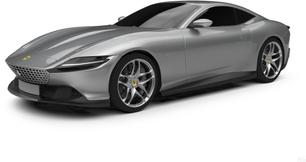
The Roma is a subtle, beautifully balanced and delicately detailed two-door inspired by all-time Ferrari classics like the 250 GT Lusso and 275 GTB.
Its proportions are impeccable with complex curves and sweeping lines combining to produce an exquisitely pure shape.
Slimline LED headlights are divided by horizontal DRL strips, the broad bonnet incorporates a quietly muscular power bulge and the minimalist ’egg crate’ grille sits below a sharply chiseled nose.
I’m a particular fan of the split wedge-shaped tail-lights, seamlessly incorporated into the upper deck of the rounded rear end. The active rear spoiler is also neatly hidden away in the leading edge of the boot lid. No shoutiness here, even the exterior badges are works of art.
Crack open the bonnet and the engine sparkles like a jewel in a display case. Scarlet red crackle finish on the intake plenums and cam covers make it pop like a firecracker.
The interior follows a dual cockpit theme with twin curved sections divided by a flying buttress style console between them housing the gear selection gate and central media screen.
Flashes of carbon-fibre and chromed alloy add a touch of overt raciness, Alcantara on the dash and doors echoes the ‘mouse fur’ of Ferraris past and the contrast stitching around the cabin is flawless.
The sleek front seats feel as good as they look, the typography of the Roma badge on the passenger side of the dash is super cool, and overall the interior is snug and ultra classy.
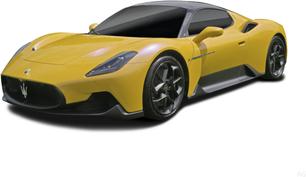
Perhaps the most striking thing about the MC20’s design is that it’s so restrained. You won’t find wings, vents, fins and diffusers all over the car, but rather an overall shape that creates downforce, rather than that job falling to tacked on additions.
And, like any modern supercar worth its salt, the MC20 is based around a carbon-fibre tub for rigidity and low weight. From that tub structure are hung aluminium front and rear subframes which, in turn, mount the suspension and other mechanical bits.
The wind tunnel still got a huge workout in the car’s development, of course, but the aim was to integrate the downforce-inducing elements rather than having them demanding your optical attention.
As a result, the whole car is an upside-down wing, if you want to simplify it. But a very pretty upside-down wing.
This gives the MC20 a smooth, sleek look that stands it apart from the rent-a-racer crowd and supports the theory that sometimes, less is, indeed, more.
Some of the detailing is lovely, too. The vents cut into the Perspex rear windscreen form Maserati’s trademark trident shape, there’s lots of visible carbon-fibre inside the door jambs, there’s lashings of Alcantara inside and the two-tone body kit breaks up the shape perfectly.
Elements we’re not so sure about include the 'Park' button mounted way down low under the dashboard, and the swing-up, scissor-type doors, which, if your more than about 180cm tall, still require you to duck under them.
On the upside, the carbon-and-leather steering wheel with its integrated controls is gorgeous to hold and gaze at.
At close to 4.7m long, the Roma isn’t compact but its supercar stance comes courtesy of a close to 2.0m width and low-riding 1.3m height (with a 2670mm wheelbase).
The cabin is cozy, as intended, but at 183cm I still have ample headroom in the front. The rear is a different story with the two ‘+2’ seats serving as occasional emergency spots only or a handy option for smaller kids.
For storage there are slim but long pockets in the doors, a surprisingly generous glove box, a wireless charging pad under the centre console, phone-size slits on either side of that console, a single cupholder between the front seats with a lidded box (containing 12V and USB-A outlets) behind it.
There’s a recess for oddments on the transmission tunnel between the rear seats, and armrests either side in the back.
The boot holds 272 litres, which is enough for several soft bags, rising to 345 litres with the 50/50 split-folding rear seatbacks lowered. There are tie-down anchors, which is handy but be aware there’s no spare, only a repair/inflator kit.
Overall, not exactly SUV-like in terms of day-to-day practicality but at least on par with its key competitors.
Although the MC20 has a front and rear luggage compartment, they’re both small enough to be pretty much useless. This is a shame, because as a long-weekend getaway car, the Maserati otherwise makes a strong case for itself.
The other area that suffers for the car’s art is the interior practicality. While the driving position is great and the pedals and wheel relationship is spot on, when it comes to storing anything, you’re on your own. Best the MC20 can offer is a single cupholder at the rear of the central tunnel.
The mid-engined layout also means there’s precious little vision through the back window. To counter that, Maserati has fitted the MC20 with an interior rear-view mirror that can act as a conventional mirror (you can still see only the engine) or as a screen for the rear-mounted camera.
The catch is the image projected to the 'mirror' lacks depth of field and forces the driver to refocus on the image rather than simply glance at it.
At $453,000 before on-road costs, the Roma Coupe lines up almost directly with a trio of well-credentialled, well-equipped and ultra-fast 2+2 supercars - the Aston Martin DB12 ($455,000), Maserati GranTurismo Trofeo ($450,000) and Porsche 911 GT3 ($446,700).
If you prefer a roofless experience, the Roma Spider convertible will set you back $520,300 (BOC).
And as you’d expect, the standard features list is impressive; the options list even more so.
Aside from the safety and performance tech covered a little later, highlights include 18-way power front seats, full-grain Frau leather trim, eight-speaker JBL audio (with digital radio), dual zone climate control, an 8.4-inch hi-definition central media display, a 16-inch (highly) configurable instrument cluster, adaptive cruise control and 20-inch forged alloy rims.
There’s also LED exterior lighting (including auto dusk-sensing headlights), Android Auto/Apple CarPlay connectivity, rain-sensing wipers and built-in nav, as well as Alcantara, chromed aluminium and carbon-fibre trim details. There’s more, but you get the idea.
And when it comes to options, the sky’s the limit with the likes of carbon-fibre everything, beefier audio as well as custom colour and trim options available through Ferrari’s ‘Tailor Made’ and ‘Special Equipment’ programs.
One popular addition is an 8.8-inch HD touchscreen for the front passenger (co-pilot?) displaying data on the car’s performance and status as well as allowing selection of music, sat-nav info and climate functions. Super cool and it will set you back $9500.
Maserati has followed the lead of many a high-end carmaker by using the options list to ramp up the profitability of the MC20. Of course, that’s after the MSRP of $438,000 has been dealt with by your accountant.
The point is that you kind of need to suspend disbelief when it comes to supercars and their value-for-money credentials. By any sane, conventional measure, they’re seriously over-priced, but within its peer group, the Maserati is neither the cheapest nor the most expensive way to go this fast.
But back to those options: Again, it’s all a case of throwing away what you think you know, because there are several options for the Maserati that cost more than a good, brand-new hatchback.
The carbon-fibre engine cover alone will cost you a staggering $13,164, and according to Maserati management, it’s a popular option.
Then, there are the carbon-fibre brakes which not only cost $28,961, but if you want the yellow-painted calipers, that’ll be another $2962.
The hydraulic front-lifter which allows you to deal with driveways and speed humps is a monstrous $8721, but at least there’s some engineering in that. Unlike the black-roof option which is, er, a black roof at $10,202. And the external carbon-fibre kit? A cool $92,806!
Enzo Ferrari famously said “aerodynamics are for people who can’t build engines” and notwithstanding the fact the Roma is slippery in the wind tunnel (Cd .30), its front-mid mounted 3.9-litre turbo-petrol V8 engine would surely meet with il Commendatore’s approval.
Sending drive to the rear wheels via an eight-speed dual-clutch auto transmission, this all-alloy, 90-degree unit features dual twin-scroll turbos, a flat plane crank, dry sump lubrication, direct fuel-injection and a single-piece cast exhaust manifold to produce 456kW from 5750rpm to the 7500rpm rev ceiling, and 760Nm from 3000-5750rpm.
Worth noting its 'front-mid' placement as the entire block is positioned low down and behind the front axle centre line.
Previous generations of Maseratis borrowed Ferrari (both brands were once part of the extended Fiat Chrysler family) technology for their drivelines in a deal that allowed both brands to share the cost of development.
And since having a Ferrari-built engine in your car was never seen as a sale hindrance, it was a sweet deal for Maserati. But when Ferrari was spun off and became a publicly-owned company in 2016, Maserati’s supply of engines dried up.
The solution was to take engine design in-house and the twin-turbocharged 3.0-litre V6 in the MC20 is one of the first fruits of that.
While it’s undoubtedly a high-tech powerplant, in other respects it’s fairly conventional. Maserati, for instance, has a long history with the V6 layout, and there’s no hybrid element to the driveline. Nor is there a hybrid option.
Maserati claims the V6 is the world’s most powerful six-cylinder production-car engine and, with no less than 463kW at 7500rpm and 730Nm between 3000 and 5500rpm, that’s a credible statement.
Technical details that you won’t see on most road cars include a dry-sump lubrication system (where the engine oil lives in a remote tank rather than the hot sump of the engine itself) and a sophisticated fuel injection system with two injectors per cylinder.
The real trick, however, is an ignition system with two spark plugs per cylinder. There are also effectively two combustion chambers, the first ensuring multiple flame fronts to achieve a more complete burn of the fuel in the main combustion chamber.
The rest of the driveline is similarly aimed at the purists out there; the transmission is an eight-speed dual-clutch, driving not all four wheels, but only the rears through a mechanical limited-slip differential.
Selectable drive modes from GT (the default setting) through to 'Wet', 'Sport', 'Corsa' (Track) and 'ESC Off' tailor the shift points, throttle sensitivity and suspension behaviour, but still allow for full engine power.
The Roma’s official (WLTP) fuel consumption figure on the combined (urban/extra-urban) cycle is 11.2L/100km, the 3.9-litre turbo-petrol V8 emitting 255g/km of CO2 in the process.
Not exactly miserly, but even with that engine begging to be revved we saw an average of 12.9L/100 over a combination of urban shuffling, twisting B-roads and some freeway running.
A start/stop function is standard and with an 80-litre fuel tank on board, the Roma’s theoretical range is around 715km, dropping to approximately 620km using our real-world number.
Fuel economy is probably not going to be top of mind for most MC20 buyers, but the official combined figure of 11.6 litres per 100km is still pretty greedy by 2022 standards.
Balanced against the available performance, however, and an engine making more than 600 old-fashioned horsepower with that combined fuel-economy number is still cause to reflect on modern technology and efficiency.
The MC20 has a 60-litre fuel tank, making it a handy cross-country car for weekends away.
Press the PS (Partenza Sportiva) button on the console, slip the manettino control on the steering wheel into ‘Race’ mode, left-foot brake (hard) and floor the throttle. Wait for the PS light on the dash, keep the accelerator pinned and lift off the brake.
Ferrari says the Roma will then proceed to accelerate from zero to 100km/h in 3.4 seconds, and in the interests of a thorough assessment I may have found a quiet light commercial area near Maranello, replicated this procedure and validated the claim.
Yes, even at 1570kg, with 760Nm of pulling power available from 3000-5750rpm, the Roma is exceptionally fast in a straight line. And the twin-turbo V8 that’s been so reserved and docile around town lights up to deliver glorious engine noise and a characteristic exhaust howl.
A flat-plane crank arrangement often makes a vee engine lumpier than a more conventional cross-plane design, but it will rev hard and fast, and in this case the compact size of the Roma’s twin turbos enhances throttle response even further.
Speaking of the turbos, variable boost management helps to smooth acceleration while keeping an eye on fuel economy and despite the flat-plane configuration this engine is perfectly civilised.
A tall top (eighth) gear makes for easy cruising but the tight B-roads and lesser highways we spent most time on didn’t allow for any high autostrada speeds.
But how’s this for a flex? Ferrari says the active rear spoiler will stay in its low-drag position until the car hits 100km/h, then pushing through medium and high drag (135-degree) positions as speed rises. But… “over 300 km/h, the spoiler is always in MD mode because in such conditions it is preferable to have a more balanced car”.
Suspension is by double wishbones at the front with a multi-link set-up at the rear and twin solenoid (magnetic) adaptive dampers all around.
Rubber wrapping the 20-inch forged alloys is top-end Michelin Pilot Sport 4 S (245/35 fr / 285/35 rr) and front-to-rear weight distribution is 50/50.
What that all adds up to is a comfortable, responsive and deeply satisfying drive experience. In standard Ferrari fashion the dual-clutch transmission is rapid-fire perfection, the steering is light but accurate and feelsome, while the in-cabin ergonomics are superb.
Push as hard as you dare in tight, flowing corners and the car just continues to grip and bait you to try harder. And if you do give in and start to run out of talent the ‘Active Yaw Control’ and limited-slip ’E-diff’ will step in to imperceptibly save your bacon.
Moving the manettino through its five positions - ‘Wet’, ‘Comfort’, ‘Sport’, ‘Race’ & ‘ESC-Off’ rapidly transforms levels of ride comfort, steering, transmission and engine response. You can also set the ride to Comfort with other attributes dialled up to 11 for a cross-country sweet spot.
And when it comes to slowing rather than going, the Brembo brake set-up is circuit ready with vented carbon ceramic rotors all around (390mm fr / 360mm rr) clamped by six-piston calipers at the front and four-piston units at the rear. They take a while to warm up, but never feel anything other than mega.
Here’s where your half-a-million bucks has gone.
The MC20’s acceleration is absolutely shattering and is all the more amazing for the fact the car uses neither all-wheel drive grip nor hybrid torque to achieve its sprinting abilities.
While the V6 is not the most sonorous of powerplants, it does manage to sound high-end and pretty sophisticated and it’s never as shouty as some of its opposition which seem to confuse decibels with kiloWatts.
While the sheer thrust confirms the existence of two turbochargers, the lack of lag (or throttle delay) and the ability to charge into the rev limiter in the lower gears does not.
Even though power peaks at 6500rpm (as with many a modern turbo motor) the MC20 will happily smash on to the redline at 8000rpm; sometimes too happily if you don’t have your finger over the upshift paddle. As with other good modern turbocharged units, this one doesn’t actually feel overtly turbocharged.
The transmission shifts relatively smoothly in GT mode, but as you crank up the mode selector to Sport, the shifts become very fast with an accompanying jolt through the backrest as each gear clicks home. The shifting process is fairly foolproof, although you do get full over-ride, so you need to pay attention.
Both the cars we were able to sample at Philip Island were sporting the optional carbon-ceramic braking package, and one was also fitted with the optional 'birdcage' alloy wheels which are lighter.
Each of them needed a firm shove on the pedal to slow things down, but it’s true the lighter wheels seem to be worth their almost-$3000 ask as that car required less leg-pressure for the same result.
The lack of a hybrid element to the driveline, as well as the rear-drive layout, suggests a degree of purity of purpose in the car’s design. And that’s backed up by its behaviour in the first corner.
Fundamentally, instead of just hurling it at an apex and allowing the electronics to sort it all out for you, the Maserati requires a more 'classical' technique if it’s to really shine.
It doesn’t, for instance, reward trail-braking (where you continue to brake once you’ve turned into a corner) and would much prefer you get your braking over and done with before applying any meaningful steering lock.
Ignore this, and the rear weight bias of the mid-engined layout can see the car try to yaw, with the rear end becoming light and the vehicle over-rotating (which is a spin, to you and I).
Similarly, getting on the power before you’ve actually got the MC20 turned, can unload the front end and send the front wheels ploughing (ploughing is an exaggeration, but at the speeds we’re dealing with here, even a small degree is a big deal) towards the outside of the turn.
Ultimately, then, the technique becomes a text-book case of brake, turn and then power out, at which point the MC20 reveals itself to be huge fun and incredibly fast. The only thing to deal with then is the knowledge that whatever happens next is going to happen extremely quickly.
No surprise, ANCAP and Euro NCAP have not assessed the Roma, but you could mount a solid case that the car’s high-level dynamic ability is its greatest active (crash avoidance) safety system.
Over and above that there are the usual anti-lock brake, traction and stability control systems (the latter is Ferrari’s adjustable SSC ‘Side Slip Control’) as well as AEB (with vehicle and cyclist detection), adaptive cruise control, lane-keeping assist, lane departure warning, blind-spot monitoring and traffic sign recognition plus front and rear parking sensors.
Also worth calling out ‘FDE’ (Ferrari Dynamic Enhancer) which works in parallel with the SSC to help modulate lateral movement in extreme circumstances.
If a crash is unavoidable there are four airbags - dual front and dual side front (head). That’s an acceptable count in a 2+2 coupe, but it would be nice to see a front centre bag.
Neither ANCAP nor Euro NCAP have tested the MC20 for crash safety, so we can’t give it a star rating.
But the lack of standard safety gear such as rear-cross traffic alert and blind-spot monitoring (it’s optional at $2797) can’t go unmentioned. That’s especially concerning when you consider the mid-engined layout makes for very poor rear visibility.
As the name implies, Ferrari’s ‘7-Year Genuine Maintenance’ program means you won’t have to worry about servicing costs for the first seven years of ownership. Everything from labour and parts to lubricants and brake fluid is included in the free-of-charge package.
For reference, maintenance is recommended every 12 months/20,000km, which is a healthy distance and roadside assistance is complimentary for the first 12 months.
Warranty cover is three years/unlimited kilometres, which trails the mainstream market but matches high-end competitors like Aston Martin, Lamborghini, McLaren and Porsche.
High-end cars often disappoint on the details, and the Maserati is no different here, offering just a three-year factory warranty (albeit with unlimited kilometres).
That trails even the most humble commuter cars these days, and suggests there’s still a degree of indifference from some carmakers. And, possibly, their customers.
There is, however, the option of fixed-price servicing for the MC20 with the first three years’ worth of servicing costing $4000.
Scheduled services are every 15,000km or 12 months, whichever comes first.