What's the difference?
Does the world really need another mid-sized SUV? Cupra reckons so, particularly if the vehicle in question carries a European badge and is engineered by people who 'get' cars and driving.
Of course, by invoking those touchstones, Cupra has perhaps made a rod for its own back. Sure, the European badge thing speaks for itself, but if your point of difference is a driver’s car versus a transport module, then you better bring your dynamic A game.
The Terramar is that A game, says Cupra. In every other way, the Terramar has a big job to do to avoid being buried in the SUV pile-on. And, ironically, being a member of the Volkswagen-Audi family, means the Cupra’s own siblings pose perhaps the biggest threat to gaining some showroom attention.
That said, those same family ties mean Cupra can tap into some worthy tech including modern platforms and cracking engines, all of which are on display here. Of the three Terramar trim levels we’ll see initially, we’ve managed to drive two of them here – the entry-level and the range-topper. And our brief was simple: Can the Cupra Terramar stand tall. And, equally importantly, can it stand out?
When the iPhone first appeared just over a decade ago, I can remember thinking a phone without buttons would be a giant pain in the neck. Until I used one, and now the idea of a keypad phone sounds akin to starting a car with a crank handle.
The new 1 Series is likely to offer most buyers a similar revelation, with its move from the BMW-traditional rear-drive layout to more conventional front and all-wheel drive. That is assuming you gave a damn in the first place, as I suspect it’s only hardcore BMW traditionalists that care about a rear-drive premium hatchback in 2020.
And that’s not who is buying the 1 Series, with the Bavarian brand’s cheapest model intended to appeal to younger buyers who are more likely to care about connectivity, practicality and personalisation options than the excitement of losing grip from the rear. It certainly hasn’t stopped plenty of people from buying 1 Series-rivalling A-Class and A3s from Mercedes-Benz and Audi over the years.
Creating a model-shared product that’s selling into a hotly contested – and crowded – marketplace is a great way to wind up with something derivative and easily overlooked. But Cupra seems to have managed to avoid that with an end result that is distinctive and has its own character within the VW family. In top-shelf VZ form, the Terramar is an entertaining drive and there’s enough driver involvement for it to be short-listed by anybody who values the journey as much as the destination.
The less powerful entry-level S version, meantime, can’t call on the services of that fabulous 2.0-litre engine and, instead, will possibly have a harder job convincing the masses of its worthiness. The lack of all-wheel drive probably won’t count for as much as the 'missing' 85kW (compared with the VZ) and some would-be buyers might find it hard to reconcile a driver’s SUV with the smaller engine in the S. Inside either variant, though, it’s prime family real estate with the clever rear seating and plenty of space and light inside. The value for money equation is pretty handy, too.
But for all that, you get the sense Cupra will need to shout about the Terramar if it’s to be heard over the general din of this fierce market segment. It would be a real shame if this car became simply a part of that background noise.
Note: CarsGuide attended this event as a guest of the manufacturer with accommodation and meals provided.
To answer the question of whether it matters that the new 1 Series is no longer rear-wheel drive, I say no it doesn’t. It may not be as romantic on the absolute limit, but it is better in every measurable way, and still feels distinctly BMW despite moving to the conventional layout of its rivals.
Be sure to check out Mal’s video review from the 1 Series launch last December:
Depending on which angle you’re looking from, the Terramar has elements of the VW Tiguan and Porsche Macan in the way it sits on the road and in the metal shapes that make up the whole. Interestingly, though, it’s probably genetically closest to the new Audi Q3 alongside which it’s built in Hungary, although there is plenty of new Tiguan in the platform and engineering aspects.
The highlights remain the nth-degree detailing that every current-model Cupra displays, combined with a sensible, practical layout. The detailing extends to what Cupra calls parametric design which, for those with their nerd on, refers to the way the little shapes moulded into the interior fan out and subtly change shape while still continuing the overall pattern.
Think of the way a nautilus shell consists of circular loops but where each one is bigger than the previous. Has car design really come to this? Apparently.
On a more practical level, the sliding rear seat is a master stroke for a vehicle like this one. The two-storey luggage floor is a nice touch, too, although the boot needs to start empty for this to be set up initially. But given Cupra’s place in the scheme of things and its continual hints at cutting-edge technology, you may ask where’s the plug-in hybrid or EV version?
The short answer is production of the plug-in hybrid model starts this week with Australian deliveries due in November this year. And an EV must surely also be on the cards given VW’s announcement that Australia will receive the SUV version of its electric offering, the ID4, and not the hatchback ID3. All of which makes an electric Terramar even more logical. We’ll keep you posted.
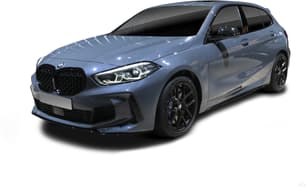
Yes, that kidney grille is rather large. If you want everyone to know you drive a BMW, you’ll love it. If not, get used to it. The X7, recent 7 Series update and upcoming 4 Series suggest they’re only going to get bigger.
Nose aside, the 1 Series hatch has always had a distinctive, long-bonnet profile, which has generally been attributed to the rear-drive layout. Despite the move to a transverse engine, the new one is actually very close in proportions when compared side by side.
It’s just 5mm shorter in overall length and 13mm taller, with body width being the most notable change at 34mm wider.
The key difference is that the front and rear wheels have been moved further back into the body, because of said engine layout change, and to make more back seat space in the rear.
Surprisingly for a model aimed at a younger demographic, the new 1 Series interior design isn’t quite the same step forward as the recent G20 3 Series.
It’s a cut above the X1 and X2 SUVS the new 1 Series shares its underpinnings with in terms of the shapes used, but is still classic understated BMW.
However its headline act is the Live Cockpit driver display on both models, which gives you fully digital instrumentation and replaces traditional analogue gauges once and for all.
There’s an awful lot going on inside the Terramar, stating with all that parametric detailing. But the copper-coloured accents are a genuine point of interest and most of the touchpoints are relatively plush as well as looking good.
Given the side profile of the car and its upswept waistline, you might think the interior would be a bit dark and gloomy. There’s certainly plenty of black on show, but the view out is actually great. Even the typical over-the-shoulder blind-spot isn’t really there.
We managed to sample the entry-level S version and the range-topping VZ and, to be honest, the major difference is the cloth-and-vinyl versus leather seating. The former is okay but never threatens to feel high-end, while the leather in the VZ is quite lovely.
There’s only one catch: If you don’t like burgundy leather, you’re out of luck, because that’s all that’s offered. Optional in the S and V variants, the idea of burgundy leather in, say, a blue car sounds awful, but in the flesh, the colour is quite subtle. Classy, even.
There’s a pair of USB charge ports in the front centre console, and another pair in the rear seat. That rear pew also gets its own climate controls (tri-zone) and central air-vents and there are reading lights as well. It also splits 40/20/40 and the centre armrest folds down to include a pair of cup-holders.
But while the rear seat offers plenty of foot and headroom, knee room is a bit tighter. It’s not terrible, but this car won’t necessarily fit families with older, taller teenage kids. Up front, there’s no shortage of space although the centre console feels quite bulky and definitely separates the front-seat occupants.
You can see and feel a bit of Audi ergonomics rubbing off in the Cupra’s touchscreens and customisable layouts and, as always, we’re big fans of having physical buttons on the centre stack for climate control and other important functions.
The luggage area isn’t huge, but is quite deep and the tailgate has a kick-sensor. Bins at each corner of the cargo area keep smaller items under control, but the inky blackness of the trim in this area means it looks like a black hole when you first open it.
With my modest 172 cm height, I never had any trouble with the old model, but the new 1 Series is a bit more more spacious by all the important measures.
The back seat base and backrest are a bit flat though, which is probably to help the backrest fold almost flat, but probably not very supportive during hard cornering.
There's also no centre armrest in the back or cup holders, but you do get bottle holders in the doors.
You also get two ISOFIX child seat mounts and there’s two USB-C charge points in the back of the centre console, but there's no directional air vents unless you opt for the dual-zone climate control that comes standard with the M135i.
The boot has grown by 20-litres to a pretty impressive 380 litres VDA which includes a very useful cavity under the floor instead of a spare tyre. An inflation kit is there for those duties. With the back seat folded flat, boot space expands to 1200 litres VDA.
The Cupra Terramar certainly looks like a premium product and that theme continues when you look at the specification.
The entry-level S version gets standard kit such as paddle shifters, 18-inch alloy wheels, LED lighting, a powered tailgate with a kick-sensor, keyless entry and start, powered and heated front seats with a memory function, a head-up display, a heated steering wheel, tri-zone climate control, dual info-screens, full wireless connectivity, ambient lighting and wireless phone charging.
Major accessories include a panoramic sunroof and a stereo upgrade and leather trim option bundled together. The drive-away price for the S is $58,490.
Move up to the $66,490 (drive-away) V variant and you add (aside from the driveline stuff we’ll get to in a moment) 19-inch copper-accented alloys and hill descent control.
The VZ at $73,490 (driveaway) goes one bigger in the wheels department with 20-inch alloys, adaptive suspension, the leather and stereo upgrade package as standard, selectable engine sound, matrix headlights, expanded driver-selectable drive modes and bigger brakes.
For the F40 generation, the 1 Series range has been cut back to two variants from launch, with the 118i for volume sales and the M135i xDrive hot hatch taking aim at the new Mercedes A35 and the Audi S3.
Both versions were priced $4000 higher than the equivalent models they replaced from launch, but have recently jumped a further $3000 and $4000 respectively. This puts the now-$45,990 118i beyond the starting prices for the equivalent Audi and Mercedes, and the $68,990 M135i xDrive is now nudging the A35’s list price.
The launch prices were largely offset by extra equipment over the previous generation, but the more recent hikes have taken the shine of this somewhat.
Thankfully, both 1 Series models now come standard with wireless Apple CarPlay. The previous ‘one year free, the rest you need to subscribe for’ plan has been scrapped since we shot the launch video below in favour of free CarPlay for life. There’s still no Android Auto, but this is due to change in July.
The 118i packs more standard equipment than before in general, including the M Sport styling pack, head up display, wireless phone charger and adjustable ambient lighting.
The M135i adds bigger brakes, a rear spoiler and 19-inch wheels, plus sport seats with leather trim, and Harman/Kardon audio among a few other things.
You can get even more from the M135i with the $1900 M Performance Package, which drops the 0-100km/h claim by one tenth to 4.7s thanks to enabling engine overboost and lighter forged 18-inch alloys, which is signified by gloss black grille surrounds, intake elements in the front bumper, mirror caps and exhaust tips.
Other options include the $2900 Enhancement Package, which brings metallic paint and a panoramic glass roof. On the 118i, it also brings 19-inch black alloys. On the M135i, it also brings active cruise control with stop and go function. This package costs an extra $500 if Storm Bay metallic is chosen.
The Comfort Package costs $2300 with the 118i and $923 with the M135i, and brings front seat heaters and lumbar adjustment for both front seats. On the 118i, it also brings proximity keys and electric front seat adjustment. On the M135i, it also brings a heated steering wheel.
The Convenience Package costs $1200 with either variant, and adds a powered hatch, modular storage system and cargo net and a ski port for the back seat.
The 118i can also be optioned with the $1000 Driver Assistance Package, which adds active cruise control (plus 0-60km/h AEB), adaptive LED headlights with auto high beams and a tyre pressure monitor.
Beyond the 118i’s standard M Sport pack, it can also be augmented with the $2100 M Sport Plus Package. This brings sports front seats, a rear spoiler, M-coloured seat belts, a sports steering wheel and upgraded M Sport brakes.
The Terramar range features a choice of two petrol engines and driveline layouts, three outputs and even a mild hybrid variant. In fact, the Terramar S which uses the hybrid driveline also happens to be the entry-level version of the car.
Generally, you’d expect the hybrid version of any line-up to be a more expensive option, but in this case, the hybrid system is one of those barely-there set-ups where a 48-volt electric motor – in this case disguised as the car’s alternator – also acts as the starter motor offering a little more 48-volt acceleration when required, and then recouping some otherwise lost during braking. Most drivers would need to be told the car is a hybrid at all.
Power for the S’s 1.5-litre, turbocharged engine tops out at 110kW, while torque peaks at 250Nm and the S is front-wheel-drive. Like the other variants, the S uses a seven-speed dual-clutch auto transmission.
The next step up the Terramar ladder is badged V and it gets a turbocharged 2.0-litre engine with no hybrid assistance, but an output of 150kW and 320Nm. This will be a familiar engine to anybody who has driven a mid-sized product from the Volkswagen family in the last decade or so.
In V form, the Terramar gains a part-time all-wheel-drive system. This is not driver-selectable but instead uses sensors to know when to shift some of the torque to the rear axle. In normal circumstances, the vehicle remains fundamentally a front-wheel drive one, but under full acceleration or on low-friction surfaces, the computer will send the torque rearward to maximise grip.
The range-topper is the Terramar VZ which is endowed with a retuned version of the same 2.0-litre engine in the V, but now punching out 195kW and 400Nm. The driveline is the same as the V’s but the VZ gets a premium brake package and also adds Cupra’s version of adaptive suspension to the mix. The system can adjust the dampers at up to 1000 times per second to provide the feel and feedback the driver chooses via the selectable driving modes.
And if you want even better brakes, there’s an optional braking package for the VZ which adds six-piston front calipers and larger front rotors. You might expect the mild-hybrid version of the Terramar to be a reasonably heavy vehicle, which it is at 1696kg. But it’s a lightweight compared with the rather hefty V at 1794kg and the decidedly portly VZ at 1803kg.
Both cars use versions of the three and four cylinder petrol engines from before, with the popularity of automatics leaving the previous manual option consigned to history. The 118i’s 1.5-litre turbo three cylinder now produces 103kW/220Nm, with max torque available all the way from 1480-4200rpm. The 118i now uses the seven-speed dual clutch automatic transmission, as seen on Mini models that use the same engine.
The M135i’s 2.0-litre turbo has been tweaked to take the place of the six-cylinder M140i from the last model and now produces 225kW/450Nm, with max torque available all the way from 1750-4500rpm. Its auto remains a torque converter though, but now the transverse-mounted unit also shared with Mini models with the same engine and splitting drive to all four wheels via the xDrive system for the first time. The drive split is constantly variable, but the rear bias tops out at 50 per cent and the only limited slip diff is an electric unit on the front axle.
Cupra claims a different combined cycle (urban/extra-urban) fuel consumption number for each of the three engines on offer, starting with the mild-hybrid version’s 5.7 litres per 100km. The mid-spec two-litre claims 7.2 litres per 100km and the high output 2.0-litre carries an 8.2 litres per 100km claim.
The standard 55 litre fuel tank in the S, then, should be good for a theoretical range of around 950km, while the V and VZ with their slightly bigger fuel tanks should be able to cover about 830km and 730km, respectively, between trips to the pump.
It pays to keep in mind, however, that Cupra recommends all three engines are run on the pricier 95-octane fuel, rather than standard 91-octane. That will add a few dollars to every fill, but the efficiency of the engines can’t be faulted.
Interestingly, in a mix of highway and city driving, our test VZ managed about 8.5L/100km which is seriously close to the official combined number. Rarely does any car get that close to its government figure.
Official combined fuel consumption is a decent 5.9L/100km with the 118i, but the M135i steps up to 7.5L/100km) 2.0 litre four in the m135i. Both engines require premium unleaded.
Fuel tank sizes vary across the two models also, with the 118i measuring 42 litres and the M135i managing 50 litres, despite its need to package rear drive components somewhere under there also.
This results in a decent theoretical range between fills of 711km for the 118i and 666km for the M135i.
Let’s start with the S model and its mild hybrid driveline. Frankly, if you can pick this is a hybrid of any sort, you’re doing very well. Sure, any hybrid tech should aim to be as transparent as possible, but this time around, it’s pretty much totally invisible.
So, in the absence of too much electric thrust, the petrol engine is left to do the heavy lifting. And, frankly, with just 110kW to propel it, the 1.5-litre engine has its work cut out. It’s perfectly fine at cruising velocities, but start asking the tough question in hilly country or when powering out of slow corners, and it can all start to feel and sound a bit busy. And yet there’s not the thrust to back up the perception of mechanical activity.
The seven-speed dual-clutch does a good job, but it too is kept mighty occupied by the task of improving velocity. Flapping at the paddle shifters might keep you happy for a while, but the transmission has its own smarts sufficient to make the most of those 110kW.
Which means, of course, the VZ variant is the one for keener drivers. But even then, the excellence of the 2.0-litre turbo when fitted to the Golf GTi is dulled a little when hauling around the Terramar's 1.8 tonnes. It still feels pretty perky, however, and this is certainly not a comparison between a very fast Golf and an SUV, so it’s fair to say the Terramar VZ gets along pretty well.
Again, the dual-clutch auto is your friend, although we reckon its shifts and shift-patterns might have been backed off a little to suit the heavier Cupra.
Ride quality is slightly superior in the S version (18-inch tyres play 20-inch on the VZ) but either specification is tied down pretty well with minimal body roll for this type of vehicle. That plays slightly against outright comfort, but the cabin remains quiet with very little suspension or tyre noise making it inside.
What’s a bit confusing is the way the adaptive dampers have been set-up in the VZ. Rather than using the 'Comfort' drive mode to soften the dampers for small, pattery bumps, Cupra seems to have concentrated on more dramatic, larger wheel movements for the 'Sport' setting. So, the mode-to-mode ride is very, very similar in normal work, but firms up a reasonable amount over longer, swooping bumps that start to use more and more of the available travel.
By far our biggest complaint is that old cracked record about the driver-assistance systems being too insistent. The Terramar is by no means the worst we’ve sampled, but the lane-keeping assistance is over-zealous to the point where you’ll turn it off (defeating the purpose of its inclusion). And the driver distraction alert is just flat out annoying for its habit of confusing any facial expression other than Blue Steel as a clue that you’re nodding off.
For a brand with a marketing slogan of pure driving pleasure, this is the important part, particularly given the new 1 Series has lost its rear wheel drive USP.
Why do some of us love rear wheel drive? It tends to be more fun when you're driving on the limit, and generally makes for nicer steering because you're only using the front wheels to turn corners.
So how does the new 1 Series drive? That depends on which version.
The 118i is quite a nice package really. It rides a bit more gently than what I remember in the A-Class and generally feels more like a premium product. It also feels a step ahead of the 2 Series Active Tourer it shares its underpinnings with, which is a good thing.
The three-cylinder engine is quite smooth for a fundamentally unbalanced triple, and it makes enough power to get you out of trouble.
Do you miss rear wheel drive? Not really, as you can only tell the difference when you're going real fast, which let's face it, is not somewhere 118i drivers are likely to go very often.
The M135i is a vastly different beast, as you'd expect. Aside from being real quick, it's that much tighter everywhere, but still definitely on the more comfortable side than what we expect the future full house M version to be.
The continuously variable xDrive all-wheel drive system does a great job of putting its power down, but the rear bias maxes out at 50 per cent, which is probably spot on for chasing lap times, but means you miss out on the tailiness of the old one altogether.
So it’s not as classically fun as the old M140i, but it’s easily faster, and that's what will probably matter most to most buyers.
Speaking of such technologies, you’d expect all the latest driver assistance aids from a brand like Cupra, and you won’t be disappointed. There’s adaptive cruise control with follow-and-stop abilities, lane-keeping warning and assistance, collision warning, autonomous emergency braking, pedestrian and cyclist recognition, swerve-assist, traffic sign recognition, blind-spot monitoring, rear cross-traffic alert, front and rear parking sensors, a 360-degree camera view, driver distraction warning and tyre pressure monitoring.
As well as seven airbags including a centre-front bag, there are also three top-tether restraint mounts in the rear seat and ISOFIX mounts on the outboard rear positions. ANCAP has given the Terramar a maximum five-star safety rating with a 2025 date stamp.
The new 1 Series comes with most of the important safety gear, but like the X1 and X2 SUVs and 2 Series Active Tourer that the new 1 Series shares its platform with, you still can’t get proper auto emergency braking unless you opt for active cruise control.
Both versions do offer partial automatic braking, which confusingly was enough to earn the new 1 Series a maximum five-star ANCAP safety rating according to 2019 standards, but we feel this is not good enough and is worth considering before you put your money down.
Aside from the options packages mentioned above, active cruise control with AEB (up to 60km/h) can be added to either version for $850, but when it’s been a standard item on something as cheap as a Mazda2 since 2017, it’s not a good look.
Cupra’s standard five-year/unlimited kilometre warranty applies to the entire Terramar range. While that’s a decent amount of cover, it trails some of the cheaper brands out there with seven, eight or even 10-year warranties.
The Terramar also comes with five years' of roadside assistance including extras like emergency accommodation, towing and even car rental should the unthinkable happen.
Cupra also offers capped-price servicing packages for the Terramar, with an option of three- and five-year plans. The first three years of servicing can be pre-paid at the time of purchase for $1490, while five years' of servicing costs $2590. That’s based on the Terramar’s 15,000km or 12 months service intervals.
BMW is yet to step up to the five year warranty offered by most mainstream brands and now Mercedes-Benz and Genesis, continuing with the three year/unlimited coverage matched by Audi.
As always, BMW describes the service intervals as condition based, and the car will alert the driver when a service is due. This will occur at least every 12 months though, but individual intervals will vary based on how the car is driven.
This can all be bundled into five year/80,000km service packs though, with the Basic pack costing $1465, but the Plus pack adds brake pad and disc replacement to regular fluids and consumables for $3790. Assuming 12 month intervals, these prices are about average for a premium branded product.