What's the difference?
It may be getting on, but the outgoing, G05-series X5 remains Australia’s third best-selling BMW this year, is second only to the Land Rover Defender 4x4 amongst larger premium SUV volume overall, and an enduring critical success to boot.
Not bad for an old timer.
Any change, then, is a challenge. Does the new, fifth-generation, G65 move the game on?
With the electrified versions still some months away, we drive the petrol and diesel models to find out.
No good deed goes unpunished.
Porsche, a brand synonymous with petrol-guzzling sports cars, tried to do the right thing and make a nearly wholesale switch to electric vehicles by the end of the decade. The problem was, while this made governments happy, it didn’t sit well with customers.
Porsche’s all-electric Macan is enduring a torrid 2026, with sales down over 75 per cent now that all the petrol-engined options are gone.
But that hasn’t stopped the German brand trying again with an all-electric Cayenne. However, there are some key differences that mean this latest electric Porsche won’t suffer the same fate.
Namely, the petrol-powered and hybrid versions aren’t going anywhere and new versions are rumoured to be coming in the not-too-distant future.
For now though, we have this all-new electric Cayenne - so how does it stack up to its predecessors as the sports car brand’s big SUV? And will it be second time lucky for Porsche’s electric transition? Based on two rather unorthodox days of test driving, the verdict might surprise you…
Expectations run high every time BMW rolls out a new-generation X5. Luckily for the brand, the fifth iteration more than rises to the challenge.
Along with bold design, it advances the breed with a truly innovative interior presentation, while maintaining excellent performance and class-leading dynamics. And even the ride quality bugs have been ironed out.
Inevitably, entry prices are also elevated, and desirable options do not come cheap, but the 2026 X5 40 xDrive petrol and its 40d xDrive diesel counterpart deliver on most counts with alluring conviction.
We cannot wait to drive the electrified versions coming next year.
Note: CarsGuide attended this event as a guest of the manufacturer with travel, accommodation and meals provided.
There is a lot riding on this new Cayenne Electric, it is the sales leader for the German brand and if it suffers the same sales decline as the Macan, that will be a big concern for Porsche.
The good news is it’s an impressive all-rounder, with an incredible breadth of capability. But so is the electric Macan.
Going electric hasn’t diminished its trademark Porsche elements, and instead has amplified them in many respects. The speed is nothing short of staggering in the Turbo, but across the range the on and off-road driving ability is impressive.
Plus it has the kind of spacious, well-considered and premium appointed cabin you should expect for a luxury SUV.
There are two key differences that could see it succeed where the Macan has faltered. Unlike the Macan, Porsche’s decision to give Cayenne buyers the option to stick with internal combustion if they prefer, is likely to ensure it remains a popular member of its line-up for years to come.
And while the Macan was perhaps too much, too soon, the Cayenne arrives at a time when Australians are embracing electric cars more than ever before. Although the luxury and performance end of the EV market is growing more slowly than the mainstream.
As for the pick of the range, as mind-blowing as the Turbo is, the truth is (like pretty much every Porsche model) the entry-level Cayenne is arguably the pick of the bunch. It has all the performance you’ll reasonably need and offers a good blend of capability and luxury for the lowest price.
Note: CarsGuide attended this event as a guest of the manufacturer with travel, accommodation and meals provided.
Built in the United States, the latest X5 uses the platform from the previous version, known as Cluster Architecture, or CLAR. One of the best in the business, if it ain’t broke…
There have also been changes and modifications throughout, of course, including to the double wishbone front and five-link independent rear suspension systems.
For the G65, the wheelbase is longer by 60mm (to 3030mm) and the vehicle overall by 72mm (to 4998mm), while width and height remain largely the same at 2000mm and 1761mm respectively. Ground clearance is 226mm.
The lightest of the lot, the 40 xDrive, weighs 200kg more than before at 2365kg (kerb).
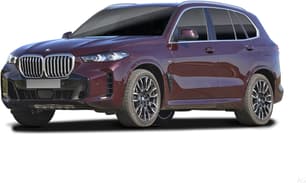
Visually this is the model’s biggest departure since launch the 1999 original. Blocky and aggressive, BMW describes the styling as ‘monolithic’, and though the quiet grace of proceeding models is gone, it is still somehow X5, thanks to proportioning and a great stance. The rear is the SUV’s best angle.
Any aero traps caused by the tall bonnet line and boxed-out arches are negated by ultra-smooth surfaces and attention to design details, including the strange yet effective door handles.
The Neue Klasse design language translates better inside the slightly roomier interior, dominated by the Panoramic Vision display below the windscreen, bizarre-looking steering wheel, trapezoidal central touchscreen and smaller display ahead of the passenger.
Inside and out, the G65 is the most modern looking X5 ever.
For all the positives of continuing to offer the previous generation Cayenne alongside the new one, it does come with some downsides too. The most obvious is unmissable design differences between the older generation and this newer one.
This new electric version has the same basic silhouette of the previous Cayenne, but the details give it a distinctive look. Being electric it needs to cut through the air as efficiently as possible, so this new model is longer and lower than the internal combustion versions.
The details of the design also give it a sharper, more modern look too. Not that the previous Cayenne suddenly looks old and outdated, but if you stick with petrol power you will be sacrificing the latest styling.
Another surprising design element with this new model is an optional off-road package, which includes a unique front bumper for greater off-road clearance and approach angle. It’s unlikely that too many Cayenne Electric owners will head deep into the bush, but for those who want to, the unique bumper will help them go further.
However, it does create a rather unusual look, as it has quite a pronounced undercut, or what I referred to as an ‘overbite’ that definitely doesn’t look as well-proportioned as the standard bodykit.
Inside, for all the hype around Porsche performance, one of the brand’s standout features has always been interior design.
This new Cayenne looks really interesting inside, with curved screens for the digital instrument display and the multimedia system, as well as the option to add a third screen in-front of the passenger.
The overall level of fit and finish, the detail and quality of the materials is exactly what you’d expect from a premium brand and an SUV at this price point.
At just under five metres long, the X5 is properly packaged to be an effective and inviting five-seater family car.
Big doors open up wide into an elevated, spacious yet cosy environment that treads a fine line between functional and minimalistic.
BMW seats are among the industry’s best, offering an elevated level of comfort and support, with ample adjustability. Even hours sat in them didn’t result in aches or pains.
The driving position is first class, offering unimpeded views of the road ahead. And although there are fewer buttons than before, at least there are physical switches for most of the major controls – starter, seating, gear selection, mirrors and volume – and all within easy reach.
That said, while the touchscreen has one of the better permanent climate control islands, its pinch-and-slide air-flow director is a bit hit-and-miss. The ventilation system itself works a treat.
Even if you’re not used to the BMW’s configurable Panoramic Vision display, it does not overwhelm, thanks to the large, clear figures and symbols that are easy to read.
Take the time to learn the menu and you’ll find endless configuration possibilities, including for the Panoramic Vision, including colour coding it to drive settings and prioritising the info you want.
And remember, there’s a head-up display directly ahead of the driver if that all becomes too much for you.
Still, will BMW ever return to the magnificent analogue dials it used to do so well?
Most of the X5’s contrasting textiles and finishes are fresh and pleasing, and include slate stone and glass trim options for a real upmarket look. Note, though, that a few squeaks and the odd misaligned panel were detected in a couple of examples, detracting from the overall quality feel.
Further back, the BMW is just as user friendly. The 40/20/40 split/fold seats are firmly inviting, with sufficient space for legs and knees due to some clever scalloping of the front seats in the example we tested.
Rear climate-controlled directional ventilation, ample storage and lovely ambience are all plus points. And most amenities are present, including a centre armrest, cupholders, USB ports and even magnetised smartphone holders. The Germans have done their homework properly here.
The same goes for the luggage compartment, offering from 655 litres (VDA) of capacity, extending out to a lush 1850L with the second-row seatbacks folded. Some extra storage exists underneath the high but flat floor, and in ICE-powered X5s, low-and-behold, you’ll find a space-saver spare wheel. Thank you, BMW.
As for the space and practicality, once again Porsche showcases that it’s not a one-trick pony brand. As fast as the Cayenne Electric is - and is very fast - the designers have also ensured it is a genuinely spacious vehicle for a family.
The second row space is good, enough to take two adults in comfort and easily accommodate three kids.
The SUV is obviously the more practical of the pair, with the Coupe losing some rear headroom.
As for the boot, space varies between 781L for the Cayenne SUV and 747L for the S and Turbo SUVs, while the Coupe looks sleeker but comes at the expense of cargo capacity, dropping to 534L for the Coupe and Coupe S and just 500L for the Coupe Turbo.
The technology integration is well-considered too. One highlight is the new curved central multimedia screen, which has a palm rest that extends out from the centre fascia to make it more ergonomic to use the screen.
The intuitive menu, as well as the physical controls for the volume and climate control, plus the ability to integrate the smartphone apps, means the key non-driving functions are incredibly easy-to-use, even on the move.
Integrated into that palm rest is a large centre console space between the front seats, which has both wireless smartphone charging as well as four USB-C ports and two cupholders. It means there is plenty of small item storage space to go with all the room for people.
By mid 2027, there will be four distinct powertrains available, with an X5 50e plug-in hybrid electric vehicle (PHEV) early in the second quarter and the iX5 60 EV some weeks later.
The latter aside, it’s six-cylinder internal combustion engines all the way, starting with the X5 40d xDrive diesel from $143,900 before on-road costs, with the X5 40 xDrive petrol version kicking off from $145,900. Electrified prices are to be announced shortly.
Here’s what comes as standard, on top of the usual array of luxuries expected at this price point:
BMW reckons that, while the base models jump $4000 from the previous-gen grade equivalents, there's more than $12,000 worth of extra features, including:
BMW also offers three-years of free access to its multimedia subscription service called Digital Premium. Air suspension with rear-wheel steering is a $7000 combo option. Wheel sizes rise up to 23 inches.
Choosing the factory tow-bar option also ups braked towing capacity to 3500kg.
So, is the X5 good value for money?
It’s certainly competitively priced and equipped against the Audi Q8, Range Rover Sport, Porsche Cayenne and Mercedes-Benz GLE grade equivalents, and probably the next-gen Audi Q7 coming sometime next year too, as that shall also receive a sizeable tech upgrade.
But other rivals offer less expensive entry points, such as the current Audi Q7, Volvo XC90, Volkswagen Touareg, Genesis GV80 and Lexus RX.
Starting with the basics, there are two different variants of the new Cayenne - the SUV and Coupe - and three trim grades to choose from - the entry-level model (known only as ‘Cayenne’), the sportier S and the flagship Turbo.
A major factor in the sales decline of the Macan is undoubtedly the rising cost of the car, which leapt up as much as $30,000 on some variants. So Porsche has been more careful with how it has positioned the Cayenne.
The new electric Cayenne is still a more expensive proposition, with the standard Cayenne SUV starting at $167,700 ($173,500 for the Coupe), which is over $20,000 more expensive than the equivalent petrol-powered model. It should be noted that that doesn’t factor in the increased performance and level of standard equipment, which includes air-suspension across the entire electric range.
Moving up the range, at $193,000 (Coupe - $194,500) the Cayenne S Electric is only just over $8000 more than its petrol alternative but the $259,800 (Coupe - $272,000) Turbo is actually more than $40,000 cheaper than the Turbo E-Hybrid. So it is not as simple as saying the electric Cayenne costs more across the board.
However, this isn’t the only one of the key differences between Porsche’s Macan and Cayenne strategy. The Cayenne petrol and hybrid models are here to stay for the foreseeable future. Rather than being completely replaced by the electric version, Porsche has learned its lesson and is giving customers more choice.
Officially Porsche hasn’t confirmed a new-generation of Cayenne petrol/hybrids, but all signs point to a new version coming in the next few years to carry on internal combustion power deep into the 2030s.
Porsche Australia also knows that the competitiveness of our very crowded market means extra equipment is a good idea. So all Australia-bound Cayenne Electrics come relatively well equipped, and more so than most overseas markets. For example, all local examples are fitted with air suspension as standard.
For the Cayenne, standard equipment includes:
For the extra money - aside from extra performance we’ll detail later - the Cayenne S adds:
The Cayenne Turbo adds even more performance as well as:
Adaptive sports seats with 18-way adjustment
Every G65 X5 40 xDrive is powered by a 3.0-litre in-line six-cylinder turbo engine, with 48-volt mild-hybrid technology featuring a 13kW/200Nm electric motor and 0.9kWh battery.
The B57 40d (for diesel) version makes 230kW of power at 4000rpm and 670Nm of torque from 1500-2500rpm, sent to all four wheels via an eight-speed ZF torque-converter automatic transmission BMW calls Steptronic.
The 2430kg 40d’s 0-100km/h sprint time requires 6.1 seconds, on the way to a top speed of 230km/h.
Not a fan of diesel? The 65kg lighter B58 40 petrol alternative produces more power (294kW between 5200-6500rpm) but less torque (580Nm from 1980-5000rpm), slashing the 0-100km/h acceleration time to 5.3s while upping top speed to 250km/h.
As mentioned earlier, there are three initial Cayenne Electric variants and each offer a different powertrain option. All are dual-motor, all-wheel drive but the power levels vary greatly depending on what you spend.
The standard Cayenne Electric comes with 300kW (325kW on Overboost), which is enough for this five-seat, family friendly SUV to launch 0-100km/h in just 4.8 seconds, which is genuinely impressive.
However, stepping up to the Cayenne S raises the power level to 400kW (490kW on Overboost) and drops the 0-100km/h time to 3.8 seconds.
Finally there’s the Cayenne Turbo, with up to 850kW of power and a claimed 0-100km/h capability of just 2.5 seconds. Which is borderline crazy for such a big SUV.
It is worth explaining that the 850kW claim for the Cayenne Turbo is only available for short bursts of performance when you activate Overboost, and the ‘standard’ output for the two electric motors is 630kW, which may sound like a lot less but is actually more than enough to make the Cayenne Turbo feel fast anytime you need more performance.
Using European WLTP data, BMW says the X5 40d xDrive should average around 7.3 litres per 100km, translating to 193 grams/km of carbon dioxide emissions.
Brimming its 75L tank with diesel should give over 1020km of range.
Meanwhile, the X5 40 xDrive ups those respective figures to 9.3L/100km and 213g/km, for over 890km between petrol refills of its 87L tank.
Our circa-200km launch drive from Sydney’s CBD down to the south coast of NSW saw the X5 40d xDrive diesel indicate a consumption average of 7.3L/100km, against the 40 xDrive petrol’s 10.4L/100km.
That’s not bad at all given how enthusiastically both BMWs were driven.
The Cayenne is Porsche’s third electric model, after the Taycan and Macan, and it shows. The brand has taken battery production in-house for the Cayenne, producing the 106kWh unit at its own factory in Eastern Europe.
Range is rated at 542km for the Cayenne, 571km for the Cayenne S and 537km for the Cayenne Turbo.
Thermal efficiency is the key selling point for Porsche, as it unlocks not only the peak performance but also the repeatability that allows the Cayenne to launch so quickly over and over again. It’s notable, that unlike most other EVs that get slower the more time you extract peak performance out of them, Porsche was happy for us to undertake multiple acceleration runs in the same vehicle.
But that’s not the only trick Porsche has up its sleeve. It will be introducing inductive charging with the Cayenne. This means you’ll be able to buy a charging pad you can place on the floor in your garage, and simply drive it, park on top of it and the Cayenne will charge wirelessly.
This has the potential to be a game-changer for EV buyers as it removes the need to plug in to replenish the batteries, making life even easier for owners. It’s not available in Australia at the time of publication, but the company says it will be available from the fourth quarter and all Australian-delivered models, even those sold now, will be able to be retrofitted to take advantage of the technology.
BMW pretty much invented the premium performance SUV with the original E53 X5, chiefly because it was based on the E39 5 Series. Every generation since has leveraged that reputation.
The latest version remains the driver’s choice, not least because it uses BMW’s excellent CLAR platform from before. It’s a great base for any vehicle.
The carryover bits, albeit evolved, only enhance the G65, starting with the powertrains.
Another brand pillar, the pair of in-line sixes available do offer surprisingly varied driving experiences, and not quite in the way you might expect.
Take the X5 40 xDrive petrol.
This is more typically classic BMW, with a turbine-smooth, elastic sensation to the performance on offer as it launches away, especially in Sport mode.
The real sensation of speed happens when the (imagined) rev needle swings past north, meaning that the B58 is in full flight. With so much mass to move quickly, it needs to inhale all the way in before the cobwebs are truly blown away, singing a soaring mechanical melody as it exhales.
The petrol X5 melds precision with discipline, thanks to fabulously flowing steering, terrifically deft handling and solid body control. Few road conditions seem to faze this BMW. And not once did the ADAS tech intervene or interfere with progress.
We tested two petrol variations – one with the standard adaptive dampers and the other with the air suspension/four-wheel steering combo; with both wearing optional 22-inch wheels, the differences are fairly subtle at speed on the rural backroads of southern NSW, questioning the value of spending more on the cushier set-up. The normal X5’s ride quality is firm yet comfortable enough. On the other hand, steering assistance from the rear axle would certainly benefit tight parking manoeuvres.
A more profound contrast can be found when switching to the X5 diesel, since it trades rousing crescendos for tremendous low-down grunt.
Packing an almighty wallop that makes small work of moving 2.5 tonnes of SUV the moment the throttle is tickled, the 40d xDrive strides forward with reassuring, relaxed calm, emitting a baritone murmur that will have occupants second guessing the type of fuel in the tank.
Remarkably, the diesel’s effortless pace made it the preferred performer during our two days with the new X5.
Whether the 40d would feel as dynamically dextrous as the petrol is doubtful, though in isolation, both are sporty, invigorating drives, offering a largely serene travelling experience.
Largely? Some road noise coursed through inside the plush cabin regardless of fuel type, and the sheer weight of the BMW was evident when those massive wheels thumped over larger bumps. But there is a real sense of elevated engineering going on within.
In other words, what you hope for but do not always get in a luxury SUV.
The X5 remains at the top of its game.
Porsche Australia invited us to drive the new Cayenne Electric in Port Lincoln, South Australia. While a picturesque part of the country, it seemed like an unlikely venue to test drive a new Porsche, as it’s typically Ford Ranger/Toyota HiLux country.
But one of the reasons Porsche launched the Cayenne Electric in regional South Australia was because they had managed to find a small airstrip we could use to fully explore the acceleration potential.
Even some operator error, which meant my launch was using ‘just’ the 630kW, the acceleration was sickeningly fast and had me hitting more than 170km/h in just 200m. With the full 850kW unleashed the Cayenne is actually faster 0-100km/h than Porsche’s hero sports car, the iconic 911 Turbo S.
That alone is a remarkable achievement, but Porsche had a few more reasons for taking us to Port Lincoln. After a drive on some sealed roads, which demonstrated the SUV's on-road composure, we found ourselves heading off-road… more off-road than I thought possible (or at least sensible) in a Porsche.
After surviving some of the gnarliest rocky roads, we found ourselves in some stunning sand dunes. We were driving the Cayenne S with the optional off-road package but the only other modification was to let down the tyres.
Carving through sand dunes like you’re in the Dakar Rally is likely to be a rare job for the Cayenne Electric, but the fact it is capable is immensely impressive and helps to demonstrate the breadth of capability that this electric SUV has.
But Porsche wasn’t finished showing off just how multi-talented the Cayenne is.
They had a Cayenne Turbo attached to a trailer, carrying the previously beaten 911 Turbo S, to prove that it can live up to its claimed 3500kg towing capacity.
Towing a nearly $600k sports car with a $260k SUV is an expensive way to demonstrate the point, but the Cayenne didn’t miss a beat. Certainly the battery was dropping more rapidly than it was unladen, but the electric Cayenne underlined that it can do everything the petrol versions can manage (at least over a short distance).
There is currently no ANCAP crash-test rating. But associates Euro NCAP has recently awarded the latest X5 the full five stars.
Here’s what they stated: “The BMW X5 emerges with a thoroughly well-deserved 5-star rating. With consistently good performance in all four stages of an accident, the car demonstrates excellent all-round safety.”
The G65 comes with a high level of advanced driver-assist safety (ADAS) technologies, including front and rear autonomous emergency braking (AEB), lane departure collision features such as emergency lane keep and blind-spot monitoring, as well as cyclist dooring mitigation and adaptive cruise control.
Six airbags are fitted, including side head curtain and a front-centre item, along with a pair of ISOFIX and child-seat tether anchorage points in the rear seats.
As for safety, the Cayenne Electric is as well equipped as you should expect a car at this price to be. There are all the features that have become the norm, including speed limit warning, autonomous emergency braking, lane keeping assist, etc.
But it’s not the fact that it has all the safety features that’s impressive, it’s the level of calibration. Yes, the speed limit warning will go off if you speed, but generally the other safety systems were very well-behaved and understated during our drive.
However, the only caveat with that is our drive was almost entirely in regional areas, so we should reserve final and definitive judgement until we get it into the urban environment.
As for its safety rating, the Cayenne was crash tested by Euro NCAP in December 2025 and awarded a maximum five-star score. It is unlikely ANCAP will crash test such an expensive model here, so expect the same rating to carry over barring something unusual.
BMW offers a five-year/unlimited kilometre warranty, along with three years of roadside assistance.
This is average for a premium brand, but behind most mainstream manufacturers, some of which run to seven and even 10-year conditional coverage.
Servicing intervals are ‘condition based’, meaning the vehicle will indicate when servicing is due. We recommend pre-empting any issues with a visit to a dealer every 12 months or 10,000km.
While there is no capped-price servicing, BMW does offer pre-paid servicing packages: a five-year/80,000km schedule at $3570, or $5710 for a full brake disc/pad overhaul during that time frame.
Currently there are 48 BMW dealers throughout Australia.
The Cayenne Electric is covered by Porsche’s usual three-year/unlimited kilometre warranty, and the battery gets eight years of coverage.
Both of these are fairly standard by historical terms, but with so many luxury brands - including Audi, BMW, Lexus and Mercedes-Benz - all now offering five years of coverage, it does leave Porsche lagging behind.
Servicing intervals are every 12 months or 15,000km, whichever comes first, which is standard for an internal combustion engine vehicle.
Porsche doesn’t offer capped-price servicing, so prices may vary from dealer to dealer. However, the brand does sell a special EV-focused ‘Porsche Scheduled Maintenance Plan’ that costs $1995 for three years, $3695 for four years and $3995 for five years of servicing.