What's the difference?
When the BMW iX first showed up a few years ago, it was a promising look at what BMW seemed capable of when it comes to electric cars.
While mildly flawed, the iX was fast, comfortable and felt properly premium. Now it’s had a decent update, with the iX xDrive45 M Sport here to replace the former entry-level xDrive 40.
BMW claims among other mechanical and tech updates a power increase of 25 per cent, a 30 per cent greater energy content for the battery, a 38 per cent increase in driving range and a 17 per cent faster charging rate.
But in the time since the iX launched, there have been big strides in the premium electric SUV space, including new arrivals from European opposition like the Polestar 3; even a new American in the form of the Cadillac Lyriq.
Throughout its history Volvo has been known for a lot of things. Being a safety leader, dorky but endearing station wagons, ‘bloody Volvo drivers’, and more recently, a trailblazer in minimalist premium design.
The C40 is the first step in a next chapter for Volvo, with the brand wanting to be known next for its leadership in the electric space. For the first time for Volvo, it’s a fully electric offering
But in a world of Teslas, Polestars, and Mercedes Benz EQs, where does the C40 sit, and is it worth considering in an increasingly congested premium small SUV space?
We went to its Australian launch to find out.
If anyone was worried that it would be too late to get a decent bit of value out of an entry-level iX, there's reassuring news.
With more power, range and features added to the model and the cost remaining close to its former sticker price, the iX has held up well despite now existing in a more competitive environment.
The C40 becomes a compelling option in the electrified small SUV space, offering a premium look and feel, great range and tech inclusions at the price, as well as awesome on-road dynamics.
Its main downsides are the rear seat, which is compromised by its platform and design-led roofline, and the overwhelming power and added traction of the dual-motor makes the single motor less attractive on the value front.
Still, regardless of variant chosen, the C40 looks to offer a stand-out balance of price, range, and performance, against its traditional rivals and newcomers alike.
The iX was a bit divisive upon its original launch, because it was one of the early adopters of BMW’s current ‘big grille’ era.
The good news for the iX is that many have adjusted their expectations on that front and it now feels pretty well at home in the brand’s line-up.
The addition of the 'Iconic Glow' grille surround might be a step too far for some, but overall the iX has aged well and its exterior design hasn’t changed much because of that.
The adaptive LED headlights have new DRL elements, and the M Sport pack is now standard, but if you were only casually familiar with the iX you’d have to be looking closely to spot the update.
The new colour palette for the iX also includes the pictured 'Arctic Race Blue metallic', though I’m personally a fan of the iX in all black, giving it a more monolithic look.
Inside, it’s a similar story - what was once perhaps ahead of its time is now the expectation in an electric SUV. Minimalism in terms of physical controls, but plenty of space.
Helping the feeling of spaciousness is the now-standard panoramic sunroof, though a lack of physical shade is one of the iX’s few interior let-downs. Instead, it can electrochromatically ‘shade’, which still lets in plenty of light.
At night, ambient lighting joins the glow of the iX’s rather large 14.9-inch multimedia touchscreen and 12.3-inch driver display.
Volvo has become a brand with a distinctive and consistent design language which embodies the kind of beautiful minimalism normally associated with Scandinavian brands.
I have always liked how Volvo says more with less design elements, with only gentle touches of chrome or gloss black, and a lack of over-the-top sporty pieces avoiding the temptation to over-sell the sporty potential of the brand’s range.
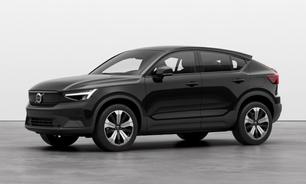
The C40 takes the small SUV formula, well established by its XC40 relation, and gets a bit weird and experimental. It’s slightly lower and has a more coupe-styled rear, with a strongly raked rear window giving it a sportier and more aggressive look than the rest of Volvo’s SUV range.
The styling is sold by an angular spoiler piece running atop the boot, and the rear light clusters have gone all minimalist, constructed of individual pieces rather than a single transparent housing, and they give a nod to the C30 hatchback which this car is the spiritual successor to, by name and nature.
The interior offers up no surprises, sticking to the formula Volvo has established across all of its current models. An effortlessly premium space with, again, a minimalistic dash dominated by the portrait touchscreen, the C40’s premium nature is confirmed by its finely patterned inlays, simple chrome pieces, and abundance of soft-touch surfaces.
The big upright vent fittings with clever rhomboid patterns on their adjustment dials are always a highlight piece of modern Volvos, and the pattern work is continued on the central volume adjust dial and even on the little rotating pieces of the light and wiper stalks. Clever.
Even the software is paired back on the multimedia suite and digital dashboard, with easy to use shortcuts and simple menus which suit the car.
Volvo might turn off some buyers with the more unconventional shape of the C40. But for those looking for a more traditional SUV it also offers the XC40 in the same two variants, and the Polestar 2 caters to those not looking for an SUV at all.
The space on offer in both rows of the iX is a huge plus, and it might even be enough to make you look past some of the small downsides to the electric Bimmer’s interior.
The iX’s clever two-level central console has the phone charger pad and drinks holders down out of the way and means you can put distractions (phone) and your tall bottles out of the way. There's a slot above for your phone to sit upright with a gap under for charging, too.
The storage bin under the armrest also has plenty of space as well as a little shelf for smaller items you don't want to go hunting for, but the iX’s control panel and dial are still reflective and, at certain times of the day, this means distracting light getting in your eyes.
Speaking of distracting, I have found BMW’s multimedia software to be less intuitive and more complicated with each major update, and ‘OS 8.5’ is no different. At this point, using the brand’s touchscreen feels like operating an iPad on the move, with dozens of menu tiles to sort through.
But back to the physical space that is the iX’s interior - the big EV makes a lot of sense as a family car, especially if your kids are old enough to appreciate (and keep clean) the fit and finish.
Not only does the drive have a nicely adjustable and comfortable sports seat thanks to the M Sport pack, there's also heating and a massage function.
The front passenger gets the same, and the second row is borderline palatial. There's heaps of kneeroom, headroom, and even space under the front seats at their lowest setting to slot your feet.
The four-zone climate controls mean arguments are avoided, there is of course a central armrest, though even with it folded up and a person in the centre there's enough room in the back to be comfortable.
Behind that, the iX’s 500 litres of boot space could probably be expanded but at the expense of rear legroom, so it's acceptable. There is space under the floor for cables, but no space saver spare, just a repair kit.
There's a switch that allows you to fold the seats down from the tailgate, but you can also manually fold the middle seat for a 40/20/40 split rather than the more expected 60/40.
The C40 is essentially a XC40 with a cropped down roofline, and there are some obvious downsides which this new shape brings.
The front seat throws no surprises, though, offering plenty of room for two adults with a welcome level of adjustability for the seat and wheel. The seats could be more comfortable, though, with a notable lack of padding in the base compared to some luxury (or even non-luxury) rivals.
I’m a fan of the fabric trim which comes on both grades, bucking the trend of needing to have leather or leather-like trim for a car to feel ‘premium’.
The ample window space up front, including the massive glass roof helps the C40’s cabin feel spacious, but the view out the rear with its aggressive design is all but a very limited letterbox aspect, particularly if the rear seat headrests are in the upright position.
While some controls are exclusively via touch interface, there is a physical volume dial, and shortcut buttons for the defogger functions.
Temperature is controlled by touch, however, and the detail settings have some smaller toggle adjustments. Tricky to jab at when you’re on the move.
The digital dash is refreshingly simple, but minimally adjustable, with the choice of either a nifty navigation screen, a blank screen, or trip details being the only options.
Cabin storage is good but not stellar. There are bottle holders and big pockets in the doors, a set of two cupholders in the centre (beats the Polestar 2’s single cupholder), a small tray with a wireless charger under the multimedia screen, and a smallish console armrest box.
The rear seat is where the real problem exists. Unlike the XC40, the C40’s cropped roofline means my head was hard up against the roof (I’m 182cm tall).
I did have decent knee room behind my own seating position, however the seat comfort in the back still isn’t as good as some rivals.
The middle position is also compromised, thanks to the raised centre floor piece the C40’s platform needs to facilitate all-wheel drive in its combustion relations.
A bottle holder appears in each door pocket, and in a rare inclusion, there are heated outboard rear seats, adjustable air vents, and USB-C charging ports.
The boot has a quoted capacity of 413 litres with the rear seats up. The floor is comparatively high suggesting a smallish space when loaded with luggage cases, for instance. Stay tuned for a follow-up review so we can see how well it holds our three-piece demo set.
The floor itself has an adjustable, pop-up divider and multiple luggage hooks, making it quite versatile, and there is a cavity beneath which can hold your charging cables as well as the inflator kit in place of a spare wheel.
The sole entry-grade iX is the xDrive45 M Sport, which brings with it more than the original base xDrive40, but also a price a few thousand dollars higher.
It starts from $142,900 but can quickly become much more expensive when you start ticking options boxes. But in this market segment, it's not that unusual, especially considering recent arrivals like the Polestar 3.
Given it’s only a little more expensive than before, the extra kit and higher grade that now forms the iX entry-point is impressive.
The 'M Sport' pack is now standard as the name suggests, plus there’s M trim inside like the steering wheel, the M seats and silver design highlights.
The LED lights are now adaptive and the glowing grille surround has also been added.
There’s also now a panoramic glass roof as standard, rather than an option, plus the steering wheel is heated and there’s now a tyre pressure monitor.
Aside from that, there’s plenty that carries over, like the wireless phone charging, wireless Android Auto and Apple CarPlay, 18-speaker surround sound by Harman Kardon, four-zone climate control and heated front seats.
There’s also an 'Executive Pack' which adds some comfort features like soft-close doors, privacy glass and front seat ventilation with rear seat heating. That one’s $6500.
Then there’s active steering, which brings the rear wheels into play for more manoeuvrability and stability for $3000.
Adaptive air suspension is $4000, while the most expensive option is a 30-speaker Bowers & Wilkins ‘Diamond’ surround sound system for $9500.
When it comes to electric vehicles, it’s impossible to consider price alone, as you also have to consider driving range, and the C40 manages to impress on both fronts.
Its refreshingly simplified range consists of just two highly-specified variants, a single motor which starts from $74,990, offering a 434km driving range, or a dual motor starting from $82,490 which offers a 420km driving range.
There’s much more devil in the detail, but to set the scene there are now quite a few direct rivals in this price-bracket, including everything from the Tesla Model Y (from $72,300), Mercedes-Benz EQA (from $78,513), Polestar 2 (from $63,900) and even the Kia Niro which is similarly sized and specified (from $65,300).
Interestingly, the C40 is closely related to the Polestar 2, but has a much higher base starting price. Volvo says this is because it carries a higher standard specification, and offers the C40 without option packs.
Standard gear on the base single motor C40 includes 19-inch alloy wheels, a 9.0-inch portrait multimedia touchscreen (running a Google-based always-online software suite), LED headlights, dual-zone climate control, a fixed panoramic sunroof, electrically adjustable front seats, heated seats for the front two and outboard rear seats, a powered tailgate, as well as keyless entry with touch-free ignition.
Interestingly, Volvo also told us some 90 per cent of customer interest so far has been for the more expensive dual-motor variant, which is particularly impressive for doubling the power output while adding 20-inch alloy wheels, a 360-degree parking suite, premium Harmon Kardon audio, and an alternate interior trim.
Both variants score safety equipment and items which are otherwise part of expensive option packs in the Polestar 2 range. We’ll take a look at the full safety gear later in this review.
Overall, the C40 impresses on the premium car value front compared to rivals, bolstered by solid range and impressive performance.
The iX has, as the xDrive part of its name would suggest, a dual-motor electric set-up with all-wheel drive.
Power and torque now total 300kW and 700Nm for the system in the xDrive45 M Sport, up from the 240kW and 630Nm on offer in the outgoing xDrive40.
BMW says the iX is now good to hit 100km/h from a standstill in 5.1 seconds, with its claimed top speed a nice, rounded 200km/h.
Great news here, the C40 can be chosen with two powerful layouts, either a front-wheel drive 170kW/330Nm set-up, or a dual-motor all-wheel drive arrangement, able to make use of nearly double the power at 300kW/660Nm. The dual-motor is capable of sprinting from 0-100km/h in just 4.7 seconds.
The front-drive is backed by a 69kWh battery allowing it a 434km range, while the dual motor ups the battery size to 78kWh to allow a 420km driving range.
The iX’s 94.8kWh battery allows a range up to 522km, but relatively low efficiency because of the size and weight.
Its 20kWh/100km is on the higher side of power use for cars around this size and this is part of the reason its huge battery capacity results in a fairly average driving range.
Maximum power input for DC fast charging is, however, up from 150kW to 175kW with the update, which is good news for those long drives.
Surprisingly, energy consumption is quite high for both C40 variants. The single motor is the more efficient of the two, consuming 16.8kWh/100km on the more lenient ADR testing schedule, while the dual motor officially consumes 22.2kWh/100km to the same standard. I saw around 23kWh/100km overall in my short test of the dual-motor variant.
Energy consumption could be better for both, as I have achieved more consistently impressive results particularly from Hyundai and Kia electric cars.
Where the C40 is more impressive though is its charging specs, which are exactly where they need to be for a car this size. On a rapid DC charger, the C40 can charge at a rate of 150kW meaning a 10 - 80 percent charge in 40 minutes for the dual motor, or 32 minutes for the single motor.
On the slower AC standard, the C40 charges at a rate of 11kW. Expect a 10 - 80 percent charge time of around five or six hours on this standard.
The C40 uses a European-standard Type 2 CCS charging port, although it misses out on the handy two-way charging feature offered by some rivals.
The BMW iX was a relatively early entry into the catalogue of electric cars I’ve driven and because of that it had a couple of (in hindsight) unfair criticisms levelled at it.
For a start, it felt heavier than expected and its ride quality didn’t feel up to BMW’s standards - both things that plenty of electric SUVs have struggled with since.
But its drivetrain, design, and interior all impressed, aside from perhaps some of the aforementioned interior reflections.
Now years on, and the iX has aged well.
Some of the mechanicals and suspension also copped a tweak along with the entry iX now being a more powerful ‘45’. The result is a big electric SUV that holds up better than I remember.
‘Smooth’ is the key word that comes to mind in regards to a lot of the iX’s characteristics. While it’s still not perfect and feels heavy, the iX rides well in comparison to many SUVs on the market, including some of its close rivals.
Perhaps key to this is the fact its standard 21-inch wheels leave plenty of tyre to help the suspension soak up sharp edges on bumps, while we’re sure BMW’s handling engineers have learned more about getting the best out of a big, heavy electric vehicle in the last couple of years.
Road noise is well-muted as a result, and the shape of the iX doesn’t seem to lend itself to excessive wind noise. Even when you’re getting rather quick.
Despite being a 2525kg beast, its 5.1-second sprint to 100km/h is in the muscle car realm - the last of Holden’s V8 Commodores would do about that, for reference.
Its acceleration is also nicely progressive, rather than giving you an almighty but unnecessary jolt of torque right as you put your foot down. But once there’s traction and you’re rolling, the xDrive45 is impressive.
Meanwhile, its cornering and braking still reveal the heft behind the iX, it’s not something you can chuck around like a go-kart, but that’s also not really its area.
Anyone familiar with BMW’s steering characteristics will find the slightly higher force required for its weight (and thickness of the steering wheel rim) standard, though it’s still unnecessarily on the heavier side.
If you’ve driven any kind of XC40 or even a Polestar 2 before, the C40 will offer no surprises. It’s pretty much exactly the same from behind the wheel with a few subtle tweaks.
This is a very good thing. The C40 is quiet, easy to drive, and its electric motor and regen system offer a smooth single-pedal experience.
It is also alarmingly, overwhelmingly, rapid. While its massive set of batteries under the floor make it feel heavy off the line in stop-start traffic, sticking your boot into the accelerator will remove any doubt, particularly in the dual-motor variant, that this Volvo means business.
The dual-motor also has an incredible torque-vectoring system, making it extremely difficult to elicit so much as a squeak from its tyres. It also feels as though torque is distributed quite evenly between its two driven axles, making it feel neither prone to over- or understeer.
This has the effect of making the C40 feel somewhat indestructible in the corners, with absurd levels of grip.
The same feeling is present in top-spec versions of the Polestar 2, only the feeling of ever-present weight is more noticeable in the higher-riding C40, which can make it unsettling to take corners at the kinds of speeds it is capable of.
The steering tune is interesting. Volvo offers two software-controlled modes, either heavy or standard, and the standard mode is heavy enough.
Despite its electrical assistance, the wheel does continue to offer some organic feedback, making the C40 a pleasure to steer on countryside roads.
The ride is also surprisingly good, despite massive wheel options. I was impressed how easily the C40 handled most bumps and undulations, communicating little to the cabin.
The ride can approach its limits with such big wheels and the weight of its batteries, generally these are communicated via unsettling thuds from underneath the car. Regular undulations at higher speeds also had the C40 bouncing around a little.
On the whole, though, the cabin is kept relatively insulated and serene, adding an element of total confidence, similar to that offered by Teslas, whilst offering better ride quality with a softer edge. At higher speed, at least on the 20-inch wheels, road noise does pick up, however.
In terms of electric driving, there is a single adjustable setting for regen. The car either offers a full single pedal mode with maximum regenerative braking to bring the car to a halt with the motor alone, or a ‘standard’ mode which tones the regen down and offers it blended in via the brake pedal.
Single pedal mode is more efficient. I suggest you stick to it if you want to make the most of this car’s efficiency.
I was surprised to have so few complaints about the C40’s drive experience. This is a balanced and capable EV which is yet another example of how even vehicles which use combustion platforms are improved out of sight by full electrification.
The BMW iX holds a five-star ANCAP rating, which it earned under slightly more lenient testing back in 2021.
Seven airbags, auto emergency braking with cyclist and pedestrian detection up to 80km/h, lane-assist, rear-cross traffic alert and intersection assist, plus a surround view parking camera all help immensely.
Sticking to its brand promise, Volvo offers the full range of active safety equipment on the C40 regardless of variant.
This includes freeway-speed auto emergency braking, rear auto braking, lane keep assist with lane departure warning, blind spot monitoring with rear cross-traffic alert, and one of the best adaptive cruise control systems on the market.
The only item the single motor misses out on is a 360-degree parking camera, which is exclusive to the dual motor variant.
It is notable how the adaptive cruise control, blind spot monitoring rear cross-traffic alert, and rear auto braking are on the options list for the Polestar 2.
These active systems combined with eight airbags (the standard dual front, side, and curtain, as well as a driver’s knee and centre airbag) make for a five-star ANCAP safety rating to the latest 2022 standards.
BMW offers a five-year/unlimited kilometre warranty with an eight-year/160,000km warranty on the battery.
BMW servicing takes place as needed rather than on a schedule, meaning you’ll be alerted via the car or app when a service is required in the near future.
For the iX a six-year all-inclusive service pack costs $3475, regardless of how many km you drive.
BMW has 54 servicing dealers listed in Australia, with each capital city covered and many more locations in the eastern states.
The C40 is covered by Volvo’s five year and unlimited kilometre warranty, with a separate eight-year, 160,000km warranty for the battery. There is also eight years of roadside assistance attached.
It is pleasing to see the service intervals for the C40 are long, as they should be for an electric car with so few moving parts, set at two years or 30,000km.
The first 24 month service is free of charge, and Volvo tells us service pricing after this period will average out to around $100 a year ($200 per visit).