What's the difference?
When the iPhone first appeared just over a decade ago, I can remember thinking a phone without buttons would be a giant pain in the neck. Until I used one, and now the idea of a keypad phone sounds akin to starting a car with a crank handle.
The new 1 Series is likely to offer most buyers a similar revelation, with its move from the BMW-traditional rear-drive layout to more conventional front and all-wheel drive. That is assuming you gave a damn in the first place, as I suspect it’s only hardcore BMW traditionalists that care about a rear-drive premium hatchback in 2020.
And that’s not who is buying the 1 Series, with the Bavarian brand’s cheapest model intended to appeal to younger buyers who are more likely to care about connectivity, practicality and personalisation options than the excitement of losing grip from the rear. It certainly hasn’t stopped plenty of people from buying 1 Series-rivalling A-Class and A3s from Mercedes-Benz and Audi over the years.
Zeekr is making waves in Australia at the moment but it's not because of the car you see before you.
Nope, it’s the 7X mid-size SUV that’s captured a heap of attention and a whole lot of sales. In fact, of the 1832 sales the brand has managed over the first three months of 2026, just 54 were for the X.
But that was the old X and this is the new one. With more power, more performance, faster charging and a whole heap of pretty special equipment, especially for the small SUV segment.
So, is that enough to finally put the X on the map?
To answer the question of whether it matters that the new 1 Series is no longer rear-wheel drive, I say no it doesn’t. It may not be as romantic on the absolute limit, but it is better in every measurable way, and still feels distinctly BMW despite moving to the conventional layout of its rivals.
Be sure to check out Mal’s video review from the 1 Series launch last December:
It's a good thing in a small package, this Zeekr X, and there are a lot of things I like about it. In fact, the only sticking point for me is the price. But that's all about perspective. If you see this as a newcomer Chinese brand, then yes, there are a lot of more affordable options out there. But if you see it as a premium player, it's really a more affordable version of a Volvo.
Note: The author, Andrew Chesterton, is a co-owner of Smart As Media, a content agency and media distribution service with a number of automotive brands among its clients. When producing content for CarsGuide, he does so in accordance with the CarsGuide Editorial Guidelines and Code of Ethics, and the views and opinions expressed in this article are solely those of the author.
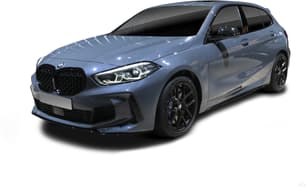
Yes, that kidney grille is rather large. If you want everyone to know you drive a BMW, you’ll love it. If not, get used to it. The X7, recent 7 Series update and upcoming 4 Series suggest they’re only going to get bigger.
Nose aside, the 1 Series hatch has always had a distinctive, long-bonnet profile, which has generally been attributed to the rear-drive layout. Despite the move to a transverse engine, the new one is actually very close in proportions when compared side by side.
It’s just 5mm shorter in overall length and 13mm taller, with body width being the most notable change at 34mm wider.
The key difference is that the front and rear wheels have been moved further back into the body, because of said engine layout change, and to make more back seat space in the rear.
Surprisingly for a model aimed at a younger demographic, the new 1 Series interior design isn’t quite the same step forward as the recent G20 3 Series.
It’s a cut above the X1 and X2 SUVS the new 1 Series shares its underpinnings with in terms of the shapes used, but is still classic understated BMW.
However its headline act is the Live Cockpit driver display on both models, which gives you fully digital instrumentation and replaces traditional analogue gauges once and for all.
The visual changes aren’t massive. This AWD version welcomes a couple of new exterior colours, including the 'Matt Khaki Green' of our test car. It also gets the two-tone black roof and there are new 20-inch alloy designs.
Elsewhere, it's the futuristic-style of design we’re used to which differentiates the X from its Volvo EX30 twin under the skin.
Inside, this is a seriously well-equipped and polished-feeling small SUV, and — unlike some of the newcomer brands to Australia — it all feels very high quality and well put together. And that includes the material choices.
I don’t even hate the fact that most of the functions are controlled via this screen, thanks to the little shortcuts glued to the home screen. I do, however, hate the fact that there’s no easy way to change the wing mirrors or shortcuts for toning down some of the safety stuff.
That aside, though, it’s a nice and high-quality feeling space.
With my modest 172 cm height, I never had any trouble with the old model, but the new 1 Series is a bit more more spacious by all the important measures.
The back seat base and backrest are a bit flat though, which is probably to help the backrest fold almost flat, but probably not very supportive during hard cornering.
There's also no centre armrest in the back or cup holders, but you do get bottle holders in the doors.
You also get two ISOFIX child seat mounts and there’s two USB-C charge points in the back of the centre console, but there's no directional air vents unless you opt for the dual-zone climate control that comes standard with the M135i.
The boot has grown by 20-litres to a pretty impressive 380 litres VDA which includes a very useful cavity under the floor instead of a spare tyre. An inflation kit is there for those duties. With the back seat folded flat, boot space expands to 1200 litres VDA.
You know you're in a small vehicle when you can't fit two large (not those crazy American-style jumbo cups, just normal coffee-shop takeaway) coffees in the cupholders, but so it is with the Zeekr X.
The small SUV's 4432mm length, 1836mm in width and 1566mm height doesn't leave much room to spread out up front. There's ample room for driver and passenger, of course, but we are talking about a small vehicle here.
Clever storage helps to mitigate that, though, especially the super-deep storage space in the centre console and the very clever fridge that separates the driver and passenger seats.
Weirdly, though, the space doesn’t feel overly tight in the back seat. We had a massive baby seat in there, and that fit without issue. And full size humans can genuinely get pretty comfortable. I'm 175cm, and I had enough knee and headroom.
In the boot, there’s 404 litres of volume with the rear seats upright and 1247 litres with them folded flat. And it’s worth pointing out this isn’t intended to be a family car, but there’s certainly enough space for the shopping... and a pram.
For the F40 generation, the 1 Series range has been cut back to two variants from launch, with the 118i for volume sales and the M135i xDrive hot hatch taking aim at the new Mercedes A35 and the Audi S3.
Both versions were priced $4000 higher than the equivalent models they replaced from launch, but have recently jumped a further $3000 and $4000 respectively. This puts the now-$45,990 118i beyond the starting prices for the equivalent Audi and Mercedes, and the $68,990 M135i xDrive is now nudging the A35’s list price.
The launch prices were largely offset by extra equipment over the previous generation, but the more recent hikes have taken the shine of this somewhat.
Thankfully, both 1 Series models now come standard with wireless Apple CarPlay. The previous ‘one year free, the rest you need to subscribe for’ plan has been scrapped since we shot the launch video below in favour of free CarPlay for life. There’s still no Android Auto, but this is due to change in July.
The 118i packs more standard equipment than before in general, including the M Sport styling pack, head up display, wireless phone charger and adjustable ambient lighting.
The M135i adds bigger brakes, a rear spoiler and 19-inch wheels, plus sport seats with leather trim, and Harman/Kardon audio among a few other things.
You can get even more from the M135i with the $1900 M Performance Package, which drops the 0-100km/h claim by one tenth to 4.7s thanks to enabling engine overboost and lighter forged 18-inch alloys, which is signified by gloss black grille surrounds, intake elements in the front bumper, mirror caps and exhaust tips.
Other options include the $2900 Enhancement Package, which brings metallic paint and a panoramic glass roof. On the 118i, it also brings 19-inch black alloys. On the M135i, it also brings active cruise control with stop and go function. This package costs an extra $500 if Storm Bay metallic is chosen.
The Comfort Package costs $2300 with the 118i and $923 with the M135i, and brings front seat heaters and lumbar adjustment for both front seats. On the 118i, it also brings proximity keys and electric front seat adjustment. On the M135i, it also brings a heated steering wheel.
The Convenience Package costs $1200 with either variant, and adds a powered hatch, modular storage system and cargo net and a ski port for the back seat.
The 118i can also be optioned with the $1000 Driver Assistance Package, which adds active cruise control (plus 0-60km/h AEB), adaptive LED headlights with auto high beams and a tyre pressure monitor.
Beyond the 118i’s standard M Sport pack, it can also be augmented with the $2100 M Sport Plus Package. This brings sports front seats, a rear spoiler, M-coloured seat belts, a sports steering wheel and upgraded M Sport brakes.
This is a small SUV with a LOT of stuff. There are two trims in the Zeekr X range – the entry-level rear-drive model is $48,900, drive-away, while the all-wheel drive version we've tested is $57,900 on the road.
The obvious comparison is to the Volvo EX30, which shares its platform with the Zeekr X through both brands' Chinese parent company Geely.
As of right now, the cheapest single-motor Volvo is $56,051, drive-away in NSW, or $49,990 plus on-roads, making the Zeekr version much, much cheaper.
Anyway, outside there are 19- or 20-inch alloys, though our test car is fitted with the optional 20-inch black alloys, paired with a black-with-red-highlights interior treatment, which adds $2000 to the price.
Ours is also fitted with the electric front doors which open or close at the push of a button, and back doors that unlatch, but don’t fully open, the same way, which adds another $2000.
Both trims also get heated and cooled front seats, and heating in the rear window seats, but this AWD version also adds a massage function for front seat riders.
There’s also wireless charging, a 13-speaker Yamaha sound system and — very cool, literally — is the little drinks fridge between the front seats in the AWD variant.
Tech is handled by a 14.6-inch touchscreen with Apple CarPlay and Android Auto and there’s a head-up display for the driver.
Both cars use versions of the three and four cylinder petrol engines from before, with the popularity of automatics leaving the previous manual option consigned to history. The 118i’s 1.5-litre turbo three cylinder now produces 103kW/220Nm, with max torque available all the way from 1480-4200rpm. The 118i now uses the seven-speed dual clutch automatic transmission, as seen on Mini models that use the same engine.
The M135i’s 2.0-litre turbo has been tweaked to take the place of the six-cylinder M140i from the last model and now produces 225kW/450Nm, with max torque available all the way from 1750-4500rpm. Its auto remains a torque converter though, but now the transverse-mounted unit also shared with Mini models with the same engine and splitting drive to all four wheels via the xDrive system for the first time. The drive split is constantly variable, but the rear bias tops out at 50 per cent and the only limited slip diff is an electric unit on the front axle.
The big news here is a more powerful rear motor – meaning you get more grunt whether you opt for the rear-wheel drive or this all-wheel drive.
In rear-drive form, that boosts your outputs from 200kW to 250kW, dropping the sprint to 100km/h to 5.6 seconds. In AWD guise, your new outputs are 365kW (up from 315kW) and 573Nm, and your sprint to 100km/h falls to 3.7 seconds.
Official combined fuel consumption is a decent 5.9L/100km with the 118i, but the M135i steps up to 7.5L/100km) 2.0 litre four in the m135i. Both engines require premium unleaded.
Fuel tank sizes vary across the two models also, with the 118i measuring 42 litres and the M135i managing 50 litres, despite its need to package rear drive components somewhere under there also.
This results in a decent theoretical range between fills of 711km for the 118i and 666km for the M135i.
This is where it starts to get weird. The rear-drive Zeekr X is fitted with a 61kWh LFP battery, which can accept up to 230kW DC fast charging, taking you from 10 to 80 per cent charged in just 18 minutes. Total claimed range is 405km.
The flagship AWD, though, charges at a slower rate. It gets a 66kWh NMN battery and can only be charged at 150kW, meaning the same charge takes 30 minutes. Zeekr is promising a 415km driving range between charges.
For a brand with a marketing slogan of pure driving pleasure, this is the important part, particularly given the new 1 Series has lost its rear wheel drive USP.
Why do some of us love rear wheel drive? It tends to be more fun when you're driving on the limit, and generally makes for nicer steering because you're only using the front wheels to turn corners.
So how does the new 1 Series drive? That depends on which version.
The 118i is quite a nice package really. It rides a bit more gently than what I remember in the A-Class and generally feels more like a premium product. It also feels a step ahead of the 2 Series Active Tourer it shares its underpinnings with, which is a good thing.
The three-cylinder engine is quite smooth for a fundamentally unbalanced triple, and it makes enough power to get you out of trouble.
Do you miss rear wheel drive? Not really, as you can only tell the difference when you're going real fast, which let's face it, is not somewhere 118i drivers are likely to go very often.
The M135i is a vastly different beast, as you'd expect. Aside from being real quick, it's that much tighter everywhere, but still definitely on the more comfortable side than what we expect the future full house M version to be.
The continuously variable xDrive all-wheel drive system does a great job of putting its power down, but the rear bias maxes out at 50 per cent, which is probably spot on for chasing lap times, but means you miss out on the tailiness of the old one altogether.
So it’s not as classically fun as the old M140i, but it’s easily faster, and that's what will probably matter most to most buyers.
Short answer? Pretty good, with some caveats.
I'm partial to a firmer ride. I find some Chinese car companies can feel like they get their suspension bits from Captain Snooze, such is the soft, pillowy ride served up. And to be honest, it makes me a little seasick at times.
The Zeekr is not like that. It has firmness dialled into the ride equation and can feel harsh at times, but also improves the drive experience, delivering connection and engagement at the cost of some sharpness on the wrong road.
It's also faster than the model it replaces, but it's also one of those cars in which the real-life feeling doesn't quite match the on-paper promise.
This thing serves up supercar speed, but it doesn't feel like it from behind the wheel. Instead, the acceleration - especially from a rolling start - feels potent, but not biblical.
From a standing start it pauses for a moment, almost like an internal-combustion vehicle might, before delivering a quick (but not stratospheric) flow of power. None of that is a bad thing, by the way. Who wants their small SUV to accelerate like a supercar?
It's otherwise an entirely pleasant drive. The cabin is serene and quiet and it's a small car that doesn't feel like one. There's nothing light or tinny about the drive experience, instead there's a heft and quality.
The new 1 Series comes with most of the important safety gear, but like the X1 and X2 SUVs and 2 Series Active Tourer that the new 1 Series shares its platform with, you still can’t get proper auto emergency braking unless you opt for active cruise control.
Both versions do offer partial automatic braking, which confusingly was enough to earn the new 1 Series a maximum five-star ANCAP safety rating according to 2019 standards, but we feel this is not good enough and is worth considering before you put your money down.
Aside from the options packages mentioned above, active cruise control with AEB (up to 60km/h) can be added to either version for $850, but when it’s been a standard item on something as cheap as a Mazda2 since 2017, it’s not a good look.
The Zeekr X wears a maximum five-star ANCAP safety rating, earned in 2024, which means the long list of required active safety stuff is present and accounted for, all wrapped up in what Zeekr calls its 'Intelligent Driving Assist System'.
There are five cameras, five radars and 12 sensors, which is a crazy number for a car this small.
And this is also not a car in which I was desperately trying to figure out how to deactivate any of the active safety systems – save the overzealous over-speed warning – which is a win these days, too.
There are also seven airbags, including a centre front airbag.
The Zeekr X is fitted with ISOFIX anchors on the rear outboard seats and top tether anchorages for all rear seating positions.
BMW is yet to step up to the five year warranty offered by most mainstream brands and now Mercedes-Benz and Genesis, continuing with the three year/unlimited coverage matched by Audi.
As always, BMW describes the service intervals as condition based, and the car will alert the driver when a service is due. This will occur at least every 12 months though, but individual intervals will vary based on how the car is driven.
This can all be bundled into five year/80,000km service packs though, with the Basic pack costing $1465, but the Plus pack adds brake pad and disc replacement to regular fluids and consumables for $3790. Assuming 12 month intervals, these prices are about average for a premium branded product.
Zeekr's coverage is an underwhelming five-year, unlimited-kilometres, while the drive battery is covered for eight-years or 160,000km. There’s five years' of roadside assistance thrown in, too.
Service intervals are 20,000km or 12 months, with five years' of ownership setting you back a hefty $3072; an average of $614 per workshop visit.
There are currently 16 Zeekr dealers in Australia - two of which are 'pop-up' sites rather than full retail centres.
Multiple locations in Melbourne, Sydney and Brisbane with the ACT, Adelaide and Perth also covered. Others include Geelong and the Sunshine Coast but so far you're out of luck in Tassie or the NT.