What's the difference?
We’re in the new BMW iX3, the first production model to arrive on BMW’s Neue Klasse (new class) EV architecture. We’re testing the flagship 50 xDrive, and it begs the question: has BMW actually managed to make its next generation of EVs feel like a proper Bimmer? Buyers expect a lot from that badge when it comes to ride and handling, so does this electric SUV actually deliver?
Long before Tesla EVs, there were electric golf buggies.
From the first half of last century, they began quietly ferrying birdie and eagle enthusiasts around their favourite courses.
For many, these have been their first (and only) experience of electric vehicles (EVs) at work.
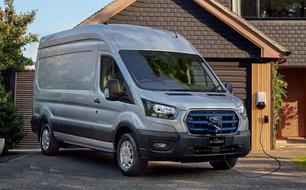
Now, the blue-collared Blue Oval mob has this – the all-new E-Transit Custom.
Designed to take on other electric mid-sized vans such as the LDV eDeliver7, Peugeot E-Expert and the Mercedes-Benz Vito Electric, it is the brand’s second – and more affordable – foray into van electrification.
Does the E-Transit Custom score above par? Let’s dive straight in!
The BMW iX3 50 xDrive is a seriously quick electric SUV that earns points for its family practicality, while its impressive range could go a long way towards easing range anxiety. The ride isn’t always as settled as I’d like, but for the most part, this is a well-executed premium EV.
Wow. This is state-of-the-art EV van engineering – complete with sporty handling and an excellent ride – yet it maintains all the usual Transit attributes.
The Tesla of electric vans? Maybe.
The only thing remains is pricing and how the E-Transit Custom behaves and drives on Australian roads… and we’ll have the answer to those by the end of this year.
But as it stands, Ford's European mid-sized van is keeping the innovative spirit of the original alive.
Note: CarsGuide attended this event as a guest of the manufacturer, with travel, accommodation and meals provided.
BMW has done a really good job with the iX3's styling. It’s distinctly futuristic without falling into that pillowy, blob-like look that some EVs have. The LED light signatures are gorgeous, although the illuminated kidney grille, from some angles, gives off bucktooth vibes. The rear indicators are also far too small.
The optioned 22-inch alloys are enormous and look fantastic, but are they worth the extra coin? Because in the EV world, size does matter and the larger the tyre, the bigger the hit to the driving range (in this case, roughly between 8-10 per cent).
Inside, BMW has avoided the same-same, slightly sterile feel of some EV cabins. There’s plenty of personality here, with the burgundy two-tone synthetic leather, stepped dashboard and seriously flashy displays bringing plenty of wow factor. The knitted accent panels across the dashboard add some welcomed warmth and texture to what could otherwise be a very tech-heavy cabin.
It may look like the old Transit Custom but the new one has been completely redesigned and rides on an all-new platform.
It’s more aero efficient and the wheelbase has been stretched with the front wheels pulled forward to liberate more leg and foot room.
The roof remains under 2.1-metres high for easier car park clearance, but there’s more space inside due to a lower floor that’s aided by new side steps. This, along with wider side apertures, make for easier loading and unloading.
The E-Transit’s traction battery is integrated into the lower-floor structure, adding significant rigidity as well as a lower centre of gravity, benefitting dynamics and control, as does the switch to an independent rear suspension set-up that conversely improves packaging.
Key cargo-capacity facts are: 3450mm (maximum load length), 6.8 cubic metres (Standard Roof load volume), 9.0 cubic metres (High Roof load volume, up to 1011kg (payload), 3225kg (Gross Vehicle Mass) and 2300kg (maximum braked towing capacity).
More info pertaining to the Australian-market E-Transit Custom will be revealed later in 2024.
The front row is spacious, and the sport seats offer plenty of adjustment to get comfortable. The massage function is particularly good when you’re sitting in a school pick-up line or waiting for the car to charge. Access is also easy, thanks to the comfortable step-in and step-out height.
There are a few storage options up front, including a shelf underneath the centre console, a couple of cupholders and drink bottle holders in the doors. Both the centre console and glovebox are on the shallow side, but I love the dual phone holders and the way they’re angled so you can still see your phone screen when you need to.
Charging options are good, with a 12-volt socket, two USB-C ports and a ventilated wireless charging pad. A second charging pad for your co-pilot would have been nice, though.
The displays look a little overwhelming at first, but the panoramic display is surprisingly intuitive to use while driving. In fact, I found it made the 3D head-up display feel somewhat redundant. The multimedia system is highly customisable and easy to navigate once you’ve spent some time getting familiar with it. Wireless Apple CarPlay was also easy to connect, and Android Auto is available too.
The rear row is just as spacious as the front, with a flat floor that will make middle-seat passengers happy. There’s also enough width for three kids to sit comfortably. The seats are firm but supportive, and I like the height of the centre armrest.
Storage back here isn’t quite as generous, with two cupholders and door-bin storage essentially covering the options. The hard seat backs are easy to clean, though, and my son was a fan of the rear climate controls, directional air vents and two USB-C ports.
There are three top-tether anchor points and two ISOFIX child-seat mounts, while the 40/20/40-split rear seat adds some useful flexibility when you need to carry a mix of passengers and cargo.
The boot offers up to 520 litres of capacity with all seats in use, which is plenty for a big grocery haul or a road trip’s worth of luggage. There’s a handy netted pocket on the side and a hard cargo cover, although, unsurprisingly for an EV, you only get a tyre repair kit rather than a spare wheel. The powered tailgate is also a welcome convenience.
Rounding everything off is a 58L frunk which houses all the charging cables.
It isn’t just parcels and packages that benefit from all the engineering advances made in the new-gen Transit Custom.
Big doors open to a new, lower and larger cabin. With the front wheels pushed forward, it’s flatter, with more space for three-abreast seating. And, now, the driver enjoys better cross-cabin access right to the opposite door with fewer obstacles.
To aid entry and egress due to its flat base, the E-Transit Custom scores a “squircle” (squarish) steering wheel. It’s one of the few visual distinctions in an otherwise fairly mundane, though well-made, interior. Material quality is of the hardy but pleasant variety.
Our test van was the optional Sport model as-yet not confirmed for the EV (though it’s coming for the diesel), with darker hues, upholstery stripes and a few more luxury features.
Australian-bound E-Transit Customs will be closer to the European Trend spec, which we factored in strongly when assessing the electrified newcomer.
Both grades sampled included Ford’s optional ‘Mobile Office’ that will be made available in Australia. Among other things, it provides a three-position wheel, from the regular position to roughly 45- and 90-degree angles.
The thinking here is for drivers to respectively either rest a laptop or have an in-situ table – complete with a squircle-shaped tray – tilt all the way forward for meal times. A lockout device prevents vehicle operation in anything but the home position.
Handy, though note that two of the three vans we drove with this feature had a rattly wheel in the normal driving position. Ford promises a fix for production is coming.
Other Mobile Office additions include various mounting points for accessories.
The driving position is 4WD-high, with the vast windscreen and very deep side windows providing panoramic views. Because of the rear bulkhead behind the seats, a camera-fied rear-vision mirror, along with the sizeable exterior mirrors, provide sufficient side/rear vision.
The driver’s seat is supportive and comfy if not that shapely, and it seems more fully padded than the flimsy cushions of the (narrower) centre and passenger seats.
The latter both hinge forward to reveal a massive storage cavity (ideal for charging cables) as well as the load-through hatch as per the previous-gen Transit where fitted.
Speaking of storage, Ford’s engineers have repositioned the passenger front airbag from its traditional dashtop home to above the windscreen header, liberating a second glove box fit for housing laptops.
The dashboard’s 13-inch touchscreen is perfectly sized and driver-angled. It uses Ford’s excellent SYNC 4 multimedia system, is powered by a 5G modem for OTA software updates for around 30 modules, and is functional, fast and intuitive. It also comes with Alexa voice commands.
Ample ventilation, big grab handles, massive door pockets for bottles, additional storage areas including behind the configurable digital instrumentation pod, several cupholders, USB-A and -C outlets near shelving areas for minimal cable entanglements, plenty of LED light sources and an armrest/tray, highlight Ford’s many decades of experience building mid-sized vans.
On the launch drive's smooth German roads, wind and road noise intrusion were impressively subdued for a van (especially so given the quiet e-motor operation compared to the clatter of a diesel), though the large frontal area means at speed you won’t mistake this for a luxury EV.
Still, being roomy yet cosy, practical yet thoughtfully presented and solidly built without feeling cheap, the E-Transit Custom's cabin is right on the money – a secure and inviting workhorse first and foremost.
Keep in mind, too, that the cargo area will likely include Ford’s 'Load Area Protection Kit', bringing a moulded load floor liner and protection for the sides and rear doors. Because, this is a workhorse, after all.
There are two variants available for the iX3, and we’re in the flagship 50 xDrive for this review. It starts from $109,900 before on-road costs, putting it in the same general territory as rivals like the Mercedes-Benz GLC400, from $112,200, and the Volvo EX60 Ultra P10, from $101,990.
Of course, like most European cars, that’s before you start adding options and our test car has quite a few.
There's $7700 22-inch M light alloy wheels and Frozen Space Silver metallic paint for another $6000. Topping it off is the M Sport Package Pro for $3500, which adds the BMW Iconic Glow Exterior Package — essentially some very swishy ambient lighting — red M Sport brake calipers, M seat belts, sport front seats and steering wheel, a 3D head-up display and a Harman Kardon sound system.
Standard equipment includes:
All up, our iX3 comes in at around $140,000 drive-away. With that in mind, it is a little surprising, then, that the rear seats miss out on heating and the front seats aren’t ventilated. Those feel like notable omissions in a car that otherwise leans heavily into premium comfort and technology.
So, how much does the V710-series E-Transit Custom cost? Nobody at Ford is saying right now.
However, with the LDV kicking off from under $65,000, the Peugeot from $80K and the Mercedes from about $91K, our money is on cost-of-entry at around $75K when sales commence at the end of this year.
Whichever way it goes, the E-Transit Custom will cost substantially less than the much-larger (V363) E-Transit full-sized van launched here last year at a whopping $104,990, before on-road costs – though that’s since been slashed to $89,990.
Note, too, that we’re only getting the long-wheelbase version, in standard or high-roof specifications for the time being.
Aimed at small to medium-sized businesses, Ford’s Turkish-built EV should be generously-equipped, with adaptive cruise control, a new patented heat pump for significantly reduced battery drain, heated front seats, a reversing camera, a 13-inch touchscreen offering Ford’s excellent 'SYNC 4' multimedia system powered by a 5G modem for OTA software updates, Alexa voice-control assistance and wireless Apple CarPlay/Android Auto.
Plus, the E-Transit Custom has achieved a record-high Euro NCAP rating for a medium-sized van. More details are outlined in the safety section below.
Note, though, there is no spare wheel, just a tyre inflation kit, sadly.
And while you can option up an outlet to power your tools, there is no bi-directional charging, so you cannot power your home in a blackout with this EV.
That said, the E-Transit Custom’s real value is to be found in the imbedded design and engineering features that distinguish this from other electric vans, maintaining a legacy of innovation that started with the original Transit way back in 1965.
The UK’s bestselling vehicle period in 2021 and 2022, the regular Transit Custom is absolutely vital to Ford’s health globally, and it’s not about to drop the ball with the electric version.
Here’s how.
The new BMW iX3 is built on an 800-volt platform and features a dual-motor all-wheel-drive set-up producing up to 345kW of power and 645Nm of torque. It can sprint from 0-100km/h in just 4.9 seconds, so in a nutshell, it’s pretty darn powerful and fast.
It might not be segment-leading when it comes to outright performance, but there’s certainly no shortage of grunt for a family SUV.
Mated to a large battery pack sharing tech with the Ford F-150 Lightning truck, the E-Transit Custom's single, front-mounted electric motor delivers 160kW of power and 415Nm of torque to the rear wheels via a single-speed auto.
As usual, 'Eco', 'Normal' and 'Sport' modes are included to suit the driver’s mood.
One of the reasons Australia won't bother with the 100kW version is its electronically-limited 117km/h top speed; the 160kW can manage all of 133km/h.
Keeping all that performance in check are a strut/leaf spring arrangement up front and a semi-trailing arm independent rear suspension borrowed from its larger sibling.
Full technical specifications will be revealed closer to the E-Transit Custom’s local launch at the end of this year.
The iX3 has a massive 108.7kWh lithium-ion NCM battery and a WLTP driving range of up to 805km. With the optional 22-inch alloys, that range does take a hit in our test vehicle, dropping to around 740km, which is still very good.
With my average consumption sitting at 15.5kWh/100km, I’ve actually beaten the claimed energy consumption of 18.8kWh/100km. That’s after a mix of highway and urban driving throughout the week, which is seriously impressive for a large, powerful electric SUV.
The iX3 has a Type 2/CCS charging port and can accept up to 22kW on an AC charger and a hefty 400kW on a fast DC charger. Finding a charger capable of delivering that much power will be the real challenge, but if you do, BMW claims a 10-80 per cent charge in just 21 minutes. That’s excellent charging performance and makes longer road trips considerably easier.
However, it does lose marks for missing out on vehicle-to-load (V2L) functionality. BMW Australia says the iX3 is equipped with the hardware for V2L, but the company is waiting on approvals for the required accessories before it can be rolled out to Australian versions. In other words, it's coming soon.
Ford's official energy consumption figure for the E-Transit Custom is 21.8kWh/100km and the trip computer in our Sport grade test vehicle read 21.6kWh/100km, which is about on the money for this size of van.
With the 64kWh Nickel Cobalt Manganese battery pack that’s 'shrink-wrapped' low down under the load area to help achieve that low floor, the WLTP range figure is 308km for the 160kW (and 337km for the 100kW E-Transit Custom Australia is likely to miss out on).
Ford reckons these numbers are roughly four times the average-daily mileage for van drivers in Europe.
Brake-by-wire regenerative-braking tech allows for one-pedal braking, which in turn helps recharge the battery pack. If you lash out for a big 11kW Wallbox accessory, the standard 11kW AC on-board charge allows a full overnight top-up.
As the E-Transit has a 124kW DC fast-charge capacity, a high-capacity station can replenish the battery from 10-80 per cent full in under 45 minutes.
The iX3 50 has plenty of power and torque to satisfy when you need to plant it on a hill or overtake. Power is delivered smoothly in Efficient mode, but it definitely feels more dynamic when you switch to Sport.
The suspension is nicely balanced around town and through corners, but occasionally the car feels a little unsettled on an uneven open road. This is where you start to wonder whether those big tyres are doing the car any favours.
The steering is lighter than expected, although you do get used to it after a couple of days. The car can also feel heavy when you need to stop quickly, to the point where the brakes can feel a smidge spongey. Otherwise, they’re responsive enough.
The cabin is impressively quiet around town, although road noise, again, likely helped along by those big tyres, creeps in a little more on the open road. To be clear, it’s only more noticeable by EV standards; this is still a quiet car compared with a combustion-powered SUV.
Visibility is quite good from my driving position, and I like the commanding view overall. SUVs do rule the roost in this regard. There are four regenerative braking levels, including B mode for one-pedal driving, and I’ve kept it on either level three or B throughout the week.
I also like that you can still creep at lower speeds in B mode, and the 360-degree camera is exceptionally clear. The way the camera view moves with the steering wheel takes a beat to get used to, though. If you're a little unsure, you can activate the parking assist function, and the car will park itself.
For every one of its four generations since 1965, the Transit has set the pace for driveability, as if Ford of Europe was determined to stamp its dynamic authority in the commercial vehicle space.
The original broke the van mould by being far more car-like than any that came before, offering the availability of a powerful engine, responsive steering and safe handling.
That the E-Transit Custom maintains the philosophy is no surprise; that it ended up being so fresh and rewarding to drive – albeit on German roads carefully chosen by Ford – should be a warning for rivals to raise their standards.
Let’s start with the lofty yet cocooning driver environment, which immediately sets you at ease and in the mood. Nothing awkward or uncomfortable to report here.
Shift the natty little column wand into D, and the instant throttle response of a good EV seems slightly too good to be true in what is a boxy workhorse. Acceleration is urgent yet smooth, humming away as the speed builds in a big yet measured way.
That’s all good and well, but given the sheer mass of this mid-sized van, the second big test is how measured and controlled the handling is, especially at speed.
Again, there’s ample feel from the squircle wheel, as the E-Transit tips crisply into corners, glides through fast curves and generally maintains its composure when turning up the pace.
Credit, no doubt, to the new trailing link independent rear suspension system, which must take a lot of the credit in making the Ford van handle so confidently.
It also does a great job absorbing bumps and isolating the occupants from the road surface underneath.
We tried the standard Trend-spec 15-inch wheeled version, as well as the 17-inch Sport version, which does have a slightly firmer edge, but then seems ever keener through corners.
One of the E-Transit Custom’s true achievements is that – with no diesel engine to drown other noises out – the lack of wind, road and tyre noise intrusion is just so relaxing. Its refinement and ability to combat fatigue augers well for EV van drivers of the future.
Again, keep in mind that we’re on slick Euro roads in specially-prepared launch vehicles, equipped with ballast in the back to emulate a load (and hunker down the rear).
Ultimately, the true test will come when behind the wheel of the E-Transit in Australia. But, our first drive revealed what is surely the most modern and enjoyable van we’ve yet to experience: fast, fun, secure and comfortable.
The BMW iX3 has a maximum five-star ANCAP safety rating, based on testing conducted under the new 2026 protocols. It scored 71 per cent for Safe Driving, 83 per cent for Crash Avoidance, 86 per cent for Crash Protection and 95 per cent for Post-Crash Response.
Importantly, I found the safety systems unobtrusive in everyday driving, while the adaptive cruise control is nicely calibrated and doesn’t constantly feel like it’s fighting you for control.
Standard features include:
Ford Australia has yet to confirm the E-Transit Custom’s final safety spec, but the regular diesel version provides many of the answers.
Euro NCAP has awarded the broader V710 Transit Custom range a maximum five-star 'Platinum' rating. A best-in-class result thanks to a broad array of driver-assist safety.
This includes AEB with passenger and cyclist detection as well as intersection-assist (all operable from 0km/h), lane-keep systems (from 60km/h), blind-spot monitor, rear cross-traffic alert, full stop/go adaptive cruise control and exit-warning alert.
A full suite of airbags is also fitted.
We’ll find out more closer to the E-Transit Custom’s Australian launch.
The iX3 is covered by a five-year/200,000km warranty, which is a fairly typical term at this end of the market. You can also pre-purchase a six-year servicing plan for $2420, which is a reasonable cost for a vehicle in this price bracket.
Maintenance is governed by BMW’s Condition Based Servicing system, so the car will tell you when it’s time to head in for a service. Depending on how you drive it, expect servicing to be required somewhere between 12 and 24 months.
As with all Fords, a five-year/unlimited-kilometre warranty with (a conditional) seven years of roadside assistance is anticipated. All high-voltage components including the battery are subject to an eight-year/160,000km warranty.
With dramatically fewer moving parts, Ford reckons operating costs can be reduced by up to 40 per cent compared to the diesel-powered Transit Custom equivalent with service intervals likely to match its big EV bro’s at 12 months/30,000km.
The time-saving convenience this brings is one way Ford reckons helps to justify the circa-30 per cent premium the EV commands.
Note, though, that these figures are based on European data and may take in regional EV subsidies and incentives not available in Australia.
Expect capped-price servicing to be another incentive.
All that info and more will drop closer to the EV’s launch closer to the end of this year.