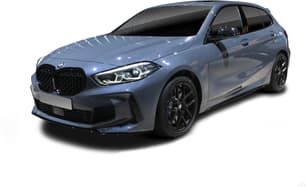
What's the difference?
It wasn’t that long ago the notion of a front-wheel drive (FWD) BMW was unheard of, but along came the third-generation 1 Series five-door hatchback in September 2019.
The 'F40' 1 Series' predecessors were based on rear-wheel drive (RWD) platforms, as was every other model in BMW's long history – to that point.
Ironically, though, the F40 1 Series' performance flagship remains the all-wheel drive (AWD) M135i xDrive, but now it has a FWD counterpart, the Volkswagen Golf GTI-baiting 128ti.
Critically, this represents the first time since the late 1990s range of 3 Series Compact three-door hatchbacks that the ti, Turismo Internazionale, badge has been affixed to a BMW.
So, does the 128ti hot hatch live up to the ti lineage of sporty BMW small cars? And perhaps more importantly, does it prove a FWD BMW can be truly desirable? Read on to find out.
Kia admits that, even a handful of years ago, a car like the EV4 likely wouldn't exist in Australia. With a forecast of 70 sales a month, or 840 a year, it won't come close to the brand's biggest all-electric sellers, and senior executives and product planners alike would have been wondering if it was worth the effort.
But times have changed, and so have regulations, and Kia is happy to roll the dice on as many EVs as it can get its hands on to lower its fleet emissions in the wake of the New Vehicle Efficiency Standard (NVES).
If you'll forgive the long and rambling intro, I'll now get to the point. Long live the NVES, because the EV4 is a good (if a little bizarre-looking) thing. It's quite lovely to drive, will cross vast distances in its long-range guise, and will undoubtedly make our roads a more visually interesting place.
But would you have one over the Tesla Model 3 or BYD Seal? Read on.
It might not be rear-wheel drive, but the 128ti is a thoroughly enjoyable BMW to steer, proving the 'f' in front-wheel drive can stand for fun. It’s a very good hot hatch.
And given how expensive mainstream hot hatches have become, the 128ti is a bargain, giving would-be Golf GTI, Focus ST and i30 N buyers a thing or two to think about.
After all, the 128ti is a premium hot hatch by virtue of the BMW badges it wears and the higher quality of its parts, but not its price. And for that reason, it cannot be ignored.
An electric sedan is really shrinking the buyer pool, which is why Kia has such gentle expectations for the EV4 in Australia. But it's a lovely driving EV with plenty of perks, and the design alone will brighten up Australia's roadways. For my money, I'd either be going for the cheapest one that's sharp value with plenty of kit, or the flagship GT-Line that gets the big battery and the works in terms of equipment. The Earth for me sits in no-man's land.
Note: CarsGuide attended this event as a guest of the manufacturer, with travel, accommodation and meals provided.
Note: The author, Andrew Chesterton, is a co-owner of Smart As Media, a content agency and media distribution service with a number of automotive brands among its clients. When producing content for CarsGuide, he does so in accordance with the CarsGuide Editorial Guidelines and Code of Ethics, and the views and opinions expressed in this article are solely those of the author.
You can count me among those who aren't fans of the 1 Series' version of BMW’s 'kidney' grille. It’s not just out of proportion, but arguably, misplaced.
In fact, it just spoils the front end, although I'm also not a fan of the bumper's 'smiling' centre air intake.
But, thankfully, that’s where my unfavourable opinion ends, as the angular headlights and hexagonal DRLs look the part, while the 128ti's red-trimmed side air intakes bring a sense of occasion.
And you better be a big fan of red trim, as the 128ti liberally applies it around the side, where the brake calipers have some presence behind the attractive 18-inch Y-spoke alloy wheels. And don’t forget the side skirt insert and 'ti' decal!
At the rear, aside from the obligatory '128ti' badge and the relatively subtle red-trimmed side air intakes, there isn’t much to separate the 128ti from a garden variety 1 Series, but that’s no bad thing as it's its best angle.
The sporty rear spoiler, sleek tail-lights, stupendous diffuser insert and scintillating dual exhaust tailpipes are gorgeous. And the 128ti is attractive in profile, thanks to its appealing silhouette and smoothly sculpted lines.
Inside, the 128ti stands out from the 1 Series crowd with the red stitching applied to the steering wheel, seats, armrests and dashboard, while the floor mats have – you guessed it – red piping.
The most interesting design flourish, though, is the red-stitched ti logo on the centre armrest. That's one way to make a statement, and it all combines to make the 128ti feel special.
And being a 1 Series is a leg-up in the first place, as high-quality materials are used throughout, in concert with a simple but effective design.
Mercifully, the centre stack features physical climate and audio controls, while the centre console has an appropriately sized gear selector and a rotary dial to control the multimedia system.
That's right, the 128ti has multiple input methods aside from the 10.25-inch central touchscreen and voice control, making it a relative breeze to operate, especially with Apple CarPlay and Android Auto support of the wireless variety.
That said, there's plenty of room for improvement for the 128ti's 10.25-inch digital instrument cluster, which lacks the breadth of functionality of its competitors.
The slippery-looking unit that adorns this page is the EV4 sedan. There’s also a hatch, but it comes out of Europe, while this one comes out of Korea, and that would likely make the hatch far more expensive than this bad boy. It's under study, apparently, but yet to be confirmed.
Anyway, to steal a hackneyed football analogy, for mine this is a game of two halves. I actually really like the front end. It looks sleek and slippery and there’s a real presence from the swollen arches.
I am, however, a little less sold on this rear end, which looks sharp and blocky and almost like it has been bolted on. Also annoying is the fact that it looks like it should be a liftback, with the boot hinged up above the rear windscreen. But nope, it's hinged below it, so you still get a dinky little opening to squeeze your stuff through.
Kia's international designers are pushing the boat out at the moment, and they deserve credit for making things different. Whether it sinks or swims with the general public, though, will be the real test.
Inside, it's all pretty traditional Kia, with all three models sharing the twin 12.3-inch digital displays, along with the little climate panel in the middle. Kudos to Kia for keeping some physical buttons, too. I'm less sold on the use of some cheap, hard plastics, even in the top-spec cars.
Measuring 4319mm long (with a 2670mm wheelbase), 1799mm wide and 1434mm tall, the 128ti is a small hatchback in every sense of the term, but it makes the most of its size.
The boot's cargo capacity is competitive, at 380L, although it can be increased to a more accommodating 1200L by stowing the 60/40 split-fold rear bench.
Either way, there's a decent load lip to contend with, but four tie-down points, two bag hooks and a side storage net are on hand for securing loose items.
In the second row, there's a welcome four centimetres of legroom behind my 184cm driving position as well as a centimetre or two of headroom, even with our test car’s optional panoramic sunroof.
Three adults can sit on the rear seats on short journeys, but they will have next-to-no shoulder-room, plus a large central tunnel (necessary for AWD 1 Series variants) to deal with.
Young children are accommodated, though, with two ISOFIX and three top-tether anchorage points available for fitting child seats.
Amenities-wise, those in the back have access to the storage nets on the front seat backrests, clothes hooks, the centre console's directional air vents and two USB-C ports.
The door bins can take a regular bottle each, but there isn't a fold-down armrest with cupholders.
Up front, the glove box is surprisingly large, while the driver-side cubby is not only decently sized, but two-tiered. The central storage bin is also solid, and has a USB-C port hidden inside.
Ahead of that are a 12V power outlet, a pair of cupholders, a USB-A port and a narrow, open cubby that should house a wireless smartphone charger (but doesn't). And yes, the door bins are ready to swallow a regular bottle apiece. So, pretty damn good overall.
At 4730mm long, 1860mm wide and 1480mm tall, the EV4 sits between the Model 3 and the Seal in terms of its outright dimensions. Kia says the EV4's wheelbase and interior packaging has been designed to maximise backseat space, which I must admit, there is plenty of.
Sitting behind my own 175cm driving position, I had miles and miles of leg room, and enough head room, though there is some kind of optical illusion that occurs in the backseat of the EV4 – even though you definitely have enough space, the dark materials of the GT-Line still leaving me feeling a little claustrophobic somehow.
Something else not to be sneezed at is the inclusion of the household-style power plug in the back. My laptop died while I was taking notes on my test, and I plugged it straight in and powered it up. Super handy.
At the back, there is 490 litres of boot space, which is about middle ground. The Seal is more like 400 litres, but the Model 3 offers more.
Sadly the EV4 is yet another EV that does not have a spare wheel of any kind. Instead you have to make do with a tyre repair kit.
Priced from a tempting $55,031, plus on-road costs, the 128ti finds itself right in the thick of the hot-hatch action, with its M135i xDrive big brother at least $10,539 dearer, while its most direct rival, the Golf GTI, is just $541 cheaper.
Of course, more affordable FWD hot hatches are available, and they're more potent than the 128ti and GTI, including the Ford Focus ST X ($51,990) and automatic Hyundai i30 N Premium ($52,000).
Either way, the 128ti stands out from the 1 Series crowd with its bespoke steering tune, lowered sports suspension (-10mm), black grille, unique two-tone 18-inch alloy wheels with 225/40 Michelin Pilot Sport 4 tyres, upgraded brakes with red calipers, and black side-mirror caps.
There's also red trim on the front and rear air intakes, and side skirts, with 'ti' decals positioned above the latter. The steering wheel, seats, armrests, dashboard and floor mats have similarly coloured accents.
Other standard equipment includes a body kit, dusk-sensing adaptive LED headlights, rain-sensing wipers, a tyre repair kit, power-folding side mirrors with heating and puddle lights, keyless entry and start, a 10.25-inch touchscreen multimedia system, satellite navigation, wireless Apple CarPlay and Android Auto support, digital radio and a six-speaker sound system.
And then there’s a 10.25-inch digital instrument cluster, a 9.2-inch head-up display, dual-zone climate control, a sports steering wheel, power-adjustable front sports seats with memory functionality, an auto-dimming rearview mirror, black/red cloth and synthetic leather upholstery, 'Illuminated Boston' trim, ambient lighting and M seat belts.
Options include a $3000 'Enhancement Package' (metallic paintwork, panoramic sunroof and adaptive cruise control with stop and go functionality), which was fitted to our test vehicle for an 'as tested' price of $58,031.
Other key options include a $1077 'Convenience Package' (power tailgate, boot storage net and ski port), a $2000 'Executive Package' (alarm, rear privacy glass, 10-speaker hi-fi sound, gesture control and tyre pressure monitoring) and a $1023 'Comfort Package' (heated steering wheel, and front seats with lumbar support).
In modern Kia EV style, the EV4 arrives in three trim levels — the Air, Earth and GT-Line — and then in Standard Range or Long Range battery sizes.
The range opens with the Air, which is a pretty sharp-feeling $49,990 before all of your on-road costs. Kia says drive-away pricing is coming, but how much it will be is still to be figured out.
That money buys you the Standard Range battery, which we will come back to in a moment, along with 17-inch alloys, flush-finishing door handles, LED lighting, rain-sensing wipers and heated wing mirrors.
Inside, there are two-tone cloth seats, an artificial-leather steering wheel and dual-zone climate with rear vents, while tech is handled by Kia’s loveable dual 12.3-inch screens (one for your entertainment, and another for your diving info), with a smaller 5.0-inch screen between them that handles climate settings. There’s wireless Apple CarPlay and Android Auto, a six-speaker stereo and four USB-C connections, too.
All EV4 model grades get two vehicle-to-load (V2L) connections (so you can plug things in with a normal household plug), with one in the backseat and the other as part of the exterior charger – though the latter is an accessory on the Air. All also get access to the Kia Connect app and over-the-air updates, too.
Stepping up to the Earth ups the spend to $59,190, which is a gigantic financial leap, but you’re mostly paying for the bigger battery and longer driving range, as well as 19-inch alloys, cloth-and-synthetic-leather seats, a powered seat for the driver, and Kia’s very cool and comfortable mesh headrests.
Finally, the GT-Line tops the range, and is yours for $64,690. It gets a more polished look, courtesy of the exterior plastics being swapped out for gloss-black detailing, and it rides on its own 19-inch alloy design. It also gets a sunroof, a powered boot, dynamic welcome lights and projection headlights.
Inside, there’s a heated steering wheel, full synthetic-leather seats, relaxation seats to get comfy when charging, and ambient interior lighting. You also get ventilated front seats, a better eight-speaker Harman Kardon stereo and wireless device charging.
That is a big, broad pricing spectrum, and something tells me Kia has worked very, very hard to get that entry-level model below $50k, where it can compete with the likes of the BYD Seal ($46,990) and Tesla Model 3 ($54,900).
The 128ti is motivated by a familiar 2.0-litre turbo-petrol four-cylinder engine, with its version producing a promising 180kW of power at 6500rpm and 380Nm of torque from 1500-4400rpm.
Disappointingly, Australian examples are detuned relative to their European counterparts, which are 15kW/20Nm more potent due to their market-specific set-up.
Either way, drive is sent to the front wheels via a dependable ZF eight-speed torque-converter automatic transmission (with paddle-shifters) and a determined Torsen limited-slip differential.
This combination helps the 128ti sprint from a standstill to 100km/h in a brisk 6.3 seconds while on the way to a not-in-Australia top speed of 243km/h.
For reference, competitor outputs are: M135i xDrive (225kW/450Nm), Golf GTI (180kW/370Nm), i30 N Premium (206kW/392Nm), and Focus ST X (206kW/420Nm).
All EV4 models are front-wheel drive, with a single front-mounted motor producing 150kW and 283Nm, fed through a single-speed gearbox. That’s enough, Kia says, to knock off the sprint to 100km/h in around 7.5 seconds. The Air is the fastest, at 7.4s, while the heavier Earth and GT-Line claim 7.8s. Top speed is a claimed 170km/h.
The 128ti's fuel consumption on the combined cycle test (ADR 81/02) is a promising 6.8L/100km, while its carbon dioxide (CO2) emissions are 156g/km.
However, in real-world testing, I averaged a reasonable 8.4L/100km over an even combination of urban and highway driving. Without my heavy right foot, an even better return could be had.
For reference, the 128ti's 50L fuel tank takes more expensive 98 RON premium petrol at minimum. Its claimed driving range is 735km, but in my experience, I got 595km.
Let’s talk about range for a moment, because it's bloody impressive. Not quite the best out there, but the furthest any electric Kia has ever travelled between charges.
There are two battery options, a 58.3kWh NCM battery in the Standard Range, and a 81.4kWh unit in Long Range models. The Standard will deliver 456kms in driving range, but the Long Range ups that to 612kms, both on the WLTP cycle.
The EV4’s 400-volt architecture does slow down charging a little, though, with DC fast charging capped at 128kW. That means going from 10 to 80 per cent in around 30 mins when using the fastest chargers. If you’re using a 50kW charger, it’s up to almost an hour and 20 minutes for the bigger battery, which is a long coffee stop.
Plugged in at home, provided you have an 11kW wallbox, it’ll take just under five and a half hours, or just over seven hours, to go from 10 per cent to fully charged, so an overnight charge no matter the battery size.
So, can a FWD BMW be fun to drive? As far as the 128ti is concerned, the answer is a resounding yes.
Yes, you get the feeling you’re being pulled rather than pushed, but the 128ti attacks corners with entertaining vigour.
Of course, the 2.0-litre turbo-petrol four-cylinder engine’s 180kW/380Nm outputs can easily overwhelm the front wheels off the line, and torque steer is a threat, particularly when pushing hard around bends, but they’re welcome characteristics.
After all, corner exits are improved by the 128ti’s Torsen limited-slip differential, which works hard to optimise grip when you need it most.
When going for the jugular, understeer still rears its ugly head, but wrestling the 128ti into shape is half the fun.
That said, body control isn't quite as strong as hoped. Turn in sharply and the 1445kg 128ti generates a surprising amount of roll.
It’s worth noting the lowered sports suspension goes without adaptive dampers, its fixed-rate set-up attempting to find the delicate balance between comfort and dynamic response.
All in all, the 128ti's ride is firm but well judged, with short, sharp imperfections the only real bother. Needless to say, it’s capable of being a daily driver, and so it should be.
As mentioned, the electric power steering has a unique calibration, and it's nice and direct, with a good amount of feel. But if you prefer more heft, simply engage 'Sport' mode.
Speaking of which, the Sport drive mode also releases the full potential of the engine and the eight-speed auto, sharpening up the throttle and raising the shift points.
The 128ti engine is a gem, offering up plenty of punch, especially throughout the mid-range, where torque is at its fattest and power is about to peak. The accompanying soundtrack also has some presence, even if it is artificially 'enhanced.'
But the smooth yet relatively quick shifting automatic transmission can take plenty of credit for the brisk performance on offer.
That said, the 128ti's first and second ratios are surprisingly short, so pay attention if you take matters into your own hands via the steering wheel’s paddle shifters.
I learned something new and exciting (well, to me, at least. You might be very bored) from Kia's ride and handling guru on this launch. And that is that the tuning frequency for common city road imperfections, like bridge expanders, is actually the same as for the bigger, bouncier undulations you get on country roads. And so you can tune to prioritise one or the other, not both.
In real terms, it means a car that feels custom-built for the city, gliding over urban roads with mega comfort (which is exactly what the EV4 does), feels slightly less at home out of town, where there is more obvious movement in the cabin.
Bored yet? Ok, the point is that, while never uncomfortable, the EV4 feels right at home in the city, which is where it's expected to spend most of its time, but weirdly firmer on longer adventures.
This really is easy, city EV motoring, done well. There's no alienating floatiness to the ride, no lifeless lightness to the steering, it's comfortable, quiet and – despite no headline-grabbing power figures – more than potent enough to get you up and moving.
There's nice weight to the steering, and though the front tyres gave up their grip a couple of times when pushed with some steering lock on, there isn't much in the way of aggressive body roll, and it all feels pretty confidence inspiring.
The power is most effective from around 10km/h to 80km/h, before the urgency starts to fall away – it's slower to respond at freeway speeds – but that too just leans into its city credentials.
There's really not much to complain about here. It feels well sorted, and quite fun to drive. There is nothing that really stands out as spectacular about the drive experience, but nor is there anything to complain about. It's just really solid motoring, which isn't always guaranteed these days.
The 128ti and the wider 1 Series range received a maximum five-star rating from independent Australian vehicle safety authority ANCAP in 2019.
Advanced driver-assist systems in the 128ti extend to autonomous emergency braking (AEB) with pedestrian and cyclist detection, lane-keep assist, cruise control, speed sign recognition, high-beam assist, driver attention alert, blind-spot monitoring, active rear cross-traffic alert, park assist, rear AEB, a reversing camera, front and rear parking sensors, and 'Reversing Assistant.'
That said, annoyingly, adaptive cruise control with stop and go functionality is part of the 128ti’s optional Enhancement Package fitted to our test vehicle, or as an individual option.
And tyre pressure monitoring is tied to its extra-cost Executive Package. Both should be standard.
Also included are six airbags (dual front, side and curtain), anti-skid brakes (ABS) and the usual electronic stability and traction control systems.
There’s no ANCAP rating on the EV4 yet, but the brand says it's confident it will adopt the five-star scores issued in Europe. All models get seven airbags, like active cruise control, AEB autonomous emergency braking (meaning it will anchor up if it senses an accident), front and rear parking sensors, an active blind spot monitor that will take evasive action if it senses a collision, and lots, lots more.
Only the GT-Line switches up the standard safety kit offered on the other two grades, adding a surround-view monitor, a camera that shows what’s happening in your blind spot, powered child locks and a reverse parking aid that will brake for you if it thinks you're going to hit something.
Like all BMW models, the 128ti comes with a three-year/unlimited-kilometre warranty, which is two years off the five years/unlimited km premium benchmark set by Audi, Genesis, Jaguar/Land Rover, Lexus, Mercedes-Benz, and Volvo.
The 128ti also comes with three years of roadside assistance, while its service intervals are average, at every 12 months or 15,000km, whichever comes first.
Capped-price servicing packages are available, with three years/40,000km starting from $1350, while five years/80,000km kicks off at $1700. The latter, in particular, offers great value.
Kia ownership proposition is simple, and pretty strong. You get a seven-year warranty no matter how far you travel, an eight-year warranty for the high-voltage systems, again no matter how far you travel, and capped-price servicing. Pre-paying your service costs will set you back $688 for three years, just over $1300 for five years, or just under $2000 for seven years.