What's the difference?
Spoilt. That's what we are. If you're in the market for a hot hatch, you can have your pick of German-built and French ones from as little as $27,000. There isn't a dud among them now that the VW Polo GTI has had a bit of an update and you can pick and choose your style. Audi's S1 is aiming to be king of the kids with its stiffly-priced S1.
Set the finances aside and consider for a moment what's on offer. As it turns out, a lot.
Chinese newcomer GAC couldn’t have timed the arrival of its Aion UT in Australia any better.
At the time of writing, we were in the midst of another Middle East-related fuel crisis, and more buyers than ever before were considering switching to their first electric car.
It’s a good thing there hasn’t ever been a better time to buy one, especially with price tags getting lower and lower thanks to keen new players like GAC.
The Aion UT, which is a vaguely Corolla-sized hatchback is now one of the most affordable new EVs on the market, and aims to outfox its primary rivals, like the BYD Dolphin and GWM Ora.
But, as you may have figured out by now, newcomer brands can come with their fair share of quirks. So, is the Aion UT the affordable hatchback it needs to be? We went to its Australian launch to find out.
Cars this small shouldn't be this fast and useable at the same time, but the Audi S1 is. It isn't without its problems - the ride is harder even than the Fiesta ST which might weary some prospective buyers.
It's also a bit difficult to justify the price - in its basic form it's missing a few creature comforts that you'd expect in a $50,000 car - reversing camera, high-res screen, that sort of thing.
However, in the hot hatch world, those things don't matter. It has the bragging rights, the tech and the outright blinding speed to take on the bonkers Focus ST and equally zany Megane RS. And even the Audi S3.
The Aion UT is a cleverly-specified little hatchback and a great entry-point into electric motoring. The software needs a bit of work from a usability perspective, plus the spongy ride and cutesy styling might not be for everyone.
However, with strong points including driving range, cabin space and value, there’s even a pitch for it in some cases to be an only car compared to most of its price rivals, which are more likely to be thought of as a second car runabout in a two-car garage.
The pick of the range is definitely the entry-level Premium. It comes in at a headline-grabbing price with specs to blow rivals out of the water, while only missing out on a few luxuries.
Note: CarsGuide attended this event as a guest of the manufacturer, with accommodation and meals provided.
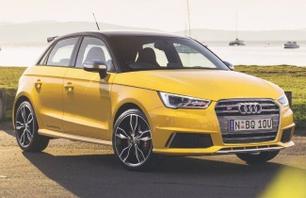
The A1 is so small it starts to strain Audi's design language. When you cram on the S-style bumpers and raccoon-eyed trim on the hatchback, it's starts to look a bit busy.
It isn't quite a shrink-wrapped A3 - Ingolstadt's designers know better than that - but it's full of Audi design cues, such as the strong, light-catching character lines, distinctive LED daytime running lights and fondness for big wheels.
Inside is along the themes of the A3, with what are becoming Audi's trademark; round eyeball air-con vents, the manual fold-down screen familiar to Q3 owners (but smaller) and a good clear dash. The handbrake jars slightly as it feels cheap to hold and wobbles a bit.
The S Sport seats are big and comfortable, and the top half of the backs are capped in plastic, which was colour-coded on our car. The rear passengers will certainly get an eyeful of whatever terrifying hue you've chosen, so choose wisely.
Despite the five doors, the back seats are occasionals, like the Mini the A1 is gunning for, and the boot is very small, but okay for shopping for couples or singles.
GAC tells us the UT hatch was designed in Milan, Italy, but it also isn’t ashamed of the Chinese influence on its overall appearance, like the ultra-short bonnet and Chinese city-car style face.
Along the side it has a modern, aerodynamic profile, and the ultra-short overhangs and long wheelbase maximise the amount of room for batteries under the floor and interior space.
The rear feels a lot like a modern Mini, with its bulbous tailgate and protruding light clusters, spiced up with a sporty spoiler piece jutting out.
It’s not a bad looking thing and it’s available in an array of fun colours.
On the inside it seems to follow the established rule-book of Chinese automakers, with plush trims, big screens with minimal physical buttons as well as a contemporary two-spoke steering wheel.
There’s a trendy floating console which hosts the cupholders and wireless charger on the Luxury grade, and an array of interesting patterns and textures through the doors and dash which you wouldn’t have once seen on a car at this price-point.
However, it is worth noting that while the seats are quite nice, and the steering wheel is a stand-out touchpoint, the trims on the doors and across the dash-top are hard plastics, more so than some of this car’s rivals.
Starting at $49,900, Audi S1 is by far the priciest of the small-hatch based hotties, at least until Mini's madcap JCW arrives. This price is just almost double that of VW stablemate's forthcoming 2015 Polo GTI.
Standard on the manual-and-five-door-only S1 is a ten speaker stereo, climate control, ambient lighting, remote central locking, cruise control, satnav, headlight washers, auto headlights with xenon low beams, partial leather seats, leather-bound steering wheel, auto wipers and rear parking sensors.
Our Misano Red ($990 option) came with two extra packs. The Quattro Exterior Package ($3990) adds bi-xenon headlights with red trim, red brake calipers, spoiler, quattro logos on rear doors (ahem!) and five-spoke 18-inch alloys that are part matt black, part polished.
The Quattro Interior Package ($2490) adds S Sport front seats with Nappa leather and red backrest capping with quattro logo (ugh), more nappa around the cabin with contrast stitching, flat bottom steering wheel and red rings on the air vents.
There's an S Performance Package that brings the best of these two packs together for $4990, saving about $1500 and the embarrassment of the quattro logos.
Our test car also had aluminium air vents ($220), black contrasting boot lid ($300) and black roof ($720).
The A1 is so small it starts to strain Audi's design language
The grand total is a sobering $58,610. There's a couple more options that'll easily pop you over $60,000.
Audi's MMI is dash-mounted in the A1 as there's no room on the narrow centre console. As ever, it works well and doesn't take much getting used to. The satnav is a bit grainy on the smaller screen but is otherwise a competent unit.
Sound is from a ten-speaker stereo and you can stream across Bluetooth or plug in a memory card. The sound was good but the system did take a while to find the phone whenever we came back to the car.
The GAC Aion UT starts from $31,990, before on-road costs, for the entry-level Premium grade, which makes it the third-most affordable EV you can buy in Australia after the city-sized BYD Atto 1 and the entry-level version of the BYD Dolphin.
It sits closer to price-parity with the GWM Ora, but is significantly more affordable than the rear-drive MG4 and more spec-competitive top-grade BYD Dolphin.
The bigger threat to the Aion UT is that a lot of buyers will be willing to spend slightly more to get into one of the most affordable electric small SUVs, like the BYD Atto 2 or Jaecoo J5.
Still, GAC makes a solid pitch for its hatch, which offers a higher spec level than its most direct price rivals.
For example, the Aion UT is more powerful than the entry-level Dolphin and Ora while offering a higher level of interior equipment.
Even the just-arrived front-drive MG4 Urban also starts at $31,990, but that’s for a version with significantly less driving range.
In fact, I’d go so far as to say the entry-level version of the Aion UT (the confusingly-named Premium) is probably the pick of the two variant range.
Standard equipment levels on this car include 17-inch alloy wheels, LED lighting all around, synthetic leather interior trim with heated and power adjust front seats, a 14.6-inch multimedia touchscreen with online connectivity and built-in nav as well as wireless Apple CarPlay and Android Auto.
There’s also an 8.88-inch digital instrument cluster, heated steering wheel and the full array of safety kit.
With the same power and battery size, this leaves only arguably unnecessary luxuries for the Luxury grade, like a wireless phone charger, ventilated driver’s seat, auto dimming rear vision mirror with auto power folding wing mirrors, a powered tailgate and of course, a panoramic sunroof (with shade!).
This is where the action is. The S1's tiny body packs a 2.0-litre turbocharged four-cylinder producing 170kW and 370Nm of torque. The S1 will streak to 100km/h in 5.9 seconds thank to the traction aid of quattro all-wheel drive.
All Audi S1s come with a six-speed manual
Despite a pretty solid hammering during its week with us, including more time than we'd have liked in Sydney traffic, the stop-start function helped deliver a pretty reasonable 10.2L/100km, however that's a long way over claimed 7.1L/100km.
All Audi S1s come with a six-speed manual, so dual-clutch haters can save the whining. The only downside from not having a self-shifter is the ECU can't deliver the boy racer farts, parps and crackles of the other S cars.
The Aion UT has a front-mounted electric motor producing 150kW/210Nm. That’s plenty punchy for any hatchback at this price, and I like the way the brand hasn’t messed around with a sub-100kW motor in the base variant to push prospects towards the top-spec car.
It’s more powerful than all of its closest rivals and at the time of writing you’ll have to spend four to six thousand dollars more to get into something equivalent from BYD, Chery, Jaecoo, Leapmotor or MG.
It even has a claimed 0-100km/h sprint time as low as 7.3 seconds.
If you're buying the S1 as a comfortable urban runabout with a cool badge, you're half right. While the seating for front passengers is certainly supportive, the hard suspension tune will ensure you're well aware of road surface imperfections.
The S1 is a rocket
Thankfully, what it missed out on in the ride department it makes up for in every other way - the S1 is a rocket. The 2.0-litre turbo jammed under the bonnet has almost no lag and is paired with a slick six-speed manual that is terrific fun to manhandle through the gears.
The way the S1 picks up speed when it's on boost is addictive and licence-endangering. A flattened accelerator in second or third will obliterate just about anything this side of $100,000 and you'll be having more fun in this than big brother S3 because the chassis is more adjustable and there's a bit more life.
You can hear the turbo sing to accompany the bassy exhaust growl. Hit the massive brakes hard and the car remains stable even over rutted roads. Turning the wheel brings almost-instant turn-in, mashing the throttle again a fun little wriggle. It's superb.
It's tremendous fun point-to-point on a twisty road
You'll have to be a bit patient with the throttle to get the wriggle, though - give it too much too early and it will want to push wide, the quattro system shuffling power around to try and quell understeer while the electronic diff fiddles with the braking system to do the same thing. It gets there in the end, but you're better off meting out the power with your right foot for maximum rewards.
It's tremendous fun point-to-point on a twisty road - despite being a bit heavy for its size (1415kg), it's as chuckable as the next best thing, the Fiesta ST.
The drive experience can be where a lot of Chinese cars fall down but I walked away less frustrated by the Aion UT.
That’s not to say it will behave as you might expect a low-slung hatchback to. The suspension, for example, is extremely soft as it maintains its original Chinese-market state-of-tune.
This makes the car waft over imperfections on city roads. And in that sense it offers supreme ride comfort in the scenarios it was designed for. However, at the extremes, like some speed bumps, or particularly deep pot holes there can be a surprisingly violent re-bound sending a thud through the cabin.
The other trade-off for soft suspension is less body control. I was surprised to find that the Aion UT holds it together mostly well on a flat country B-road, but when undulations and big dips introduce themselves, the soft suspension can be too slow to react, making the car lose confidence in higher-speed open road scenarios we’re more used to in Australia.
The steering, like many electric cars in this category, is relatively heavily electrically assisted. This makes it light and easy to adjust at low speeds for easy park and maneuverability in the confines of a city. It loses a little bit of road-feel at higher speeds but the Aion UT’s steering is far from the least connected I’ve experienced recently.
One thing it can’t be criticised for is a lack of power. With 150kW instantaneously available the Aion UT has some serious poke and while the ChaoYang tyre package is tuned more for efficiency than grip, it’s again not one of the worst I’ve driven with.
One thing which helps the whole experience along is this car’s hatchback layout. With the weight of the battery low and squat and the wheels all the way out to the edges of the frame, the Aion UT inherently handles decently compared to an electric crossover or small SUV.
Like all Chinese cars, the UT has a host of occasionally frustrating driver aids, which you can read about in the Safety section below. While I was inclined to turn some of the features off after testing them, the alerts are relatively quiet and non-invasive.
Is the UT any good to drive? It’s not bad for the segment, I was largely pleased with how it handled and the power on offer, and while it still has its annoyances, they’re not big deal-breakers.
The MG4 rear-drive is a better allrounder, while the GWM Ora isn’t as good. I’d say it’s on par with the BYD Dolphin, but they excel in different areas. The Dolphin's a bit sharper in terms of handling but the Aion UT is more comfortable.
Six airbags, stability and traction control, ABS, brake assist and distribution all add up to a five star ANCAP rating.
As with many Chinese cars the list of active safety equipment is long but that doesn’t mean it’s particularly well calibrated.
Standard gear includes the key stuff like auto emergency braking (AEB), lane keep assist, blind-spot monitoring, rear cross-traffic alert and adaptive cruise control. There are also rarer features for an affordable car like this including traffic sign recognition, door open warning, auto high beams and front cross-traffic alert.
On the parking front you get a 360-degree parking camera view as well as front and rear proximity sensors.
There's also an annoying driver monitoring system and one I haven’t seen much in the form of an occupant warning system, which seems to imagine you’re not wearing a seatbelt when you are.
It’s not the only safety system I found myself reaching to turn off. The lane keep assist could occasionally be a bit heavy-handed and the traffic sign alert was typically frustrating. This, sadly, is what we’ve come to expect from these types of systems from many Chinese automakers.
It’s not the most annoying system I’ve used, though, and the alerts are quiet enough and far enough apart that they aren't as intrusive as they can be in some rivals. You can also adjust the tolerance of some of the systems in the (needlessly complicated) menus to make them less annoying.
At the launch, the Aion UT was yet to be rated by ANCAP.