What's the difference?
The Audi A5 has done something naughty. It’s replaced the Audi A4.
Or at least that’s the case for now after the Ingolstadt brand made a bit of a mess of its naming strategy.
Essentially, the Audi A5 is now available as a sedan or a wagon, and the next A4 coming soon will be electric. The previous A5 was a swoopier two-door coupe or four-door gran coupe style model. So the A5 is now effectively Audi’s main BMW 3 Series or Mercedes C-Class and CLA rival.
Plus, the Audi S5 is also here to cater to performance car fans.
Can a new platform, a sleek, fresh look and a techy interior do the job?
We’ve been pedalling around the Victorian countryside in the hopes of finding out.
Stick with me, and I reckon we’ll get to the bottom of it. The question about the car, that is, not the bottom of Victoria.
Half a decade on, the current-generation Mazda 3 has weathered a world of change.
Cheap cars have vanished. Electric vehicles are commonplace and the small car class it belongs to has been decimated by SUVs. Big names like the Ford Focus, Holden Astra and Mitsubishi Lancer are history.
But while it looks identical to the car unveiled at the 2018 LA Auto Show, today’s Mazda 3 has also evolved, albeit gently.
Let’s see how competitive the latest and improved (as well as more expensive) version is.
The Audi A5 remains a convincing option in the premium mid-size sedan category, even with the near-$10K price increase over its equivalent grade A4 predecessor.
Even in its base spec, it’s a lovely thing to drive and adds enough new kit to be a reasonable option when it comes to value. In terms of tech usability, it stands out from rivals. Practicality is still king for Audi.
But for the heart-over-head types, the S5 is fast and fun while remaining a comfortable cruiser and the price is decent. On a personal note, a six-cylinder wagon? That's a big yes from me.
For the time it’s available, it’s hard to go past the value on offer in the S5 Edition One. Getting an AWD V6 with that kind of capability for under $100K is something that's sure to tempt buyers. If it doesn’t, we need to take a good look at ourselves.
Note: CarsGuide attended this event as a guest of the manufacturer, with meals provided.
Given how effortlessly it traverses the mainstream and premium small car classes, the Mazda 3 might be the best value small car on the planet.
With racy styling, sports car handling, classy interior presentation and impressive, intelligent efficiency, there’s plenty to sink your teeth into here.
Poor rear vision, a dark back-seat area and smallish boot aside, it doesn’t have any glaring faults.
In a world overrun with SUVs, props to Mazda for evolving the small car so brilliantly to mask a half-decade of existence. Continuous improvements have made the 2024 G25 Evolve SP Vision an essential small car shortlist proposition, regardless of price.
The A5 incorporates Audi’s new design language in a way that makes the 2026 model stand out from Audi’s older offerings, but we won’t know how well it works in the family until more new-gen Audi cars arrive.
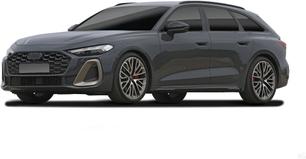
For now, the A5 is a generally handsome car. It very much looks like an Audi from the front, even a recent A4 if you only very quickly glanced.
The aforementioned S line styling does plenty in making even the base Audi A5 look like a properly luxe thing. There were a few double-checks at the launch to make sure drivers were getting into the right cars.
Fortunately the new car’s designers refrained from busying up the car with trim, the only big features being the side vents at the front.
But even in Avant form the S5 looks athletic, quad-exhausts in the lower bar and the angular rear bodywork moving away from the previously softer, more rounded look Audi had gone with before.
Inside, the changes are arguably more obvious. The A5 is now much more ‘screeny’ than before, especially if optioned with the passenger-side touchscreen.
It’s still decidedly Audi in its layout and design, with geometric shapes on the steering wheel, screen housing, door cards and even on the gear shifter, which is no longer the more traditional handle-type.
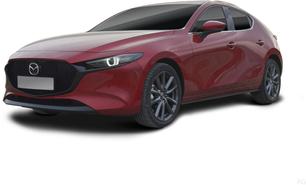
How is it that the current Mazda 3 is already five years old? This hatchback is still stunning, the sort of car you look back at when walking away.
The shape is sleek and almost coupe-like, with a shark-like nose, cab-backward-style long bonnet, upswept shoulder line and a fastback silhouette.
More importantly, it’s the way the light dances across the sculptured sides that draw the eyes in. Bereft of clutter, it makes you wish all mainstream manufacturers had the courage to be so daring.
We’ve said it before – the 'BP'-generation Mazda 3 (Axela in Japan) is the brand’s boldest C-segment hatch since the 1993 'BA' 323 (Astina/Lantis/323F).
But there’s a price to pay for such timeless beauty…
…and that gear selector is a bit indicative of the new A5’s interior. It’s now more of a switch that requires a little more attention than the traditional shifter, just like the way the more screen-focused interior requires a little more of your eyeball time than physical buttons.
Don’t get me wrong, as far as screens in modern cars go, Audi seems to have made it as easy as possible to use the new-gen software in the A5. The menus are clear, there are good shortcuts and there’s no lag… but buttons are always better when your focus needs to be on the road.
Fortunately the driver display is nice and clear, it’s a good update on Audi’s ‘Virtual Cockpit’ and you can set it to display important information without looking too busy.
Ergonomically, the way the central screen is angled towards the driver, the centre console layout and the small control panel on the door for lights, mirrors and the like all seem to be well considered and mean you don’t have to awkwardly reach for anything.
There are a few quirks specific to the A5 and S5, one being that if you opt for the panoramic sunroof, it comes with a transparency switch rather than a physical cover, so it doesn’t do much to keep the light out.
It’s also good to note that the passenger screen - again, if optioned - turns to privacy mode when playing media so as to not distract the driver. Pretty handy!
Behind the front row, a regular-sized adult should have enough room to sit comfortably for a decent amount of time without feeling cramped. The light through the sunroof comes in handy here.
Behind that is a 445L boot in Sedan form, or 1299L with the rear seats folded down. As an Avant, the space increases to 448L and 1396L respectively.
There is a price to pay for all this quasi-coupe styling flair, and that’s a comparatively snug-feeling interior, though you’d never call it cramped.
Actually, the Mazda 3 is no less spacious than most of its competition in all but one area, with enough room even for 200cm drivers, along with sufficient shoulder width and ceiling height to match.
If you’re really tall, maybe that missing sunroof isn’t such a bad thing, after all.
Sat so low-down on cushy, enveloping front seats that offer plenty of comfort and support, this is the anti-SUV. Maybe Mazda should have called this the MX-3.
Sporty and spot-on, the driving position is a laid-back affair, with an emphasis on better ergonomics, as emphasised by the thoughtful placement of switchgear that’s all within easy reach, ahead of a beautifully flowing and layered dash. Proudly Japanese in flavour, it brings to mind functional minimalism.
Drilling into some of the 3’s finer interior details, the analogue-look digital instrumentation is super-legible, ultra-classy and gorgeously lit at night. As previously mentioned, the dials and surrounding air vents are reminiscent of the later Porsche 944 and 968.
It’s not just all for the sake of aesthetics, either.
Yes, it’s lovely, but the thinned-rim three-spoke steering wheel feels great to grip, with nifty little paddle shifters that are a delight to prod.
Same goes for the physical volume knob and climate-control buttons, sidestepping the need to get distracted and frustrated by virtual sub-menus.
And having a conventional gear lever with old-school Tiptronic-style shifts suits the 3’s athletic vibe.
Plus, forward vision is A-OK, ventilation is faultless, storage is better than you might expect, and the fit and finish is as good if not better than any of this 3’s German premium opponents.
Out back, the split-fold rear backrest is set at a comfortable angle, the cushion is well padded, and you’re provided with USB ports, air vents, and an armrest with two cupholders. More thoughtfulness.
But while knee room is fair, rear headroom isn’t great if you’re tall or wear a beehive, as the falling ceiling line reveals.
Vision out is limited by that rising window line and fat pillars. Getting in and out of the back requires some contortionist moves. And the small windows mean it can be gloomier in the back than a Smiths album.
Finally, at just 295 litres, the 3’s cargo capacity is disappointing. Sure, it eclipses the Corolla hatch’s 217L cubby, but other rivals are far larger back there.
At least the floor is wide and flat and there are 60/40-split backrests for cabin access for longer items.
Note that a space-saver spare wheel lurks underneath. Mazda argues there’s always the closely-related CX-30 if you need (slightly) more space (317L).
Meanwhile, at the other end of the 3…
The new Audi A5 range starts from $79,900 before on-road costs for the standard A5 Sedan, though the rest of the models available at launch are all S5 variants. A more powerful A5 with 200kW and quattro all-wheel drive will come later, as well as a 270kW plug-in hybrid A5 quattro variant.
For now, the sole A5 in the line-up is well equipped for the price, coming with standard 19-inch alloy wheels, matrix LED headlights with adjustable lighting signatures, keyless entry and digital key via Audi’s app, electric bootlid (or tailgate, given its liftback style) and S line styling as standard.
Interior features include sports seats in real and synthetic leather, heated and electrically adjustable up front, leather steering wheel, tri-zone climate control, a 14.5-inch OLED multimedia touchscreen and 11.9-inch driver display, wireless phone charging as well as wireless Android Auto and Apple CarPlay.
The A5 can be optioned with a Style pack for $3000 which adds 20-inch wheels, tinted glass and black exterior trim. There’s also a Premium pack for $3769 which adds a head-up display, high-power USB ports, a Bang & Olufsen sound system, ambient lighting and front door acoustic window glazing.
The other key variants in the line-up from launch are the S5 Sedan and S5 Avant, coming in at $114,900 and $117,900 respectively. Aside from the more advanced drivetrains, the S5s also gain plenty more features over the A5 including 20-inch Audi Sport alloy wheels, selectable OLED rear lights, tinted windows and more paint colour options.
Inside, Nappa leather-upholstered seats gain cooling and massage functions up front, the steering wheel is heated, and there’s ambient lighting with a ‘dynamic interaction light strip’ that changes colour based on vehicle functions like indicating or changing temperatures.
There’s also a head-up display, high-power USB outlets, a Bang & Olufsen sound system and, perhaps most notably, a 10.9-inch touchscreen for the front passenger as standard. It’s a $1500 option in the A5.
Audi also has a launch variant of the S5, the Edition One, which comes at a lower price and a trim spec closer to the A5, but with the S5’s performance. It has non-adjustable sport suspension, for example, and to score much of the main S5’s kit requires cost-options or option packs.
But the prices are tempting, just $99,900 for the S5 Edition One Sedan or $102,900 for the Avant, $15,000 less than their same-power siblings. For an extra $6000, you can add a head-up display, high-power USB ports and the Bang & Olufsen sound system to the Edition One.
Comparing the entry A5 to the recent entry-level A4, the new A5 wears a price increase of $8000 (the ageing A4 is $71,900), but has more power and a much more modern interior. On price alone it seems a steep jump, but the value is still there compared to rivals. A Mercedes C200 currently starts from $89,900, while a BMW 330i is $92,900.
Mazda has rationalised the MY24 3 range, with fewer grades and no more manuals, sadly.
The pretty little piece of automotive industrial design you see here is the mid-range Evolve SP Vision, which sounds less like a car and more like a posh hairdryer from Vidal Sassoon.
Priced from $36,520 before on-road costs (or about $41K drive-away before you start haggling), this Mazda 3 is a sporty and well-equipped alternative to the likes of the speedy Hyundai i30 N-Line Premium, spacious Kia Cerato GT Turbo, new Subaru Impreza AWD 2.0R and evergreen Toyota Corolla ZR. All cost roughly the same money.
The thing is, do Mazda’s upmarket aspirations mean the 3 possesses the ride quality and chic to embarrass at times substantially more expensive hatchbacks with premium pretensions? We’re talking rivals like the BMW 1 Series, Mercedes-Benz A-Class, Peugeot 308 and VW Golf, here.
Stay with us, because we reckon you might be surprised by how far the 3 has come since its humble 323 predecessors.
Anyway, this version comes with most of the good gear, including a full suite of driver-assist safety tech like front and rear Autonomous Emergency Braking (AEB), blind-spot alert, lane-keep assist and adaptive cruise control, as well as keyless start and walk-away lock, powered driver’s seat with memory, 360-degree camera views, a head-up display, digital radio, sat-nav, auto tilt/folding exterior mirrors, dual-zone climate control, Bluetooth phone/audio connectivity and 18-inch alloys.
Oh, and for 2023, an upgraded version introduces a smartphone charger and wireless for the Apple CarPlay/Android Auto function, along with USB-C port access front and rear.
What’s missing at the Evolve SP Vision’s price point? Some mainstream rivals offer leather and a sunroof, available respectively in the more-expensive GT Vision, from $40,000, and flagship Astina grades, from nearly $42,500.
Still, that’s quite a lot of small car for the money, given the quality of the presentation and design. Speaking of which…
The Audi A5 is powered by a four-cylinder turbo-petrol engine which powers the front wheels via a seven-speed dual-clutch automatic transmission. It makes 150kW of power and 340Nm of torque, and should, Audi says, propel the A5 to 100km/h in 7.8 seconds before (eventually) reaching a top speed of 248km/h.
The S5, in all its variants, is powered by a 3.0-litre turbo-petrol V6 which is assisted by a mild hybrid system. It produces 270kW and 550Nm, sending that to all four wheels via a similar seven-speed dual-clutch.
The S5 is much quicker as a result - 100km/h comes along in just 4.5 seconds according to Audi, before reaching a 250km/h top speed.
When you think about it, shoehorning a big torquey engine in a light and agile small car is a recipe for fun. Ford did just that with the Escort RS2000 in the 1970s… and Mazda’s now an expert at it, too.
The engine in question is the G25, a 2.5-litre four-cylinder naturally aspirated twin-cam petrol engine, delivering 139kW of power at 6000rpm and 252Nm of torque at 4000rpm.
As this Evolve SP Vision hatch tips the scales at 1415kg, it makes for a healthy, and consequently very lively, power-to-weight ratio of over 98kW/tonne.
That’s if you decide to use all the available revs, which the six-speed torque-converter auto makes great use of.
Driving the front wheels, it offers a 'Sport' mode to extend the revs even more, which is keeping in line with this Mazda’s sporty character.
Less so is the company’s decision to ditch the old multi-link independent rear suspension system a few years back for a more prosaic torsion beam arrangement. We’ll get to how that affects ride and handling in a moment.
Audi claims the A5 uses 6.9 litres of fuel per 100km, which should theoretically deplete the 56-litre fuel tank after 811km of driving. We couldn’t test this on the launch, but reaching claimed fuel efficiency figures remains an elusive challenge.
The S5, according to Audi, comes with an impressive 7.1L/100km figure in Sedan form, or 7.2L/100km as an Avant. That’s 788km and 777km of theoretical driving range if you’re up for a challenge.
Mazda claims the G25 averages 6.6L/100km on the combined cycle… for a carbon-dioxide emissions rating of 154g/km. On a 51L tank, that gives a potential distance of over 940km!
Driven good and hard in our hands, we managed 7.5L/100km, which isn’t bad given the speed and conditions it was subjected to.
Plus, the Mazda’s happy on 91 RON 'standard' unleaded petrol.
One of the first press cars I ever drove as an even younger lad than I am now was the circa-2017 Audi S4.
Without the perspective of all the many, many cars I've since driven, that S4 blew my mind a little bit with its combination of capability and refinement.
Now, with the context of most of the cars available to the Australian buyer in mind, it’s reassuring to get into this new generation and find that the mid-size Audi torch has been gracefully passed on.
Audi says the new generation, sitting on its new platform, has more focus on balanced driving dynamics, steering precision and steering feel. Without sacrificing comfort, Audi wants the A5 to be a sharper driver’s car.
It might not gel with the Euro tradition of a rear-drive executive sedan given the base A5 is front-wheel drive - the brand of course focusing on its quattro all-wheel drive system - but the A5 is decidedly agile for its size.
Compared to the S5 especially, as the A5’S 1770kg plays the S5’s 2025kg in Sedan form (2040kg as an Avant). It’s a noticeable weight difference, and it makes the A5 more playful without getting properly ragged.
It also rides on smaller 19-inch wheels and would overall probably make for the better daily driver. Even without the all-wheel-drive traction and extra power the S5 offers, the A5 makes a good case for properly plush commuting. Its 150kW isn’t lacking by any means, and that 340Nm does plenty to help when overtaking.
Its suspension feels well damped, keeping the road’s imperfections out of the cabin without numbing the ride and leaving you without feedback. The steering is similarly direct without being too heavy, making the A5 feel athletic for its size.
But for all the A5’s strengths, there is something undeniable about a six-cylinder European sedan (or wagon). The S5 is heavier, sure, and therefore not as naturally nimble, but it makes up for it. And it’s not just the extra power and mild-hybrid assistance.
It’s a great highway cruiser for a start, but it also adds the confidence of all-wheel drive to a trip, which proved extremely useful on the very rainy winter day we tested it. It holds up well on rough surfaces despite the bigger wheels and extra heft, plus it doesn’t feel out of hand when cornering fast, rolling into a predictable understeer rather than quickly losing traction.
But if you’re in any way conscious of your budget, consider the Edition One. It doesn’t lack any of the key things that make the S5 great, and you get to pocket enough money to buy a second used car.
Ask yourself. What do you want from a new small car?
Since the first Familia of the early 1960s, Mazda’s been at it constantly, through the 1300 and 323 eras and into the modern age of the 3.
The Hiroshima brand knows its stuff. Space, practicality, comfort, ease, reliability and affordability. But a small car has to offer more, specifically in the way it makes the owner feel.
That’s why, while the Focuses, Lancers, Astras and Pulsars are gone, the 3’s still here. And it isn’t just the lush visuals inside and out that are, well, sensory-rich.
As older Alfa Romeo owners know, there’s something special about an engine that sounds alive, and the moment you push the 3’s starter, it purrs into life. That’s the first clue.
Slot the refreshingly old-school lever into Drive, and the G25 leaps into action, and, if you need it to, will keep pulling forward strongly, engine buzzing, like it’s on a mission.
That describes the torquey urge of this big 2.5L four, paired perfectly with the sensibly-geared auto.
We miss Mazda’s magnificent manual immensely, but the 3’s instant response reflects its favourable circa-100kW/tonne power-to-weight ratio.
And, as we’ve harped on in the past, the twin-cam unit’s extra oomph beyond 4000rpm delivers muscular high-speed responses akin to a good turbo – or a great old-school Alfa. You can keep your laggy dual-clutch transmissions, Europe.
Now, sweet, smooth and speedy performance is one thing, but having the chassis tuned with precise and fluid steering for tactile handling, and confident roadholding, backed by nuanced driver-assist and traction controls, are another.
There is a consistent and unifying control to the 3’s linear and forgiving dynamics, reminiscent of past masters like the Focus (and today’s brilliant Peugeot 308) that makes it a joy to drive enthusiastically through fast corners, with the knowledge that it won’t suddenly snap-oversteer and bite an unalert driver back.
For a Mazda, the ride is quiet enough, but there is still some droning transmitted through the cabin, via the Bridgestone Turanza (215/45) tyres, on coarse-chip bitumen surfaces.
And while suspension comfort is pretty impressive for the most part, larger bumps reveal the torsion beam’s limitations, as the car can occasionally thud over them in a way that we remember the multi-link rear end wouldn’t.
Anyway, what we’re saying is that, overall, the 3 Evolve SP Vision is an immersive and interactive driving experience that is right up there with the best of them.
Brawny performance, exquisite agility and a refinement that, collectively, have eluded every small Mazda in living memory until this generation’s 2019 debut. This 3’s right on the money. Still.
The A5 and its S5 variants share the same safety features, with the full suite of Audi’s more-than 30 safety and driver assistance systems standard across the line-up.
Physically, the A5 has nine airbags and has been crash-tested by Euro NCAP, the firm awarding it five stars. There's no local ANCAP score as yet.
Some of the key safety features in the A5 and S5 models include a driver attention alert, seatbelt reminders, tyre pressure indicator, adaptive cruise control, lane departure warnings and lane assist, front braking assist, front and rear cross-traffic alert, speed limit sign recognition, surround view cameras and park assist with front and rear parking sensors.
There are also ISOFIX points for fitting child seats to the rear outboard seats.
Tested way back when this generation was new in early 2019, the Mazda 3 scored a maximum five-star ANCAP crash-test rating.
On the driver-assist front you’ll find front and rear AEB (with a working range of 40km/h to 200km/h) with pedestrian and cycle detection available between 10-80km/h, while the 'Forward Collision Warning' operates from 40-200km/h.
Blind-spot monitoring, lane departure warning, lane-keep assist, 'Forward Obstruction Warning', rear and front 'Cross-Traffic Alert', 'Secondary Collision', auto high beams, breakaway pedals, adaptive cruise control (with full stop/go functionality and cruising/traffic support), parking sensors front/rear, 360-degree round-view monitor, reverse camera, traffic sign recognition, driver monitor and tyre-pressure monitors are also included.
The lane-keep support systems work between 55-200km/h.
Seven airbags – front, side, curtain and a driver’s knee bag – are fitted, along with anti-lock brakes with 'Electronic Brake-force Distribution', 'Emergency Brake Assist', stability control, traction control, hill-start assist are also fitted, seat-belt pretensioners, and two rear-seat ISOFIX points as well as three top tethers for child seat straps.
Audi’s five-year/unlimited kilometre warranty is starting to fall behind the industry standard, though is about normal for a premium brand. On top of this, customers can opt to purchase extra years of warranty up to a maximum nine years which costs $3590.
Audi does also offer 12 years of bodywork manufacturing warranty against corrosion or perforation. There’s also five years of Audi roadside assistance.
Servicing intervals for the A5 come in at every 15,000km or 12 months, with customers able to purchase fixed-price servicing plans at a discount compared to paying per service.
A five-year servicing pack for the A5 Sedan is $3360, and for the S5 it’s priced at $3540.
Mazda offers a five-year/unlimited kilometre warranty, with five-years roadside assistance… and that’s nothing special nowadays.
Service intervals are at 12 months or every 15,000km.
A fixed-price service scheme is available, averaging out to $434 annually over the first five years. Mazda shows pricing right up to 16 years and 240,000km on its website.