What's the difference?
This is the new Tesla Model Y L, of course, but before we even start I need to ask you a very important question.
How often, honestly, do you use all seven seats in your seven-seater? Or if you only have five seats, how often is there a human in every single one?
Rarely, if ever?
Yep, me too. So stick around, because this is, by far, the best family SUV seating layout. And one where there’ll finally be no fighting over who gets stuck with the dodgy seat.
And as a result, the six-seat Tesla Model Y L might just be among the best all-electric SUV offerings around.
The dual-cab ute market and light truck market are potentially two very different landscapes.
While the dual-cab continues to storm the sales charts in Australia, there’s also a growing awareness among hardcore users of these vehicles, that a light truck might often be a better solution.
Better payloads and higher Gross Combination Mass ratings in an age of increasing legal and insurance concerns over overloaded vehicles, were once the light truck’s strong suit. But these days, vehicles like the full-sized US-made pick-ups and even the muscled-up Ford Ranger Super Duty have bridged or even exceeded that gap.
At which point, the light-truck’s benefits become the ease with which it can take on heavier jobs and the sheer size of the cargo and cabin area, not to mention those truck-specific qualities born of generations of refining a concept.
In Australia, it’s Isuzu that absolutely brains the opposition in sales terms. And part of the reason for that has been a realisation that not all would-be buyers want the hassle of the traditional truck-buying process of purchasing a bare chassis and then equipping it so suit their needs.
Which is where Isuzu’s RTW (ready To Work) concept comes in. You simply choose the truck you want, choose a tray, van or service body and then let Isuzu deal with it and phone you when it’s ready to collect.
It's so simple, it’s a wonder not everybody is doing it.
The other news is that Isuzu has finally updated its popular N Series fleet after about 16 years. A new cabin, extensive chassis changes, uprated engines, and all-new transmission, improved suspension and a new focus on safety are all headlines. But 16 years is a long time between drinks, so do the improvements make enough of a difference to keep the concept relevant in a changing market?
If you like the five-seat Model Y, then you'll like the six-seat L version even more. I think this the best example of Tesla's electric SUV to date, and the cabin layout just makes a lot of sense, and would suit plenty of families who don't need to squeeze someone into a compromised middle seat.
Note: The author, Andrew Chesterton, is a co-owner of Smart As Media, a content agency and media distribution service with a number of automotive brands among its clients. When producing content for CarsGuide, he does so in accordance with the CarsGuide Editorial Guidelines and Code of Ethics, and the views and opinions expressed in this article are solely those of the author.
A truck like the NPR (or any other truck, really) is never going to replace a dual-cab ute in terms of its duality. While the latter can tend to weekday chores and be quickly reconfigured for weekend fun, the light truck has no such facility. Nope, it’s a workhorse. Period.
You need a fair bit of real estate just to park the Isuzu overnight and it certainly won’t fit in the typical supermarket car space. It’s hardly sporty to drive, either, although the latest upgrades have made it more user friendly in a total sense and safer than ever before.
But what it does do that a dual-cab ute can’t often do, is tackle bigger, heavier jobs with a fair bit of bandwidth still up its sleeve. And if the nine-to-five side of things is where you need to be, then a vehicle like this has to be worth a look. And if you consistently find that you’re sailing close to the wind in terms of exceeding a ute’s legal payload, towing capacity or GCM, then the extra bigness of a light truck could make a huge difference.
That’s especially so given the price tag. Okay, you’re not buying a lot of high tech for your money, but you are getting some seriously stout engineering and an expectation that you won’t be working the thing to death anytime soon.
Note: CarsGuide attended this event as a guest of the manufacturer, with meals provided.
Spoiler alert - it looks a lot like a five-seat Model Y, doesn’t it, albeit a slightly bigger one. And you’d have to be a bigger Tesla head than me to immediately spot the differences at a glance.
The wheelbase is longer, the rear doors are bigger as are the rear 3/4 panels and the roof line is higher, helping with headroom in the third row.
Still, safe to say if you like the look of the five-seat Model Y, you’ll like this one. And if you hate it, well, good luck.
The alloys are 19-inch and shaded by the aerodynamic caps and there are light bars front and rear which debuted on the updated five-seat Model Y when it arrived mid-last year.
The bigger changes are inside, of course. I promise we’ll get to the second and third rows in the Practicality section, but let’s talk about the look and feel first.
There’s a love/hate relationship with Tesla’s stripped-back aesthetics, and I’m probably somewhere in the middle. I like the airiness of the space in the cabin, and I think it feels nicely put together, and I really dig the contrasting fabric used on the doors and dash which add a little visual interest to the cabin.
But I hate using the central screen to select a gear and I hate not being able to see how fast I’m going without turning my head. A head-up display would work wonders in the Model Y L cabin.
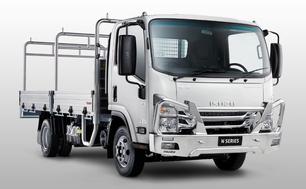
It can’t be easy to make a light truck look fashionable, but Isuzu has done a reasonable job of making the thing look, at least, current. The lighting has all been changed to LEDs now, and the bold, angular face the truck presents looks pretty modern.
But new tech has also forced some design changes. The bull-bar that is part of the Tradepack deal, for instance, has been redesigned with changes to the main hoop. That’s all to accommodate the radar units inside each headlight that inform the front cross-traffic warning system of anything in the way.
Also notable is the attention to detail of the optional (rather than the alloy tray seen here) Australian-made service body. With a choice of internal layouts, the flip-up sides reveal a proper workshop on wheels when configured that way.
It’s also nice to see that all the clips and catches on the drop-side tray can be easily replaced if damaged.
Captain’s chairs are simply a more luxurious version of second-row seating. With that there is no argument and the heated and cooled chairs that occupy the second row of the Model Y L are pretty good examples of them.
Space, both knee and headroom, is ample, and you can adjust each seat individually if you want to grant a bit more space to any third row occupants. Armrests deploy at the push of a button — as do the two hidden cupholders — and it really is easy to settle in and get comfy.
The third row is a bit more hit and miss. I’m 175cm and found I had enough legroom and headroom, but the big plastic mouldings that emerge from each side of the Model Y (which house a cupholder) are a miss. They end up pushing you into the seat next to you, and I can foresee a lot of arm rubbing with anything like two adults back there.
Also confusing is how to actually get out of it. You can fold the seat in front of you flat, but then you have to climb over it. I found it easier to just walk out between the seats.
There are another two USB-C ports in the rear row and you get air vents but no temperature controls.
The Model Y L stretches 4969mm in length, 1668mm in height and 2129mm in width, which is roughly 18cm longer and 4.5cm taller than the five-seat model. The extra space doesn’t sound like that much, but start dropping rows and you find a heap of storage space.
Both the second and third row stow electronically from the boot, but with them in place you’ll find 420 litres of storage in the double-layer boot. Drop the third row, and that number grows to 1076 litres. With the third row folded there is a massive 2423 litres of space. The frunk serves up another 116 litres.
There’s also room (and the ISOFIX attachment points) for four child seats.
The new cabin Isuzu has brewed up certainly brings the truck into the present, but it’s still very much a light truck in some respects. As in, it’s still a pretty good climb inside, although there are steps and handles to make that easier. The steering column still gets in the way as you swing your left leg inside, though.
The plastic surfaces would still make a car interior designer cringe, and the floor is vinyl and the seats cloth. But the three-abreast seating arrangement makes sense and, should you choose the dual-cab N Series option, there’s actually seven seats in all.
Cabin storage has obviously been a priority for Isuzu, and there are three large, netted overhead bins above the top of the windscreen, as well as bins and buckets across the width of the lower dashboard. Interestingly, each door has just a single, slim pocket and no bottle storage.
The centre console addresses that somewhat with a pair of cup-holders and a pen slot, while there’s also a large bin behind the seat on the bulkhead. There’s also an interior light that wouldn’t look out of place in an industrial kitchen.
The dashboard is home to a pair of USB charge-ports in the centre and the truck stuff continues with a wand for the exhaust brake and a knob near the steering column for a fast-idle setting. It’s also nice to see that even though Isuzu has adopted keyless entry and start for the N Series, the starter button resembles a conventional key and is located right where it should be in the side of the steering column.
What’s missing? Mainly a vanity mirror on either side of the cabin and a physical volume knob for the stereo. Oh, and paddle shifters would be nice too, especially when towing.
Externally, the Tradepack option gets you an aluminium drop-side tray, sturdy ladder racks, a tow bar, bull bar, toolboxes fitted below the tray between the axles and even a wash station for after-work clean ups.
The tray is fitted in Australia (many of the Ready to Work body options are also made here) and the load floor is a vast expanse of alloy with the ability to cope with small, heavy objects thanks to its high-impact materials. But the usual drop-side tray caveats apply including a high loading height, rattling from the sides and the legal requirement to lash everything down before hitting the road.
Meantime, part of the overall appeal of the Isuzu line-up is that there are something like 40 different permutations of cabin width, wheelbase, GVM, overall length and driveline.
But here’s perhaps the N Series’ greatest trick when it comes to being practical: While it’s easy to dismiss the vehicle for being too big and unwieldy, many operators would possibly find that the extra payload and real estate in the cargo area means that they might not need to tow a trailer every time they venture on to a job site. At which point, the dual-cab ute with a tandem trailer starts to look less convenient, especially if there’s any reversing or squeezing on to a tight site involved.
Oh, and if tight spaces really are an issue, the N Series’ sub-10m turning circle makes a typical dual-cab’s 12.5 metre turning circle look ridiculously ungainly. And that’s before we get to that trailer.
Typically for a vehicle like this, a full-sized spare tyre is included.
The Model Y L sits smack bang between the $68,900 Long Range AWD and the $89,400 Performance, setting you back $74,900, before your on-road costs. It’s also the only three-row option in the Tesla family.
Aside from people movers, we’re not swimming with options in the three-row electric space, either. The Kia EV9 will get it done from $97,000, the Hyundai IONIQ 9 starts from around $120K and the Volvo EX90 is more expensive again (from $124,990).
Anyway, in Tesla land, the Model Y L rides on 19-inch alloy wheels, has a glass roof, automatic wipers and Tesla’s smartphone access key, as well as the little credit-card swipe.
Inside, there’s a 16.0-inch central screen that handles everything. And I mean everything. It's your gear selector, your speedometer, and everything else, too. There’s no Apple CarPlay or Android Auto, but you can access things like Spotify and podcasts through the in-built apps and the on-board navigation system is a good one, too.
All of that pairs with a 19-speaker sound system, and there are dual wireless charge pads. All three rows of seats are heated, while the first and second row get ventilation, too.
A second 8.0-inch touchscreen in the middle row then handles things like the seat heating or cooling, music and games to amuse the kids. And the Model Y L also debuts V2L, or Vehicle to Load, for Tesla in Australia, using a connector in the external charger.
Like the rest of the N Series line-up, the NPR Tradepack model we’ve chosen to review here is available in a range of cabin widths and wheelbases and even a choice of Gross Vehicle Mass. But first, let’s break down the badge. In Isuzu-speak, N stands for the smallest family in the light-truck line-up. As such, it can be driven on a normal car license in Australia.
The P stands for the GVM, in this case that license-friendly 4.5 tonnes, although you can opt for the higher, 6.5-tonne GVM at which point an endorsed license is required.
And, finally, R is Isuzu’s in-house code for a truck that is two-wheel-drive and uses conventional steel-spring suspension rather than air suspension.
Isuzu says the Tradepack option with its large tray and fittings is a very popular one, so that’s what we’ve concentrated on here. That pack equates to all the drop-side tray, racks and fittings, so it’s a comprehensive add-on. Of course, you can take your NPR as a bare cab-chassis, too, and save by swapping over the tray and fittings from your old truck.
Beyond the nuts and bolts stuff, the NPR includes LED lights all-round, heated and powered exterior mirrors (and they’re huge), keyless entry and start, cruise control, steering-wheel mounted controls, climate-control air-con, a suspension driver’s seat and a tilt and reach adjustable steering column. There’s also a 10.1 inch multimedia screen in the centre of the dashboard, digital radio, sat-nav and wired Apple CarPlay and Android Auto connectivity.
The features that tell you this is still a truck and not a passenger car include the steel wheels, cloth seat trim and vinyl flooring.
As it sits, the NPR Tradepack costs $86,014 on the road, but that’s an all-up figure, and not one where you then have to arrange your own accessories and bits and pieces. It’s also within a few hundred dollars of the Ford Ranger Super Duty Super Cab which, perhaps not so coincidentally, has an identical GVM of 4000kg, GCM of 8000kg and slightly more towing capacity of 4500kg versus the NPR dual-clutch’s 4000kg.
The Model Y L gets Tesla’s dual-motor AWD powertrain, with two electric motors producing a total 378kW and 590Nm. That’s enough, Tesla says, to knock off the sprint to 100km/h in five seconds flat.
Believe it or not there’s actually a family connection between the 3.0-litre turbo diesel in the Isuzu NRL and the Isuzu D-Max dual-cab and MU-X SUV.
While the displacement of the D-Max remains, the unit in the light truck has been retuned to liberate more torque at lower engine speeds. In this case, that’s 129kW at 2860rpm and 430Nm of torque anywhere between 1450rpm and 2860rpm. That gives the engine great flexibility, but the transmission also plays a part.
That’s either a six-speed manual or a nine-speed dual-clutch unit. The latter has either manual or fully automatic shift modes, and it’s worth is backed up by the potential for lower fuel consumption thanks to the inherent efficiency in such a transmission as well as the three extra ratios.
Designed and made in-house at Isuzu, the brand says it’s confident the wet-clutch unit doesn’t carry the potential flaws of some other dual-clutch units we could name. That said, Isuzu has downgraded the towing capacity from 4.5 to four tonnes if the nine-speed is fitted.
And just like any good truck, there’s the provision for a power-take-off on the side of each transmission option, as well as an exhaust brake to help the mechanical brakes when fully laden.
Unlike many light trucks before it, the Isuzu doesn’t get stuck with a rigid front axle. Instead, you get a proper independent set-up with coil springs, while the rear end remains a live axle with leaf springs in the interests of carting lots of heavy stuff.
Tesla is always a little vague when it comes to the size of its batteries, but reports point to the Model Y L carrying a 84Wh (useable) NMC battery.
Whatever the specifics, the range is strong, with Tesla promising a 681km driving range on the WLTP combined (urban/extra-urban) cycle.
It’s also set up for 250kW DC fast charging, which should see you take on 288km in 15 minutes, according to Tesla.
This is a cursed subject in the truck segment, because there’s just no standard pattern of usage, nor a typical loading scenario. Some trucks will spend their whole lives heavily loaded going from red light to red light, others will be less burdened and driven between regional towns.
But what we can tell you is that unladen and driven sensibly, this truck should be able to return fuel consumption figures in the low teens per 100km. Throw the full payload and a trailer on the back and head for hilly country and you could easily double that and then some.
As such, the range from the 100-litre fuel tank is going to vary enormously, but should be somewhere between 500 and 800km.
The other thing to bear in mind is that the upgrade to this model has brought the Isuzus in line with Euro 6 emissions or their Japanese equivalent. So they now need AdBLue and there’s a 14-litre tank for that.
Honestly, it feels like the Tesla Model Y has grown up. I didn’t love earlier iterations of this car and I found the Performance to be fast but lacking any emotional fizz.
This one, though, feels solid and composed, and the power on tap (of which there is ample) is more about effortless progress than it is attempting to offer sports car excitement.
The steering is now nicely weighted and feels direct enough without being too sharp, and the cabin is well insulated, with often the slightly off-putting sort of rubbing noise the steering wheel makes when you turn it the only intrusive sound.
One drawback is a ride that definitely errs on the side of firm. This Model Y L gets electronic damping designed to iron out some of the more jagged stuff, but it still feels brittle in places, and you can definitely feel some sharpness in the cabin. Now, to be fair, it’s not too firm for me, but it might be for you.
Another is a bizarre turning circle which constantly reminds you you’re driving a big bus, especially when you try to complete a tight three-point turn.
But despite its stretched dimensions, I found the Model Y L easy to drive and park in the city, and once you're up to speed with Tesla's operating system (there's no Apple CarPlay or Android Auto), then the screen is pretty easy to use, too.
Actually climbing aboard the Isuzu is job one, and you’ll need the handles and step to do it safely. Then again, it’s probably no more testing than getting into a really low sports car in a degree of difficulty sense.
With that accomplished, you’re met with two things; the view out and the very un-car-like driving position. The first is fantastic for forward vision. And it’s not just the height advantage over other traffic. The cab-over-engine layout also means you’re almost at the very front of the truck, meaning you can see a lot more of what’s directly in front of you, even if it’s almost under your nose. Jumping back into a dual-cab ute for comparison emphasises the point enormously.
The driving position, meanwhile, might take more getting used to. The steering wheel is almost flat and you tend to sit pretty upright. Long-distance drivers will tell you this is actually great for long stints at the helm, and it honestly feels pretty natural after just a few minutes. But the steering column placement means there’s no chance of left-foot braking which some drivers (this one included) prefer.
Once you’re rolling, the dual-clutch transmission starts to feel pretty handy with short, sharp upshifts and a calibration that sees it keen to downshift on deceleration to help balance the vehicle, take the stress off the brakes and ensure that the engine is in its power band for when you next throttle on.
Speaking of which, the engine is not exactly overpowering, but it does produce the meat of its muscle in the right places, helped no end by having nine ratios to play with. And here’s an interesting point: The way the engine is installed in the NPR – and despite the fact that you’re sitting pretty much right on top of it – there’s less noise and vibration from the 3.0-litre than in an Isuzu D-Max ute. Obviously, low vibrations and less noise are factors in staving off driver fatigue, and clearly Isuzu knows how to achieve this.
Ride quality will vary hugely depending on what’s on board. We tried the NPR with a full load of gear on the tray, taking it almost to its payload limit. At that point, the ride was actually quite compliant, and the only odd sensation is that of having your backside right over the front axle.
The other mantra held dear by fleet managers is that the best way to reduce breakdowns is to take the driver out of the equation as much as possible. That explains the dual-clutch transmission, for one, but it also perhaps explains why the NPR is set up to be actually very easy and simple to drive. It’s definitely scarier to look at than to pilot. And that turning circle is something else!
The Model Y L gets the same maximum five-star ACNAP safety rating as the rest of the Model Y range, with nine airbags (up from seven in the five-seat model), and things like AEB (Auto Emergency Braking), lane-keeping assist, 'Forward Collision Warning' and blind-spot monitoring all along for the ride.
Interestingly, the curtain airbags from the five-seat version haven't been replaced, with coverage still only extending to the second row. New airbags have instead been added for third-row occupants.
One more analogue quirk of the Tesla Model Y L is the thick B-pillar, which does a good job of almost completely obscuring driver-side blind-spot checks (for those of us who still like to do those manually).
You can absolutely thank OH&S legislation for the huge leaps in active and passive safety that vehicles like the Isuzu have made in recent years.
Although this class of vehicle is not required to be crash tested (and, therefore, there’s no safety star rating available) even a scant knowledge of physics suggests that sitting the passengers up high in a vehicle with a strong chassis is a very good start when it comes to crash safety.
Passive safety is also helped by an airbag for both driver and the two front-seat passengers in the case of the three-seat variant we’ve looked at here. But only the outboard passengers get a three-point seat-belt, and the centre position gets a simple lap-belt.
There are also side intrusion bars in the doors as per passenger-car best practice and the overhead storage space features a safety net. There are no side-curtain airbags, but again, that high seating position makes the N Series inherently safer for passengers in a typical side impact.
But it gets better with a long list of driver aids, most of them straight out of the current passenger-car playbook. Running changes to the vehicle over the years have seen the addition of autonomous emergency braking (AEB), anti-skid brakes, stability control, a driver attention monitor, a distance warning system for vehicles in front, brake-force distribution and lane departure warning.
New safety tech this time around includes front cross-traffic alert and braking, mis-acceleration (pedal-error) mitigation, traffic and speed-sign recognition, a distance warning system that also advises of the speed of the car in front and improvements to the rear camera system.
And yet, there’s probably more work to be done here. We’d like to see a standard 360-degree camera and tyre pressure monitoring as well. These are both available at extra cost right now, but really should be standard on a vehicle like this. Rear cross-traffic alert is also missing, but that’s more about standardising the sensors and their calibration on a huge range of rear-body designs, apparently.
There’s also an apparent tech gap to be bridged, too, and right now only the dual-clutch-equipped version gets the speed limiter and adaptive cruise control, while the conventional manual does not.
Isuzu is also making a big noise about the new electronic park brake which can be used in an emergency to bring the vehicle to a complete, controlled stop if necessary.
Tesla warranty is a these-days-underwhelming five years and unlimited kilometres, while the high-voltage battery is covered for eight years or (a wildly specific) 192,000km.
There’s also five years' of roadside assistance, including puncture repair (a good thing, given the lack of a spare wheel). I also couldn’t find a puncture repair kit and later research suggests Tesla sells them, rather than provides them as standard.
Tesla servicing is condition-based, so there’s no fixed schedule, with a summary on the car’s touchscreen providing a record of when vehicle maintenance was last carried out and prompts for when they should be performed next.
In the absence of a combustion powertrain the emphasis is on things like wheel rotation, balancing and alignment, brake fluid testing, air-con servicing, camera precision, radiator cleaning and high-voltage battery maintenance.
Expecty a ‘Vehicle Health Check’ to come in under $300 with ‘General Diagnosis’ at around $270 per hour.
Despite the hard life many trucks are destined to live, Isuzu offers a standard six-year/250,000km warranty on the cabin and chassis of this model. The rear RTW body (whatever form that takes) is covered for three years. There’s also a three-year warranty on genuine accessories provided they were installed by a certified fitter.
Service intervals are every 25,000km, 12 months or 5000 hours of operation, whichever comes first. There’s also six years of roadside assistance thrown in.
Isuzu offers a range of service agreements ranging from the basic package right up to a plan that covers everything including wiper blade replacement.
There are currently 84 Isuzu dealers or authorised service outlets around the country, including some pretty far flung spots, so service and parts should be less of a problem than for some other brands.
Mechanically, Isuzu has worked to reduce servicing times, including the use of sealed-for-life wheel bearings.