What's the difference?
The idea of a Tesla that can tow sounds about as likely as an astrophysicist with three Olympic gold medals, who also moonlights as a hand model.
The EV brand has blazed a trail for every other mainstream and premium car manufacturer to jump on the electric bandwagon, and today they’ve still got the biggest batteries and most impressive range ratings, while also having the most extensive extensive network of charge stations made up of Superchargers and destination chargers, covering every state and territory.
They’re not perfect though, often displaying niggling build quality issues and production delays for upcoming models. There’s also a degree of uncertainty bred by a founder who flits between the modern-day space race, manufacturing flame throwers and offering to send miniature submarines to rescue stranded children.
But there’s no questioning the overall impact Tesla has had on the automotive industry, along with the incredible brand awareness and aspiration it’s generated from non-enthusiast Joe Average consumers around the world.
The Model X is also rated to tow, with a decent 2250kg braked rating and an integrated tow bar that folds out of sight when not in use, which both fits its SUV character and encourages you to give it a go.
Let’s be honest, medium SUVs are the bread and butter of the Aussie new car market and there are a lot of rivals to choose from.
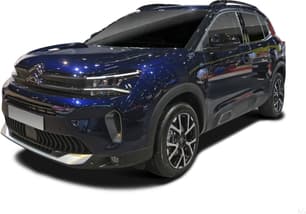
Which is why the Citroen C5 Aircross Sport’s much-needed update is welcomed with open arms, especially since it’s the only model in the range.
It boasts more space than a lot of its rivals but it’s been let down in the past by a sparse safety sheet and older tech.
The facelifted model sees tweaks to the design, safety and tech, making it more of a true competitor against the likes of the Kia Sportage, ever-popular Mazda CX-5 and practical Nissan X-Trail.
But are the changes enough for it to be considered as a family SUV? I’ve been testing it this week with my family of three to find out for you!
After nearly 700km of testing with both cars, it’s fair to say that the Tesla is indeed a capable tow vehicle, provided you keep the distances relatively short and plan around charge station locations.
Overall average - Penrith to Bathurst to Penrith
Fuel and energy consumption will always depend on the driving conditions, which is why we chose different routes for each leg of our testing.
Averaged across the two legs, towing the caravan with the Model X used 101 per cent more energy than without, or halved its driving range, which sounds a bit scary.
The LandCruiser by comparison added 63 per cent on average, which is still a big difference, but matters less in the real world when its big fuel tanks would still give you about 760km of driving range, which can be refilled quickly at any diesel-stocked servo.
So you could do a weekend trip with the caravan from Penrith with one supercharge in Bathurst, but it would’ve been highly unlikely to manage the extra 55km if you were leaving from Sydney CBD.
The bottom line is that there’s plenty of things - like smaller camper trailers - lighter than our caravan that will help the Tesla to do the towing job better right now.
Compared to the ‘Cruiser, the Tesla is a lesson in the benefits of a lower centre of gravity and road-focused handling.
As always, bigger batteries and more recharge points will go a long way to rectifying the Tesla’s towing shortcomings, and I'm sure we'll get there eventually.
But no matter what, its acceleration performance under load is simply excellent.
Thanks to our friends at Avida for making this test possible with the use of the 17-foot Avida Wave Tourer Electric Pop-Top single-axle caravan. They can also be reached on 1300 428 432.
So, what did my family think about the Citroen C5 Aircross Sport?
I love how it looks and its updated safety list. It’s fairly spacious inside and has a great boot space but it’s lacking a lot of family-orientated practicality in the back seat. The lack of individual storage and amenities is noticeable when you have a kid or two but even as an adult, not having a cupholder for your coffee/drink on a trip feels odd.
The multimedia system and reversing camera need to be improved, too. Overall, it will suit a small family which is out of the baby stage but can’t yet justify upgrading to a larger SUV. It gets a 6.5/10 from my family.
Energy consumption is just one element of a tow vehicle though, with stability, braking and acceleration performance being the most important details.
The big ‘Cruiser is always a safe bet for towing heavy loads, but it's fair to say its off-road ability, tall body and short wheelbase mean it could be better on the road, and the Tesla goes some way to proving that.
With all those batteries mounted nice and low, the Tesla is significantly more stable with 1.7 tonnes on the back than the LandCruiser, in all conditions. It’s also helped by that longer wheelbase.
The Tesla’s airbag suspension is another surprise advantage, and while it can be a bit choppy around town over minor bumps, bigger bumps on the highway are soaked up really nicely and it all settles quicker than with the LandCruiser - even with the caravan on the back.
Tesla is famous for instant acceleration at any speed, and this effect remains when towing. The LandCruiser’s twin-turbo V8 (with max torque available from 1600-2600rpm) has long been a benchmark for tow vehicles, but the Model X makes it feel sluggish by comparison.
You know how caravan vehicles are usually the slow ones up hills? This time, we were the ones doing the overtaking, even up the steep bends heading out of Lithgow. To overtake, it just takes the slightest flex of your right foot.
Clearly there’s a big caveat though when it comes to how much energy it’s consuming while you’re enjoying that performance, and it’s deceptive because it doesn’t make any more noise like a conventional engine when you’re pushing it.
You’d also think the weight of the van would overcome the engine-braking effect of the regenerative brakes, but they are still very effective at conserving your brakes downhill and preventing the car from running away from you, and no doubt giving the batteries a bigger boost at the same time.
On that note, the LandCruiser’s cruise control also does a great job of witholding speed on downhill runs, proactively dropping gears to engine brake enough to keep the Avida Wave in check.
Despite its city-friendly size, the C5 Aircross Sport is just as happy cruising on the open-road as it is in an urban environment.
The ride is smooth enough once you get up to a steady speed but the suspension can feel harsh on a bumpy road.
Also, the auto stop-start function can make it feel sluggish to respond, so I disabled this on most trips.
There is plenty of power so you'll feel confident overtaking or getting up to speed on the open road. However, you have to be a little more aggressive with the accelerator when you’re hitting hills.
The steering can, at times, feel vague when you’re at lower speeds but is otherwise responsive.
The cabin space is quiet and nice to be in on the highway and you’ll be able to chat with your passengers with ease.
What I like most about this though is the visibility – the windows are large and I feel like I have a clear view most of the time, which isn’t always the case in an SUV.
Parking this is a cinch with entry to tight car parks helped by a 10.7m turning circle!
However, the 180-degree view camera isn’t great and near hopeless at night time. A clearer image would be welcome but front and rear parking sensors ease the annoyance.