What's the difference?
The idea of a Tesla that can tow sounds about as likely as an astrophysicist with three Olympic gold medals, who also moonlights as a hand model.
The EV brand has blazed a trail for every other mainstream and premium car manufacturer to jump on the electric bandwagon, and today they’ve still got the biggest batteries and most impressive range ratings, while also having the most extensive extensive network of charge stations made up of Superchargers and destination chargers, covering every state and territory.
They’re not perfect though, often displaying niggling build quality issues and production delays for upcoming models. There’s also a degree of uncertainty bred by a founder who flits between the modern-day space race, manufacturing flame throwers and offering to send miniature submarines to rescue stranded children.
But there’s no questioning the overall impact Tesla has had on the automotive industry, along with the incredible brand awareness and aspiration it’s generated from non-enthusiast Joe Average consumers around the world.
The Model X is also rated to tow, with a decent 2250kg braked rating and an integrated tow bar that folds out of sight when not in use, which both fits its SUV character and encourages you to give it a go.
As far as clichés go, attempting to make “a silk purse from a sow’s ear” couldn’t be more apt than when contemplating the original NX of 2014.
What was essentially the Lexus-fication of the vocal, fidgety and thirsty old Toyota RAV4 may have worked a treat sales-wise, but proved trickier when assessed against the lens of a BMW X3, Audi Q5 and Volvo XC60 rival.
The earliest NX just wasn’t refined enough.
This was especially true following the reborn RAV4 arrival in 2019, proving to be embarrassingly more competent – even compared to most luxury midsized SUV alternatives.
Now, finally, the NX redesign has followed suit, moving on to a variation of the Toyota’s stronger, quieter and more advanced TNGA architecture (dubbed GA-K) as a starting base.
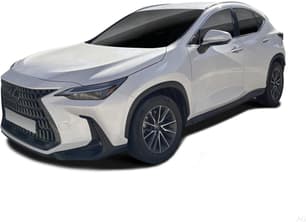
Speaking of which, let’s dive straight into the least-expensive version, the NX 250 Luxury 2WD auto, to find out if the most popular Lexus model in Australia has finally found its mojo.
After nearly 700km of testing with both cars, it’s fair to say that the Tesla is indeed a capable tow vehicle, provided you keep the distances relatively short and plan around charge station locations.
Overall average - Penrith to Bathurst to Penrith
Fuel and energy consumption will always depend on the driving conditions, which is why we chose different routes for each leg of our testing.
Averaged across the two legs, towing the caravan with the Model X used 101 per cent more energy than without, or halved its driving range, which sounds a bit scary.
The LandCruiser by comparison added 63 per cent on average, which is still a big difference, but matters less in the real world when its big fuel tanks would still give you about 760km of driving range, which can be refilled quickly at any diesel-stocked servo.
So you could do a weekend trip with the caravan from Penrith with one supercharge in Bathurst, but it would’ve been highly unlikely to manage the extra 55km if you were leaving from Sydney CBD.
The bottom line is that there’s plenty of things - like smaller camper trailers - lighter than our caravan that will help the Tesla to do the towing job better right now.
Compared to the ‘Cruiser, the Tesla is a lesson in the benefits of a lower centre of gravity and road-focused handling.
As always, bigger batteries and more recharge points will go a long way to rectifying the Tesla’s towing shortcomings, and I'm sure we'll get there eventually.
But no matter what, its acceleration performance under load is simply excellent.
Thanks to our friends at Avida for making this test possible with the use of the 17-foot Avida Wave Tourer Electric Pop-Top single-axle caravan. They can also be reached on 1300 428 432.
So, is the cheapest Lexus NX the grade you’d skip? Depends on where you live and drive.
If you’re urban based and bound, save up a bit more and go the petrol-electric hybrid; otherwise, out on country roads especially, the spirited and sporty NX 250 is more than up to the task.
Either way, though, the latest NX is finally fit to fight the other premium brands’ medium SUV efforts, head on and held up high. Welcome to big mid league, Lexus.
Ignore or underestimate at your own peril, everybody else.
Energy consumption is just one element of a tow vehicle though, with stability, braking and acceleration performance being the most important details.
The big ‘Cruiser is always a safe bet for towing heavy loads, but it's fair to say its off-road ability, tall body and short wheelbase mean it could be better on the road, and the Tesla goes some way to proving that.
With all those batteries mounted nice and low, the Tesla is significantly more stable with 1.7 tonnes on the back than the LandCruiser, in all conditions. It’s also helped by that longer wheelbase.
The Tesla’s airbag suspension is another surprise advantage, and while it can be a bit choppy around town over minor bumps, bigger bumps on the highway are soaked up really nicely and it all settles quicker than with the LandCruiser - even with the caravan on the back.
Tesla is famous for instant acceleration at any speed, and this effect remains when towing. The LandCruiser’s twin-turbo V8 (with max torque available from 1600-2600rpm) has long been a benchmark for tow vehicles, but the Model X makes it feel sluggish by comparison.
You know how caravan vehicles are usually the slow ones up hills? This time, we were the ones doing the overtaking, even up the steep bends heading out of Lithgow. To overtake, it just takes the slightest flex of your right foot.
Clearly there’s a big caveat though when it comes to how much energy it’s consuming while you’re enjoying that performance, and it’s deceptive because it doesn’t make any more noise like a conventional engine when you’re pushing it.
You’d also think the weight of the van would overcome the engine-braking effect of the regenerative brakes, but they are still very effective at conserving your brakes downhill and preventing the car from running away from you, and no doubt giving the batteries a bigger boost at the same time.
On that note, the LandCruiser’s cruise control also does a great job of witholding speed on downhill runs, proactively dropping gears to engine brake enough to keep the Avida Wave in check.
The NX 250 truly is a tale of two cars.
Around town, it is utterly capable and benign. The 2.5-litre atmo four-pot petrol unit is a revvy, raucous sort of engine, pulling away strongly off the line, responding quickly to pressing down on the throttle, shuffling up through seven of the lower gears smoothly (top is a highway overdrive), and generally being an easy vehicle to drive.
About the only concern is how noisy the engine can become if you’re needing to accelerate hard, with a definite mechanical zing that gives the Lexus a bit of a hoon attitude. We’re also a little hesitant about using the Sport mode in built-up areas, as ratios are held on to whether up or down shifting, amplifying the loud nature of this powertrain.
Other aspects of the NX 250’s driveability around town rate highly: light yet linear steering, with a tight turning circle providing easy manoeuvrability and parking; firm yet still absorbent suspension, offering an appropriately isolating ride over most bad road surfaces; and an overall sense of sound engineering. It seems quieter than an equivalent RAV4, more importantly.
Which led us to initially conclude that, in an urban environment, you’d naturally pay the extra $3K for the NX 250 Hybrid, to eliminate that noisy engine when pushing down hard on the throttle. Easy.
However, then we ventured out on a long rural drive, a few couple of hundred kilometres from the big city. On country roads, the NX 250 really sparks up in a most compelling way.
Yes, the engine is still a bit rowdy, but as the revs rise and the needle edges near the 6800rpm red line, the Lexus just keeps on building up speed rapidly, providing an unexpectedly sporty edge. Above 5000rpm this thing still has plenty of oomph, relying on a deep well of power to really extend its legs.
It also makes sense to slot the auto lever into manual, and use the finely positioned paddle shifters. That’s when you’re most aware of the gearbox being a torque-converter auto, with defined and assertive selections. It’s a good way to feel involved in the experience too.
Actually, as a mechanical ensemble, it all comes together at speed; that light and easy steering remains relaxed yet reactive, weighing up nicely if you choose Sport. The handling maintains a fluid, connected feel, with ample levels of grip from the Bridgestone tyres.
It occurred to us that driving the NX 250 Hybrid out on rural backroads would deny the enthusiast of the base model’s lightness and agility, since the latter weighs hundreds of kilos less; the brakes are perfectly modulated instead of feeling vaguely mushy and/or trigger happy as with many electrified SUVs; and – even with the road noise being well-supressed – you’re far less aware that the atmo petrol engine is singing loudly at speed.
Plus, the ride out in the sticks, even on our craggy old test strip that would jar the bones of some other midsized SUVs, remains calm and comfortably firm. That’s real progress for the NX.
We’d appreciate a bit more nuance in the way the stability control kicks in (quite late) to catch the tail; while the driver-assist tech like the adaptive cruise control and lane-keep assist do their jobs admirably, the latter’s constant chiming can be annoying; and there's a fair amount of road-noise intrusion over coarse bitumen. Like most midsized luxury SUVs, actually. Still quieter than a RAV4, though.
No jarring faults then. Lexus has done its homework and fixed most of the things that annoyed or infuriated us about the previous generation version. Good work.