What's the difference?
Things are going well for Subaru. In the first half of 2023, all of its models in Australia are outselling their figures for the same time last year by hundreds, some even by thousands.
Except for one model, the XV. In fact, sales have plummeted! So what happened to it? It was one of the brand’s top sellers, right?
Well, it’s still here, but now it’s called Crosstrek in Australia as it already is in the rest of the world. And maybe we lied a little - it’s selling very well. In June 2023 it outsold the Forester and Outback, both well established models in Subaru’s local history.
But the name isn’t all that’s new, because this Impreza-spinoff SUV now comes as a hybrid - available here as the Crosstrek Hybrid S.
Traditionally, Subaru has been pretty… traditional. So, will a step towards the future - electrification, that is - help or hinder the Crosstrek’s rise to mass popularity?
Mazda calls the new CX-70 its "flagship" five-seat SUV, which also makes it yet another flag-bearer for the brands relentless push up market as part of its 'Mazda Premium' strategy.
It might have a different badge, but it's really a five-seat version of the brand's biggest and most expensive offering, the seven-seat CX-90.
And, for reasons that will become clear in a moment, it's something of a bargain, at least in the context of Mazda's plush large SUV range.
How so, you ask? Read on.
It’s not perfect, in fact, the Crosstrek has a few factors that would probably turn off groups of buyers at a time, but Subaru knows its audience isn’t ‘everyone’.
Subaru customers aren’t trying to get their fuel efficiency below 4.5L/100km, nor find the car with the most luxurious interior. They’re looking for a practical Jack or Jill of all trades, which the Crosstrek does rather well for its segment.
Few small SUVs are as agreeable on rough and unsealed roads without sacrificing suburban comfort, while its features list is practical and provides plenty for the money.
Unfortunately, the hybrid system is a little underwhelming, and if it’s the main draw of the Crosstrek for you, it could be worth considering the less expensive ($38,590) Hybrid L or even a hybrid rival like the Toyota Corolla Cross or Mitsubishi Eclipse Cross.
If the all-round ability of the Crosstrek is the draw, however, the non-hybrid L is still an excellent offering and doesn’t use a lot more fuel than the Hybrid - plus it’s several grand cheaper at $41,490.
The Crosstrek is great for active people who need a bit of flexibility in one car but for the vast majority, the hybrid probably isn’t the sweet spot in the range. However, that won’t hinder the Crosstrek as an overall model, its popularity is already proven, and the option of a Hybrid puts Subaru a little closer to the eventual necessity of electrification.
For mine, the CX-70 is the pick of Mazda's premium SUV range, and if you can survive without a third row of seats, it's significantly cheaper than its CX-90 twin, too.
Note: CarsGuide attended this event as a guest of the manufacturer, with travel, accommodation and meals provided.
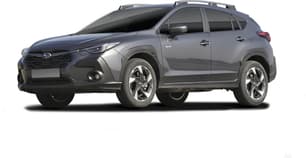
Perhaps unsurprisingly, the new Crosstrek looks an awful lot like its a development of the Subaru XV.
Which, given the latter’s popularity, is a very good thing.
While there are a lot of similarities, especially when it comes to some of the more rugged elements, the Crosstrek still manages to look quite new.
It’s rugged without having too many ‘busy’ design elements and it even looks at home in inner-city suburbs.
Of course, its raised body and cladding are mostly for practical reasons, but it gives the small SUV an adventurous aesthetic that separates it from city-focused rivals.
As essentially a high-riding development of the Impreza hatch, its size and proportions also make it look more like a ‘big car’ than a small SUV.
Yes, the Mazda premium SUV range can look a little same-same, but Mazda insists there are critical differences.
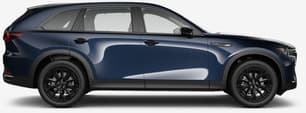
That said, if you can immediately spot the difference between the CX-70 and CX-90 without taking a peek inside, you're doing better than me, given it is the same exact dimensions as Mazda's three-row flagship.
Sure, Mazda talks about things like this design being a “passion pursuer” that serves up "dignified performance” – all of which sounds utterly ridiculous – but the less marketing-speak version is that it looks like a shapely large SUV that ditches the boxy dimensions of a proper 4WD for a more sleek and swooping profile.
Inside, it's a plush and premium-feeling space, with lovely cabin materials, plenty of tech, and plenty of space.
Practicality is pretty much a staple of Subaru as a brand, so it should be a huge surprise that it feels that way from the driver’s seat.
The interior doesn’t look futuristic, but it does look functional.
For example, even though the centre of the dash is all screen - and we love buttons for climate controls around here - the controls for air conditioning and temperature are at least always present on the screen, no sub-menus needed.
The phone charger is large enough for even very tall phones (looking at you, Samsung Galaxy S20 Ultra, pictured), and it’s out of the way to minimise extra digital distraction.
The steering wheel’s buttons, while many, are all clear and simple, as is the iPad-like icon layout on the multimedia screen.
Storage in the front is miles ahead of the rear seats, a large central bin with two cupholders, a big glove box, and decent space for water bottles in the door cards. In the rear, two central cupholders in the armrest and a small space in the door.
But there is a decent amount of space for an adult to sit in the rear, even if the sides of the roof are a little close to the head. It’s a little like the front, where the seats are supportive and easy to adjust to a comfortable position.
Further back, the boot space is a relatively small 315 litres, though its slightly larger than the 291L the petrol versions come with - that extra space likely swallowed by a spare tyre in the petrol versions, as opposed to the smaller batteries taking up some space in the hybrids.
The CX-70 measures a substantial 5120mm long, 1994mm wide, and 1745mm tall, and it rides on a 3120mm wheelbase.
It will tow 2.5 tonnes no matter which engine you choose, and the expansive boot will swallow between 589 litres and 2015 litres, depending on how you configure the backseat.
All of that space translates to a hugely airy backseat experience, with the second row able to be fixed in a position that either prioritises leg room or boot space.
With the former, you've got tons of space in the second row. I'm 175cm, and my knee and leg room was ample, with only the intrusive tunnel that runs down the middle-centre of the cabin eating into leg room for the middle passenger.
There are also air vents and temp controls, twin USB charge ports, seat heating in the window seats and swathes of very nice materials.
The boot is massive, too. I can't even reach the back of the rear seats when I lean into it, and Mazda says it will swallow smaller surfboard or SUPs without needing to resort to roof racks.
Under-floor storage adds a bit more security for precious items, too.
When you’re wearing a hybrid badge and you’re up against veterans in the field like Toyota with the Corolla Cross, you want to make sure you’re offering up something substantial.
At $45,090, before on-road costs, the Hybrid S tops the range and comes with a features list that screams it from the rooftops. Or the mountaintops. Or at least as far as the gravel tracks will take you towards the mountaintop.
From the outside, 18-inch wheels are the first indicator for the ‘S’ grade - note that hybrids don’t come with spare wheels, just repair kits - as well as body coloured door handles and black plastic trim and cladding, aside from the gloss mirror caps.
The door mirrors are heated and fold away when parked, while up top there’s a sunroof flanked by roof rails, with a styled spoiler at the rear.
Interestingly, there’s no power tailgate.
LED DRLs and headlights are automatic and are aided by steering responsive active cornering lamps, while the wipers are auto rain-sensing.
Inside, dual-zone climate control and heated front seats (the driver’s is eight-way power adjustable) for the cold - all seats are leather accented - while the steering wheel and shifter are also leather-wrapped.
Tech is covered off by the usual 11.6-inch portrait touchscreen centrepiece, with sat-nav, AM/FM and digital radio, wireless Android Auto and Apple CarPlay, USB-A and USB-C plugs (in the rear, too), a wireless phone charger, and a 10-speaker Harman Kardon sound system over the usual six-speaker set-up. There’s even an auxiliary audio input.
The driver display is a small 4.2-inch unit flanked by physical dials.
We'll drill down on this a little more in the practicality section, but it's important to note here that the CX-70 is the same size as the CX-90 – both are 5120mm long, 1994mm wide and 1745mm high — which means the only real difference between the two models is the third row of seats in the CX-90.
And, as it turns out, that's a very expensive pair of chairs. The CX-70 starts with the GT trim at $75,970 before on-road costs for the petrol or $77,970 for the diesel, and then climbs to the Azami trim, which is $82,970 or $84,970.
The CX-90, though, is $82,577 or $85,785 for the GT, or $91,461 or $93,030 for the Azami.
That makes the CX-90's third row at least a $6600 option, but as much as an $8000 upgrade. Mazda has made moves to address this, with a drive-away "plate clearance" that closes that gap, but we suspect those offers will become permanent fixtures to make the jump from 70 to 90 less ferocious.
Anyway, Mazda has thrown just about everything they've got at the CX-70. The GT kicks off with plenty of high-end gear, including 21-inch black alloy wheels, adaptive LED headlights, a panoramic sunroof and a handsfree powered tailgate.
Inside, there are twin 12.3-inch screens with Apple CarPlay and Android Auto, a 12-speaker Bose stereo, leather seats that are heated front and rear, three-zone climate control and a heated steering wheel.
The Azami then adds things like ambient lighting, black Nappa leather seats, which are now ventilated in the front, footwell lighting, body-coloured wheel arches and lower cladding and body-coloured door handles.
This is perhaps the part of the review you’re most interested in - as well as the following sections on efficiency and maybe driving - if the ‘Hybrid’ part of the Crosstrek Hybrid S’ name brought you here.
Like its design and interior, the engine will be familiar to anyone who has owned or driven a relatively recent Subaru - a 2.0-litre flat-four petrol engine good for 110kW/196Nm - which means it makes a little less than the standard petrol variant’s 115kW.
However, the electric motor is capable of its own 12kW/66Nm outputs, though Subaru doesn’t supply a claimed total maximum for the whole powertrain.
Drive is transferred to all four wheels - it is a Subaru after all - via a seven-step continuously variable transmission (CVT).
You can have one of two engines in the CX-70, with the cheapest being a 3.3-litre, six-cylinder turbo-petrol, producing 254kW and 500Nm. There's also a 3.3-litre, six-cylinder turbo-diesel, making 187kW and 550Nm. Both are equipped with a 48-volt mild hybrid system to marginally reduce fuel use.
All models are AWD, and pair with an eight-speed automatic transmission.
Subaru claims the Crosstrek Hybrid will sip 6.5L/100km on the combined cycle, which isn’t enough to blow anyone away, even when you take into account the extra fuel needed for permanent all-wheel drive. The AWD Corolla Cross Hybrid comes with a claimed 4.4L/100km.
Compare this to the 8.5L/100km reading the Crosstrek returned after our time with the car, mostly with a (somewhat unkind) mix of inner-city and semi-rural backroad driving, and it’s clear the Crosstrek isn’t one of the most frugal cars in its class.
More highway driving would certainly have lowered the figure - we’ve achieved 8.0-litres on previous testing with a non-hybrid Crosstrek - but perhaps being top of the charts for efficiency isn’t necessarily what Subaru buyers are looking for.
Of course, the Crosstrek Hybrid S employs a couple of features to avoid using fuel where it can be avoided, such as auto stop-start and its (relatively mild) electric system taking over when mostly coasting or the engine isn’t required.
Petrol-powered cars will sip 8.1L/100km on the combined cycle, while the diesel drops that to 5.4 litres.
Both models get a 74-litre tank, meaning a theoretical driving range of around 900kms in the petrol, and almost 1400kms in the diesel.
Two things stand out after a short stint behind the wheel of the Crosstrek Hybrid, and both become more cemented over time.
The first is that the ‘Hybrid’ part of the ‘Crosstrek Hybrid S’ isn’t quite as prominent in its real-world impact as it is in its name.
The 110kW engine doesn’t feel like it’s being massively helped along by any electric assistance, and the electric motor is very rarely doing the work by itself, as you’d find in any hybrid from Toyota or Honda.
That’s a shame, because the Crosstrek could do with a little extra oomph, if not for getting up to speed then for avoiding thrashy engine sounds under acceleration.
The CVT, while not necessarily detrimental to its performance, doesn’t help with that.
But balancing that out is a chassis and platform that’s engaging and predictable - and that’s predictable as a good thing - making the Crosstrek pleasant to pilot.
Its controls like steering and braking are nicely weighted for low speeds, commuting, and for more spirited driving, while the suspension and chassis handles surfaces from smooth suburban roads, to city tram tracks, to unsealed roads with ease, soaking up bumps and shakes nicely.
If you’re noticing a theme in this review, it’s that Subaru doesn’t seem to be chasing any ‘best at’ metrics in favour of giving the Crosstrek the ability to do a range of different driving and being at least satisfactory in any given area.
Interestingly, the CX-70 has been tagged as the expected smallest seller of Mazda's premium SUV range, but I reckon it just might be the pick of the bunch.
Every one of the CX-0 models (60, 70, 80 and 90) all get slightly different suspension tunes, and while you can find harsh edges in the other models, the CX-70 feels utterly composed and refined, at least on the smooth-ish roads of our launch test route.
Perhaps most surprising, though, is the CX-70's ability to hold its own on a properly twisting road. We expected lots of weight transfer and the high-pitched sounds of tyres screaming out in pain, but instead found Mazda's massive SUV served up grip, composure, and very little in the way of sea-swell-style body roll.
The two big six-cylinder engines also feel perfectly suited to a vehicle in this space. There's tons of power whenever you need it, and solid levels of refinement in terms of engine noise or diesel rattles.
For mine, the petrol engine is the pick though, feeing just a little smoother than the diesel option. The latter can feel a bit jerky at slower speeds, whether that's the power delivery or the gearbox, and it doesn't seem to happen with the petrol engine.
The biggest caveat, though, is that we haven't driven the CX-70 in its natural environment, the city and suburbs, so while it largely shone on flowing country roads, how it performs on roads like the ones near your place remains a bit of a mystery.
As the range-topper, the Subaru Hybrid S comes with the lot in terms of safety.
And even though it hasn’t been tested by ANCAP yet, it’d be a shock if its score was anything less than the maximum five stars.
It’s what the XV scored in 2017, and the brand hasn’t missed out on full marks since the Impreza and Foresters of the early 2000s.
Nine airbags include dual front, dual front side, dual curtain, driver's knee, far side, and front passenger seat cushion airbags, plus Subaru’s 'EyeSight' safety suite does the work in crash prevention.
On top of the standard safety features you’d expect from any new car like electronic stability control and ABS, there’s a ‘Pedestrian alert system’, emergency lane keep assist with departure warning and prevention, a ‘Driver Monitoring System’ that includes drowsiness and distraction warnings, sensors and monitors for blind spots and rear cross-traffic, and of course parking sensors.
Some less common features of EyeSight include ‘Lead Vehicle Start Alert’, ‘Pre-Collision Braking System’, ‘Pre-Collision Throttle Management’, ‘Intelligent Speed Limiter’ as well as ‘Speed Sign Recognition’ and ‘Brake Light Recognition’.
Specific to the S, is a surround-view parking camera, high beam assist, plus front- and side-view monitors to help avoid kerbing wheels or bumping towbars.
It’s all fairly well implemented in the Crosstrek, though some of its chimes can be a bit much - the driver distraction alert can mistake a quick climate control change at the lights for a proper lapse of focus, while an alert for approaching speed and red light cameras comes without any indication of what the noise is for.
The CX-70 hasn’t been ANCAP tested, but it does arrive with a pretty stacked safety offering, including a 360-degree-view camera, blind-spot monitoring, front and rear cross-traffic alert, and a total of eight airbags, including a knee airbag for the driver.
The Crosstrek is covered by Subaru’s five-year/unlimited kilometre warranty, with servicing intervals coming up every 12 months or 15,000km under Subaru’s five-year capped-price servicing.
Subaru also adds 12 months of free roadside assistance.
This is all fairly standard in the industry, though some brands like Kia and MG offer seven-year warranties, or there’s Mitsubishi with a 10-year warranty (even if it requires certain conditions to be met during the decade).
Servicing is not particularly cheap in the CX-70, and the service intervals, at least in the diesel, feel a little short, too.
Buy that one, and you’ll be visiting the dealership every 12 months or 10,000kms, and the first five years of ownership will cost you $3298.
Petrol cars require servicing every 12 months or 15,000kms, and five years will set you back $3436.
The CX-70 is also covered by Mazda's five-year, unlimited-kilometre warranty.