What's the difference?
It’s finally happened: Rolls-Royce has become so divorced from the everyday world of common folk that it's no longer even sharing the previously agreed meanings of words. Rolls has its own meanings, possibly its own language, which must be spoken with a plum on the tongue.
They’ve been heading here for a while. For example, at Rolls, “affordable” means the car we're driving today, the Rolls-Royce Ghost Series II, which is yours for just $680,000 (an indicative price, bumping to $800K for the Black Badge). And “iconic British marque” means, obviously, “BMW bought us in 2003, so there might be some German bits”.
It turns out that “driver-focused” means something different at Rolls-Royce, too. Thanks to a smattering of chassis innovations, Rolls says this updated 2025 Ghost is “the most driver-focused V12 Rolls-Royce ever”. Which is “a side of Ghost’s character that our clients increasingly and enthusiastically embrace”.
Don’t fall for it. The Ghost’s extra focus is not actually very focusy, and its additional dynamism is really only more dynamic in the way that a bed that could corner at all would be more dynamic than a normal bed. None of that matters.
The reason it doesn’t matter is because the Ghost Series II is wonderful. Indeed, it is very nearly perfect. Which is a word that even Rolls won’t quibble over.
In an era where internal combustion power appears to be rapidly disappearing into the rear-view mirrors along comes Audi, casually wheeling out a new RS5.
But the pride of Ingolstadt hasn’t completely sidelined its e-tron-style electrification, because while a fire-breathing 2.9-litre twin-turbo-petrol V6 sits under this newcomer’s bonnet, it’s now supported by a grunty electric motor in its eight-speed auto transmission and another on the rear axle to manage torque vectoring.
The result is mega-power and massive torque with all-wheel-drive quattro grip offered in four-door sedan and Avant wagon form.
And CarsGuide was invited to a launch drive program on Tasmania’s east coast, home to some of the best driving roads in the country, with a quick fang around the Symmons Plains race circuit included.
Time to see what this new, plug-in hybrid, 630hp beast has to offer.
In a disruptive era when the coachbuilder has pivoted to SUVs like the Cullinan, a sort of London black cab that’s been dipped in opulence, and succeeds despite itself, and the brand’s grand, million-dollar EV, the Spectre, the Ghost is a safe and familiar space.
A beautiful, long, broad, immaculate land boat. It’s a space Rolls inhabits with relish.
The Ghost Series II feels nothing like a track-day option when you’re behind the wheel. But it might do if you were stepping out of a Phantom. Or a Cullinan. Or a Wraith. Especially if you’re stepping out of the back doors.
It’s the perfect driver’s car. As long as all your other cars are also Rolls-Royces.
Audi says this car’s shift to a plug-in hybrid powertrain represents a “defining moment” for Audi Sport enhancing the RS5’s character and performance.
After this first drive we can only agree. Its power, driving dynamics, refinement and quality apply a fierce blowtorch to the belly of its European hot rod rivals.
Note: CarsGuide attended this event as a guest of the manufacturer with travel, accommodation and meals provided.
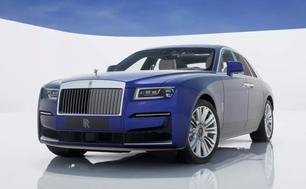
Yes, its exterior is more monolithic than before. The previous iteration was hardly fiddly, but the (apparently client driven) evolution here edges ever so gracefully towards what Rolls-Royce might secretly think of as brutalism.
The Ghost Series II’s generous 2148mm width is further emphasised up front, stretched across its upright prow, with slimline headlights adding definition and — surprisingly — a touch of villainy.
New, Spectre-inspired tail lamps and a discreetly inscribed double ‘R’ monogram add a reserved flourish from behind, and buyers can choose from two new 22-inch, nine-spoke wheel designs.
It’s subtle, no doubt. But it’s also impeccable.
The new RS5 sedan and Avant wagon are beautifully proportioned, with big rims and rubber, pumped guards and a visual balance that matches a close to 50/50 front to rear mechanical weight distribution.
Instantly recognisable as an Audi, big ticket elements include a huge 3D honeycomb grille, front wheel-arch exit vents, a rear spoiler on both versions and RS-specific OLED tail-lights with a chequered flag signature.
Beauty is always in the eye of the beholder but I think this car exudes equal parts sophistication and menace.
Inside, the RS5 is all business, from the configurable multi-screen displays (including a lap analysis tool) to the flat bottom and top steering wheel as well as the beautifully sculpted seats and obvious attention to detail.
The driver’s the main event here and the interior treatment extends the exterior’s intense personality perfectly.
Inside, yes, there are bonkers touches in this most refined of automotive spaces, such as upholstery pinpricked by 107,000 'Placed Perforations' of 1.2mm in diameter, each individually examined, that replicate the shape of some clouds spotted over Rolls-Royce's Goodwood HQ.
Beside those flourishes of lunatic opulence, the more practical features feel pedestrian, but they’re comprehensive. The wireless Apple CarPlay and Android Auto, the seamless 'Central Information Display' and the 18-speaker 1400-watt audio, the upgraded Wi-Fi hotspot and the unobtrusive USB-C ports. The rear-seats flush with giant, streaming-optimised screens and heated and ventilated massaging seats.
Rolls acknowledges the generational movement of its clientele from back seat to front, with over 90 per cent of buyers now opting to — gasp! — steer themselves in a Ghost. But with back-seat savoir faire in its DNA, Rolls simply extends its hospitality to every seat.
In terms of space and practicality, in the front, at 183cm tall I’ve got plenty of breathing space.
And for storage, there are pockets in the doors big enough to hold large bottles as well as a couple of cupholders in the centre console.
A tray ahead of the gearshifter is for wireless charging but if your phone isn’t in there it doubles as an oddments tray and there are two USB-C ports and a 12-volt socket inside it.
There’s a fairly shallow lidded storage box between the seats which doubles as an armrest between driver and passenger and there’s a medium-size glove box.
In the back, I’ve got plenty of foot and legroom although without too much effort I can touch my head on the roof lining, so I’d call that marginal.
For storage, there are decent bins in the doors, big enough for bottles. There’s a pull-down armrest in the centre, again with a pair of cupholders.
There are netted pockets on the front seatbacks, adjustable air vents with temperature control as well as another pair of USB-C outlets to keep everyone happy and charged up in the back seat.
Boot space is passable for a car of this size, with the sedan offering 331 litres VDA with five seats up and the Avant wagon at 361L in the same configuration.
Both feature a 40/20/40 split-folding rear seat for extra flexibility and space - 1170L with the second row folded in the sedan and 1302L in the wagon.
There are tie-down anchors, bag hooks as well as numerous extra storage spaces and braked trailer towing capacity is a handy 2.1 tonnes.
But there’s no spare wheel of any kind. A repair/inflator kit is your only option, which in this market, isn’t good enough.
The Ghost Series II is yours for an indicative price of just $680,000 (or $800K for the Black Badge) plus substantial on-road costs. The Ghost Series II extended (which we didn’t drive at the international launch in Provence) will slip in at around $20K less than the Black Badge before additional charges.
If they seem like big numbers, you’re probably the sort of person who looks at price tags, or who shops in shops that put price tags on things. These are not common traits of Rolls-Royce buyers, who may only be vaguely aware of the actual price of their vehicle, and whose historical impression of guillotines is generally unfavourable.
So, high six-hundreds is table stakes.
But you might also think the ‘standard’ Ghost, like all Rolls-Royces, is considered by most buyers to be a mere starting point, from which they’ll typically up-spec their ride from a sumptuous and expensive options list.
Spending another 10 percent of the purchase price on customisation is a bare-bones outlay for most owners, but even so, the evolved Ghost’s out-of-the-box features are so comprehensive as to be almost overwhelming.
First, because the Ghost has been Rolls-Royce’s driver’s car since the first (modern) generation arrived in 2010, specifically to cater to a weird (for Rolls clientele) new generation of buyers who wanted to drive their Rolls themselves.
So that price gets you, above all, that proven but superb 6.75-litre twin-turbo V12 engine, massaged via an eight-speed transmission and an AWD system that’s as rich and viscous as Crassus’s last libation.
There’s its subtly tinkered 'flight on land' 'Planar Suspension System' (note the unspoken dissonance between the terms ‘flight on land’ and ‘driver-focused'), with an ingenious 'Satellite Aided Transmission' system that uses GPS to pick the ideal gear with which to launch out of turns.
It works hand-in-velvet-glove with Goodwood's 'Flagbearer' camera system, which tracks the road ahead to chide potholes into submission in advance.
Because it’s a Rolls, though, that’s barely even the start of the story.
The coachwork is extraordinary, with new trim options including natural open-pore 'Grey Stained Ash' design elements, a sumptuous new bamboo rayon textile called 'Duality Twill'.
There a night-sky inspired illuminated fascia that apes elements of time-lapse celestial photography, part of the central glass panel that stretches the length of the dash.
Sure, you might expect that level of detail for the outlay. But for the outlay it’s far from missing anything you’d expect.
Before we get behind the wheel, it’s prudent to check in on cost-of-entry.
Sitting at $179,827, before on-road costs for the sedan and $182,827, BOC for the Avant, this third-generation RS5 is a relatively modest, roughly seven per cent step up in price from the second-gen Coupe and Sportback models it replaces.
Obvious rivals include fellow Bavarian, the BMW M3 (from $169,600) as well as the Mercedes-AMG C63 S E Performance ($193,100) with the Alfa Romeo Giulia Quadrifoglio (from $174,200) lurking in the shadows.
Aside from the performance and safety tech we’ll get to shortly, standard equipment highlights include:
Suffice it to say this machine meets the market when it comes to included features.
Rolls doesn’t like acceleration figures — too gauche, darling — but armed with that proven 420kW and 850Nm V12, the Ghost Series II has serious heft. Delivering max torque from 1600rpm — just 600rpm above idle — the effect is genuinely of one endless surge, a wafting cloud of momentum that subtly slips between gears as it exudes itself across the countryside.
The Black Badge edition, like all of its, er, ‘disruptive’ ilk offers a ‘Low’ button (‘Low’ means ‘Sport’ in Rollspeak), which bumps gearshift speeds by 50 percent when you plant your foot, and delivers a distinctly non-Rolls-like pop and burble on overrun. It also provides an extra 21kW and 50Nm, because Black Badge is mean and tough.
The RS5 is powered by an updated version of the previous model’s all-alloy 2.9-litre, twin-turbo petrol V6 engine which produces 375kW/600Nm all on its own.
It features direct-injection and variable geometry turbos as well as variable intake and exhaust cam timing. And now it’s supported by an electric motor integrated into the eight-speed auto transmission that tips in 130kW/460Nm.
A mighty combination with overall outputs of 470kW/825Nm. Enough to propel either version of this car from 0-100km/h in a blistering 3.6 seconds.
Provence is not entirely a driver’s paradise, with every stretch of slightly twisty tarmac only a counterpoint to a motorway lined with Marseille lorries, Depardieu-esque men in tractors who refuse to move to the verge, and small villages where each kerbside corners sit millimetres from the foot of an adjacent boulangerie.
Which is to say it’s neither a place for economy runs, nor a location at which to run up the consumption numbers with a madcap series of impromptu hill climbs.
Our Ghost II drive returned around 16L/100km, which feels about right with that gorilla-in-a-tuxedo 6.75L V12, and is only slightly above the official figures of 15.8L/100km. Not great, could be worse.
Claimed combined cycle (urban/extra-urban) fuel economy is a miserly 4.2L/100km for the sedan and 4.4L for the Avant, which is amazing for a car with this much performance potential.
But it’s worth noting that number rises to (a still impressive) 10L/100km when the battery’s depleted.
On an enthusiastic section of the launch drive we saw an average of 17L/100km which dropped to 7.0L on a cruisier section.
What’s more, thanks to a 25.9kWh lithium-ion battery, it can cover 78km in EV-only mode at up to 140km/h if you’re game.
Charging capacity is 11kW AC, for a full top-up in two and a half hours and minimum fuel requirement is 98 RON premium unleaded.
With the battery fully charged you can expect a combined cycle range of around 1200km, which is more than useful.
The Ghost Series II drives like a magic carpet, serene and untroubled; in almost any stable other than that of Rolls, calling it a ‘driver’s car’ would have you throttled by their skunkworks. Everything is relative.
Still, it hides its considerable dimensions well. There’s never any doubt that you’re in a large saloon, as you white-knuckle the Ghost’s impeccably appointed steering wheel, but there’s always enough power to deliver creamily instant throttle response, even in the case of initially misjudged cambers.
Nor can the Black Badge hide the shimmy of that characteristic ‘flight on land’ body drift. The upside is that its manners are impeccable, even through the worst possible pieces of corrugation Provence can deliver.
If anything, the Ghost Series II’s big-hearted bulk adds to the fun factor, especially in some of Rolls-Royce’s more garish colour options, when gasping South of France MAMILs stare in amazement as a bright yellow, five-and-a-half metre Rolls passes them on the outside, scattering their various baguettes and garlands of onions.
This RS5 has 40 per cent more power and 40 per cent more torque than the model it replaces, which was no slouch. It is properly fast.
We gave it a red-hot go on the circuit and the car remained predictable, balanced and sharp.
The drivetrain, including the quattro all-wheel-drive system, centre diff and torque-vectoring across the rear axle keeps everything in hand and quietly turns you into a superhero.
The eight-speed auto transmission is a conventional torque converter type, and it’s quick on the up-change but it’s half a beat slower to pick up a ratio on the down-shift relative to a dual-clutch. Not much in it, but it’s there.
So, we’ve established this car’s fast; capable of accelerating from 0-100km/h in 3.6 seconds. But if you want full weapons-grade in an instant while cruising, try pressing the bright red Boost button on the steering wheel. Everything immediately goes to maximum and for 10 seconds you’ve got it all.
The RS Sport exhaust is an active, variable system, tuned specifically for the RS5, constantly adjusting according to your driving style.
Cruise along and it remains quietly civilised, but pin the throttle and all of a sudden you’re hearing that wonderful growl from the V6 engine.
Suspension is by multi-links at the front and the rear and there are dual-valve adaptive dampers all around. The car rides very nicely with three set-up choices - Sport, Balanced and Comfort.
We were in Balanced most of the launch drive program on fairly coarse B-roads as well as some main highways and we were surprised by the (285/30) Pirelli P Zero R tyres and how quiet they are. Exceptionally grippy on the circuit but very quiet on the open road.
And wind noise is minimal. So, as a GT this car is very comfortable, quiet and refined.
The steering is progressive rate and speed-dependent and it is just beautiful. Accurate and feelsome, you’ve got a great connection with the front wheels without any undue feedback coming up to your hands.
You can feel this car’s roughly 2.4-tonne weight, but it always feels buttoned-down, agile and responsive.
The Dynamic Torque Control system complies with the classic swan on the lake syndrome. Serene and calm on the surface but furiously doing its thing underneath. It keeps everything on track, almost magically.
It delivers 8.0kW and 40Nm, acting as a high‐voltage actuator within the rear transaxle, redistributing torque differences between the rear wheels within milliseconds.
And the quattro system features a redesigned centre diff with integrated preload function for continuous torque distribution, delivering sharper response during rapid throttle transitions.
When it comes to slowing, the brakes are professional grade. You’ve got dinner plate-size ventilated rotors (420mm fr - 400mm rr) and 10-piston callipers up the front.
You can stand the car on its nose as it washes off speed rapidly and progressively with fantastic pedal feel.
Under the heading of miscellaneous observations, the sports front seats look and feel fantastic. Comfortable after hours behind the wheel. But also, when you’re pushing on the open road, or really having a go on the circuit, their side bolsters are just right, providing enough support without pinching you or proving uncomfortable.
You get airbags, ESC, adaptive cruise, parking sensors and auto parking, and a rear camera. But don’t expect Rolls-Royce to allow the blighters at ANCAP to wreck one.
The RS5 has not been assessed by ANCAP, but all the expected safety boxes are ticked, including but not limited to:
There are eight airbags, sadly not including a front centre bag. But for child seats there are three top tethers across the second row with ISOFIX lower anchors on both outboard positions.
The numerous advanced driver assistance systems (ADAS) are effective without being overly intrusive. Not always an easy balancing act to achieve.
The RS5 is covered by Audi’s five-year, unlimited km warranty, which lags the mainstream market but is still par for the course at the top end.
The traction battery is covered for eight years/160,000km and there’s a 12-year corrosion warranty.
Service interval is 12 months/15,000km and a five-year service plan is $3650 which isn’t outrageous for this kind of car in this part of the market.
Audi has more than 50 dealerships across Australia covering every state and territory as well as key regional and rural centres.