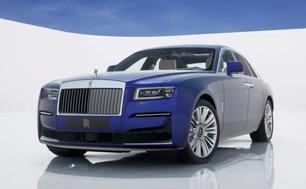
What's the difference?
It’s finally happened: Rolls-Royce has become so divorced from the everyday world of common folk that it's no longer even sharing the previously agreed meanings of words. Rolls has its own meanings, possibly its own language, which must be spoken with a plum on the tongue.
They’ve been heading here for a while. For example, at Rolls, “affordable” means the car we're driving today, the Rolls-Royce Ghost Series II, which is yours for just $680,000 (an indicative price, bumping to $800K for the Black Badge). And “iconic British marque” means, obviously, “BMW bought us in 2003, so there might be some German bits”.
It turns out that “driver-focused” means something different at Rolls-Royce, too. Thanks to a smattering of chassis innovations, Rolls says this updated 2025 Ghost is “the most driver-focused V12 Rolls-Royce ever”. Which is “a side of Ghost’s character that our clients increasingly and enthusiastically embrace”.
Don’t fall for it. The Ghost’s extra focus is not actually very focusy, and its additional dynamism is really only more dynamic in the way that a bed that could corner at all would be more dynamic than a normal bed. None of that matters.
The reason it doesn’t matter is because the Ghost Series II is wonderful. Indeed, it is very nearly perfect. Which is a word that even Rolls won’t quibble over.
Balancing luxury car comfort, hot hatch agility and supercar speed is no easy task, yet that is what made the six previous generations of BMW's M5 so iconic.
In seventh-generation ‘G90’ guise, the M5 has another skeleton in the cupboard: the toughest emissions regulations that Europe, and now Australia, have ever seen.
A twin-turbo V8 was untenable and going battery electric was not an option. Plug-in hybrid was the only answer. For the new M5, BMW combined a revised 4.4-litre ‘S68’ bent eight with a punchy electric motor for 535kW and 1000Nm.
Problem is, the G90 is widely acknowledged as one of the greatest BMW M cars of all time, especially in CS trim. And thanks to a circa-600kg weight hike to nearly 2500kg, the new M5's 0-100km/h claim is actually slower than the old 'F90' M5.
Doesn’t exactly sound like a big leap forward, does it?
A drive through the Central West of NSW and around the iconic Mount Panorama racing circuit gave us answers to two questions. Does the M5 work on Australia roads, and does BMW M's latest super-sedan represent progress?
In a disruptive era when the coachbuilder has pivoted to SUVs like the Cullinan, a sort of London black cab that’s been dipped in opulence, and succeeds despite itself, and the brand’s grand, million-dollar EV, the Spectre, the Ghost is a safe and familiar space.
A beautiful, long, broad, immaculate land boat. It’s a space Rolls inhabits with relish.
The Ghost Series II feels nothing like a track-day option when you’re behind the wheel. But it might do if you were stepping out of a Phantom. Or a Cullinan. Or a Wraith. Especially if you’re stepping out of the back doors.
It’s the perfect driver’s car. As long as all your other cars are also Rolls-Royces.
Let’s get one thing out of the way: the new M5 is a very good car. Considering the emissions limitations and size increase of its base model, it is an impressive bit of engineering.
What’s trickier is deciding whether the new car is really better to drive. Less edgy but supremely comfortable and quiet; BMW leaned into the daily usability of the plug-in hybrid M5 rather than amping the petrol-electric system for maximum thrills. And do you know what? That’s fine with me.
The new M5 still performs on road and track and does an incredible job of hiding its weight (most of the time). Perhaps the G90 is a little more Audi RS6 than F90 in its demeanour but some would argue that’s no bad thing.
The concept of the BMW M5 is not static, it evolves with the times, and the G90 is no exception. Expect future Competition and CS variants to unlock some extra lunacy.
Note: CarsGuide attended this event as a guest of the manufacturer, with meals provided.