What's the difference?
The Mini Countryman is the not-so-mini cousin to the iconic and smaller Mini Cooper.
The new generation offers a larger body-size, fun new interiors and a whole suite of updated technology.
We're in the flagship John Cooper Works grade in Favoured trim to find out if this small SUV is still urban-friendly and fun after all of these changes.
The hot hatch wars, an on-going automotive conflict, fired up when Volkswagen lobbed a massive, Golf GTI-shaped salvo into an unsuspecting global car market in the middle of 1976.
Peugeot may have run a bold out-flanking manoeuvre with deployment of the 205GTi from the mid-1980s, and other skirmishes broke out soon after with the likes of Suzuki’s Swift GTi, but so far the German maker has retained majority ownership of those three little letters that mean so much.
Fast forward to 1995 and application of the GTI tag spread to the compact VW Polo, which close to three decades later brings us to the current, sixth-generation version.
It arrived in Australia in 2018, and four years down the track it’s time for an update, with subtle cosmetic tweaks and a significant safety upgrade included.
Volkswagen Australia invited us to the car’s local launch including a varied drive program, topped off with a hot-lap track session, to get a first taste of how it shapes up.
The new Mini Countryman John Cooper Works in Favoured trim offers everything you’d expect it to - the iconic Mini styling, a powerful driving performance and a well-equipped cabin. It’s a wonderfully quick urban dweller that you can park anywhere but is just as happy on the open-road. For me, this is pure fun and offers more personality than a lot of its rivals.
The Polo GTI faces tough competition in the form of Hyundai’s recently arrived, very good, and well-equipped i20 N, as well as Ford’s sleek and super-capable Fiesta ST. But as mentioned at the start, VW occupies the hot-hatch high ground with the GTI badge, and this upgraded Polo is loaded with features, dynamically outstanding and on the leading edge in terms of safety. Time will tell if the higher price, higher spec strategy is the right one, but there’s no doubting this updated Polo GTI is a compelling package.
Note: CarsGuide attended this event as a guest of the manufacturer, with meals provided.
It's a case of the 'not-so-mini' when it comes to the new Countryman because it now stands at 4447mm in length, 1843mm in width and 1645mm in height. That's 170mm longer and 21mm wider than the previous generation!
But the Countryman still has all of the fun styling you’d expect in a Mini and it’s that iconic styling that sets this car apart from its rivals. It knows its fun and isn't afraid to show it.
Our Mini Countryman gets JCW badging across the body of the car, including its wheels but it's the chequered flag motif across the grille that reminds you what’s under the bonnet.
Unfortunately, our test model is finished in the rather boring 'Midnight Black II' but the range of colours and customisations available on the Countryman will help make it feel like your own.
Head inside and there's a hefty mix of materials in the cabin space. You’ve got a thick and rough-textured weave/knit across the dash, doors and tops of the sports seats but that’s then mixed with a black synthetic upholstery and plastics everywhere else.
The red stitching and accents won’t land with everyone but it certainly creates a fun atmosphere.
There are some lovely design highlights with rose gold metal accents in the door handles and air vents. A panoramic sunroof adds some much needed airiness and I adore the way you still get a ‘turn-key’ experience despite having keyless start with the starter knob.
The round media screen isn't as well-integrated as before but it looks gorgeous and the different drive modes give you a range of colours to further customise the cabin.
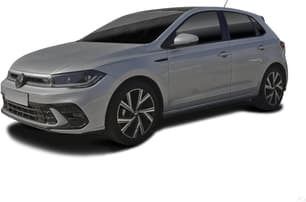
Not exactly a massive change to the exterior of the Polo GTI with this mid-life refresh, but sharp-eyed car spotters will notice a new front bumper treatment including a revised lower grille, defined by a body-coloured border and flanked by LED driving lights.
The headlights have also been reshaped to mark the arrival of standard matrix LED beams, with the signature horizontal red keyline moves from the centre to the bottom edge of the upper grille. A continuous LED strip across the nose stands the car apart after dark.
Previously part of the GTI’s ‘Luxury Pack’, the ‘Faro’ design 18-inch alloys fill the wheel arches nicely, and overall the car’s compact, tightly wrapped body and finely chiselled lines are familiar.
At the back, the LED tail-light clusters have been extended laterally into the hatch door, but the car’s fundamental shape is unchanged.
Inside the dash layout is the same, although the centre of the sports steering wheel has been massaged into a more organic shape with the airbag/horn now an oval rather than a circle.
The rest of the interior is relatively understated in typical VW fashion, the neatly sculpted sports seats trimmed with traditional ‘Clark’ tartan cloth on the cushion and backrest centres. And ‘Kings Red’ inlays in the dash, centre console and front door trims, are a reminder of the car’s heritage and sporty intent.
The cabin of the Mini Countryman doesn't feel like it belongs in a small SUV. The legroom is still best up front but the second row offers more than enough space for taller adults. It will be most comfortable for four rather than five adults, though.
The electric front seats have large side bolstering and decent padding but they are on the firmer side. You get a little bit of fatigue on a longer trip but around town they’re great and the massage function on the driver's seat is strong.
The rear seat is even firmer than the front and set like a stadium seat, so it won't be as comfy for adults on a longer trip. The fold-down armrest adds some bolstering.
While the storage looks a little odd at first, all of the cubbies are quite functional. There's a lot of them, too, and the dual shelves underneath the starter-knob are particularly handy for your larger 'small' items, like phones and sunnies case. This is where the wireless charging pad is, too.
The glove box can fit a manual and the little centre console is kind of adorable but still fit all of my keys and wallet.
The sliding armrest is a nice touch and there's a couple of USB-C ports underneath it. There are two large cupholders, two drink holders and small storage bins in the doors.
In the rear you get a drink bottle holder in each door, two map pockets, two USB-C ports and two cupholders.
The circular multimedia screen looks great and once you get used to how the menus are accessed and the little shortcuts, it’s a fairly simple system to use while on the go.
The touchscreen is fairly responsive but you'll need to do wide swipes across to switch the menu screens.
I’m not a massive fan of having to access a screen for most of your functions but do like the way climate control remains on the screen at all times and it's just the fan function that needs a couple of extra toggles.
The multimedia system is run by Android Automotive and has wired and wireless phone mirroring. The Apple CarPlay maintained a steady connection this week with my iPhone 15 Pro Max and the built-in sat nav is easy to use.
Rounding out the interior is the large 505L boot and if you want more storage options, the back row has a 40/20/40 split-fold.
The loading space has a small lip, and a handy storage compartment underneath the floor which holds the tyre repair kit and other items you don’t want rolling around. JCWs get a hands-free powered tailgate, which is always handy after a big shopping trip.
At just under 4.1 metres long the Polo GTI is a decidedly compact hot hatch, but thanks in no small part to a relatively lengthy (2.6m) wheelbase, interior space is impressive.
The driver and front passenger have plenty of breathing room, and the rear is remarkable. At 183cm, sitting behind the driver’s seat set to my position, I enjoyed ample legroom, and more than enough headroom.
Width is another story, because while two adults will be fine in the back, there isn’t enough space for three to sit in comfort for any length of time.
Storage options in the front include a small lidded box between the seats (which doubles as an adjustable armrest), two cupholders and various oddments spaces in the centre console, as well as the wireless charging bay in front of the gearshift.
There are also pockets in the doors with room for (medium) bottles, a decent glove box, a shallow drawer under the passenger seat, and an overhead drop-down tray for glasses.
Map pockets on the front seat backrests, and small bins in the doors add extra practicality, but there’s no fold-down centre armrest or individual ventilation control for rear seaters.
For connectivity and power, there are two USB-C ports in the front, plus another two in the rear, as well as a 12-volt socket in the front centre console.
Boot space is a healthy 305 litres (VDA) with the 60/40 split-folding rear seats upright, that number growing to 1079L with them folded down.
Tie down anchors are handy for strapping loose loads, while shopping bag hooks help keep smaller bundles under control. And be aware, the spare is a space-saver.
There are five versions of the new Mini Countryman, which includes a line-up of petrol and fully-electric powertrains.
For the petrol John Cooper Works (JCW), there are two trim levels available and our test model is the flagship Favoured variant. It's priced from $73,990, before on road costs, making it an affordable high-performance small SUV compared to its Euro rivals.
The third-gen Mini Countryman JCW is built alongside the BMW X1 and because they share the same platform and engine, it directly competes against the X1 M35i xDrive which is priced from $92,300 MSRP.
So, if its the impressive engine outputs you’re after our JCW Favoured is the better pick. The Audi RS Q3 2.5 TFSI quattro is even more expensive at $101,215 but it does have better engine outputs.
Surprisingly, the John Cooper Works Favoured doesn’t add all that much to the ‘base’ Classic trim but the additions include 20-inch alloy wheels with performance brakes (including red calipers) and six extra paintwork options. You also get electric front seats, with memory and massage functions for the driver.
JCW models come with keyless entry and start, heated front seats, a panoramic sunroof, adaptive cornering LED headlights, dual climate control, powered tailgate with kick-function, heated steering wheel and velour floor mats.
The technology includes a round 9.4-inch OLED multimedia screen, dash cam recorder, a premium Harman Kardon sound system, digital radio, a head-up display, 'Spike' Mini Assistant, an interior camera (you can take selfies!), augmented satellite navigation, wireless Apple CarPlay/Android Auto, a wireless charging pad, four USB-C ports and two 12-volt sockets.
While it's impressively more affordable than its peers, the JCW in Favoured trim misses out on a few top-grade features you'd expect at this level. Features like front seat ventilation and heated rear outboard seats or even a massage function on the front passenger seat.
Headline news is the Polo GTI’s before on-road costs price has gone up by close to 18 per cent, from $32,890 to $38,750.
Why? More standard equipment; some new things and other previously optional features now included in the base price.
The aim is to bring the car into line with the specification the majority of customers are ordering, because Volkswagen believes the days of a ‘price leader’ Polo GTI are behind it. That is, pique a buyer’s interest with a keenly priced but relatively sparse base model, and they invariably add options once engaged in the process.
So, the Polo GTI has put a price gap on its two key competitors, the Ford Fiesta ST ($32,290) and Hyundai i20N ($32,990), but it’s now loaded with a whole lot of fruit for the money.
The new bits are ‘Matrix’ LED headlights, a centre airbag, and 18-inch alloy rims (up from 17s), while the elements moved from the options list to the standard equipment column are assistance features bundled under the ‘IQ.Drive’ umbrella including, blind-spot monitoring, rear cross-traffic alert, front parking sensors (joining those in the rear), ‘Park Assist’, adaptive cruise control, and auto-folding exterior mirrors.
Also included in the GTI’s base price are the ‘IQ.Light’ matrix LED headlights, ‘Dynamic Light Assist’ (auto low to main beam switch with light profile adjusted to avoid dazzling cars ahead or oncoming), ‘Premium’ LED tail-lights (with dynamic indicators), metallic paint ($600 on the Polo Life and Style), LED driving lights, dual-zone climate-control, front and rear carpet mats, ‘Digital Cockpit Pro’ (incorporating nav and phone functions), ambient interior lighting, wireless device charging, and sports front seats.
Then you can add ‘Discover’ nav in the 8.0-inch media touchscreen set-up, auto headlights, rain-sensing wipers, ‘Manoeuvre Braking’ (low-speed rear AEB), an auto-dimming rearview mirror, leather trim on the sports steering wheel, gearshift and handbrake lever, and six-speaker audio.
A ‘Sound & Tech Package’ is available for the GTI ($1500) incorporating a 9.2-inch multimedia screen, and a Beats branded premium audio system (digital eight-channel amp, 300 watts).
A Panoramic glass sunroof ($1500) is also offered, and premium metallic paint adds $300.
The JCW Countryman is an all-wheel-drive with a seven-speed dual-clutch auto transmission. It has a 2.0-litre, four-cylinder, turbo-petrol engine that produces up to 233kW of power and 400Nm of torque. This model has a 0-100km/h sprint time of just 5.4-seconds!
There are eight drive 'experience' modes you can choose from, comprising 'Core', 'Green', 'Go Kart' (very fun), 'Personal', 'Timeless', 'Vivid', 'Balance' and 'Trail'.
The Polo GTI is powered by a version of Volkswagen’s 2.0-litre (EA888) four-cylinder turbo-petrol engine, driving the front wheels through a six-speed dual-clutch auto transmission.
The iron block/alloy head unit uses direct- and port-injection, variable valve lift on the intake side, and variable valve timing on the intake and exhaust sides to produce maximum torque of 320Nm from 1450 to 4390rpm, at which point peak power of 147kW takes over from 4390-6000rpm.
For a performance SUV, the JCW Favoured has a lowish official combined (urban/extra-urban) fuel cycle figure of just 7.7L/100km and a large 54L fuel tank, giving you a theoretical driving range of up to 701km, which isn’t bad for such a little go-getter.
After doing a few bigger road trips this week, plus a long weekend in the city, my real-world usage has popped out at 7.9L/100km, which is excellent but expect it to be higher if you only do city driving.
VW’s official fuel economy figure for the Polo GTI on the combined (ADR 81/02 - urban, extra-urban) cycle is 6.5L/100km, the 2.0-litre turbo four emitting 150g/km of CO2 in the process. Not bad for hot-hatch with this kind of performance.
Minimum fuel requirement is 95 RON premium unleaded and you’ll need 40 litres of it to fill the tank. Using the official consumption figure that translates to a range of 615km.
Even if you don’t love the design, the power and performance of the turbo-petrol engine will win you over. It’s just pure unadulterated fun on the open road and in the city. You get a total hot-hatch experience, despite the Countryman being an SUV.
The adaptive suspension feels a little stiff when you’re going over uneven road surfaces at higher speeds and road noise also creeps in, but around town this is a comfortable ride.
Visibility is great, even in heavy rain with a child's car seat installed in the rear (we had a mix of weather on test). Thanks in no small part to the all-wheel drive system it felt sure-footed in the wet and I felt confident this car would do everything I asked of it.
The firm steering makes for a nimble on-road experience no matter the situation and you have gear-shifting paddles on the steering wheel.
There’s also a 'Boost' mode that wrangles the top performance out of the suspension, steering and engine for when you want more control.
You can park the Countryman just about anywhere and the 360-degree camera view system is excellent quality. It’s easy to park, even in small, tight car parks.
The Polo launch drive program covered around 150km of city, suburban and freeway running from inner Sydney, through twisting B-roads to the city’s south, and sprawling semi-rural areas further west, topped off with a closed track session at the Luddenham Raceway.
Weighing in at a fraction over 1.3 tonnes, with 147kW/320Nm sent to the front wheels, the Polo GTI is capable of sprinting from 0-100km/h in 6.8 seconds, which is satisfyingly quick.
And the 2.0-litre, four-cylinder turbo-petrol engine’s dyno sheet must be a thing of beauty with maximum torque available from from 1450 to 4390rpm, and peak power picking things up at precisely the end of that plateau, remaining on tap all the way to 6000rpm.
So, mid-range punch is always there, and the six-speed ‘DSG’ dual-clutch auto delivers rapid, precise shifts, with wheel-mounted paddles dialling up the fun factor when you want to shift ratios yourself.
Combined engine and exhaust noise is agreeably rorty without tipping over the annoyance threshold, although the high-performance 215/40 Continental ContiSportContact rubber transfers a fair amount of rumble on coarser surfaces.
The base suspension set-up is strut front/torsion beam rear, with the standard ‘Sport Select’ system built around switchable dampers, offering the choice of ‘Normal’ and ‘Sport’ modes.
Normal is nicely composed with comfy compliance over longer undulations as well as higher frequency bumps and dips. But if the red mist descends and you’re ready for some fun the (noticeably firmer) Sport setting buttons everything down that bit more.
As well as the damping, throttle response is faster, the DSG picks up the pace as does the steering. Even the exhaust is enhanced, although it’s via the synthetic ‘Sound Actuator.’ Boo!
Balanced and predictable in quick cornering, the Polo GTI’s electro-mechanically assisted steering is precise and beautifully weighted, with great road feel. And the car’s ‘Extended Differential Lock’ uses the traction control and braking systems to minimise wheel spin, maximise traction, and help limit understeer.
On top of all that, the carefully sculpted sports seats deliver secure location without compromising comfort, and the grippy sports wheel feels great.
Braking is by ventilated discs at the front with solid rotors at the rear, and even under the pressure of a flat-out track session (moderated with the help of some admirably patient tame racing drivers) they remained progressive and firm.
In more civilised surroundings the Polo’s size and excellent all-around vision (not to mention a clear reversing camera) make it a cinch to park. The combination of on-screen touch controls, and physical dials for the multimedia system is welcome. And the connection for Apple CarPlay and Android Auto is wired or wireless which is handy for those who prefer the surety of a wired connection or the flexibility of one less cable in their life.
The new Mini Countryman hasn’t been assessed by ANCAP but features a healthy list of crash-avoidance safety features and has nine airbags, including a front centre bag.
Standard safety equipment includes driver monitoring, rear cross-traffic alert, AEB, 'Cornering Brake Control', blind-spot monitoring, emergency e-call, lane keeping aid, lane departure warning, side exit assist, a dash cam recorder, tyre pressure monitoring, 360-degree view camera system plus front and rear parking sensors.
The adaptive cruise control is also well-tuned and one of the better systems I’ve sampled recently.
The rear seat has two ISOFIX child seat mounts and three top tether anchor points but two seats will fit best.
The current Polo scored a maximum five-star ANCAP rating when it launched in 2018, and it must have been tempting for VW to save more than a few euros by side-stepping active and passive safety upgrades in this refresh.
But, bravo, it didn’t, the German giant re-submitting this updated version for assessment against more challenging 2022 criteria.
The GTI is loaded with a raft of crash-avoidance tech under the umbrella of ‘IQ.Drive’, including AEB (with cyclist and pedestrian detection), lane-keeping assist (with lane departure warning), ‘Multi-Collision Brake’ (automatically slows the car after a collision, reducing the chance of a secondary impact), driver fatigue detection, ‘Park Assist’ (perpendicular and parallel), front and rear parking distance sensors, rear AEB (low-speed), a reversing camera (with static and dynamic guidelines), adaptive cruise control (with speed limiter and distance warning display), and tyre pressure monitoring.
If, despite all that, a crash is unavoidable there are seven airbags on-board - driver and front passenger (front and side), front centre, and full-length side curtain.
A front centre airbag is the solution many manufacturers are using to meet ANCAP’s recently introduced, tougher criteria around head clash injuries.
There are three top tether points across the rear seat for child seats and/or baby capsules, with ISOFIX anchors on the two outer positions.
The Countryman is offered with a five-year/unlimited km warranty which is pretty standard fare for a Euro model. You can pre-purchase a five year or up to 80,000km servicing plan for $2250, which is very competitive for the class.
Servicing intervals are condition based, so your Mini will tell you when it needs to visit the workshop.
Volkswagen Australia covers the Polo GTI with a five-year/unlimited kilometre warranty, which is now the volume market standard.
The paint is warranted for three years/unlimited kilometres, “Through Corrosion” is covered for 12 years/unlimited kilometres, and 12 months roadside assistance is included.
Servicing is required every 12 months or 15,000km, with prices over the first five years ranging from a low of $455 to a high of $1498, the average per service coming out at $701, which is a pretty solid number.
Capped price servicing is available, however, over five- and three-year plans. Paying up-front for five years results in a $765 saving over pay-as-you-go.
A nice side benefit is the ability to fold servicing costs into the vehicle’s financing at the time of purchase, and the plan is transferable if you decide to sell the car before the five or three years is up.