What's the difference?
The MG ZS stands as a firm favourite with Aussie small SUV buyers, in a close-fought arm wrestle with the Hyundai Kona and Mitsubishi ASX for supremacy in a cut-throat competitive part of the new-car market.
Launched here in late 2017, and updated in 2020, MG subsequently added the ZS EV before launching this new-gen version in late 2024. It has initially been offered in hybrid and naturally aspirated petrol versions to maintain its position at the pointy end of the sales race. However, there’s nothing like a turbo model to add some extra spice to your compact SUV line-up.
And that’s what we have here, the ZS Essence Turbo, a punchy, keenly-priced addition to MG’s local range. Stay with us to see if it has enough boost pressure to muscle its way onto your new-car short list.
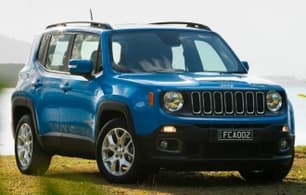
Jeep's Renegade might be late to the mini-SUV party but it comes with a pretty impressive back catalogue to suggest that this is a SUV that can cash the cheques its name can write.
The top of the range Trailhawk can write even bigger cheques than the lower models, bringing with it a range of off-road tech toys to let you really get down and dirty.
The MG ZS Essence Turbo has a lot going for it. It’s keenly priced, well equipped, spacious and comfortable with good performance, refinement and safety. On the downside, it’s thirstier than it should be, despite a stonking 10-year warranty servicing is relatively pricey and there are some low-level quality concerns. But should it be on your $30-35K small SUV shopping list. One hundred per cent, yes.
Rugged, dependable and good off-road are the most obvious qualities of the Trailhawk. It stands out from the rest of the mini-SUVs by being able to do the S and the U with plenty of vigour.
It's just a shame that its on-road manners can't match that of its big brother, the Cherokee. Unless you're planning on proper off-roading, the Trailhawk might not be quite what you're looking for.
From its narrow, acutely angled headlights to the deep gill-like inlets sitting either side of its large grille, the MG ZS conforms to the currently popular 'make it look a bit like a shark’ school of front-end car design.
From the nose back, this five-seater’s overall proportions follow a familiar small SUV template, without any significant pulse-quickening deviations.
And by the time you get to the back, the rear door and tail-light treatment is borderline generic. Replace the MG octagon with any number of other mass market automotive logos and you wouldn’t look twice.
That said, the shape is well balanced, the standard 18-inch rims fill the wheel arches nicely and our test car’s rich and lustrous ‘Diamond Red Metallic’ paint finish drew multiple compliments during our time behind the wheel.
The interior is simple with some cool touches thrown in, like the aero-style geometric vents with a bright, brushed finish around their leading edge, a neatly integrated 12.3-inch media touchscreen in the centre of the dash and another of the same size in front of the driver for instrumentation.
There’s a sensible mix of physical and digital controls for major functions and the steering wheel is flat on the bottom and the top. It adjusts for height, but disappointingly, not reach.
Materials around the dash and doors are soft-touch, which is nice, and the synthetic leather seat trim, with lighter contrast stitching and perforated centre panels looks and feels good.
In what is absolutely not a coincidence, the Renegade immediately conjures up the Wrangler. Upright grille from the Willys Jeep (references abound here), round headlights, squared off wheel arches to mimic the Wrangler's guards, short overhangs and big rear view mirrors.
The 17-inch wheels look completely lost in the wheelarches which are even more cavernous owing to the Trailhawk's 50mm of extra ride height. The wheels are also a bit cheap looking but will probably survive the belting the car is intended to take.
Less rugged is the interior, despite a fairly self-conscious effort to make it look and feel chunky. The front seats are flat and unsupportive with the rears just as lacklustre making sure everyone is sliding around together. Luckily, front passengers get a dash-mounted grab handle.
It seems quite well put together, however, but with carpets and easily-marked plastics, you'll hope your passengers don't bring the mud in with them too often. And the "Since 1941" stamped into the steering wheel can go.
The dashboard is reasonably clear and has plenty of information to share via the screen between the dials but whoever thought marking the redline with a water splash graphic in bright orange should probably rethink their design decisions.
Storage is limited to two cupholders up front, door pockets in each door and nets on the front seat backs.
Cost of entry for the MG ZS Essence Turbo is $31,990, drive-away, which is a pretty sharp price in one of the most hotly contested segments in the Australian market. Worth noting the sizeable gap to its Essence Hybrid+ stablemate at $40,217, drive-away.
That low-$30K positioning puts the Essence Turbo up against a swag of well-credentialled rivals including the GWM Haval Jolion Premium Hybrid 2WD ($32,990, drive-away), Hyundai Kona 2WD ($32,500), Kia Seltos Sport FWD ($33,050), Mazda CX-30 G20 Pure FWD ($33,940), Mitsubishi ASX LS ($30,490), Nissan Qashqai ST FWD ($34,665), Subaru Crosstrek 2.0L ($34,990) and Toyota Corolla Cross GX 2WD ($33,980). All prices before on-road costs unless otherwise noted.
To grab a value-for-money edge against this challenging field the MG needs more than just an attractive price tag. And the ZS Essence Turbo boasts an impressive standard features list.
Over and above the safety and performance tech we’ll get to shortly, included are 18-inch alloy wheels, climate control air, multiple drive modes, a 12.3-inch multimedia screen and 12.3-inch digital instrument cluster, keyless entry and start, a panoramic sunroof, synthetic leather trim, six-way power adjustment for the driver’s seat, six-speaker audio, rain-sensing wipers, Android Auto, Apple CarPlay and Bluetooth connectivity as well as digital radio.
There’s also auto LED headlights (as well as LED DRLs and tail-lights), a leather-trimmed steering wheel, built-in sat nav, adaptive cruise control, a hi-def 360-degree camera view, a reversing camera and auto-fold exterior mirrors.
At the MG’s price point - drive-away, remember - that’s a strong basket of standard fruit.
The Renegade range starts at $28,000 for the 1.6-litre Renegade Sport manual front-wheel drive, climbing between $2000 and $3000 through the Sport Auto, Longitude Auto, Limited Auto with a final jump of $4000 to the 2.4-litre auto-only Trailhawk.
Standard is a nine-speaker stereo with Bluetooth and USB, 17-inch alloys, dual-zone climate control, reversing camera, rear parking sensors, keyless entry and start, cruise control, electric front seats with heating, satellite navigation, automatic bi-xenon headlights, auto wipers, leather trim, roof rails, front and middle bash plates, full size spare, heated leather steering wheel, privacy glass, trailer sway control and tyre pressure monitoring.
The lairy Omaha orange is $500, part of an eleven colour palette with only two no-cost paint options (black and white).
You can add lane departure warning, auto-parking and a black painted roof for $500 each, a removable and retractable roof called My Sky Roof for $2200 or a more conventional electric sunroof for $1900.
The Beats-branded nine-speaker stereo is run via Fiat-Chryser's UConnect system, accessible through the 6.5-inch touchscreen. While it improves with every attempt, it's still quite clunky and when the sat-nav is added, becomes a bit of a mess.
Thankfully, not every function has been crammed into the touchscreen interface, so you'll spend more time with your hands on the wheel rather than working out which bit of the screen has the climate control.
As its name implies, the ZS Essence Turbo is powered by a 1.5-litre, turbo-petrol, four-cylinder engine sending 125kW (at 6000rpm) and 275Nm (at 4500rpm) to the front wheels via a continuously variable auto transmission (CVT).
It’s an all-alloy unit, featuring direct fuel-injection as well as variable valve timing on the intake and exhaust side which helps optimise engine response.
The Trailhawk is powered by Fiat's 2.4-litre four naturally-aspirated four-cylinder producing 129 kW and 230 Nm. Jeep reckons you'll get 7.5L/100km on the combined cycle. Our mostly city driving with a longish motorway run produced an 11.0L/100km average over a week.
The transmission is a nine-speed ZF automatic driving all four wheels.
The Trailhawk also has Jeep's five mode Selec-Terrain system which should cover pretty much every eventuality – Auto, Sport, Mud, Sand and, just for the Trailhawk, Rock. The Trailhawk is rated to tow 400kg unbraked and 907kg braked.
Stand-out qualities once behind the wheel of the ZS Essence Turbo are its comfy ride, responsive throttle and low noise levels.
Although MG doesn’t quote a 0-100km/h acceleration time, you can expect triple figures to come up in around eight seconds, which is rapid enough for the cut and thrust of city traffic.
And power delivery is satisfyingly linear. There are no laggy clues that a turbo engine resides under the bonnet, although maximum pulling power doesn’t arrive until 4500rpm, which is unusually high for a forced induction engine.
But there’s still plenty of oomph low down and the CVT auto is one of the better examples, keeping the engine on the boil nicely without any engine droning drama. Freeway cruising is a breeze.
That said, a pair of steering wheel paddles for stepped manual ‘gear’ changes would be a nice addition to take maximum advantage of the engine’s willing nature.
But you have to be realistic in terms of standard mechanical spec at a low-$30K price point. If you're in the mood, the switch to ‘Sport’ mode revs things up, though.
Suspension is by struts at the front and torsion beam at the rear, the car remaining well balanced during quick lane changes or through sharp corners.
Tyres are 225/50 Giti ‘GitiComfort’ on 18-inch alloy rims and despite that sizeable wheel diameter (for the class), a relatively cushy tyre sidewall height also helps with overall refinement.
The front seats are comfortable and supportive enough, although the small gap between the headrest and my noggin meant I was constantly bumping against it. Kind of annoying but it may have more to do with my XXXL melon than the restraint design.
The electrically assisted steering is accurate and road feel is fair, although the squared-off wheel design takes a bit of getting used to and its adjustment is stuck in 1994, shifting for height but not reach.
Braking is by discs all around (ventilated front) and they wash off speed effectively with a progressive pedal action.
An 11.2m turning circle isn’t exactly tiny, although all around vision is clear, and parking, assisted by the 360-degree camera view, reversing camera and rear parking sensors, is straight forward.
Niggles? The handbrake has to be applied manually, which may sound like a classic first-world problem, but the majority of new cars now apply it automatically when parked.
A ‘bing-bong’ overspeed warning, related to the traffic sign recognition function, is infuriating, as is the need to shuffle through multiple menus every time you drive the car to turn it off. Hyundai and Kia have recently minimised this issue with a short-cut button, which we suggest MG takes a close look at.
And one misty morning I noticed the bottom four rows of the rear screen demister had gone out on strike, which doesn’t feel great from a quality point-of-view.
In a similar vein, I recently spent time in the ZS Hybrid+ and thought one of the suspending cords on the rear parcel shelf hadn’t been properly fixed. Turns out the small plastic fitting holding the string had pulled out of the tailgate door and wouldn’t stay put when pushed back in. Awkward.
The Trailhawk name suggest that things are going to get muddy – compared to the rest of the range, the range-topper rides 50mm higher and has exposed, easy-to-reach tow hooks in the fairly unlikely event you get stuck. It also has a 20:1 low-range crawl ratio and Active Drive 4x4 which means it can switch between front and all-wheel drive. It'll also wade through almost half a metre of water. It's a genuine mud-plugging proposition and will take on some much bigger machinery out in the bush.
On the road, where we spent all our time in the Renegade, it's not what you'd call particularly inspiring. There's a number of sources of noise that contribute to a less than quiet cabin and having to constantly correct your course at freeway speeds adds to the tiring nature of the Renegade.
It's much better at lower speeds, pottering around but then again, its nine-speed transmission needs a lot more work on the shift mapping because it seems to forget which gear it needs to be in when you sink the right foot. If you don't need the Trailhawk's extra off-road goodies, consider the 1.4 litre Limited or Longitude.
ANCAP has assessed the MG ZS but only hybrid variants. So, even though that resulted in a maximum five-star score, this turbo model is technically untested.
No surprise then that the car is equipped with a full suite of active (crash-avoidance) tech including auto emergency braking (AEB), adaptive cruise control, lane change and lane keeping assist, blind-spot monitoring, driver attention alert, forward and rear collision alert, rear cross-traffic alert, tyre pressure monitoring, a 360-degree camera view and more.
And it’s important to note these systems are well calibrated in that any micro corrections they make are only sporadic and relatively subtle, even in adaptive cruise mode where less refined systems are often found out.
Then, if despite all that, a crash is unavoidable there are six airbags onboard - dual front, front side and full-length curtain. Would be nice to see the increasingly common front centre bag but it’s MIA for the time being.
There are three top tether points for child seats across the second row with ISOFIX anchors on the two outer positions.
Seven airbags (including driver's knee bag), traction and stability controls, roll mitigation, blind spot monitoring, ABS and brake assist.
The Renegade does not yet have an ANCAP star rating although it scored five EuroNCAP stars in 2014.