What's the difference?
Meet the IM6 Performance, “presented by MG”. And that last bit’s important, because while it’s marketed and sold by the Chinese mainstream player, it really is unlike any other MG going around.
Think of it as like a Lexus to Toyota, or an Audi to Volkswagen, with the Chinese brand going premium, and seemingly making a direct play for Tesla’s fan base. How so? Well, there’s only two models in IM line-up (sound familiar?) with the IM6 a rival for the Model Y, and the IM5 (which we’ve also tested) a competitor to the Model 3.
The IM6 is spacious, pretty sumptuous and ridiculously fast. And it offers up some features I’ve only ever really seen in high-end German metal. But it’s also got some quirks.
So, can MG run with the big dogs of the premium car world with the IM6 Performance? And should Tesla be worried? Let’s find out.
Land Rover was making SUVs before they were even called SUVs.
Range Rovers were ferrying families around in prestigious four-wheel drive comfort decades before Audi, BMW or Mercedes-Benz even thought of doing it, too.
So, even with all its rivals these days, how well does a Range Rover do modern family duties?
Well the Range Rover Autobiography came to live with my little family of four for a week. We had the seven-seater long-wheelbase version with the twin-turbo petrol V8 engine, and this is what we discovered…
A super solid first outing from the IM brand. Don't let the pricing fool you, there is still bang for buck on offer in the IM6 Performance, even if it at times feels a bit too digital for my tastes.
The Range Rover Autobiography long wheelbase is an outstanding SUV that is not just beautiful to drive but makes family practicality a priority, too,
The price is reasonable relative to the competition, the features list is long and complementary servicing offers peace of mind.
If you don’t need the third row, I’d consider the standard wheelbase Autobiography even if it does reduce legroom, there’s still plenty of space.
My son stopped short of giving the Range Rover Autobiography full marks "because there are no massaging seats in the second row".
I feel almost mean saying this, because there will be plenty of people who like the way the IM6 looks, and I don’t want to rain on their parade. But… I’m not one of them.
It reminds me a bit of the pre-facelift Tesla Model Y, in that it’s largely feature-less and a bit blobby, and there’s not a sharp angle anywhere to be found on the thing. Premium to me means powerful and assured — picture just about any Audi — whereas I just find this a bit bland and soft.
Anyway, I do like the big alloys, the insulated glass roof and the light treatment front and rear.
And I like the cabin. The seats aren’t leather, but they’re super thick and comfortable, and there is a genuinely premium air in the cabin, helped by the acreage of screens and the quality elements, like the little door panels.
The doors unlatch electrically, matching the pop-out door handles outside, but they can be a bit fidgety. Someone from MG told me how they worked (you kind of cover the handle and let the door come to you) but I watched everyone else who tried to open them struggle. If you're at the point where you have to explain how a door handle works, you might have over-egged the pudding.
The second screen below the main one acts a bit like a mobile phone. You can alter your home screen widgets and access the main menu, even as Apple CarPlay is synched at the top. You’ll get used to it, I’m sure, but I found it to be a bit fidgety.
Actually it reminds me a little bit of the Lexus trackpad, or whatever that hateful system was called, where you controlled the main screen via a little mousepad thing, though happily it’s nowhere near as annoying as that was.
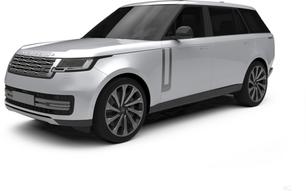
This fifth-generation Range Rover debuted in 2021 and despite its smooth, modern styling this SUV retains the familiar traditional Range Rover look with the short squared bonnet, flat roofline and tall windows.
Let’s talk about the wheelbase, because it has a huge impact on passenger space.
We had the long wheelbase which is 3197mm between the front and rear wheels - that’s 200mm more than the standard wheelbase.
Just look at those stretched rear doors in the photos - this is a go-anywhere limousine, or go-anywhere daycare centre in my case.
The overall length of the long wheelbase Range Rover is 5252mm. That’s big, but the design of this SUV doesn’t make it appear enormous.
What I don't like are the retractable door handles. They take a while to pop out and they look and feel cheap. Land Rover has used these on its other SUVs and if I had time I’d pen a letter asking the company to please stop. I’m sincerely hoping this review will do the same thing. I await your response JLR.
I think the tail-lights are pure genius. The pencil thin design is such a brave move away from the norm where brands are going over the top with LED lighting, and the simplicity is refreshing.
Inside, a traditional-looking Range Rover cabin awaits you with the flat dashboard, the low window sills contrasted by super modern touches like the displays and fully digital dials.
It’s sumptuous, luxurious, but not over the top. Again some people are looking for bling and gimmicks, but you won’t find them here - and I like that. This interior feels solid and substantial, but plush.
The IM6 measures 4904mm long, 1988mm wide and 1669mm tall, and it rides on a 2950mm wheelbase, with IM describing it as a "mid-large SUV", though I expect it will be classed as a medium SUV Australia.
That said, ICE and EV mid-size electric SUVs are not cut from the same cloth, with the latter making use of a flat floor to maximise space. And so it is with the IM6, where backseat room is pretty damn impressive. I’m 175cm, and I had no problem at all with legroom or headroom, plus the same plush seats from up there are in the back, too.
There are also air vents but no temperature controls, and while there are USB ports, there is no regular household-style plug in the cabin.
The glass in the windows is laminated, while the roof is double glazed, which MG tells me is Australian summer-proof, but I guess we'll know for sure in a couple of months.
There’s no shortage of cargo room either. There’s a 32-litre frunk up front, and there’s 646 litres in the boot with the rear seats in place. They’re 60/40 split, and if you drop them, luggage space grows to 1621 litres.
The towing capacity is a braked 1500kg, too, but I don’t expect to see many of these towing a camper trailer around.
Range Rovers have been a family favourite for decades and they’ve been doing school runs and trips away long before other brands even thought about producing SUVs for families.
So what you’re buying is Land Rover’s decades of knowing how to make a family SUV and you can tell by little things such as, how wide the doors open, how easy it is to get in and out of (even for little kids), the flat floor, the good visibility (thanks to low window sills), and then there’s the space and cabin storage. Stuff other brands seem to be still working out.
The second row seats in the Autobiography have electric sun shades, dual-zone climate control and the window seats are power adjustable and heated.
My eight-year old couldn’t resist playing with his electric sunshade and the seat adjustment, but fortunately the driver has an override switch which let me turn off his 'seat privileges’ as he called it.
Being the long wheelbase means the rear doors are long and heavy. So while the eight-year old could open them, he had trouble closing them.
The long wheelbase offers unrivalled legroom in the back and that meant my wife and I could put our own seats back further for our own comfort -even with a baby seat behind us.
Enormous door pockets, a giant centre console storage area, cupholders in all three rows, USB ports, wireless phone charging and in our case an optional domestic power outlet ($130) made this a comfortable, roomy, well equipped cabin.
Sure, the third row isn’t exactly spacious, but I’ve never met one that is.
The intelligent seat folding system is remarkable. From the boot or side doors you can electronically adjust the second and third rows - either to raise them or lower them so they are flat for storage.
With all seats in place there is 229 litres of cargo space still left in the boot, but with those back seats folded flat you have 713 litres of capacity - and that’s just up to the cargo cover.
The Range Rover Autobiography has air suspension and this means the SUV can lower itself to an 'Access' height to make it even easier to get in and out.
Premium play means more premium prices, and my IM6 Performance will set you back $80,990 on the road. That might have just sent your eyebrows skyward, but keep in mind it’s faster than some Ferraris, and is swimming with high-end tech, so the bang-for-buck factor is actually still pretty good.
There are cheaper ones, too. The single-motor Premium grade is $60,990 drive-away, albeit with less power and slower charging. Then there’s the Platinum, with a bigger battery and faster charging, which is $69,990
The Performance, though, gets everything IM has to give, including an 800-volt architecture, which means super-fast charging, as well as twin motors, brutal acceleration, a decent driving range and adaptive air suspension.
Elsewhere, you get LED lighting, a big and insulated glass roof, and 20-inch alloy wheels. Inside, there are thick and soft synthetic leather seats that are heated and cooled in both rows, a banging 20-speaker sound system, and wireless charging to pair with wireless Apple CarPlay and Android Auto.
There’s also 'active noise cancellation', and a seat-aware digital assistant which is about the best, and fastest, I’ve ever used. The IM6’s speaker system can locate where a voice is coming from, so any passenger can use the assistant. For example, if you’re in the backseat and say 'hey IM, lower my window', only your window opens. It’s a technology that I specifically remember the German brands crowing about not so long ago.
There’s also a 10.5-inch central touchscreen that controls much of the vast 26.3-inch screen that runs from in front of the driver to the centre of the cabin, as well as clever little magnets embedded in the dash in front of the driver, as well as in the back of the front seat headrests, that are designed to hold phones, iPads or other little accessories.
Also cool is the IM6’s self-parking tech, but there’s also a relatively useless crab walk function, which leans on the rear-wheel steering system to drive diagonally at slow speeds. I’m still not entirely sure when you’d use that one, to be honest.
Honestly, it’s a lot of stuff, and a lot of tech.
The Autobiography sits high in the Range Rover line-up and only the SVO (Special Vehicle Operations) models command higher prices.
Our Range Rover Autobiography was the long-wheelbase with the twin-turbo petrol V8 engine and has a list price of $312,193.
The standard features include retractable door handles with a proximity key, the LED headlights and tail-lights, a power tailgate and the panoramic sunroof.
Inside, 'Caraway' perforated semi-aniline leather seats are standard, too. So is a 13.1-inch screen with wireless Apple CarPlay and Android Auto, plus sat nav. There’s a fully digital driver display, a head-up display, wireless phone charging, and a Meridian 'Signature' sound system.
Four-zone climate control is standard and will keep the kids comfortable in the back, while the sun shades will project them from that giant fireball in the sky.
Up front there are heated and cooled seats which also massage, while the outboard rear seats are heated and power adjustable.
Our Autobiography was the seven-seater and it’s only about $1600 more than the five-seat version.
Ours had a few options fitted - there are the 23-inch wheels, the standard alloys are 22-inch, there’s also the black contrasting roof and the privacy glass which is so dark it’s almost impossible to look in.
All up the total list price for ours came to $318,603.
This is the real party trick of the IM6, because there’s a nuclear power plant under the metal somewhere. All up, the twin-motor setup produces a total 578kW and 802Nm, though I suspect you’re never accessing all the grunt all at once. Still, 100km/h zips by in 3.4 seconds, and the top speed is 239km/h. For the record, that’s exactly as fast the Ferrari Roma Spider I recently handed back, so yeah, it’s properly supercar quick.
The 4.4-litre twin-turbo petrol V8 is a perfect match for the Range Rover Autobiography.
There’s enormous power at 390kW and a colossal 750Nm of torque, but it’s delivered so smoothly and without sounding like Armageddon is beginning.
You might here the engine referred to as the P530. That signifies it’s petrol and makes about 530 horsepower.
All that grunt means that despite weighing more than 2.7 tonnes, this SUV can hurl itself from a stand still to 100km/h in 4.8 seconds.
An eight-speed automatic sends the drive to all four wheels. And making this SUV incredibly capable off-road is an excellent four-wheel drive system with a low range gear, plus a maximum ground clearance (thanks to the adjustable air suspension) of 283mm and a wading depth of up to 900mm.
There is a six-cylinder diesel, but if you decide on that instead of the V8 then it's all over between you and me. That’s how good this V8 is.
Also on board is a 100kWh Nickel-Cobalt-Magnesium battery that produces a WLTP driving range of 505kms. Pretty good.
Charging is strong, too. The high-tech platform allows for 396kW DC fast charging, which is faster than what is currently offered in Australia. The claim is 30-80 per cent charged in 15 minutes. There’s also an external vehicle-to-load (V2L) port.
Now, you’re going to use a lot of fuel. But that’s okay because this will probably be your last petrol car and the next one will be electric so let’s go out with a bang - last drinks at the petrol bar! Land Rover says you’ll use 11.8L/100km.
After a week of punishing my Range Rover with school drop offs, shopping centre car parks, hilly suburbs, motorways and rural roads the petrol pump told me we’d used 19.8L/100km.
I’m not shocked by that consumption. This is a 2.7 tonne all-wheel drive twin-turbo V8 SUV that was almost always ferrying around four people with a pram, garden supplies and shopping in bumper to bumper traffic. A real world fuel test.
There is that six-cylinder diesel and a hybrid version of the Range Rover, but this V8 engine suits the character of the SUV perfectly - anything else and it’s like eating reduced fat ice cream.
First things first, don't get too distracted by the word "performance" here. The IM6 doesn't act like a performance car, it feels bit too plush, and bit too digital, for that.
But that's not necessarily a bad thing. Performance cars are often loud, raucous and uncomfortable, and the IM6 is none of those things. Instead, those mountains of power and torque make silky, silent progress absolutely effortless, which feels pretty premium to me.
MG makes a big deal of how much work went into insulating the cabin from noise – with active noise cancellation joined by double-paned insulated glass – and it is a properly calming and quiet space.
Also strong is the suspension, with the adaptive air setup soaking up most bumps and bruises, but I found it can clang over really solid bumps, sounding like it's bouncing off a stopper. The steering is solid, too, with a nice weight, if not overly talkative in the feedback department, while the rear-wheel steering helps eat into the turning circle for tight three-point turns.
The downside, though, is that it all feels a little too digital, and like there's been a little too much overthinking gone into it. Having to push a button to see behind you in a hurry is bonkers (see my explanation in the Safety section below), and the secondary screen is more annoying than intuitive. And there were several bings or bongs I couldn't even identify. All of which interrupts the otherwise calming nature of the drive experience.
Driving the V8-powered, long-wheelbase, 2.7-tonne, Range Rover Autobiography is a lot easier than it sounds. Really, it’s the Range Rover’s height above sea level which will strike you first.
You’ll lord it over other cars. The length doesn’t come into it - even for parking because the visibility is so good, the steering is so light and the engine is civilised and smooth.
This is truly an easy and enjoyable SUV to drive, with power and performance whenever you need it.
There are several drive modes from a 'Dynamic' sporty one, which makes the engine more responsive and suspension firmer, to off-road settings.
Most of the time I left the Range Rover in 'Comfort' mode for the softest ride, but with 530 horsepower lurking in the background ready to jump out and eat up hills and overtaking.
The front seats are wide, comfortable and supportive even after hours of driving.
There is a long list of safety aids on the IM6, and I won't detail the lot here. But I will call out a couple of curious mentions.
As always, the driver distraction warning is annoying, but can be switched off. And MG also counts the IM platform, or what it calls a digital chassis, as part of the safety offering. It has its own digital brain that adapts the air suspension, the rear-wheel steering and the active safety kit on the fly.
The other curiosity is the weird way you see out the back. Rather than fit a digital rear-view mirror to counteract the almost non-existent rear vision, you instead push up on a little toggle on the steering wheel to bring up a live view of what's happening behind you on the central screen.
The Range Rover was given the maximum five-star ANCAP rating when it was tested in 2022.
For second-row child occupant protection the Range Rover scored a high 86 per cent in frontal and side impacts.
Standard safety tech includes AEB (junction and forward) with cyclists and pedestrian detection, there’s blind-spot warning, lane keeping assistance and rear cross-traffic alert, but no rear AEB.
For child seats there are ISOFIX mounts in the second row, and top tether anchor points in the second row and third rows.
Along with an entire suite of airbags it’s good to see a centre airbag up front and also head-covering curtain airbags all three rows.
The IM6 is covered by a five-year, unlimited-kilometre warranty, rather than MG’S 10-year term. Capped-price servicing is offered for the first five years, with your total bill just under $3000. The service intervals are 20,000kms or 12 months.
The warranty is good with five-years and unlimited kilometre coverage.
There’s also five years roadside assistance and a complimentary five-year/130,000km service plan.
Yep, that's complimentary, as in free servicing for five years. I didn’t believe it myself and called Land Rover to check and was told that it does indeed mean free-of-charge.