What's the difference?
Meet the IM6 Performance, “presented by MG”. And that last bit’s important, because while it’s marketed and sold by the Chinese mainstream player, it really is unlike any other MG going around.
Think of it as like a Lexus to Toyota, or an Audi to Volkswagen, with the Chinese brand going premium, and seemingly making a direct play for Tesla’s fan base. How so? Well, there’s only two models in IM line-up (sound familiar?) with the IM6 a rival for the Model Y, and the IM5 (which we’ve also tested) a competitor to the Model 3.
The IM6 is spacious, pretty sumptuous and ridiculously fast. And it offers up some features I’ve only ever really seen in high-end German metal. But it’s also got some quirks.
So, can MG run with the big dogs of the premium car world with the IM6 Performance? And should Tesla be worried? Let’s find out.
If Holden had a dollar for every time someone had criticised the new and international flavour of Australia’s formerly home-grown hero, it would surely have more than enough spare cash to blow the dust of that vast South Australian factory and restart local Commodore production immediately.
Hell, there’d probably be enough left over to relaunch the Camira while they were at it. And maybe even knock out a new Gemini or two.
So we’re not going to do that again here. The all-new Commodore, in this case the Calais Tourer, is now here - granted having travelled further than the one it replaces - and so we’ll be playing this review with the straightest of bats.
Because the truth is, if you peel the badging - and thus the swirling emotion - off its elongated rump, then you’ll find this German-built Tourer is, really and truly, a very good thing.
A super solid first outing from the IM brand. Don't let the pricing fool you, there is still bang for buck on offer in the IM6 Performance, even if it at times feels a bit too digital for my tastes.
A best-of-both-worlds option that should have us questioning our SUV obsession, the Calais Tourer delivers plenty of practicality perks and a higher ride height in a dynamic and car-like package. The equipment levels are spot on, including the comprehensive safety package, and it you act smartly, you'll get a hugely long warranty to boot.
It sure is thirsty, though, and we can't help but think plenty of owners would be happier with a smaller, more-efficient engine.
I feel almost mean saying this, because there will be plenty of people who like the way the IM6 looks, and I don’t want to rain on their parade. But… I’m not one of them.
It reminds me a bit of the pre-facelift Tesla Model Y, in that it’s largely feature-less and a bit blobby, and there’s not a sharp angle anywhere to be found on the thing. Premium to me means powerful and assured — picture just about any Audi — whereas I just find this a bit bland and soft.
Anyway, I do like the big alloys, the insulated glass roof and the light treatment front and rear.
And I like the cabin. The seats aren’t leather, but they’re super thick and comfortable, and there is a genuinely premium air in the cabin, helped by the acreage of screens and the quality elements, like the little door panels.
The doors unlatch electrically, matching the pop-out door handles outside, but they can be a bit fidgety. Someone from MG told me how they worked (you kind of cover the handle and let the door come to you) but I watched everyone else who tried to open them struggle. If you're at the point where you have to explain how a door handle works, you might have over-egged the pudding.
The second screen below the main one acts a bit like a mobile phone. You can alter your home screen widgets and access the main menu, even as Apple CarPlay is synched at the top. You’ll get used to it, I’m sure, but I found it to be a bit fidgety.
Actually it reminds me a little bit of the Lexus trackpad, or whatever that hateful system was called, where you controlled the main screen via a little mousepad thing, though happily it’s nowhere near as annoying as that was.
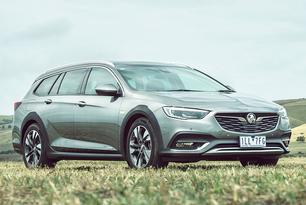
Less an SUV (happily), and more a high-riding wagon, the Calais Tourer borrows a little from the Subaru XV in its exterior design, sporting the same plastic cladding over each wheel arch. Clearly there is a whole heap of shared DNA between the Sportwagon and Tourer, and so it offers similar perks; like its SUV-shaming boot space.
Elsewhere, the Tourer shares the same soft and rounded edges as the rest of the Commodore range, and while it is genuinely quite handsome from most angles, it is at its best viewed front on, where a simple front-end is bookmarked at each corner by a narrow headlight on top, and an encased fog light below. It’s all a touch understated, sure, but it looks sharp in the metal.
Inside, it’s a clean and functional cabin design, with most of the touchscreen functions controlled by a simple row of four horizontal buttons, and with a gloss-black surround encasing the centre console. The thin leather wheel feels lovely under the touch, and the contrasting door trims and soft-touch materials find their way into the backseat, too.
The IM6 measures 4904mm long, 1988mm wide and 1669mm tall, and it rides on a 2950mm wheelbase, with IM describing it as a "mid-large SUV", though I expect it will be classed as a medium SUV Australia.
That said, ICE and EV mid-size electric SUVs are not cut from the same cloth, with the latter making use of a flat floor to maximise space. And so it is with the IM6, where backseat room is pretty damn impressive. I’m 175cm, and I had no problem at all with legroom or headroom, plus the same plush seats from up there are in the back, too.
There are also air vents but no temperature controls, and while there are USB ports, there is no regular household-style plug in the cabin.
The glass in the windows is laminated, while the roof is double glazed, which MG tells me is Australian summer-proof, but I guess we'll know for sure in a couple of months.
There’s no shortage of cargo room either. There’s a 32-litre frunk up front, and there’s 646 litres in the boot with the rear seats in place. They’re 60/40 split, and if you drop them, luggage space grows to 1621 litres.
The towing capacity is a braked 1500kg, too, but I don’t expect to see many of these towing a camper trailer around.
The Tourer serves up identical storage space to its Sportwagon near-enough twin, with 793 litres of storage (to the roof line) with the rear seats in place, and 1665 litres with the rear seat folded down. That’s about 200 litres more than the regular Commodore hatchback.
Where the Tourer does differ from the Sportwagon is in its exterior dimensions, measuring 5004mm in length (versus 4986mm in the Sportwagon) and 1525mm in height (versus 1483mm). Width and wheelbase are identical, though (1871mm and 2829mm), and so the interior space dimensions - like headroom and legroom - are identical no matter which of the estate-style Commodores you opt for.
The key dimension here, though, is ride height, with the Tourer offering 20mm more ground clearance (42mm greater height overall) than the Sportwagon. That, combined with the on-demand all-wheel-drive system, allows for some light off-roading - though you won’t be conquering Everest.
Up front, expect two cupholders hidden under a gloss-black cover, as well as power and USB connections located in a central cubby. The back seat is home to two extra cupholders hidden in a pulldown divider, and there is room in each of the doors for bottles. The back seat is also home to air vents (but no temperature controls) and two USB charge points located just below the vents.
Premium play means more premium prices, and my IM6 Performance will set you back $80,990 on the road. That might have just sent your eyebrows skyward, but keep in mind it’s faster than some Ferraris, and is swimming with high-end tech, so the bang-for-buck factor is actually still pretty good.
There are cheaper ones, too. The single-motor Premium grade is $60,990 drive-away, albeit with less power and slower charging. Then there’s the Platinum, with a bigger battery and faster charging, which is $69,990
The Performance, though, gets everything IM has to give, including an 800-volt architecture, which means super-fast charging, as well as twin motors, brutal acceleration, a decent driving range and adaptive air suspension.
Elsewhere, you get LED lighting, a big and insulated glass roof, and 20-inch alloy wheels. Inside, there are thick and soft synthetic leather seats that are heated and cooled in both rows, a banging 20-speaker sound system, and wireless charging to pair with wireless Apple CarPlay and Android Auto.
There’s also 'active noise cancellation', and a seat-aware digital assistant which is about the best, and fastest, I’ve ever used. The IM6’s speaker system can locate where a voice is coming from, so any passenger can use the assistant. For example, if you’re in the backseat and say 'hey IM, lower my window', only your window opens. It’s a technology that I specifically remember the German brands crowing about not so long ago.
There’s also a 10.5-inch central touchscreen that controls much of the vast 26.3-inch screen that runs from in front of the driver to the centre of the cabin, as well as clever little magnets embedded in the dash in front of the driver, as well as in the back of the front seat headrests, that are designed to hold phones, iPads or other little accessories.
Also cool is the IM6’s self-parking tech, but there’s also a relatively useless crab walk function, which leans on the rear-wheel steering system to drive diagonally at slow speeds. I’m still not entirely sure when you’d use that one, to be honest.
Honestly, it’s a lot of stuff, and a lot of tech.
The Calais has long formed the most luxurious rung of the Commodore ladder, and the wagon-ish Tourer is without doubt the most practical version. It will set you back $45,990 ($47,990 drive-away) in the guise we’ve tested here, and $53,990 In Calais V specification.
Not to be sneezed at, then. But it does arrive with plenty of stuff to help justify your investment.
Outside, you’ll find 18-inch alloys, a handsfree auto-opening boot, heated mirrors, keyless entry with push-button start, a remote start function, rain-sensing wipers and automatic headlights with LED DRLs. Inside, expect leather seats that are heated in the front, a leather-wrapped wheel, dual-zone climate control, standard satellite navigation and a wireless charging pad for compatible phones.
On the technology front, an 8.0-inch touchscreen pairs with an eight-speaker stereo, and it’s both Apple CarPlay and Android Auto equipped. There’s also a genuinely impressive standard safety package, too, but we’ll drill down on that under the Safety sub-heading.
This is the real party trick of the IM6, because there’s a nuclear power plant under the metal somewhere. All up, the twin-motor setup produces a total 578kW and 802Nm, though I suspect you’re never accessing all the grunt all at once. Still, 100km/h zips by in 3.4 seconds, and the top speed is 239km/h. For the record, that’s exactly as fast the Ferrari Roma Spider I recently handed back, so yeah, it’s properly supercar quick.
A really rather good 3.6-litre V6 engine Is parked under the bonnet, feeding 235kW at 6800rpm and 381Nm at 5200rpm to all four wheels as required, thanks to an on-demand all-wheel-drive system. The suspension is tuned specifically for its high-riding antics, too.
The grunt is fed through a nine-speed automatic, and while Holden doesn’t quote a specific zero-to-100km/h time, it’s no slouch from the lights.
The 3.6-litre engine means a braked towing capacity of 2100kg, and an unbraked max of 750kg.
Also on board is a 100kWh Nickel-Cobalt-Magnesium battery that produces a WLTP driving range of 505kms. Pretty good.
Charging is strong, too. The high-tech platform allows for 396kW DC fast charging, which is faster than what is currently offered in Australia. The claim is 30-80 per cent charged in 15 minutes. There’s also an external vehicle-to-load (V2L) port.
Not so good, I’m afraid. The offical number is on the high-side at 9.1 litres per 100 kilometres on the claimed/combined cycle (though that's less than the equivalent Subaru Outback), but we were averaging a smidge under 14.0L/100km after what was admittedly quite a lot of city driving. Still, that’s high.
Emissions are pegged at 212g/km or C02, and the Tourer’s 61-litre tank will accept cheaper 91RON fuel, or an E10 blend.
First things first, don't get too distracted by the word "performance" here. The IM6 doesn't act like a performance car, it feels bit too plush, and bit too digital, for that.
But that's not necessarily a bad thing. Performance cars are often loud, raucous and uncomfortable, and the IM6 is none of those things. Instead, those mountains of power and torque make silky, silent progress absolutely effortless, which feels pretty premium to me.
MG makes a big deal of how much work went into insulating the cabin from noise – with active noise cancellation joined by double-paned insulated glass – and it is a properly calming and quiet space.
Also strong is the suspension, with the adaptive air setup soaking up most bumps and bruises, but I found it can clang over really solid bumps, sounding like it's bouncing off a stopper. The steering is solid, too, with a nice weight, if not overly talkative in the feedback department, while the rear-wheel steering helps eat into the turning circle for tight three-point turns.
The downside, though, is that it all feels a little too digital, and like there's been a little too much overthinking gone into it. Having to push a button to see behind you in a hurry is bonkers (see my explanation in the Safety section below), and the secondary screen is more annoying than intuitive. And there were several bings or bongs I couldn't even identify. All of which interrupts the otherwise calming nature of the drive experience.
Really very good. That 3.6-litre engine (why they haven’t offered the Tourer with the smaller and smarter turbo engine is something of a mystery) might be a touch old-school and a touch thirsty, but it’s a rich and powerful thing, and it gives the Calais-stamped Tourer a perky personality that defies its dimensions.
The Calais Tourer was built in Germany, and fitted with an engine and transmission from the USA, before undergoing local tuning here in Australia (think bespoke steering and suspension tunes calibrated both at the company’s testing facility and after a 200,000km test on Aussie roads), and it’s the last of those Dr Frankenstein ingredients that have had the biggest impact here.
The Tourer’s ride is fantastic, perfectly poised between firm composure and everyday comfort, and - like most good wagons - it will honestly leave you wondering why so many people are clamouring aboard the SUV train when you can all the space with better dynamics in a humble estate.
The nine-speed ‘box is smooth and sharp in its operation, too. But the fuel use is a concern. Sure, we spent the bulk of our time in the city, where stop-start traffic naturally uses more fuel. But then, surely so would most owners?
There is a long list of safety aids on the IM6, and I won't detail the lot here. But I will call out a couple of curious mentions.
As always, the driver distraction warning is annoying, but can be switched off. And MG also counts the IM platform, or what it calls a digital chassis, as part of the safety offering. It has its own digital brain that adapts the air suspension, the rear-wheel steering and the active safety kit on the fly.
The other curiosity is the weird way you see out the back. Rather than fit a digital rear-view mirror to counteract the almost non-existent rear vision, you instead push up on a little toggle on the steering wheel to bring up a live view of what's happening behind you on the central screen.
You’ve got to hand it to the Lion for the standard safety package here, which includes the Holden Eye camera system as standard, adding auto emergency braking (AEB), lane keep assist, lane departure warning and forward collision warning. You’ll also find semi-autonomous parking, a reversing camera and rear parking sensors.
The Calais Tourer adds blind-sport monitoring and rear cross-traffic alert to that pretty comprehensive package. All of which helps the Commodore range qualify for the maximum five-star ANCAP safety rating.
Finally, you can add six airbags and two ISOFIX attachment points to the mix.
The IM6 is covered by a five-year, unlimited-kilometre warranty, rather than MG’S 10-year term. Capped-price servicing is offered for the first five years, with your total bill just under $3000. The service intervals are 20,000kms or 12 months.
Holden has recently relinquished the initial warranty offering, now including the Commodore in its seven-year, unlimited-kilometre warranty program, meaning it mixes with the very best in the aftercare business. For now, at least; normally, the Commodore carries the brand's standard three year/100,000km warranty. But be on the lookout for the return of this deal if you miss out this time.
Service intervals are pegged at 12 months or 12,000kms, and the Commodore falls under Holden’s extensive capped-price servicing program, and it will cost between $259 and $359 for each of the first seven annual services.