What's the difference?
Remember when MG’s first convertible sports car came out? I don’t, I’m 30. But I remember when the most recent one came out.
It’s got a weird name and it’s very hard to avoid drawing attention to yourself when you get out of it at the shops… but should you buy one?
I’ve been getting about in the new MG Cyberster to answer exactly that question.
Have you ever wished for an electric version of a high-riding hatchback, something like a Subaru XV, but with batteries and a bit more prestige?
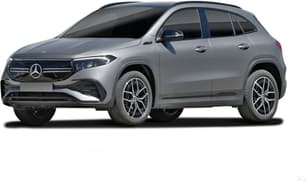
Clearly, many luxury car buyers have, as the conceptually similar EQA 250 has proven since launching in Australia at the tail end of 2020. Mercedes-Benz can’t import enough of them.
Now, there’s a 350 4Matic version, with two electric motors, not one, all-wheel instead of just front-wheel drive, and appreciably stronger performance.
But in the two years since the EQA’s debut, the EV landscape has transformed, with Korea and China leading in innovation, disrupting the long-established order of things.
In other words, can the new 350 4Matic cut it? Read on.
The Cyberster is certainly an impressive thing in a lot of ways, but if you were expecting a perfect sports car from MG, you'll be a bit disappointed.
It's quite expensive if you're looking for a nice EV, but on the flip side it's quite cheap if being fast is your main concern.
If anything, the Cyberster is an exciting look at what the brand is capable of, even if it's a bit rough around the edges.
On one hand, the EQA 350 4Matic has the styling, interior presentation, forceful performance and handling prowess to make you forgive its very expensive price tag, especially when so many rival EVs are also so talented.
But there’s too much that’s ordinary about this Mercedes to justify its huge ask, including a lack of that final polish in the way it drives and rides.
Despite being a recent release, the EQA is already feeling beyond its age. For the money, the 350 4Matic feels out of its depth.
MG reckons the Cyberster draws on the proportions of classic roadsters like its MG A and B from the ‘50s and ‘60s.
And I reckon that’s about where the comparison ends, really.
But don’t get me wrong, I think it’s got some pretty angles and nice elements.
It’s got the long bonnet, but its cabin isn't set so far back and its aerodynamic lines and curves probably weren't a priority back then either.
This is the standard colour, English White, which is more like off-white or cream or beige.
You can have a red roof on the lighter colours, white, silver, and grey, but red and yellow Cybersters have black ones.
The tail-lights at the back were inspired by the union jack, but they’re probably one of the elements on this car I'd put in the ‘tacky’ column.
A high-riding hatchback (its handy 209mm ground clearance is only 4.0mm shy of the GLA equivalent), the smooth and handsome EQA is like an EQC that’s been left in a tumble dryer for too long, shrinking into its smaller proportions.
Along with the EQA's obvious electric powertrain inclusion, differences compared to the GLA include a blanked-out grille, a redesigned bumper, fresh wheel styles and a full-width LED tail-light treatment.
All add some character to the rather amorphous donor car.
A three-screen dash sounds a little daunting at first, but it’s not that far from the giant screens in some new cars now.
The central 10.25-inch screen is info only, while the flanking 7.0-inch screens are touchscreens, as is the climate control screen in the console.
As much as I’m a fan of physical buttons where possible, this car shows that multiple screens means you don’t need many sub-menus.
Basically, this feels like a lot, but you get used to it relatively quickly.
And while it also seems like MG’s software has become more intuitive and less laggy, the placements of the screens is a little annoying - the side screens on the dash are blocked by the steering wheel, and the central touchscreen is a bit fiddly.
Like I mentioned, no wireless phone mirroring is a let-down and there’s not really an obvious place to put a phone, but the ability to level out the cup holders is kind of interesting and the central storage where the USB-A and C ports are is big enough.
There’s a narrow bit of storage behind the seats, but the boot is actually 249 litres and seems much more usable than you might expect.
It's also worth noting the Cyberster comes with an AC slow charging cable as standard, but not a DC fast-charging cable for plugging in at some charging stations.
Like the second-gen (H247) GLA, the EQA sits up high, offering lofty seating. That’s core to this range’s appeal, making getting in and out a less acrobatic feat compared to smaller and lower EVs.
The cabin is very similar to many of the second-generation MFA2 transverse-engine/front-drive-based Benzes like the current A-Class. That means solid looking and feeling doors and dash, upping the sense of quality. Very on-brand stuff.
This is a very modern and inviting interior, with those aforementioned screens set within a large rectangular binnacle. To the centre there are the trio of turbine-style air vents that still bring a spark of joy to the cabin (as well as seriously effective ventilation), along with the row of metallic toggle switches; both provide pleasing, high-quality sensory experiences.
It can lean towards overkill with a trashy night-club ambience if restraint is not exercised with the (configurable) coloured light show dotting the EQA's cabin.
Not to everybody’s liking, but thankfully you can turn that stuff off, so no complaining necessary here.
You wouldn’t call the EQA particularly spacious with its curvy roof, snug sports seating, high waistline, narrow glass areas and thick pillars, but even 200cm-tall people should find enough legroom up front. There’s a sense of cosiness rather than crampedness.
The 350 4Matic’s sports seats do a great job holding and caressing you in, providing excellent bracing through tight corners. Three’s ample (powered) adjustment, including for lumbar and lower-back areas, as well as enough support for thighs. The cushions themselves are typically firm yet comfy. And the seats look great.
The driving position is superb, ahead of a set of vibrant digital instrumentation choices that run the gamut of tastes, with the 'Classic' dial-like look and minimalist settings (reminiscent of Saab in its essentials-only display) included, so as to not scare away traditionalists. There is also a 'Progressive' screen that’s colourful and techy, though the info presented is a lot to take in.
What may not please conservative Benz buyers are the cheap-looking plastics dotted throughout the interior, along with the rattles that are regular companions, especially over less-than-smooth roads.
This has been a bugbear of all MFA-platform vehicles for more than a decade now, and while better than in some previous models, the EQA at $100K should possess vault-like build quality, not squeaky trim.
And when will that small and flimsy gear selector stalk be binned?
Our test car’s ‘Hey, Mercedes’ voice control system was erratic at best, barely providing any assistance and regularly annoying/entertaining with misunderstood responses and laughably limited functionality. Was our example glitchy? Perhaps.
Storage is good. And, ergonomically, everything’s within reach of the driver, but there’s a lot to take in, with scattered switchgear.
It’s also worth noting that, if you’re new to the MBUX multimedia system, taking the time to learn its many functions and capabilities is advisable, as it’s more logical and simpler than the intimidating first impression suggests.
A deft thumb is required for the steering-wheel spoke-actuated tabs for instrument data, but even technophobes ought to master it all eventually.
The central part of the screen can be swiped to access the vast array of features, including the excellent audio system and detailed vehicle control settings.
Further back, passengers sit up high, giving a wide view of what’s happening up front, while the backrest is angled at just the right position.
There’s not much fun to be had sitting on the raised middle bit, and shoulder space is seriously limited with three abreast, but otherwise, even adults should find sufficient legroom and headroom – even with the panoramic sunroof fitted.
Deep door pockets, face-level air outlets, reading lights and a folding armrest are to be found back there, though the latter includes a flimsy slide-out cupholder set that’s not worthy of the brand.
Because there’s a battery pack in the rear half of the EQA, cargo capacity shrinks from the donor GLA's 435 litres to just 340L, while dropping the 40/20/40 backrests extends that into the cabin for a 1320L load space. Note there’s no spare wheel, just a tyre inflation kit.
People don’t buy these small crossover Mercedes models for space or practicality – that’s why the GLB/EQB exist – but the EQA isn’t too bad for the urban demographic which wants/needs a compact, high-riding EV with impressive ground clearance.
The MG Cyberster finds itself here as the only electric convertible sports car on offer, which means it’s hard to compare its $115,000 price tag to any direct rivals.
The Kia EV6 GT and Hyundai Ioniq 5 N are the wrong shape, the Porsche Cayman has the wrong running gear and most other things with doors like this are a lot more expensive.
So what does $115,000, before on-road costs, get you?
It’s only available in one variant, with pretty much the only cost-option being paint colours.
Aside from the scissor doors, there’s the electric folding roof, triple-screen cockpit with another centre panel, an eight-speaker Bose sound system, heated electric seats and steering wheel, and ambient lighting.
The exterior lights are all automatic intelligent LEDs, and you can open the doors with the key fob.
It is, however, missing a couple of things.
No phone charger might be down to space, but no wireless phone mirroring is a bit annoying, and the manual steering wheel adjustment feels a little cheap in a six-figure EV.
Does it represent good value for the price? We’re not so sure.
Starting from $96,900, before on-road costs, the EQA 350 4Matic all-wheel drive (AWD) costs over $15,000 more the established EQA 250 front-drive version.
That’s a lot of dosh, even in the world of expensive EVs, given that’s nearly in Tesla Model 3/Y Performance, new flagship Kia EV6 GT and range-topping Hyundai Ioniq 5 Epiq (with change) territory.
These are bespoke electric vehicles in that they’re designed from the ground up to be electrified, not internal combustion engine (ICE) models modified to take electric motors and batteries, as the EQA is. It doesn’t take much imagination to see the popular GLA small-car/crossover behind the badge.
The same applies to the GLB-based EQB, which at least offers a seven-seat version in the base 250, giving it a unique selling proposition. The 350 4Matic benefits from no such advantage against its fierce volley of foes.
Additionally, the Mercedes must battle some pretty impressive yet cheaper ICE-based EV AWD rivals, including the Volvo XC40/C40 Recharge Twin fraternal twins, Polestar 2 Long Range Dual Motor and coming BMW iX1 xDrive30.
As the Stuttgart EV isn’t measurably ahead and is sometimes even behind these in performance, efficiency, range and charging capacity, its pricing seems needlessly steep.
Unfortunately, the 350 4Matic isn’t brimming with extra standard features to compensate, either.
Along with that second motor and AWD, your $15,200 premium over the 250 scores an AMG makeover inside and out, with an AMG Line Sports exterior treatment, 20-inch AMG alloys, AMG interior trim with synthetic leather and suede seat material, a leather AMG steering wheel, aluminium pedal covers and a top-stitched dash.
The 250’s optional 'Vision Package' is also thrown in, bringing a panoramic sunroof and surround-view camera.
You’ll also find dual keyless entry/go, electric and heated front seats, dual-zone climate control, ‘Hey, Mercedes’ voice control, a wireless smartphone charger, two 10.25-inch screens (for instrumentation and multimedia touchscreen), Bluetooth connectivity, wired Apple CarPlay/Android Auto, digital radio, satellite navigation, 10-speaker audio, ambient lighting, a powered tailgate and adaptive dampers.
On the safety front there are LED headlights with high-beam assist, autonomous emergency braking, blind-spot monitoring, lane-keep assist, adaptive cruise control, evasive steering assist and parking sensors all-round.
However, items that can dial up the glamour for potential buyers in EQA adverts, also cost thousands of dollars extra, such as a head-up display, hand gesture activation for several vehicle functions and the 'MBUX' augmented reality for navigation.
There’s a Wallbox from $1710 (before fitment) for personal parking-space charging, bringing a Type 2 AC Charger, 22kW single-phase and three-phase charging.
A free Chargefox subscription is also part of the deal. But are all these enough?
Okay, here’s where the Cyberster gets impressive.
Its dual-motor set-up combines a 150kW front motor and a 250kW rear motor for a total of 375kW.
Peak torque is a hefty 725Nm.
All that is enough to get you and two tonnes of MG from zero to 100km/h in 3.2 seconds.
Sure it tops out at 208km/h, but the rush of hitting highway speeds is already enough to put your licence at risk.
The EQA 350 4Matic features an asynchronous motor and a single-speed reduction gear transmission under the bonnet, delivering 140kW of power and 385Nm of torque to the front wheels, and supported by a second, permanently excited synchronous motor located on the back axle.
'Dual E-motor' total outputs are 215kW between 7130-9506rpm up front and 5746-7661rpm for the rear motor, for a 520Nm torque total, from zero rpm.
Drive is infinitely variable on both axles, for AWD capability. Tipping the scales at 2091kg (kerb), the 350 4Matic’s power-to-weight ratio is an impressive 103kW per tonne.
Result? Some six seconds is required to race from 0-100km/h, on the way to a 160km/h top speed.
The EQA employs a 66.5kWh lithium-ion battery pack fitted between the axles, with a maximum 11kW AC and 100kW DC charging capability.
Suspension is via MacPherson-style struts up front while a multi-link arrangement is out back. Steering is by electrically assisted rack-and-pinion.
The MG Cyberster has a 77kWh battery and a claimed efficiency of 19.1kWh/100km.
While that means its claimed driving range of 443km relies on a bit of energy to be recuperated from braking, something you don’t really get on the highway, it actually works in the car’s favour during dynamic driving.
After 264km of driving on a test loop that included some urban but mostly highway and rural driving, the Cyberster’s trip computer displayed a 19.4kWh/100km average consumption.
The battery sat at 27 per cent, with 108km estimated range remaining.
While 443km of total range seems optimistic for a car that’s likely to be driven relatively quickly a lot of the time, the efficiency of the Cyberster held up better than you might have expected.
Using WLTP figures, the EQA 350 4Matic’s official consumption figure is 17.9kWh/100km. Maximum range is rated at 400km.
At pick-up, our EQA was displaying a 395km maximum range availability. After 273km of a mix of city, urban and freeway driving, our car showed 47km of range left, which means we could expect up to 320km in real-world driving scenarios.
That did include some performance testing, which tends to suck out the kilowatts, by the way.
Our trip computer showed the vehicle had consumed 20.8kWh/100km on average.
Like the EQB, the EQA offers varying levels of energy recuperation to help recharge the battery pack. In ‘D Auto’ it figures out the level of resistance automatically, but drivers can also choose to do this manually via ‘D+’ that provides coasting, ‘D’ that brings mild regeneration off-throttle, and ‘D—’ that activates maximising regen for close to single-pedal driving. These are paddle activated.
Cables for home charging with three-prong outlets are included – an eight-metre long one plus a five-metre public charging cable.
Mercedes says a 100kW DC charger will take an EQA from 10-80 per cent charged in 30 minutes, while an 11kW AC public outlet needs seven hours, and at home using a regular 3.0kW 10-amp socket requires at least 34 hours.
Mercedes also offers a Wallbox with up to 22kW charging capability for your home or office from $1710, not including installation. That drops the charging time to under eight hours, which is ideal for overnight-home or all-day work charging scenarios.
There’s good news and bad news about the Cyberster from behind the wheel.
The good news is it’s quite easy to drive this thing very fast.
The bad news is it feels like it would be quite easy to get sick of as a day-to-day car, depending on your situation.
The first thing I noticed is the seat feels a bit high, even at its lowest setting. That's likely due to the placement of the battery pack under the floor of of the car.
Following that, if you’re taller than me (I'm five foot 11), it feels like the wrong road surface will have you nudging your head into the roof liner.
That mechanical roof should take about 15 seconds to lower or raise, and that can be done at speeds up to 50km/h.
It could be a symptom of trying to keep 1985kg tied down, but some of Melbourne's highways and arterial roads between 70 and 100km/h had the Cyberster bobbing quite a bit.
But the suspension doesn't let individual bumps intrude too much into the cabin, so it’s not all bad.
Similarly, there’s good and bad when it comes to the steering and braking.
The first being that the steering seems pretty accurate, even though the feedback is a bit numb.
The braking on the other hand is handled by some pretty capable Brembos up front that pull the heavy roadster up quickly, but don’t always clamp as hard as you might expect when approaching a traffic light at 60km/h.
But stopping’s one thing, and going’s another.
There are three main drive modes, Comfort, Sport, and Super Sport, which mainly alter the acceleration intensity. And they feel well calibrated.
Comfort keeps things calm and cruisy, Sport is plenty for the road, and Super Sport has the potential to draw the attention of the authorities.
There’s good adjustability when it comes to regen braking, and even a decent single-pedal driving mode.
Aside from a couple of particularly heinous roads, the Cyberster held mostly flat when cornering at high speeds, but the potential for its suspension to let its wheels lose their footing might - or should - stop you from pushing the MG too hard.
At high speeds, there’s a bit of wind noise that you really can’t complain about if you’ve just purchased a drop-top, but the noise, vibration and harshness is decent, all things considered.
My only gripe with the interior fit out is that the passenger seat wobbles a little, and rattles on the surface behind it before moving it forward.
It’s impressive what this car can do in terms of performance, it’s just a shame it’s not more playful.
Probably the most impressive thing about the EQA 350 4Matic is how effortless, easy, and fun it is to drive, whether around town or out on the open road.
Slot the flimsy drive selector to D and this wastes no time moving off the line, streaking past 100km/h even more swiftly than the 6.0s official time suggests.
The Mercedes powers along with strong acceleration available at all times. With such instant torque on tap, this is a treat weaving through traffic, zipping into rapidly closing gaps like a little go-cart.
At slower speeds, even in slippery conditions, the 350 4Matic feels glued to the road, possessing tons of grip wearing Pirelli P Zero 235/45R20 rubber, to help it carve through without breaking a sweat, pulled along by endless torrents of torque. Just a slight flex of your right foot has this car bounding ahead in no time.
Armed with nicely weighted and responsive steering and a planted yet agile chassis, all the makings are present for a premium electric hot hatch experience.
However, there’s just a bit too much weight, which seems to manifest itself in somewhat top-heavy handling at higher speeds or through fairly tight corners.
In such conditions, the Benz feels a bit nervous and a tad skittish, and not quite as composed as we’d hoped.
Disappointingly, while there’s regenerative braking using the steering paddles, it doesn’t quite bring the car to a full stop, but instead slows it down with enough force to wipe off most but not all of the speed. You can’t rely on full stop/go single-pedal braking, then.
Finally, there’s the suspension’s ability to cope with our patchy road surfaces. Over big bumps, ride comfort is fine, but smaller-frequency ones are all-too-often felt.
There’s an underlying firmness to the chassis tune that’s in keeping with the EQA’s German heritage, but we expected more suppleness and isolation in a high-riding SUV equipped with adaptive dampers.
Plus, there’s more tyre/road noise than we’d like.
So, as a sprightly urban runabout, the EQA is ideal, with forceful acceleration and a slick powertrain. Backed up by the security of AWD, the 350 4Matic is great in inclement weather, too, with exceptional roadholding dynamics. But it isn’t quite as agile nor sophisticated and refined as we’d like a $100K Mercedes EV to be.
The Cyberster hasn’t been tested by ANCAP but as a niche sports car, it may never get tested.
The good news is it rides on the same platform as the MG4, which has five stars.
It’s got frontal and side airbags, plus all the usual new-car tech like adaptive cruise, lane-keep assist, blind spot warnings, collision warnings and avoidance, and speed limit warnings.
The Cyberster’s active safety is actually mercifully restrained, giving a couple of relatively quiet dings when exceeding the limit before you turn it off, letting you do the steering even when lane-keep is on, and in my case, only giving me a driver attention alert when I yawned while at a red light.
On the ANCAP website, a EuroNCAP-tested EQA scored a five-star crash-test safety result. This was conducted in 2019.
Included is Mercedes’ 'Driver Assistance Package' that features, among other safety items, autonomous emergency braking, blind-spot monitoring with an exit warning that alerts the driver to approaching cyclists or vehicles if the door begins to open into their path, lane-keep assist and adaptive cruise control, as well as evasive steering and a ‘Parking Package’ featuring front and rear parking sensors and a surround-view camera.
There are also nine airbags, made up of front, pelvis side and window bags for driver and front passenger, and side and curtain airbags for rear occupants. There’s also a knee airbag for the driver.
The AEB with forward collision warning works between 7.0km/h and 200km/h, and offers pedestrian and cyclist protection day or night. The 'Active Lane Assist' tech operates between 60km/h and 200km/h.
The EQA makes a sound for pedestrians and other warns other road users that’s audible at speeds below 20km/h, plus a reversing tone.
Along with a trio of child-seat tether anchorages, the EQA’s rear seat base is fitted with two ISOFIX attachments.
MG has a 10-year/250,000km warranty that’s pretty impressive by industry standards, and the warranty also covers its EVs.
It’s important to note that the convertible roof is one of a few items (including 12-volt batteries and light bulbs) that MG covers for less than 10 years. In the case of the roof it’s only five.
It’s worth closely reading the fine print before you crack into buying a car, regardless.
There are also ten capped-price services which occur every 12 months or 25,000km, ranging from $246 to $785. The average price per service is $503.40.
MG also offers free roadside assist for the period of the warranty.
Mercedes-Benz offers a five-year/unlimited kilometre warranty.
The battery pack warranty is also industry-standard, valid for the usual eight years/160,000km. Service intervals are every year or 25,000km.
There is no capped-price servicing, however buyers can purchase up-front when new to save money.
The EQA 'Service Plan' starts at $1600 for the first three years/75,000km (whichever occurs first), $2200 for four years and $2650 for five years.