What's the difference?
The latest VS20 Vito range, comprising Vito/eVito light commercials and Tourer/V-Class people movers, brings the first major facelift to Mercedes-Benz’s mid-sized (2.5-3.5-tonne GVM) van since 2015, along with numerous comfort, convenience, technology and safety upgrades.
The workhorse fleet is available in medium wheelbase (MWB) and long wheelbase (LWB) Panel Vans and Crew Cabs, with a variety of drivetrain specifications including the all-electric eVito LWB van.
We were recently handed the keys to one of the latest turbo-diesel variants to see how it measures up from a tradie/business perspective in one of Australia’s most competitive vehicle markets.
There was a time when utes were bought purely for work but some these days look more like high-riding prestige cars with their sparkling pearlescent paint, sumptuous leather seats that heat, cool and massage, high-tech hybrid drivetrains, independent rear suspensions and 0-100km/h times that were once the sole domain of supercars.
However, traditional ute buyers like tradies, farmers and fleets are still well catered for by some brands when seeking a utilitarian turbo-diesel workhorse designed primarily for hard yakka.
Mitsubishi has recently added 4x2 and 4x4 cab-chassis variants to its local Triton line-up comprising single-cab, club-cab and dual-cab body style across most model grades to broaden the Triton’s appeal for either working roles or adventuring.
We recently spent a week aboard one of these new cab-chassis variants in base GLX specification, to see from a tradie’s perspective if it has what it takes to cut it in the rough-and-tough world of working utes.
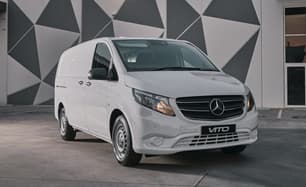
The Vito 119 Panel Van LWB offers excellent performance and driver comfort, with styling and all-round refinement that could make it an appealing business partner. However, the absence of an ANCAP star rating and a sub-one-tonne payload limit could be deal-breakers for some tradies and fleets alike, along with a list price that exceeds its Toyota HiAce LWB equivalent by almost $30K. Therefore, only a potential buyer can decide if its positives outweigh its negatives.
Apart from its distracting driver attention monitor, we can't see any major flaws that would detract from this vehicle’s comfort, practicality and performance when serving as either a utilitarian 4x4 workhorse or back-to-basics 4x4 dual cab for adventures off the beaten track.
Our LWB test vehicle rides on a 3430mm wheelbase, with 5370mm overall length and 1928mm width. Its 1916mm height ensures comfortable access to height-restricted areas like multi-storey car parks and underground loading zones and it has a reasonably tight 11.8-metre turning circle.
The rear-wheel drive chassis includes MacPherson strut front suspension, independent semi-trailing arm/coil-spring rear suspension, four-wheel disc brakes and rack and pinion steering.
It’s arguably the best-looking mid-sized van on the market with its bold frontal styling, purposeful wedge-shaped profile and elegant contours along its flanks.
The neat and functional interior has fabric-trimmed seats with an attractive speckled pattern on their facings. It also comes standard with a chrome interior package including air-vents, air con switch panel, interior door handles/surrounds and more.
The minimalist dash design results in a clean and uncluttered appearance. Even so, it still (thankfully) includes mechanical 'piano key' buttons for numerous functions and knurled barrel-style switches for controlling audio volume, cabin temperature, airflow direction and drive modes, to avoid the potential driver distraction of touchscreen prompts.
Our test vehicle rides on a compact 3130mm wheelbase and is 1865mm wide and 1795mm tall, which combined with a 12.4-metre turning circle makes it agile and easy to manoeuvre both on and off-road.
Speaking of which, its all-terrain credentials include 228mm of ground clearance, a useful 30.4 degrees approach angle (without bull-bar) and 23.4 degrees ramp breakover angle, with the departure angle dependent on the type of tray fitted. These numbers would be more than adequate for accessing rugged worksites.
Its front suspension is double-wishbone with coil-springs, paired with a robust leaf-spring live rear axle. Brakes are front discs and rear drums and it has electric power-assistance for the rack and pinion steering.
Looks are subjective of course but we reckon it has a robust and purposeful appearance in cab-chassis form, particularly with the accessories fitted to our example.
Chrome is all but extinct in its predominantly grey interior. However, hard surfaces on the centre console and door-pulls have a synthetic carbon-fibre finish, which adds a touch of style to a low-maintenance cabin that won’t get trashed by spilled coffee or muddy boots.
You also won’t find fancy features like digital instruments (it has analogue speedo/tacho) or an electronic handbrake (this one’s the good old manual lever). Plus there’s physical dials for audio volume/tuning and ‘piano key’ buttons for the cabin’s climate control, which ensures no distracting touchscreen prompts when driving.
With its 2068kg kerb weight and 3000kg GVM, our test vehicle has a 933kg payload rating which falls short of the one-tonne-plus capabilities of numerous rivals.
However, it’s also rated to tow up to 2500kg of braked trailer, which is 1000kg more than Toyota’s dominant HiAce. And with its 5500kg GCM rating (or how much it can legally carry and tow at the same time) the Vito can carry its maximum payload while towing its maximum trailer weight.
Access to the cargo bay is through sliding doors on each side with 822mm openings, or the single tailgate (optional rear barn-doors are also available). With load floor dimensions of 3061mm length and 1695mm width, along with 1270mm between the rear wheel-housings, it will carry up to two standard Aussie pallets or up to three Euro pallets, secured with a choice of eight load-anchorage points.
Standard equipment includes the cargo bay’s internal walls and doors being lined from floor to roof height. The optional Cargo Pack's solid metal bulkhead serves as both a noise insulator for the cabin and a sturdy cargo barrier, with large assist handles on each side and a full-width open storage area at its base ideal for storing ropes, straps, load-padding etc.
Access to the driver’s cabin is through doors with a relatively narrow opening angle. The seat padding is firm and well-bolstered, with the Cargo Pack’s two-seater bench offering sufficient knee clearance from the dash for central passengers.
However, central seat foot-room is limited for those with large boots and the bench seat also has no adjustment, so we’d recommend only short trips for a crew of three.
Cabin storage includes a large-bottle holder and bin in the base of each door, with a smaller bin above. The dash offers storage slots below the air-vents, plus small-bottle/cupholders and three handy open storage areas across the dash-pad.
There’s also a single glove box, overhead glasses-holder and a useful-sized compartment hidden beneath the passenger seat which is accessed through a side hatch.
With a kerb weight of only 1993kg (without tray) and 3200kg GVM, our test vehicle has a 1207kg payload rating. However, after you add the combined weight of its steel tray and other accessories (417kg), the payload rating is reduced by the same amount to 790kg. Even so, that still leaves a sizeable weight capacity for up to five tradies and their tools.
It’s also rated to tow up to 3500kg of braked trailer but with its 6250kg GCM (or how much it can legally carry and tow at the same time) the payload would have to be reduced by 450kg (from 790kg to 340kg) to avoid exceeding the GCM.
In real-world use it’s unlikely that many (if any) Triton owners would need to tow 3500kg but it’s important to be across these numbers to avoid overloading, which is dangerous and illegal.
The genuine accessory galvanised steel tray is internally 1650mm long and 1780mm wide. It has a robust checker-plate floor and a tube-frame front bulkhead with sturdy wire-mesh rear window protection.
There’s also swing-up load retainers on top of the tube-frame on each side, which when paired with the matching rear tube-rack accessory provides secure carrying space for extension ladders or long lengths of timber and PVC pipe/conduit.
There’s also external rope/strap rails along each side but like all steel trays we’ve come across there’s no internal load-anchorage points.
The driver and front passenger have access to a bottle holder and storage bin in each front door plus an overhead glasses holder and a large open compartment above the glovebox. The centre console offers more open storage plus two bottle/cupholders in the centre and a usefully-sized box at the back with a lid that doubles as a driver’s elbow rest.
The rear bench seat is comfortable and surprisingly spacious for tall people, given I’m 186cm and when seated behind the driver’s seat when set in my position, I have about 40mm of kneeroom and 60mm of headroom.
There’s also adequate head clearance for those seated in the slightly higher centre position, but the floor’s prominent transmission tunnel requires one boot either side and knees together between the front seat backrests.
And like all dual-cab utes short of a full-size US pick-up, rear shoulder room is squeezy for three adults, which is tolerable for short trips but a maximum of two adults would be ideal for longer drives.
Rear seat storage includes a bottle-holder and bin in each door plus pockets on each front seat backrest. The centre seat’s backrest also folds forward to serve as an armrest with dual bottle/cup-holders.
The bench seat’s base cushion is fixed, so unlike numerous rivals it can’t swing up and be stored vertically if more internal carrying space is required.
Our test vehicle is the Vito 119 Panel Van LWB, which like all light commercial models (except the eVito) comes standard with a 2.0-litre four-cylinder turbo-diesel engine and nine-speed automatic for a list price of $79,796.
Our example has also been fitted with a couple of factory options including a digital rear-view camera ($1031) and the 'Cargo Pack' ($2287) which adds a two-passenger front bench seat and full-width metal bulkhead with window, plus sturdy wood-flooring and bright LED lighting for the cargo bay.
These options bump the list price to $83,015, plus on-roads, so for such a sizeable spend you’d rightfully expect to get a lot more than just a prestigious badge as standard equipment.
Externally, the Vito delivers on that expectation with stylish 17-inch alloy wheels and 225/55 R17C tyres with a full-size steel spare, colour-coded front and rear bumpers, chrome grille highlights, black roof rails, rear window tint, multibeam LED headlights, LED tail-lights and classy LED puddle-lamps that project a Mercedes-Benz logo.
MY25 equipment upgrades fitted as standard include the latest 'MBUX' multimedia system with a big 10.25-inch LCD colour touchscreen, 'Hey Mercedes' voice command, wireless Apple CarPlay/Android Auto connectivity and more.
The driver’s instrument cluster gets a 5.5-inch central colour display and all models are now fitted as standard with a multifunction steering wheel with touch-sensitive controls, plus keyless start and an electronic parking brake replacing the old spring-loaded pedal version.
Standard safety has also been upgraded with active lane-keeping assistance, traffic sign recognition and tyre pressure monitoring.
Our 119 model also comes with complimentary metallic and non-metallic paint finishes, so the latest Vito is more indulgent than your typical steel-wheeled workhorse without compromising its core load-carrying capabilities.
The Triton’s cab-chassis list pricing (without tray) starts at $34,490 for the GLX single-cab 4x2 manual and finishes at $61,540 for the premium GSR dual-cab 4x4 auto.
Our GLX test vehicle comes standard with a 2.4-litre twin-turbo four-cylinder diesel engine (shared by all Tritons) and optional six-speed automatic for $49,490. This pricing is competitive with base-model 4x4 dual-cab-chassis equivalents like the Toyota HiLux Workmate ($48,735), Ford Ranger XL ($49,230) and Isuzu D-Max SX ($51,200).
However, our example is loaded with numerous items from Mitsubishi’s genuine accessories range including a steel tray ($5775), rear ladder rack ($951.42), steel bull-bar ($4755), driving lights ($1295), side-steps ($1750) and 3500kg towing kit/electronic brake controller ($2370).
This desirable ensemble adds almost $17,000 to the price, which with on-road costs would be nudging $70K to drive away. So, buyers must keep their budgets in mind, as it’s easy to get carried away in genuine accessory lolly shops.
Our test vehicle comes standard with 17-inch steel wheels and 265/65R17 all-terrain tyres plus a full-size spare. It also has heavy-duty rear suspension and underbody armour, front/rear parking sensors, reversing camera, tyre-pressure monitoring and more.
The work-focused cabin has wipe-clean fabric seat trim and vinyl floors, power-adjustable driver’s lumbar support, twin 12-volt accessory sockets and USB ports, 7.0-inch driver’s instrument cluster and a four-speaker audio system controlled by a 9.0-inch multimedia screen with Android Auto, Apple CarPlay and Bluetooth connectivity.
The 2.0-litre four-cylinder intercooled turbo-diesel meets Euro 6 emissions standards using AdBlue.
It produces 140kW of power at 4200rpm and 440Nm of torque between 1350-2400rpm. This is paired with a smooth and intuitive nine-speed torque converter automatic, which offers three drive modes comprising 'Comfort' (the standard default setting), 'Sport' and 'Manual'. The latter’s sequential manual-shifting is via steering wheel-mounted paddles.
The Triton’s 2.4-litre four-cylinder diesel engine is equipped with two turbochargers that work in sequence to boost efficiency, with the smaller one providing fast response at low rpm and the larger one optimising performance at higher rpm. The result is 150kW of power at 3500rpm and torque peaking at 470Nm between 1500-2750rpm, using AdBlue to minimise emissions.
It’s paired with a six-speed torque converter automatic that offers the choice of sequential manual shifting, which can be preferable when hauling and/or towing heavy loads, particularly in hilly terrain.
The 4x4 system is dual-range, part-time offering 2H (2WD High Range), 4H (4WD High Range) and 4L (4WD Low Range) controlled by a dial on the centre console. However, you need to step up to the GLX+ to get a rear diff-lock.
Mercedes-Benz claims official combined average consumption of only 6.7L/100km but the dash readout was showing 8.3 at the completion of our 342km test, of which about one third was hauling a heavy payload.
This was lineball with our own figure, calculated from fuel bowser and tripmeter readings, of 8.5L/100km. Any mid-sized van that can produce genuine sub-10L economy in 'real world' urban use gets a big tick from us and, based on our figures, should produce an excellent driving range of around 800km from its 70-litre diesel tank.
Mitsubishi claims official combined average consumption of 7.7L/100km but the dash display was showing 9.9 at the completion of our 316km test, which included the usual mix of suburban, city and highway driving of which about one third of that distance was hauling its maximum payload.
Our own consumption figure, calculated from fuel bowser and tripmeter readings, came in higher again at 10.7L/100km which is on the borderline of the usual 2-3L/100km discrepancy between manufacturer claims and real-world consumption.
So, based on our own numbers, the test vehicle should have a real-world driving range of around 700km from its 75-litre tank.
The Vito offers exceptional comfort for the driver, with the prestige look and feel of its leather-wrapped and height/reach adjustable steering wheel combined with a driver’s seat offering a fold-down inboard armrest, height/reach-adjustable lumbar support plus adjustable base-cushion rake and length.
A left footrest would be icing on this comfort cake, but in its absence there’s plenty of clear floor space in which to rest your left foot.
Eyelines to all mirrors are good and although the centre-seat headrest for the Cargo Pack bench partly blocks the central mirror’s rear view, most of the tailgate’s window remains clear.
Given the huge blind-spot over the driver’s left shoulder created by the cargo bay’s solid walls, the Vito’s blind-spot monitoring, rear cross-traffic alert, 360-degree camera etc are effective in creating a safety zone in such a vulnerable area.
The steering feel is superb, as we’ve come to expect from Mercedes-Benz commercial vehicles. Cabin noise remains commendably low even at highway speeds, during which the engine needs only 1700rpm to maintain 110km/h. However, tyre noise can become intrusive on coarse bitumen surfaces.
Engine response in city and suburban use is excellent, as the nine-speed auto efficiently keeps the turbo-diesel operating within its 1350-2400rpm peak torque zone. And 440Nm of torque is competitive for a van this size, ensuring strong acceleration with or without a load.
The driver-selectable Sport and Manual drive modes provide greater driver engagement and direct control respectively, but for most driving the default Comfort setting provides a commendable balance of comfort and engine response which allows the Vito to shine in a working role.
We proved this after loading 770kg into the cargo bay, which with driver equalled a total payload of 870kg which was only about 60kg under its legal limit. The coil-spring rear suspension compressed 50mm under this weight, which still left more than enough suspension travel to ensure there was no bottoming-out during our test drive.
This included our usual 13 per cent gradient, 2.0km set climb at 60km/h, in which it downshifted to fourth gear and 2000rpm (bang in the middle of its peak torque band) to easily reach the summit.
Engine-braking on the way down, in a manually-selected second gear, was impressive for an engine with relatively small displacement restraining almost 900kg in payload, requiring only one firm application of the brake pedal. Overall, it proved to be a competent load-hauler.
Large assist-handles on the A (and B) pillars, combined with the accessory side-steps on our example, make it easy to climb aboard and find a comfortable driving position.
The unladen ride is firm, as you’d expect given its 6.0-tonne-plus GCM rating, but it’s still supple enough to soak up the bumps without the harsh kidney-belting ride suffered in some cab-chassis one-tonners we’ve tested.
This is no doubt helped by the accessories fitted, which provide more than 400kg of additional sprung weight to engage the heavy-duty rear springs and improve the ride quality. That’s something to keep in mind if you often drive unladen.
The steering is firmly weighted and the brakes have good response, with the rear drums offering a terrier-like bite when the manual handbrake is applied on steep hills with a heavy load on board.
The four-cylinder 2.4-litre diesel, with its sequential turbocharging and strong outputs, provides energetic all-round performance with efficient gearing that ensures its operating within its peak torque band most of the time.
However, at highway speeds it does tend to hold top gear for too long, when the engine has dropped below 1500rpm and is clearly wanting a downshift.
To test its payload rating, we strapped 650kg on the tray which when combined with accessories and crew was right on the weight limit. The stout rear springs compressed only 25mm under this load, leaving ample bump-stop clearance that assured there was no bottoming-out on our test route.
The Triton handled this task with competence, maintaining good performance and chassis stability. It easily hauled this load up our 13 per cent gradient, 2.0km set climb at 60km/h, with the six-speed auto self-shifting down to third gear and 2500rpm which was comfortably within its peak torque band. Engine braking on the way down was also commendable.
Our only gripe is the driver distraction monitoring system which is still too reactive in certain situations, like scratching an itch below my eye even though I was looking straight ahead while doing it. Even though Mitsubishi has tried to improve this system, it needs more refinement, as it detracts from an otherwise positive driving experience.
Although Vito vans built from January 2023 are still without an ANCAP star rating, models built from May 2024 scored 90 per cent for collision avoidance in ANCAP’s Commercial Van Safety Comparison, earning the highest Platinum grading for scores of 80 per cent and above.
The latest Vito’s active safety additions join a suite of existing features including front/thorax/window airbags for driver and passenger, AEB, lane-keeping, blind-spot and rear cross-traffic alert, daytime running lights, front/rear parking sensors and lots more.
The Triton comes with a five-star ANCAP rating (tested 2024) and a suite of passive and active features highlighted by eight airbags (including side-curtains), auto emergency braking (AEB) with pedestrian/cyclist detection and junction assist, rear AEB when reversing, front/rear cross-traffic alert, traffic sign recognition, adaptive cruise control, lane-keeping, front/rear parking sensors, reversing camera, trailer stability assist and lots more. Rear seat has ISOFIX child-seat anchorages on the two outer rear seating positions and three top-tethers.
The Vito comes with a five years/250,000km warranty which includes 24-hour roadside assistance.
Scheduled servicing is 12 months/25,000km whichever occurs first. Capped-price servicing for first five scheduled services totals $5555, or a pricey average of $1111 annually.
It comes with a five-year/100,000km standard warranty, or 10 years/200,000km if serviced at Mitsubishi dealers.
Scheduled servicing is every 12 months/15,000km whichever occurs first. Pricing is capped at $6860 for 10 scheduled services up to 10 years/150,000km, or an average of $686 per service.
Mitsubishi currently has more than 200 dealers across its national network that spans metro, rural and regional areas. Mitsubishi dealerships are also service centres.