What's the difference?
The latest VS20 Vito range, comprising Vito/eVito light commercials and Tourer/V-Class people movers, brings the first major facelift to Mercedes-Benz’s mid-sized (2.5-3.5-tonne GVM) van since 2015, along with numerous comfort, convenience, technology and safety upgrades.
The workhorse fleet is available in medium wheelbase (MWB) and long wheelbase (LWB) Panel Vans and Crew Cabs, with a variety of drivetrain specifications including the all-electric eVito LWB van.
We were recently handed the keys to one of the latest turbo-diesel variants to see how it measures up from a tradie/business perspective in one of Australia’s most competitive vehicle markets.
The Renault Master range has been refreshed, and this was our first chance to see what changes have been made.
You should be able to tell just by the look of the 2020 Master that there’s a new design with a more modern looking front-end. And the inside has been thoroughly modernised, too.
But with contemporary rivals such as the VW Crafter and Mercedes-Benz Sprinter - both of which launched in all-new generation guises in 2018 - the question is whether the ageing, yet facelifted Master is worthy of consideration.
We spent a week with it - and covered plenty of kays in it - to find out.
The Vito 119 Panel Van LWB offers excellent performance and driver comfort, with styling and all-round refinement that could make it an appealing business partner. However, the absence of an ANCAP star rating and a sub-one-tonne payload limit could be deal-breakers for some tradies and fleets alike, along with a list price that exceeds its Toyota HiAce LWB equivalent by almost $30K. Therefore, only a potential buyer can decide if its positives outweigh its negatives.
If you’re after a budget-conscious offering in the large van segment, the Renault Master could be a really solid proposition. It falls short of the safety expectations set by its newer rival, though, and that’s something you might not be able to put a price on.
Our LWB test vehicle rides on a 3430mm wheelbase, with 5370mm overall length and 1928mm width. Its 1916mm height ensures comfortable access to height-restricted areas like multi-storey car parks and underground loading zones and it has a reasonably tight 11.8-metre turning circle.
The rear-wheel drive chassis includes MacPherson strut front suspension, independent semi-trailing arm/coil-spring rear suspension, four-wheel disc brakes and rack and pinion steering.
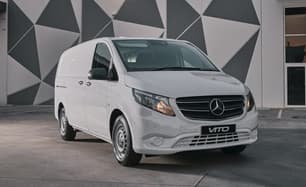
It’s arguably the best-looking mid-sized van on the market with its bold frontal styling, purposeful wedge-shaped profile and elegant contours along its flanks.
The neat and functional interior has fabric-trimmed seats with an attractive speckled pattern on their facings. It also comes standard with a chrome interior package including air-vents, air con switch panel, interior door handles/surrounds and more.
The minimalist dash design results in a clean and uncluttered appearance. Even so, it still (thankfully) includes mechanical 'piano key' buttons for numerous functions and knurled barrel-style switches for controlling audio volume, cabin temperature, airflow direction and drive modes, to avoid the potential driver distraction of touchscreen prompts.
The front-end styling of the Master has been modernised with a “robust” new look which sees it adopt a more upright nose with a bulkier grille, squared-off headlights (with LED daytime running lights as standard, along with halogen headlights).
There were no other changes made to the exterior, so if you see it side on or from the rear, you’d be hard pressed to tell if it's the new model.
This is the second facelift for this generation (X62) Master, which originated back in 2010. It is also offered in some markets as a Nissan, Opel, and Vauxhall. And this version certainly freshens up the appearance, though the practicality of the Master line-up remains unchanged.
That’s a good thing: you can still get the van as a short-wheelbase with low roof (L1H1), a mid-wheelbase with mid roof (L2H2), a long-wheelbase with mid roof (L3H2), or an extra-long-wheelbase with high roof (L4H3). There’s also the choice of a single cab-chassis Platform ute model, too.
Our test model is the L2H2, meaning dimensions of 5575mm long on a lengthy 3682mm wheelbase (giving it a 13.6-metre turning circle), while the width is 2070mm and the height is 2499mm. Too tall for car parks (and drive-thru windows, in this age of social distancing).
The good news about the height, though, is that it allows you excellent interior dimensions. The cargo hold of this version is 3083mm long, 1765mm wide (and 1380mm between the wheel-arches, enough for Aussie pallets to slide in easily), and the height is 1894mm inside. I’m six-foot tall (1820mm) and that meant I could safely step in and out of the cargo zone without fear of hitting my head. The load space is 10.8 cubic metres in this spec.
As you’ll see in the interior section, the cabin has been given a bit of attention too - you can see it in the images below.
With its 2068kg kerb weight and 3000kg GVM, our test vehicle has a 933kg payload rating which falls short of the one-tonne-plus capabilities of numerous rivals.
However, it’s also rated to tow up to 2500kg of braked trailer, which is 1000kg more than Toyota’s dominant HiAce. And with its 5500kg GCM rating (or how much it can legally carry and tow at the same time) the Vito can carry its maximum payload while towing its maximum trailer weight.
Access to the cargo bay is through sliding doors on each side with 822mm openings, or the single tailgate (optional rear barn-doors are also available). With load floor dimensions of 3061mm length and 1695mm width, along with 1270mm between the rear wheel-housings, it will carry up to two standard Aussie pallets or up to three Euro pallets, secured with a choice of eight load-anchorage points.
Standard equipment includes the cargo bay’s internal walls and doors being lined from floor to roof height. The optional Cargo Pack's solid metal bulkhead serves as both a noise insulator for the cabin and a sturdy cargo barrier, with large assist handles on each side and a full-width open storage area at its base ideal for storing ropes, straps, load-padding etc.
Access to the driver’s cabin is through doors with a relatively narrow opening angle. The seat padding is firm and well-bolstered, with the Cargo Pack’s two-seater bench offering sufficient knee clearance from the dash for central passengers.
However, central seat foot-room is limited for those with large boots and the bench seat also has no adjustment, so we’d recommend only short trips for a crew of three.
Cabin storage includes a large-bottle holder and bin in the base of each door, with a smaller bin above. The dash offers storage slots below the air-vents, plus small-bottle/cupholders and three handy open storage areas across the dash-pad.
There’s also a single glove box, overhead glasses-holder and a useful-sized compartment hidden beneath the passenger seat which is accessed through a side hatch.
Like all vans in this segment there are some cabin smarts that will make your life a lot easier if you spend a lot of time in the cockpit.
There are storage options aplenty, including overhead folder holders, a trio of dash-top storage caddies, dash-top cup holders, huge door pockets with bottle holders, some smaller storage cubbies near the shifter, and a glovebox that is, in the French tradition, good to hold a pair of gloves and not much else. This model had the dual passenger bench seat, with a hidden storage section underneath, and you can fold the middle seat down to form a desk platform with cup holders if that’s what you need.
Along with the storage smarts, the updated Master has seen some major changes in terms of infotainment intelligence, too. The new 7.0-inch MediaNav touchscreen system with Apple CarPlay and Android Auto is a welcome advancement for the brand, and during my time in the vehicle it proved simple to use and quick to react. The sound isn’t terrific, with just two speakers fitted, and I had to turn it up pretty loud to overcome the wind noise from this mid-roof model.
The driver’s seat is comfortable and offers decent adjustment, with height and lumbar adjustment. It’s easy to step up into the cab, too, despite there not being side grab handles. The driver also gets a new digital instrument display section on the redesigned dashboard, which includes a gear-shift indicator (but not a gear position indicator), and a digital speedometer and trip computer.
The steering wheel is new, too, and it’s much nicer than the old grainy plastic number in the pre-facelift version. Gone are the round vents across the dash and round plastic sections of the old model - now there are squared-off, more modern looking finishes that clearly aim to mimic the exterior’s now boxy-edged body.
In the cargo zone there are multiple tie-down hooks (eight on the floor, four on the side wall pillars), making for plenty of options to secure a load - though as can often be found with these eye-hook points, they can be a little too far inboard to make good use of, and in the Master’s case, there are no tie-down points rear of the wheel-arches. There is a 12-volt outlet in the back pillar, however.
Our test vehicle is the Vito 119 Panel Van LWB, which like all light commercial models (except the eVito) comes standard with a 2.0-litre four-cylinder turbo-diesel engine and nine-speed automatic for a list price of $79,796.
Our example has also been fitted with a couple of factory options including a digital rear-view camera ($1031) and the 'Cargo Pack' ($2287) which adds a two-passenger front bench seat and full-width metal bulkhead with window, plus sturdy wood-flooring and bright LED lighting for the cargo bay.
These options bump the list price to $83,015, plus on-roads, so for such a sizeable spend you’d rightfully expect to get a lot more than just a prestigious badge as standard equipment.
Externally, the Vito delivers on that expectation with stylish 17-inch alloy wheels and 225/55 R17C tyres with a full-size steel spare, colour-coded front and rear bumpers, chrome grille highlights, black roof rails, rear window tint, multibeam LED headlights, LED tail-lights and classy LED puddle-lamps that project a Mercedes-Benz logo.
MY25 equipment upgrades fitted as standard include the latest 'MBUX' multimedia system with a big 10.25-inch LCD colour touchscreen, 'Hey Mercedes' voice command, wireless Apple CarPlay/Android Auto connectivity and more.
The driver’s instrument cluster gets a 5.5-inch central colour display and all models are now fitted as standard with a multifunction steering wheel with touch-sensitive controls, plus keyless start and an electronic parking brake replacing the old spring-loaded pedal version.
Standard safety has also been upgraded with active lane-keeping assistance, traffic sign recognition and tyre pressure monitoring.
Our 119 model also comes with complimentary metallic and non-metallic paint finishes, so the latest Vito is more indulgent than your typical steel-wheeled workhorse without compromising its core load-carrying capabilities.
The 2020 update for the Renault Master saw prices adjusted to compensate for additional standard equipment now offered range wide.
You can read the full pricing and specs breakdown story here, but the standard goodies for the Master include: a new 7.0-inch touchscreen media system with USB input, Bluetooth, Apple CarPlay, Android Auto, sat nav and reversing camera display, a two-speaker sound system, rear parking sensors, 16-inch steel wheels with a full size spare fitted under the rear body, body-protective cladding, twin-view side mirrors with electric adjustment, electric windows, cruise control, air conditioning, remote central locking, halogen headlights, LED daytime running lights, and rear fog lights.
The list price for the L2H2 mid-wheelbase manual model used in this review is $47,490 plus on-road costs (RRP or MSRP), but Renault is advertising this exact spec for $47,990 drive-away, which is pretty compelling - you don’t even need to be an ABN holder for that discount.
The Master MWB van comes as standard with barn doors at the rear (270-degree opening), and a sliding side door on kerb side (left), while SWB models get 180-degree barn doors. It also features a steel bulkhead as standard, as well as a three-seat layout up front. There’s a handy lift-up base on the bench part of the seat, which allows you about 100 litres of hidden storage if you need it.
There are numerous options for buyers to customise their van to suit what they need. There are several packs to choose from, such as: the Trade Pack - wooden floor, full height timber wall lining, rear step, LED ceiling lights ($1600); the Business Pack - front fog lights, hands-free key card and push-button start, chrome exterior and interior trim finishes ($1000); and the Convenience Pack - auto high/low beam lights, lane departure warning, blind spot monitoring and front parking sensors ($1000).
You can option individual elements such as a driver’s side sliding door ($800), a driver’s suspension seat ($800 - removes the side airbag for the driver), a single passenger seat ($200 - N/A with driver suspension seat, adds passenger-side airbag protection), and if you choose RWD model there’s an available differential lock ($1000). Last but not least, you can have glazed dual sliding doors for $800, but only if you also option the Trade Pack.
Colour options include no-cost solid paint finishes in white, grey, dark blue, light blue, yellow, orange and red (the interesting colours will need to be pre-ordered). There are also three metallic paint options in grey, black or a silver/blue look, and the cost there is $1000.
The 2.0-litre four-cylinder intercooled turbo-diesel meets Euro 6 emissions standards using AdBlue.
It produces 140kW of power at 4200rpm and 440Nm of torque between 1350-2400rpm. This is paired with a smooth and intuitive nine-speed torque converter automatic, which offers three drive modes comprising 'Comfort' (the standard default setting), 'Sport' and 'Manual'. The latter’s sequential manual-shifting is via steering wheel-mounted paddles.
The power outputs and torque figures depend on the transmission you choose.
Despite the fact that both manual and automatic versions of the Master run a 2.3-litre four-cylinder diesel engine, there’s a difference between the engines: the version with the six-speed manual transmission is a twin-turbo unit, while the six-speed automated manual transmission makes use of a single-turbo diesel.
There’s not much in it when it comes to the difference in outputs, however.
The manual version has a slight horsepower advantage, with 120kW of power (at 3500rpm) and 360Nm of torque (at 1500rpm).
The automated manual has a maximum power of 110kW (at 3500rpm) and 350Nm of torque (at 1500rpm).
Both transmissions are geared the same across all six ratios, though from experience, the automated manual is best left at the showroom. While rivals offer conventional torque converter automatic gearboxes to appeal to a broader customer base globally, the French brand persists with its pernickety somewhat-auto option instead.
The majority of models in the Master range are front-wheel drive (FWD), but there are a couple of long-wheelbase rear-wheel drive (RWD) models available. None are all-wheel drive (AWD) or four-wheel drive (4WD).
You might be interested to note the weight specs for the Master range. There are too many variables to bore you with here, but the details on the L2H2 mid-wheelbase manual I tested, according to Renault Australia, are as follows: kerb weight - 1887kg; gross vehicle mass/GVM - 3510kg; payload - 1623kg; towing capacity - 750kg un-braked, 2500kg braked. The gross combination mass (GCM) is 6000kg.
Mercedes-Benz claims official combined average consumption of only 6.7L/100km but the dash readout was showing 8.3 at the completion of our 342km test, of which about one third was hauling a heavy payload.
This was lineball with our own figure, calculated from fuel bowser and tripmeter readings, of 8.5L/100km. Any mid-sized van that can produce genuine sub-10L economy in 'real world' urban use gets a big tick from us and, based on our figures, should produce an excellent driving range of around 800km from its 70-litre diesel tank.
There is no official combined fuel consumption claim figure stated by Renault, as the vehicle falls into the heavy commercial vehicle space.
But I can tell you it’s pretty impressive for fuel economy. I saw an average of just 8.5 litres per 100 kilometres over more than 1000km of testing - more than half of which was with the van loaded up with hundreds of kilograms of load.
With a 100-litre diesel tank, you could theoretically get about 1150km to a fill, and that’s with a mix of loaded and unloaded driving.
One thing, though: most vehicles have a graphic on their dashboard to show which side the filler neck is - you know, you see a fuel bowser and the filler is on the right, that means your vehicle’s filler is on the right. Not in the Master. It has a graphic with the filler on the right, but the actual fuel cap is on the left. And like most vans, you have to open the passenger door to fuel up.
Worried about AdBlue? No need - the engine used in the Master range is a Euro 5 unit, so there is a diesel particulate filter, but no urea after treatment setup to mention.
The Vito offers exceptional comfort for the driver, with the prestige look and feel of its leather-wrapped and height/reach adjustable steering wheel combined with a driver’s seat offering a fold-down inboard armrest, height/reach-adjustable lumbar support plus adjustable base-cushion rake and length.
A left footrest would be icing on this comfort cake, but in its absence there’s plenty of clear floor space in which to rest your left foot.
Eyelines to all mirrors are good and although the centre-seat headrest for the Cargo Pack bench partly blocks the central mirror’s rear view, most of the tailgate’s window remains clear.
Given the huge blind-spot over the driver’s left shoulder created by the cargo bay’s solid walls, the Vito’s blind-spot monitoring, rear cross-traffic alert, 360-degree camera etc are effective in creating a safety zone in such a vulnerable area.
The steering feel is superb, as we’ve come to expect from Mercedes-Benz commercial vehicles. Cabin noise remains commendably low even at highway speeds, during which the engine needs only 1700rpm to maintain 110km/h. However, tyre noise can become intrusive on coarse bitumen surfaces.
Engine response in city and suburban use is excellent, as the nine-speed auto efficiently keeps the turbo-diesel operating within its 1350-2400rpm peak torque zone. And 440Nm of torque is competitive for a van this size, ensuring strong acceleration with or without a load.
The driver-selectable Sport and Manual drive modes provide greater driver engagement and direct control respectively, but for most driving the default Comfort setting provides a commendable balance of comfort and engine response which allows the Vito to shine in a working role.
We proved this after loading 770kg into the cargo bay, which with driver equalled a total payload of 870kg which was only about 60kg under its legal limit. The coil-spring rear suspension compressed 50mm under this weight, which still left more than enough suspension travel to ensure there was no bottoming-out during our test drive.
This included our usual 13 per cent gradient, 2.0km set climb at 60km/h, in which it downshifted to fourth gear and 2000rpm (bang in the middle of its peak torque band) to easily reach the summit.
Engine-braking on the way down, in a manually-selected second gear, was impressive for an engine with relatively small displacement restraining almost 900kg in payload, requiring only one firm application of the brake pedal. Overall, it proved to be a competent load-hauler.
I did a mix of driving in the Master over the week I had it, including more than 600km of unladen driving.
Why so many kays? I used it to move house, which meant I completed two “full” trips between Sydney’s inner-west and Cowra in the Central West of NSW, and two “empty” trips back to Sydney, as well.
I’ll get to how it drove with a load on board in the section below, but the unladen experience was pretty positive.
The engine and transmission are well teamed, and there’s a good amount of usable torque and very little lag to speak of.
As with this entire generation of engines - a derivative engine in a different state of tune is used in the Nissan Navara - the refinement is mostly good until you reach higher in the rev range, where it can get a bit noisy and clattery. But the best work is done down low in the rev zone anyway.
The manual shift action isn’t what I’d call “slinky”, more “clicky”. But it’s easy to row between gears as the action is light and the clutch isn’t too heavy, either. The gearing is generous, meaning you can saunter in sixth gear around 70km/h without the engine labouring too hard, and it’ll accelerate from there to freeway pace - provided you’re not going uphill.
There is a bit of ratio management required if you encounter a steep incline, but generally it’s a decently strong powertrain for its intended use - more on that below.
I’m always astounded about the steering and ride characteristics of vans of this size. Yes, it’s large, and yes, it can get blown around a little by crosswinds, and yes, you need to factor in the longish-wheelbase and larger turning circle that results from that… but it drives a lot smaller than it is.
The steering is direct and accurate, easy to judge at high or low speeds - which is great news when you’re parking (and there’s a good quality reversing camera and rear parking sensors, but you’ve just gotta remember the roof height, too).
The ride is adequate without a load on board, too. The independent McPherson strut front suspension copes well with changes in surface and bump control, though it can be a little bouncy at times. The rear suspension is a leaf-spring torsion beam setup, and it can be a little clumsy over road joins when unladen.
It also brakes well, with solid and trustworthy response from the four-wheel disc brakes at all speeds.
Although Vito vans built from January 2023 are still without an ANCAP star rating, models built from May 2024 scored 90 per cent for collision avoidance in ANCAP’s Commercial Van Safety Comparison, earning the highest Platinum grading for scores of 80 per cent and above.
The latest Vito’s active safety additions join a suite of existing features including front/thorax/window airbags for driver and passenger, AEB, lane-keeping, blind-spot and rear cross-traffic alert, daytime running lights, front/rear parking sensors and lots more.
While there has been a safety revolution in the van segment in recent years led by Mercedes and VW, Renault has been left behind to a degree.
The Renault Master has never been put through NCAP or ANCAP crash testing. So there’s no safety star rating to speak of.
And it falls short of its chief rivals, as it doesn’t have any sort of auto emergency braking (AEB) or forward collision warning system at all.
It has a reversing camera and rear parking sensors, plus dual front airbags and driver’s side airbag protection (not passenger though?), and there are no curtain airbags either. But it has electronic stability control (ESC), electronic brake force distribution, and hill start assist with Renault’s Grip X-tend system that is designed to allow better traction in slippery situations.
You can option some safety technology into the manual versions of the Master, by way of the Convenience Pack. For $1000 it adds auto high/low beam lights, lane departure warning (not active lane keeping assist), blind spot warning (not rear cross-traffic alert), and front parking sensors.
I understand the argument that buyers shouldn’t have to pay for anything they don’t need, especially when it comes to business vehicles. But I hope that behind closed doors Renault is working furiously to improve the safety equipment offering as a matter of priority.
The Vito comes with a five years/250,000km warranty which includes 24-hour roadside assistance.
Scheduled servicing is 12 months/25,000km whichever occurs first. Capped-price servicing for first five scheduled services totals $5555, or a pricey average of $1111 annually.
The Renault van range is covered by a warranty plan that isn’t as good as you’ll get from VW or Ford. That is, the Master (and Trafic and Kangoo below it) have a three-year/unlimited kilometre warranty cover, which is two years shorter than the best in the class.
Service intervals are business-friendly at 12 months/30,000km, with a capped-price service plan spanning the first three years/90,000km. The service price is $599 per visit, but keep in mind you will need to replace the coolant ($132) and brake fluid ($79) every 60,000km. There’s also an accessory belt replacement at 90,000km ($506).
If you service your van at Renault, you’ll also be eligible for up to four years of roadside assistance cover. From the showroom floor there is 12 months cover.
Concerned about issues, problems, recalls, questions, queries, complaints, or reliability issues? Check out our Renault Master problems page.