What's the difference?
Imagine jumping in the time machine, zapping back to the late 1970s and bringing the team that produced the original Mercedes-Benz G-Wagen into 2025 and showing them where their creation has landed close to half a century later.
They’d be amazed a vehicle looking so much like their military-focused, first-generation model even existed! And once they’d absorbed that incredible fact they’d be stunned to see what lurks under its familiar bodywork.
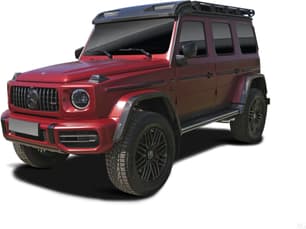
Because this is the most recent iteration of what’s now referred to as the G-Glass, the pure-electric G580 featuring four individually controlled electric motors - one at each wheel - collectively producing enough energy to power a small town.
Stay with us as we explore this take-no-prisoners EV 4WD that has multiple show-stopping, high-tech party tricks lurking up its sleeve.
The Volkswagen Transporter has a long bloodline which can be traced to 1950 when the first split-windscreen Type 2 (aka Kombi) van was launched sharing mechanical components with its equally iconic T1 ‘Beetle’ sedan sibling.
Since then, the Transporter has evolved through seven generations, with the latest being the result of a global alliance with Ford in which the automotive giants share vehicle underpinnings and other technologies. This is designed to streamline new model development and amortise costs, as demonstrated by VW’s current Amarok ute based on the Ford Ranger.
The latest Transporter shares a similar relationship with Ford’s mid-size Transit Custom range, including the full-electric e-Transporter variant based on the E-Transit Custom. We recently spent a working week aboard this electrified model to see how it measures up from a tradie’s perspective.
As per the 1979 original, the current G-Class is produced by Magna Steyr in Arnie’s home town of Graz in Austria. And many fundamental things haven’t changed since then. But clearly this EV monster’s exotic electric powertrain is a huge departure.
It retains impressive off-road ability and straight-line speed. But will it hit the mark with top-end luxury 4WDers? Short story, this thing is wild, and it will be irresistible for a likely narrow band of tech-focused ‘must have the latest and greatest’ buyers. Nothing like impressing friends and family with a tank turn.
Note: CarsGuide attended this event as a guest of the manufacturer, with travel, accommodation and meals provided.
Although closely related to Ford’s E-Transit Custom, the e-Transporter has carved its own niche in appealing to VW Transporter loyalists and businesses wanting to project a chic Euro image. For tradies and other service providers its driving range is best suited to metro duties, which if combined with the convenience of daily back-to-base charging could make it a practical solution for many working roles.
Okay, so Mercedes-Benz says, with a straight face, that “with the aim of optimising the vehicle’s aerodynamics” classic G-Class elements have been revised, including the reprofiled bonnet, ‘air curtain’ vents in the flares over the rear wheel arches, A-pillar cladding and the small spoiler on the edge of the roof.
At the same time, the 20-inch wheels are also claimed to be "aerodynamically optimised” and underneath, a 26mm underbody casing made from a mix of materials, including carbon-fibre (attached to the ladder frame with more than 50 steel screws), protects the battery from dust, dirt and rocks.
In ticking off the Edition One, car-spotters should look for black rims with blue brake callipers behind them, blue inserts in the exterior protective strips as well as black door handles and a new rectangular design box on the rear door for storing items such as charging cables, tools or snow chains. If you want a spare wheel, choose the standard model.
An optional black-panel radiator grille ($3800) features tinted lighting units as well as an animated LED light band and chrome surround. The light band can be activated as a running light or an animation when locking and unlocking the vehicle.
And it’s worth noting Mercedes-Benz and the car’s contracted manufacturer, Magna Steyr, have invested much time and many Euros in retaining the car’s classic handle and door lock design. G-Wagen owners will recognise its sound from several kilometres away.
Inside the G580 it’s clear this is one area where the G-Class has progressed enormously over the decades. It’s still quite upright in terms of the dash design, but you’re confronted by twin 12.3-inch screens, supporting the Mercedes-Benz user interface.
All very high-tech, but that’s balanced by an old-school grab-handle for the front passenger to latch onto during off-road work.
The signature turbine-style air vents are located within squared-off panels, and in the limited Edition One you have a blue fleck running through carbon-fibre inserts on the centre console, door cards and that front grab handle. In the standard car it’s a (very attractive) walnut open-pore wood rather than carbon.
A luxurious interior for sure.
Although based on the E-Transit Custom, the e-Transporter (like the Amarok) does a commendable job in establishing its own identity, with noticeable differences in styling and a spacious and functional cabin design with a distinct VW commercial vehicle look and feel.
Its dash design is free of protrusions, leaving enough floor space between it and the seats to allow drivers convenient ‘walk-through’ access from one side of the cab to the other.
Our LWB example is clearly designed with hard work in mind, armed with 16-inch steel wheels and unpainted dark grey plastic evident in areas most vulnerable to wear and tear including the bumpers, hubcaps, door handles and mirror shells.
It rides on a sprawling 3500mm wheelbase with MacPherson strut front and coil-spring rear suspension. Key body dimensions of 5450mm length and 2032mm width are combined with a practical 1978mm height, the latter allowing access to low clearance loading zones and multi-storey carparks. The long wheelbase contributes to its largish 13-metre turning circle.
For the record, the G63 is just over 4.6m long and a little more than 1.9m wide with a 2890mm wheelbase. So, not huge, but its close to 2.0m height is hard to ignore.
In the front there’s lots of breathing space, and in terms of storage you have generous bins in the doors with plenty of room for big bottles. Then there’s a centre armrest, which doubles as the top of a deep storage box housing a USB-C port inside.
A sliding roller cover in the centre console reveals two cupholders, another two USB-C sockets, a 12-volt outlet and a wireless charging pad. Add in a big glove box and you’ve got plenty of options in terms of storage, power and connectivity.
In the back, sitting behind the driver’s seat set for my 183cm position I’ve got tons of foot and legroom and, no surprise, lots of headroom.
There’s a fair bit of sculpting in the rear seat, which is as nice as it is unusual (makers often avoid bolsters on the rear seat as it makes the backrest harder to fold flat). And in terms of three-abreast accommodation, a smaller adult will be okay in the centre spot for shorter journeys. Three up to mid-teenage kids will be swimming in it.
Then, for practicality you again have generous bins in the doors. And if you need even more capacity, fold down the centre armrest which houses two different size cupholders.
In the rear of the centre console you’ve got two USB-Cs, a 12-volt power outlet, individual climate control and directional vents.
There are map rockets on the front seatbacks and more air vents in the B-pillar. So, when it comes to comfort, powering up devices and storing ‘things’ you’re well taken care of.
The side-opening tailgate door opens from right to left, which isn’t ideal when parallel parked on the left hand side of the road, but boot volume is over 600 litres (VDA) with all seats upright, expanding to nearly 2000 litres with the 60/40 split-folding rear seat lowered.
There are multiple tie-down hooks, a netted pocket, two lights, a 12-volt outlet as well as a ‘ski-port’ door and sliding cargo cover to enhance practicality and security.
As mentioned earlier, the full-size spare in the standard model, but the Design Box replaces it on the Edition One, although Mercedes-Benz says it’s aiming to make a spare available as an option later in the year.
The heavy propulsion battery mounted beneath the load floor is largely responsible for the e-Transporter’s sizeable 2540kg kerb weight, which when deducted from its 3225kg GVM leaves a payload of 685kg.
However, Volkswagen’s published rating is higher at 760kg, as European payload measurement typically allows for a 75kg driver. Even so, that’s still a modest payload compared to numerous mid-size diesel rivals (including its TDI Transporter equivalent) offering up to one tonne or more.
About 150kg of the e-Transporter’s payload can be carried on the clever trio of folding roof racks courtesy of its Ford donor, which lie flush with the roof when not in use but can quickly be locked in vertical positions to carry loads as needed.
Our test vehicle is also rated to tow up to 2300kg of braked trailer but Volkswagen does not publish a GCM figure (how much it can legally carry and tow at the same time) so we don’t know if it can tow its maximum trailer weight while carrying its maximum payload.
The cargo bay, which offers up to 6.8 cubic metres of load volume, is accessed through a standard passenger-side sliding door with 1030mm opening width or the swing-up tailgate.
The load floor, which comes standard with a protective liner, is 3002mm long and 1777mm wide with 1392mm between the rear wheel housings. This means it can carry two standard Aussie pallets or three Euro pallets secured by a choice of eight load anchorage points.
A section of load floor length can also be extended to 3450mm by opening a hinged hatch on the lower left of the cabin bulkhead, which can be handy for carrying long lengths of timber, pipe, conduit, carpet rolls etc. The walls are also neatly lined to mid-height and there’s a 12V socket.
There’s also ample cabin storage with three tiers of storage (including large-bottle holders) in each front door plus cupholders on each side of the dash-pad, which also has a large open tray in the centre with a pair of USB ports.
The lower dash includes a large glove box, driver’s pop-out cupholder, wireless phone charging pad, 12V socket and more USB ports, while the centre seat backrest folds forward to serve as a mobile work desk.
Beneath the hinged base cushions on the passenger bench seat is a cavernous hidden storage area which is ideal for the five metre long charging cable.
The new Mercedes-Benz G580 is priced at $249,900 and a more highly-specified limited Edition One version comes in at $299,900, both before on-road costs.
That’s a price territory where the BMW X5 and X6 M Competition ($244,900 & $250,900) as well as the Range Rover Autobiography ($233,961) live. Not to mention competition from the G580’s still available and appreciably pricier twin-turbo V8 Mercedes-AMG G63 stablemate ($365,900).
As you’d expect, the standard features list is substantial and the highlights are Burmester 3D Surround Sound audio (with digital radio), leather upholstery, keyless entry and start, a multi-function steering wheel trimmed in Nappa leather, power front seats with memory function, heated and cooled cupholders, and wireless smartphone charging.
There’s also dual 12.3-inch driver instrument and central media displays, ambient lighting and adaptive LED headlights as well as Android Auto and Apple CarPlay.
As well as cosmetic changes, covered shortly, the Edition One steps up to ‘Silver Pearl’ and black Nappa leather trim (with blue contrast stitching).
There’s also a range of optional packages bundling up everything from exterior body elements to interior trim and additional multimedia, the latter especially for back-seaters.
The ‘Night Package’ ($4300) includes black exterior mirror housings, black running boards and wheels as well as darkened exterior lights and a radiator shell that can be illuminated for an impressive profile while driving.
A ‘Superior Line Interior Plus Package’ ($14,500) brings full Nappa leather upholstery, ‘Active Multicontour Seat Package Plus’ and grab handles in leather. Then a ‘Manufaktur Exterior Package’ ($4100) finishes the roof, bumpers and wheel arches in ‘Obsidian Black’.
But the one that will score you maximum brownie points with the kids is the ‘Interior Comfort Package’ ($8500), featuring a rear seat entertainment system, including two integrated 11.6-inch touch displays.
The latest Transporter range comprises traditional TDI diesel powered 2WD models with list pricing (before on-road costs) of $58,590 for the short wheelbase (SWB) and $60,590 for the long wheelbase (LWB). 4Motion all-wheel drive variants are also available in both SWB ($62,590) and LWB ($64,590) configurations.
The e-Transporter, which comes standard with a single electric motor, single-speed automatic and rear-wheel drive, is the highest priced model in the range with list pricing of $83,590 for the SWB and $85,590 for the LWB.
This is higher than full-electric mid-size van rivals like the closely related Ford E-Transit Custom Trend LWB ($77,590 plus on-roads) and sharper priced LDV eDeliver 7 ($74,200 driveaway) but considerably lower than the Mercedes-Benz eVito 112 LWB which lists at $98,951.
Our test vehicle is the LWB version which comes standard with 16-inch steel wheels and 215/65 R16C tyres but no spare (tyre sealant/12v inflator kit only), LED headlights/DRLs/tail-lights/internal lighting, three folding roof racks, heated exterior mirrors a heated tailgate window with wiper and more.
The cabin and cargo bay are separated by a metal bulkhead plus there’s keyless start, single-zone climate control, heated seating for three, 12-inch digital instrument display, 13-inch multimedia touchscreen with Apple CarPlay Android Auto connectivity and digital radio, wireless phone charging, seven USB ports, two 12V sockets and more.
Buyers can personalise e-Transporters with no-cost options like deletion of the cabin bulkhead plus cargo bay options you must pay extra for including a right-hand side sliding door, dual powered sliding doors, rear barn-doors, side windows, a wooden floor liner, aircraft-style load-securing rails and shelving/cabinet preparation.
Volkswagen Commercial Vehicles also works closely with aftermarket vehicle converters to facilitate commercial and camper installations including no-cost options like a swivel front passenger seat and a second (12V) battery.
The G580 is powered by four permanently excited synchronous motors, each delivering around a CLA200’s worth of power and torque to each wheel for overall outputs in excess of 432kW/1164Nm.
Each motor has its own two-stage transmission and power electronics for almost infinite fine-tuning of the direction and amount of drive sent to individual wheels. Merc calls it ‘individual-wheel drive’.
The e-Transporter’s single electric motor, which produces 210kW of power and 415Nm of torque, drives the rear wheels through a single-speed automatic transmission. It offers numerous drive modes including 'Normal', 'Eco', 'Sport', 'Slippery' and 'Tow/Haul' plus there's a 'B' button on the gear selector which optimises regenerative braking for largely one-pedal driving and maximum energy harvesting.
The motor and transmission are neatly combined in a compact unit mounted beneath the load floor driving the rear wheels. This design has an inherent traction advantage over front-wheel drive rivals, particularly when towing and hauling heavy loads on low-grip surfaces.
Housed in a torsion-resistant casing and embedded low down in its ladder-frame chassis, the G580’s 116kWh two-tier, liquid-cooled lithium-ion battery pack delivers a WLTP-rated range of 473km, or 567km on the more lenient NEDC scale.
‘Eco Assistant’ and ‘Range Monitoring’ functions provide continuous information on battery status, energy consumption and estimated range.
Maximum system capacity is 400 volts which enables 200kW DC charging, meaning a 10 to 80 per cent fill in as little as 32 minutes. Maximum AC charging capacity is 11kW.
Claimed energy use is 23.1kWh/100km, and we saw an average of 28.6kWh across urban and highway running on the launch drive program.
Not exactly a ‘green’ EV choice, then, but it’s worth noting a one-year Chargefox subscription is included to off-set the car’s energy appetite.
Volkswagen claims a combined (urban/extra-urban) cycle electric WLTP driving range of up to 330km from a single charge of its 64kWh lithium-ion propulsion battery, which can be charged from zero to 100 per cent in around seven hours and 30 minutes using a three-phase 11kW AC charger and 10-80 per cent in just 38 minutes using 125kW DC fast charging.
The dash display confirmed a 100 per cent charge and estimated driving range of up to 298km when we collected the test vehicle. After completing 103km of metropolitan driving there was 65 per cent charge and 186km range remaining, which was consistent with the original onboard estimate.
We plugged into a public AC station (the charging port is located behind a flap in the front bumper) and after three hours the battery charge had increased from 65 to 93 per cent, with the estimated driving range rising from 186km to 290km. The total test distance was 233km with average consumption of 20kWh/100km, so based on those figures a real-world driving range of around 300km from a full charge is credible.
So, with 432kW and around 1160Nm, even though the G580 weighs in at around three tonnes, you’re talking 0-100 km/h in 4.7 seconds. And this car gets up and goes… like a beast.
What you don’t get is that traditional Merc-AMG G63 V8 rumble, because, of course, no engine.
But you do get what Mercedes calls ‘G-Roar’, essentially a sound bar at the front of the car also using the audio system inside to give it what is not exactly an engine noise but some sense of the car progressing. And you can turn it off for completely silent running.
‘Electric Dynamic Select’ changes the parameters of the motors, transmission, suspension, ESP and steering as required. On-road that means ‘Comfort’, ‘Sport’ and ‘Individual’ modes, with off-road comprising ‘Trail’ and ‘Rock’. In the Comfort setting drive flows primarily to one axle for optimum energy efficiency.
Suspension is by double wishbones at the front and a De Dion-style live (rigid) axle at the rear. You’ve got the same adaptive-type set-up as per other G-Class models, so ‘Comfort’ and ‘Sport’ modes and of the many traditional G-Class traits this car exhibits, ride quality is one of them.
Even in Comfort you’ll find even little bumps and thumps making their way up into the seat of the pants and the cabin. It is after all a body-on-frame, ladder-chassis type vehicle and that’s not unusual.
In terms of steering, it’s accurate and road feel is good. You’ve got 275-wide Falken Azenis FK520 tyres that are more on- than off-road focused. The car feels stable and nicely planted on the road.
The physical brakes are by ventilated discs front and rear, and the big rotors are the same size (353mm) all around. They work nicely and feel like a conventional set-up.
Regenerative braking kicks in as soon as you lift off the accelerator pedal. The powertrain is harvesting energy as the car decelerates and there are four levels you can adjust with the steering wheel paddles up to a quite aggressive level - not quite, but close to a single-pedal set-up.
Off-road, the G580’s ‘G-Steering’ system allows the wheels to turn at different speeds to induce slight ‘drift-like’ oversteer and tighten the turning circle. It works beautifully and the car’s fording depth is 850mm, a full 150mm more than internal-combustion G-Class models.
A three-speed off-road crawl function is adjustable to speeds as low as 2.0km/h, and the car is claimed to remain stable on sideways slopes up to 35 degrees.
Torque vectoring is used to create ‘virtual diff locks’ and there’s a ‘low-range’ setting. Switch to the ‘Offroad Cockpit’ and data including gradient, lateral inclination, compass readings, tyre pressures and the selected G-Mode appear.
A ‘Transparent Bonnet’ function creates a virtual view of what’s approaching and passing under the front wheels to help the driver pick their way through steep ascents or declines.
For the record, the G580’s approach angle is 32 degrees, departure is 30.7, breakover is 20.3 and ground-clearance is 250mm.
And of course, with the wheels independently powered, the G580’s signature move is what Mercedes-Benz calls a ‘G-Turn’ but the rest of the world calls a tank turn.
If you encounter an obstacle that makes forward progress impossible, the system spins the left- and right-hand wheels in opposite directions so this brute can turn on the spot like an M1 Abrams. You can’t help but crack up laughing when executing this extreme party trick!
In terms of miscellaneous observations around ergonomics and the car in general, it has a 13.6-metre conventional turning circle. So if you’re not using the G Turn function in the car park be ready for a sizeable turning arc.
Also, those aero tweaks here and there seem to have had an effect. Wind noise, especially for such an upright, squared-off design is surprisingly modest. And overall, from a build point of view, this car feels as though it’s been carved from a solid piece of metal. In every aspect it presents as a quality item.
It has a big left footrest and ample steering wheel and seat adjustment, with the latter including a fold-down inboard armrest, power lumbar support and even manual extension of the base cushion to provide extra thigh support.
The large truck-style door mirrors feature a wide-angle view in their lower third which combined with blind-spot monitoring and other active features ensures commanding side and rear surveillance for the driver.
More than 400Nm of torque is ample for a mid-size van and with most of that delivered instantly from standing starts thanks to the electric motor, it has zippy acceleration that’s ideal for metro driving.
It’s also like riding in a tram at suburban speeds with its near-silent drivetrain although tyre noise increases and can become intrusive at highway speeds, even with a sealed bulkhead to largely insulate the cabin from most of the tyre noise emanating from the rear wheel housings.
To sample its load carrying ability we forklifted 325kg into the cargo bay which combined with our crew of two equalled a total payload of more than half a tonne. It coped comfortably with this task across a mix of city roads and highway hauling. Overall, we found it difficult to fault as a urban-based workhorse.
Although the Mercedes-AMG G63 carries a maximum five-star ANCAP safety assessment from 2018, the pure-electric G580 is unrated. But crash avoidance tech includes active cruise control, ‘Active Steering Assist’, high-speed AEB, traffic sign recognition, lane-keeping assist, blind-spot monitoring, driver fatigue monitoring as well as a 360-degree camera view and ‘Active Parking Assist’.
And if a crash is unavoidable, there are no fewer than 11 airbags on-board, including driver and front passenger front and side, rear side, full-length curtains, driver and passenger knee and a front centre bag.
There are three top-tether points for child seats across the second row, with ISOFIX anchors on the two outer positions.
The e-Transporter does not have an ANCAP rating as yet but comes standard with multiple airbags and a suite of active features including AEB with pedestrian and cyclist detection, front cross-traffic assist with swerve support, lane keeping assist, blind-spot monitoring, traffic sign recognition including ‘wrong way’ warning, front and rear parking sensors, tyre pressure monitoring, a reversing camera, adaptive cruise control and more.
The G580 is covered by Mercedes-Benz Australia’s five-year/unlimited-km warranty, which remains the standard offering in the premium part of the market and an eight-year/160,000km drive battery warranty.
Service intervals are every 12 months or 20,000km with service plan pricing available over three ($2645), four ($3980) and five ($4670) years. In approximate terms, each workshop visit will cost ‘around’ $900. Not exactly cheap, especially for an EV, but this is no ordinary electric vehicle.
This van comes standard with a five-year/unlimited km warranty with roadside assist plus a separate eight-year/160,000km propulsion battery warranty.
Scheduled servicing is every 12 months/30,000km whichever occurs first. Volkswagen offers three-year and five-year prepaid service plans with average costs of around $400-$450 per service.
These terms are competitive with rivals like the LDV eDeliver 7 and Ford E-Transit Custom, with the LDV offering lower servicing costs and a longer battery warranty. The e-Transporter’s servicing is also considerably cheaper than its eVito German rival.
Volkswagen Group Australia is backed by a large national network of around 170-180 dealerships represented in all states and territories including many regional areas.