What's the difference?
The second-generation Mazda CX-9 may have been on sale in Australia for nearly five years now, but it remains the second best-selling large SUV using unibody construction (as opposed to old-school, off-road-focused body-on-frame).
That said, it is getting on a bit, so Mazda’s given it an update with a twist for 2021, hoping to inject a little bit more life into its flagship model.
And when we say twist, we mean it. After all, who would’ve thought there’d ever be a six-seat CX-9? Well, we’ve checked it out to see if it’s the version we needed all along. Read on.
Aussie buyers could be excused for being wary of SsangYong, given the marque’s chequered history involving numerous ownership changes, crippling debts and in 2021 its rescue from the jaws of receivership by Korean industrial conglomerate KG Group.
However, the KG Group’s corporate rehabilitation of the troubled carmaker was completed in 2022, allowing the renewed SsangYong Motor (renamed KG Mobility in Korea) to hopefully focus on its core business of producing 4x4 SUVs and pick-ups, with increasing use of electrification planned for future model development.
As part of this renewal, in late 2023 SsangYong Australia announced MY24 updates to refresh its local 4x4 Musso ute and Rexton seven-seater SUV ranges, which, combined with a Merv Hughes-hosted marketing campaign, is aimed at building brand appeal and sales through its 70-plus national dealer network.
We were recently handed the keys to the latest Rexton, which competes for buyers in Australia’s fiercely competitive ‘Large SUVs under $80K’ segment that hosts more than 20 rivals.
The CX-9 is still a great option for families looking for a large SUV, even if it is starting to show its age as new rivals continue to launch with newer technologies.
That said, the availability of a luxury-focused six-seat configuration (Azami LE AWD) for the first time might be enough to convince some buyers to give it further consideration.
But for others who need the versatility of seven seats, this is still the CX-9 we’ve all come to know and love – but just a little bit better – particularly in its best-selling Azami AWD form.
If KG Group can provide the long-term stability and new model investment that has eluded SsangYong for so long, the brand could have a promising future in Australia judging by the MY24 Rexton Adventure. It’s a solid package and what it lacks in benchmark ANCAP safety and third-row comfort is offset by a compelling driveaway price, generous warranty and national dealer network. So, if you’re looking for a feature-packed 4x4 seven-seater SUV for less than $55K, you might be pleasantly surprised by this competent Korean.
Given its latest update is relatively minor, the CX-9’s exterior largely looks the same as before, which, depending on your point of view, is a very good thing. As far as we’re concerned, it certainly is.
That said, train-spotters will notice some differences, with the GT SP (new), Azami and Azami LE (new) grades getting a refreshed grille that’s slotted and available in two grade-specific finishes unlike the insert their carryover Sport, Touring and GT siblings still have.
And aside from the GT SP, Azami and Azami LE’s new sets of 20-inch alloy wheels (again in grade-specific finishes), the only other exterior change is the Azami and Azami LE’s larger-diameter chrome exhaust tailpipe extensions. Sporty!
Inside, the CX-9 has more changes in store, headlined by the new ‘floating’ 10.25-inch central display all but the Sport and Touring get (they stick with 7.0- and 9.0-inch units respectively).
The new set-up is powered by Mazda’s latest multimedia system, which is certainly an improvement over its predecessor, and a much needed one at that.
Worth noting, touch is not an input method, with the rotary controller on the centre console the only option, which is actually great for safety, so we’re all for it.
The Azami and Azami LE also get new quilted Nappa leather upholstery, which looks and feels great, and adds to the overall high-quality theme.
Otherwise, it’s pretty much business as usual, which is great because the CX-9 has always had a well-designed interior. Yep, if it ain’t broke, don’t fix it.
With its 4850mm overall length and 1960mm width, the Rexton rides on a 2865mm wheelbase with a compact 11-metre turning circle.
Its smooth ride comes from four-coil suspension with double-wishbones up front and an independent multi-link arrangement in the rear. For those venturing into the rough stuff, it has 20.5 degrees approach and departure angles, 20 degrees ramp break-over angle and 203mm of ground clearance.
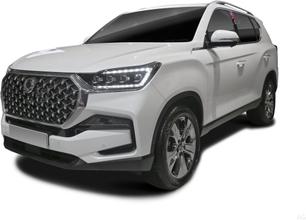
Looks are subjective, of course, but we reckon it has attractive and cohesive styling, with its prominent and ornate diamond-style grille complimented by distinctive side-body contours that can’t be mistaken for other SUVs.
The interior has a premium look and feel, with lots of exposed stitching along soft-touch seams and a tasteful blend of contrasting surfaces including chrome, satin chrome, piano black and textured patterns.
There’s good attention to detail and build quality is excellent, but there are some annoying design quirks like the need for the front passenger to access a touchscreen menu just to adjust the audio volume.
The second-row of seating has a/c vents in the centre console and is spacious even for tall people like me (186cm). When sitting behind the driver’s seat in my position, there’s about 60mm of clearance between my knees and the driver’s seat backrest, which combined with ample head and shoulder room makes for a comfortable ride.
By contrast, the third-row seating is strictly for young kids, as there are no adjustments for the second-row’s backrest angle or fore/aft base cushion positioning to accommodate taller frames like mine. The side windows in the thick rear roof pillar are also conspicuously small, which adds to a claustrophobic feel.
Fortunately, access to the third-row is made easier by the 60/40-split second-row, which can be folded and tumbled forward.
However, given I’ve found tolerable third-row comfort in some rival seven-seaters, the Rexton’s third-row is my only gripe for those with longer limbs.
Being an SUV that’s 5075mm long, 1969mm wide and 1747mm tall, practicality is arguably the most important thing for the CX-9, and with the option of six seats for the first time with the new Azami LE, it’s even more versatile.
All seven-seat grades have a 60/40 split-fold second row that manually slides and reclines the same as before, with only the Sport missing out on one-touch tumble operation, which makes accessing the 50/50 split-fold third row even easier, even if it’s still not graceful.
But the six-seat Azami LE is configured differently, given its second row has two captain’s chairs instead of a bench. That said, it operates in a very similar manner, just with power adjustment.
I still had around eight centimetres of legroom and four of legroom behind my 184cm (6'0") driving position, while the large transmission tunnel that’s a foot-space issue in seven-seat versions... isn’t.
One key difference with the very roomy and comfortable Azami LE is it only has four top-tether child-seat anchorage points, while all other grades have five thanks to their extra seat. Either way, four ISOFIX child-set anchorage points are split across the second and third rows.
Alternatively, the third row can be used by adults on shorter journeys, although they won’t have a lot of space to enjoy. Again, I'm 184cm tall and it’s tight back there, with no headroom or legroom on offer, but children will, of course, fare much better.
The CX-9’s boot is still pretty usable with all three rows in action, with 230L of cargo capacity available, but you can stow the two rear seats to get 810L in total.
And if you want maximum cargo capacity, the middle seats can also be folded, but not in the Azami LE, annoyingly.
Either way, the CX-9 doesn’t have a load lip but does have a flat floor, so loading bulkier items is a cinch, while two bag hooks and four tie-down points are on hand for securing loose items if they can’t fit in the double map pockets on the front seat backrests.
There are two cupholders in the third row, another two in the second row’s fold-down armrest (seven-seater versions) or large centre console (Azami LE), and another two in the first row’s larger centre console, while the front and rear door bins can also take bottles – and other knick-knacks.
All grades get USB ports in the first row, while the Touring and above also have them in the second row, and the GT and above also feature them in the third row. It’d be nice if there was no differentiation, though.
With its 2130kg kerb weight and 2960kg GVM, our test vehicle has a sizeable load capacity of up to 830kg, which should be ample for five occupants and their luggage.
It’s also rated to tow up to the class-benchmark 3500kg of braked trailer and its 350kg maximum tow-ball download is compatible with that requirement.
Plus, its generous 6460kg GCM (or how much it can legally carry and tow at the same time) means it can legally tow its maximum trailer weight while carrying its maximum car-load, which is a practical set of numbers for just about any recreational requirement.
Front-row cabin storage includes cup/bottle-holders and a small bin in each front door, plus a single glove box. The stylish centre console has a bin up front with sliding-lid, two cupholders in the middle with another sliding-lid, plus a box at the rear with hinged padded-lid that doubles as a driver’s elbow rest.
Those seated in the second-row get a cup/bottle holder and bin in each door, plus pockets on each front seat backrest. The fold-down centre armrest has two more cupholders and a handy hidden compartment that’s ideal for small items. Third-row occupants get storage bins on each side but no cup/bottle holders.
Accessing the cargo area through the power tailgate reveals 236 litres (VDA) of load volume with the third-row seats upright. This expands to 641 litres with the third-row folded flat and 1806 litres (or more than 1.8 cubic metres) with the second and third-rows folded.
The cargo area’s rear floor has a two-tiered design, with the top floor lying flush with the third-row seats when folded but it can be removed to reveal a lower floor that provides a second level of storage. There’s also a usefully large bin in the right-hand-side wall cavity. The only things missing are sturdy load-anchorage points at floor level to secure cargo nets or straps.
The CX-9 has become more expensive, with some grades up a little, while others are up a lot. The range now starts from $45,990, plus on-road costs, and reaches $73,875 (see pricing table below), but there is more standard equipment now.
Either way, two new grades have joined the now-comprehensive CX-9 line-up, bringing the total to six, with the new GT SP slotting in above the mid-range GT but below the previously flagship Azami, which is now bettered by the new Azami LE.
The entry-level Sport and Touring round out the line-up, with each grade coming with front-wheel drive as standard, although all-wheel drive is an expensive $4000 option for all but the Azami that instead asks for a $4435 premium, and the Azami LE which gets it as standard.
Features-wise, the Sport gets dusk-sensing LED headlights, rain-sensing wipers, 18-inch alloy wheels, push-button start, a 7.0-inch central display, satellite navigation, Apple CarPlay and Android Auto support, digital radio, a six-speaker sound system, a head-up display, three-zone climate control and black cloth upholstery.
While the Touring has the same 18-inch alloy wheels, it steps up with keyless entry, a 9.0-inch central display, paddle-shifters (new), power-adjustable front seats with heating, and black leather upholstery.
The GT goes even further with 20-inch alloy wheels, a hands-free power-operated tailgate, a sunroof, the aforementioned 10.25-inch central display (new), a 12-speaker Bose sound system, a wireless smartphone charger (new) and heated outboard middle seats.
As its name suggests, the new GT SP is the sportier version of the GT, adding a unique black finish to its 20-inch alloy wheels and side-mirror caps as well as burgundy leather upholstery and red stitching for just $500 more.
Meanwhile, the Azami has 20-inch alloy wheels with a bright finish (new) as well as adaptive LED headlights, LED daytime running lights, a 7.0-inch multifunction display, a heated steering wheel and 'Pure White' or 'Walnut Brown' quilted Nappa leather upholstery (new).
And finally, the new Azami LE mimics the Azami but replaces its middle bench with two power-adjustable captain’s chairs with heating and cooling plus a dedicated centre console, so six seats in total instead of the usual seven.
Also of note, the CX-9 has a new metallic paintwork option: 'Polymetal Grey', which helps it stand out from the crowd.
For reference, the CX-9’s rivals include the soon-to-be-replaced Toyota Kluger ($44,850 to $68,574) and the recently launched facelifted Hyundai Santa Fe ($43,990 to $61,660) and new-generation Kia Sorento ($45,850 to $63,070).
2021 Mazda CX-9 pricing before on-road costs
Our test vehicle is the new ‘Adventure’ model, which serves as the middle-grade offering between the entry-level ELX and top-shelf Ultimate.
It’s equipped with the same 2.2-litre four-cylinder turbo-diesel, eight-speed automatic and part-time 4WD as other Rextons, for a drive-away price of only $54,000 (our 'Space Black' metallic paint is a $595 option).
That pricing looks razor-sharp compared with mid-grade 4x4 seven-seaters offered by segment leaders like the Isuzu MU-X LS-U ($61,400), Ford Everest Trend ($66,790) and Toyota Prado GXL ($69,530).
And they are 'list' prices (not including on-road costs) whereas the Rexton is 'drive-away-no-more-to-pay'.
The MY24 upgrades include a new dash layout and high-mounted 12.3-inch multimedia touchscreen with Apple/Android wired connectivity. There’s also a restyled dual-zone climate control hub with touchscreen, plus new lower body mounts for improved ride quality.
The Adventure brings numerous luxuries like a walk-up welcome system (mirrors unfold and puddle lamps illuminate), touch-sensing front door locks with walk-away auto door-locking, power tailgate and soft-touch synthetic leather seats with the fronts offering power adjustment, heating and cooling.
The second-row outer rear seats and steering wheel are also heated, plus there’s speed-sensitive power steering and tyre pressure monitoring.
These appointments are in addition to the base ELX’s generous standard equipment list including 18-inch 'diamond-cut' alloy wheels with 255/60 tyres and a full-size alloy spare, LED dusk-sensing headlights/DRLs/front fog lights/tail-lights, heated door mirrors, a four-way-adjustable leather steering wheel and 12.3-inch driver's digital instrument display.
There are also four USB-C ports (two front and two in second row centre console), three 12-volt outlets (front console box, second row centre console and cargo area), electric parking brake, reversing camera, front and rear parking sensors and more. It's fair to say the Rexton Adventure is feature-packed.
All CX-9 grades are powered by a carryover 2.5-litre turbo-petrol four-cylinder engine, which produces 170kW of power at 5000rpm and 420Nm of torque at 2000rpm.
A six-speed torque-converter automatic transmission is standard, and again, you get the option of front- or all-wheel drive for all grades but one, the AWD-only Azami LE.
If you’re after a diesel-powered seven-seater, Mazda also has the similarly sized CX-8 in its line-up, but it still doesn’t offer a hybrid option in any of its SUVs, even though many rivals are moving in that direction, including the aforementioned Kluger, Santa Fe and Sorento.
The quiet and refined 2.2-litre, four-cylinder, turbo-diesel, which meets Euro 6 emissions standards, produces 149kW at 3800rpm and 441Nm across a 1000rpm-wide torque band between 1600-2600rpm. It provides energetic response in city and suburban use.
This engine is paired with an equally refined eight-speed torque converter automatic, with overdrive on its sixth, seventh and eighth ratios ensuring low-rpm operation and optimum fuel economy at highway speeds.
Sequential manual-shifting is available using the steering wheel-mounted paddles and there's a choice of three drive modes ('Power'/'Winter'/'Eco') which can be selected using a console button.
The part-time, dual-range 4WD system is controlled by a console dial, offering the choice of 2H (2WD high-range), 4H (4WD high-range) and 4L (4WD low-range). It also has an auto-locking rear diff to optimise traction as required.
According to the official combined fuel consumption figures (ADR 81/02), FWD variants of the CX-9 sip 8.4 litres per 100km, which isn’t too bad for a petrol-powered large SUV that weighs just shy of 1900kg. Claimed carbon dioxide (CO2) emissions are 197 grams per km.
And given they weigh a whisker more than two tonnes, AWD versions of the CX-9s drink a slightly higher 9.0L/100km and emit 211g/km.
We covered 188km in the Azami AWD and Azami LE AWD at the CX-9’s launch and recorded 11.5L/100km after primarily driving on country roads and highways.
While that figure is nearly 30 per cent higher than Mazda's claim, it’s not outlandish considering the type of vehicle the CX-9 is. Either way, results will vary.
For reference, AWD variants have a slightly large fuel tank (74L) than their FWD counterparts (72L), but they all take more affordable 91RON petrol at minimum.
SsangYong claims an official combined cycle average of 8.7L/100km. At the completion of our 307km test, which comprised mostly city and suburban driving with a bit of highway travel, mostly in Eco mode with up to five occupants on some trips, our figure calculated from fuel bowser and trip meter readings came in at 11.0L/100km.
Although higher than SsangYong’s claim, it was within the usual 2.0-3.0L/100km discrepancy between official and ‘real-world’ figures. So, based on our numbers, you could expect a driving range of more than 600km from its 70-litre tank, which is not bad. Based on the official figure, driving range extends to around 800km.
As far as large SUVs go, the CX-9 is one of the better ones to drive. It’s certainly not confused; it knows what it needs to do and does it well.
The engine is properly punchy down low, serving up plenty of initial torque, so much so that you rarely need to chase its top-end power. In that way, it’s very diesel-like, despite being petrol. Needless to say, acceleration is surprisingly brisk. Not bad, then!
And the transmission it’s matched to also does its job well. Gear changes are pleasingly smooth, if not quick, while it's receptive to heavy applications of the accelerator, kicking down a ratio or two with little hesitation. Yep, don’t bother with its Sport mode.
The CX-9 also rides pretty well thanks to its independent suspension set-up, which consists of MacPherson-strut front and multi-link rear axles with passive dampers. Indeed, the kids aren’t going to be upset when they’re onboard.
Again, we mainly drove on country roads and highways, but it proved to be comfortable, particularly at high speed. And even during those rare, in-town, low-speed moments, it still impressed, on lower-quality roads or not.
And while the CX-9’s electric power steering is well-weighted, some buyers might be left wishing it was a tad lighter, especially when parking, but that’s more about personal preference than anything else.
What is more universal, though, is the system’s lack of feel. Obviously, we’re not dealing with a sports car here, but a little communication through the wheel wouldn’t go astray, particularly on a twisty road.
Speaking of which, the CX-9 handles its mass pretty confidently around a corner. That said, while it is relatively tied down, it still regularly exhibits a fair degree of body roll to remind you that you’re dealing with a large SUV.
The Rexton’s overall refinement and build quality are evident when you get behind the wheel. It offers good adjustability for driver comfort and the fundamentals of the vehicle are sound, as there were no red flags during our test.
The engine is smooth and quiet with good all-around performance, the automatic transmission shifts quickly and smoothly, the steering is nicely weighted and communicative, the brakes provide reassuring response and the ride quality is supple over bumps yet disciplined enough to provide good handling response.
It’s also pleasantly quiet at highway speeds, with low tyre and wind noise. Engine noise is also minimal, given that it requires only 1600rpm to maintain 110km/h, ensuring low-stress cruising.
Most of our driving time was spent in Eco mode, as we found performance in this setting more than adequate for our purposes. We did briefly use the Power mode but didn’t notice any significant change in response.
ANCAP awarded the CX-9 its maximum five-star safety rating in 2016, and despite the test occurring nearly five years ago, its results still stand.
Needless to say, the game has moved on, with the Santa Fe and Sorento recently resetting the standard, while the Kluger is soon to follow suit.
The CX-9 does, however, get front and side airbags as well as curtain airbags that cover all three rows, whereas the Santa Fe and Sorento only cover the first and second rows.
All grades of the CX-9 also get front and rear autonomous emergency braking, lane-keep assist, blind-spot monitoring, rear cross-traffic alert, adaptive cruise control with stop and go functionality, traffic sign recognition, high-beam assist and driver attention alert.
A reversing camera and rear parking sensors are also standard in all grades, but the Touring and above add front parking sensors, while the Azami and Azami LE also get surround-view cameras.
No ANCAP rating (as yet). Even so, it comes with numerous passive and active safety features highlighted by dual front, side and curtain airbags plus a driver’s knee protection bag (but no centre airbag between driver/front passenger).
There’s also AEB, lane assistance, blind-spot warning and rear cross-traffic alert, trailer sway control, hill descent control, front/rear parking sensors, reversing camera and more, but a notable absentee is speed-sign recognition and the cruise control is non-adaptive. There are also ISOFIX child seat anchorages on the two outer second-row seating positions plus top tethers for all three.
As with all Mazda models, the CX-9 comes with a five-year/unlimited-kilometre warranty with five years of roadside assistance, both of which are average when compared to Kia’s market-leading seven-year terms with ‘no strings attached’.
Service intervals are 12 months or 10,000km, with the distance on the shorter side, although capped-price servicing is available for the first five visits, costing $2022 in total at the time of the writing, which is very reasonable.
Warranty cover is seven years/unlimited km warranty plus seven years roadside assist.
Scheduled servicing is every 12 months/15,000km whichever occurs first.
The first seven scheduled services run to $375 each, up to seven years/105,000km, for a total of $2625.