What's the difference?
Mazda has a tendency to have a lot of similar looking horses in the stable; blink and you'll miss the (very) subtle differences between the CX-8 and the CX-9 but if you're not super keen on the bulk of the CX-9 and you've outgrown the space of the CX-5... this one's for you.
Especially, if you've been considering its competition - the Hyundai Santa Fe Elite CRDi AWD and Toyota Kluger GXL AWD. Both of which have become known for their features and space.
So, how does it compare? The CX-8 GT SP diesel all-wheel drive seats seven, has a decent boot space (albeit, when the third row isn't in use) and handles like a dream.
Perfect combination? Maybe. I've been driving it for the last week with my family to find out for you.
At long last, Volkswagen’s electric mid-size SUV duo has landed in Australia.
The appeal of the ID.4 as an electric family SUV alternative to the likes of the Tiguan is obvious, but where does the more coupe-styled ID.5 fit?
It comes in a single GTX trim for now, taking aim at some of the more performance-oriented EV SUVs on the Australian market, of which there are now quite a few. But now it’s arriving later than many of its rivals.
Has VW done enough with the ID.5 GTX for it to justify a spot on your test-drive list? We went to its Australian launch to find out.
So, what did my family think about the Mazda CX-8 GT SP diesel all-wheel drive? I love how it performs on the road - it's super easy to drive and you don't notice how large it is in a car park.
There are some great family-friendly features scattered throughout and I like how practical this is too with the extra seats and top-tether points. The multimedia system isn’t my favourite and I would have preferred to have seen a few extra airbags and a 360-degree view camera, but overall, it’s a good family car and gets an 8.0/10 from me.
My son loved the sun blinds and the cool colour of the seats. He also gives it an 8.0/10.
At long last, the ID.5 GTX arrives to make a different pitch than many of its electric rivals. Less about straight-line speed and more about refinement and handling, this EV mid-sizer makes a case for itself, even if it’s not as good value as its ID.4 sibling.
Note: CarsGuide attended this event as a guest of the manufacturer, with travel, accommodation and meals provided.
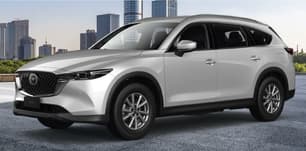
To be honest, I can't really tell the CX-8 and CX-9 apart on the road. They're both large SUVs that sport the classic Mazda bonnet - sharp and long. Up close, the CX-9 has a bulkier shape but otherwise they are remarkably similar.
The CX-8's darkened grille generates some interest with its lattice-work and there are enough shiny chrome accents scattered about the car that it looks pretty.
Yet, the sporty sharpness that Mazda is known for is still hinted at with its shaping and the 19-inch black alloy wheels.
Our model is finished in 'Platinum Quartz Metallic' and it is the highlight for the exterior styling for me. I think because it's such an interesting colour to look at - it varies a lot depending on lighting conditions. Sometimes, it almost has a sheen of pink to it and at others, it looks like pearly sand.
The interior looks polished and refined with its burgundy leather trim and soft-touchpoints. Again, there is a lot of chrome inside to make otherwise dull features, like air vents, pop out.
The key differentiator between the ID.4 and ID.5 is of course the ID.5’s descending coupe roofline. I think it grants the GTX more presence on the road, and I appreciate the touch of having a true three-dimensional spoiler piece atop the boot lid to round it out rather than a more common lip or roof-mounted extension.
Outside of this, the ID.5 sets itself apart from the rest of the Volkswagen range thanks to its curves rather than hard edges as well as contemporary light bar fittings, front and rear.
The overall visage is fresh but a tad conservative, especially compared to the more radical designs we’re seeing on new-to-the-market automakers like XPeng, or those looking to make a splash with their electric offerings, like Kia with its EV5.
There’s certainly something to be said for a more moderate approach, though, as it feels more resolved than many rivals.
Inside, to a degree, the ID.5 follows similar trends in the market, with a minimalist and screen-dominated dashboard.
The 12.9-inch central touchscreen unit is less overbearing than some 15+ inch units in other cars, and this combines with the sensible 5.3-inch digital instrument cluster to make it feel more like a car than a tech product on wheels.
Still, the minimalist theme prevails, with the ID.5’s interior being free of a space-consuming raised console or a smattering of buttons to interact with.
The seats in this GTX are particularly cool, with the single-piece backing like a Golf GTI, red stitching and nice material quality.
It leaves you with the impression the ID.5 is modern but with the build quality and know-how of a storied automaker, which is a nice balance.
The CX-8 is a very practical family hauler because there's ample room in all three rows. Yes, even adults will be able to squeeze into that third row without too many complaints!
All rows enjoy well-cushioned seats and up front they are electrically adjustable, but unfortunately, only the driver's side has lumbar support.
The middle row can slide forward manually or by using the electric button found on the side of the seats... but doing it yourself is way faster.
They do slide far enough forward that you won't embarrass yourself too much when you have to clamber into the third row. Where the seats have a 50/50 split-fold and manual adjustments (accessed via the boot).
In the first two rows there are lots of individual storage options but the front enjoys the most. The middle console is deep enough to be useful and I like the dual opening lid. Each row gets a couple of cupholders and drink bottle holders, too.
The charging options are great, with each row getting two USB-C ports and the front getting a wireless charging pad and 12-volt socket.
All of the controls and dials feel within easy reach and the 10.25-inch touchscreen multimedia system graphics are clear.
You can use it as a touchscreen or opt for the rotary dial but switching between the two was awkward for me. Especially, since the touchscreen function is disabled when you are using the wireless Apple CarPlay. This also has wired Android Auto, for those users.
The amenities are practical throughout with a dark headliner, three-zone climate control and heated outboard seats and retractable sun-blinds in the middle row.
Good news for families because there are five top-tether points across the back rows and ISOFIX child seat mounts on the outboard seats in middle row, in case you need them.
You can fit a 0-4 rearward facing child seat and it shouldn’t impact on front passenger comfort.
My six-year old found it super easy to get in and out of this car because of the 205mm ground clearance and wide door apertures. He enjoyed the high seating position, too, but was disappointed he couldn’t see out of the sunroof!
The boot space is a bit cramped with all three rows are in use at 209L but folding the third row opens up a more respectable 775L - perfect for the average family and its stuff!
The loading space is level, with the temporary spare tyre and clever storage compartments housed underneath. There is a retractable cargo blind and net, luggage anchor points and a 12-volt port, too.
And, as always, I love a powered tailgate, which this has!
First, the less-good. The minimalist and button-free interior will be a major downside for many. Pretty much everything in the ID.5’s cabin is touch-based. There’s not even a stop/start button, you just sit in the car and it’s ready to go. Additionally, it relies on the now-maligned touch sliders below the multimedia screen for volume and temperature adjustment. Never fun to use on the move. Even the buttons on the steering wheel are the touch-based haptic-feedback kind.
At least the software shapes up. It’s easy enough to navigate, and has a slew of straightforward menus. It’s also backed by enough processing power, with swift responsiveness, and the panel quality is good too, with a sharp, high-resolution finish.
This can be a double-edged sword, though. The high-resolution leads to small shortcut icons across the top of the main screen. While I’m glad the ID.5 has these so you can swap between things like the car’s settings menu and, say, Apple CarPlay easily, it takes some accuracy to jab at while you’re trying to drive.
From there, though, the cabin is clever. Free from the trappings of buttons and a raised console, it feels spacious in every dimension and the seat comfort is excellent with lovely side bolstering and padding.
The seats feel quality, but I wonder whether the synthetic suede-style microfleece trim will age as well or be as easy to clean as cloth or leather. Worth thinking about if you plan to keep this car for a long time.
I even like the touch of having little flip-down armrests which almost makes it feel like you’re being silently propelled along in an armchair in the front seats.
You need these because there’s no traditional raised console with an armrest box. Instead there’s a flexible floating central console piece. It features a modular sort of design, where you can make use of either dividers or a drop-in bottle holder piece in either the upper or lower sections, depending on your preference. Remove these things entirely to have two massive trays.
Meanwhile, the lower section features a cubby with a wireless phone charger, and it also houses the dual USB-C ports with a sliding cover so you can keep the interior tidy. I like it.
There are large bottle holders in the doors, too, and another nice touch is the digital dash being perched on the steering column, so no matter how you adjust it, you can always see it.
The back seat is also excellent in the ID.4 and ID.5, featuring plenty of space for me behind my own driving position, at 182cm tall. There’s heaps of airspace for my knees, and because there’s a flat floor courtesy of this car’s dedicated 'MEB' platform, there’s plenty of space for your feet. It also makes the centre position usable by an adult, which is rare.
Soft trims continue in the doors, but my favourite feature of the ID.5’s rear bench is how the brand has thought to strongly contour the outer two seat backings so even they have plenty of side bolstering.
The backs of the front seats feature an upper pocket for phones and the like, and a larger lower pocket, while the doors feature a large bottle holder each. A drop-down armrest has three shaped cavities for bottles of all sizes, and behind it is a ski port door.
There are adjustable air vents and a touch panel to control the rear climate zone, but because of the low design of the central console, they’re basically on the floor. Nice to have them, but they might be hard to adjust for kids or the less mobile.
This will surprise you. The boot is bigger in the ID.5 than in the ID.4 despite this car’s descending roofline. Measuring 549 litres, it’s also good for the mid-size segment and features an under-floor storage area which is great for your charging equipment. However, there is no spare wheel, just an inflator kit, and also, the ID.5 doesn’t get a frunk like many of its electric contemporaries.
The GT SP diesel AWD is one of the premium models, sitting third from the top and will cost you $65,560, before on road costs.
However, its price tag positions it as the most expensive compared to its rivals. With the closest rival being the Kluger at $65,310 and the most affordable being the Santa Fe at $60,000.
You do get a stylish-looking package with lots of features for your cash, like heated front seats, heated rear outboard seats, a tilt and slide sunroof, and premium leather interior trim.
There's some great tech scattered throughout, too, like the 10.25-inch touchscreen multimedia system, wireless charging pad, USB-A ports in the third row, Bose Premium sound system with 10 speakers, wireless Apple CarPlay and wired Android Auto.
Value is an interesting thing in this case. When you compare the ID.5’s $72,990, before-on-road costs, starting price against its ID.4 Pro sibling (which starts from just $59,990) it doesn’t feel like great value.
This feeling continues when you start to line it up against recently-arrived mid-size electric Chinese offerings, like Leapmotor’s C10 (from $43,888) and Geely’s EX5 (from $40,990).
But the ID.5 is designed to be a cut above, with a punchy all-wheel drive powertrain, and a relatively large battery, and when you consider its price against, say, the Toyota bZ4X (from $74,900 in AWD form), Subaru Solterra (from $69,990), or high-grade versions of cars a size-bracket down, like the Hyundai Kona Premium (from $68,000) or Kia Niro GT-Line (from $72,360), the ID.5 suddenly starts to look like great value.
If you want my opinion? The ID.4 Pro is still the pick of the two on raw numbers, especially since the difference in standard equipment seems to hardly justify the additional price jump, but I can see how the ID. 5 GTX can make a case for itself.
On the topic of standard equipment, the ID.5 GTX has VW’s signature ‘Matrix’ LED headlights, flush doorhandles, '3D-effect' LED tail-lights, privacy glass, an upgrade to 20-inch alloy wheels and contrasting black highlight trims with GTX highlights on the outside.
On the inside the ID.5 scores a 12.9-inch multimedia touchscreen with Apple CarPlay and Android Auto connectivity, a 5.3-inch digital instrument cluster, ambient interior lighting, tri-zone climate control, a panoramic glass roof (with powered shade), a premium Harman Kardon audio system and sports front seats trimmed in leather and 'microfleece' fabric, with power adjust, heating, and message functions for the front two positions.
On the performance front it gets the same adaptive chassis control (with frequency responsive dampers, adjustable settings and progressive steering) as the ID.4 Pro, but from there it adds a second motor (on the front axle) and all-wheel drive software with additional drive modes and an 'ESC Sport' setting.
It’s good kit, but whether it’s enough to tempt you away from its closest competitors, like the futuristic Kia EV5 GT-Line (from $71,770), incoming new Tesla Model Y (from $58,900) or unusual XPeng G6 (from $54,800) is a tough question.