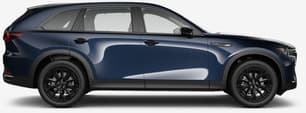
What's the difference?
Mazda calls the new CX-70 its "flagship" five-seat SUV, which also makes it yet another flag-bearer for the brands relentless push up market as part of its 'Mazda Premium' strategy.
It might have a different badge, but it's really a five-seat version of the brand's biggest and most expensive offering, the seven-seat CX-90.
And, for reasons that will become clear in a moment, it's something of a bargain, at least in the context of Mazda's plush large SUV range.
How so, you ask? Read on.
Subaru has always been a good fit for Australia.
Since the '90s, when the brand made a big splash with its rally derived Impreza and Liberty, Subaru’s rugged appeal has suited Australia’s tough conditions and recreationally adventurous buyers.
Cars like the Forester and Outback solidified the brand’s place amongst SUVs before SUVs were really a thing, and the XV is the logical progression of the Impreza range, slotting nicely into the brand's offerings of lifted all-wheel-drive wagons.
It’s been a few years since the XV launched, however, so can its latest 2021 update keep it in the fight in a quickly evolving and notoriously competitive segment against many newer rivals? We’ve taken a look at the whole range to find out.
For mine, the CX-70 is the pick of Mazda's premium SUV range, and if you can survive without a third row of seats, it's significantly cheaper than its CX-90 twin, too.
Note: CarsGuide attended this event as a guest of the manufacturer, with travel, accommodation and meals provided.
Even years on from its initial launch and with only subtle changes to its main range, it’s really to Subaru’s credit that the XV feels just as capable and modern as any of its rivals.
This is not to say it’s perfect. We can’t recommend the base model, the maths don’t really work out on the hybrids, the only available engine is breathless, and it has a small boot.
But the XV’s excellent safety suite, driving dynamics, all-wheel-drive capability, quality finish and comfortable interior mean it’s hard not to be charmed by this little lifted hatch.
Our pick of the range? While the 2.0i-L is great value, we’d recommend you splurge to the 2.0i-Premium to get the full safety suite and extra garnish.
Yes, the Mazda premium SUV range can look a little same-same, but Mazda insists there are critical differences.
That said, if you can immediately spot the difference between the CX-70 and CX-90 without taking a peek inside, you're doing better than me, given it is the same exact dimensions as Mazda's three-row flagship.
Sure, Mazda talks about things like this design being a “passion pursuer” that serves up "dignified performance” – all of which sounds utterly ridiculous – but the less marketing-speak version is that it looks like a shapely large SUV that ditches the boxy dimensions of a proper 4WD for a more sleek and swooping profile.
Inside, it's a plush and premium-feeling space, with lovely cabin materials, plenty of tech, and plenty of space.
The key to the XV’s fun and adventurous appeal is perhaps the fact that it’s not really an SUV at all. It’s rather obviously a lifted version of the brand’s Impreza hatchback, and this is to its credit.
It’s simple but tough, cute but capable, and really everything many consumers are looking for when it comes to a small, all-wheel-drive SUV. Not only does this design philosophy (of lifting wagons and hatches rather than creating bespoke “SUVs”) match Subaru’s family of products, but the ride height, plastic claddings, and tough-looking alloys offer hints of the all-wheel-drive capability that lies beneath.
Little has changed for the 2021 model year, with the XV most recently receiving a tweaked grille, updated front bumper, and a new set of alloy wheels. The XV range is also available in a fun array of colours, which Subaru hopes will help it win more of a youth vote. As an added bonus, none of the colour choices carry an extra charge.
The interior of the XV continues the fun and adventurous theme with Subaru’s signature chunky design language noticeably different from its rivals. My favourite element of this has always been the bumper-car steering wheel, which feels great in your hands in its leather-clad finish, but there are also nice soft claddings throughout the doors and big seats with nice bolstering and design.
While we like how big and sharp the main 8.0-inch screen is, if there’s one thing Subaru gets wrong it’s how busy the whole cabin package is. The visual assault of three screens seems unnecessary, and as much as I like the wheel, it is also completely adorned in somewhat confusingly labelled buttons and toggles.
Still it’s an attractive, fun, and unique design amongst its small SUV peers. Subaru fans, at least, will be sure to adore it.
The CX-70 measures a substantial 5120mm long, 1994mm wide, and 1745mm tall, and it rides on a 3120mm wheelbase.
It will tow 2.5 tonnes no matter which engine you choose, and the expansive boot will swallow between 589 litres and 2015 litres, depending on how you configure the backseat.
All of that space translates to a hugely airy backseat experience, with the second row able to be fixed in a position that either prioritises leg room or boot space.
With the former, you've got tons of space in the second row. I'm 175cm, and my knee and leg room was ample, with only the intrusive tunnel that runs down the middle-centre of the cabin eating into leg room for the middle passenger.
There are also air vents and temp controls, twin USB charge ports, seat heating in the window seats and swathes of very nice materials.
The boot is massive, too. I can't even reach the back of the rear seats when I lean into it, and Mazda says it will swallow smaller surfboard or SUPs without needing to resort to roof racks.
Under-floor storage adds a bit more security for precious items, too.
In some ways the XV is very impressive when it comes to its interior practicality, but in other ways it disappoints.
The front seats offer heaps of room for adults with good adjustability, and while the seating height is very high by default, there’s still lots of headroom and adjustability, with the added benefit of a very commanding view of the road for such a small SUV.
As mentioned, the doors, dash, and transmission tunnel are all clad in soft materials, and front passengers also benefit from no less than four USB ports in every grade except the base 2.0i, a huge centre console box, comfortably large bottle holders in the centre with a removable divider, a small bay under the climate unit that also houses a 12v outlet and auxiliary input, and a single large bottle holder in the doors with a small adjoining bin.
A surprise comes in the rear seats, which offered enough head and knee room for a particularly tall friend of mine. It’s rare for the small SUV segment to offer such space, but behind my own (182cm tall) seating position I had ample airspace for my knees and decent airspace for my head too, even despite the Premium and S grades having a sunroof fitted.
Rear passengers get a flip-down armrest with bottle holders, a small bottle holder in the doors, and pockets on the backs of the seats. The seat cladding is just as good as it is in the front, and the width in the rear seats is notable, however the centre seat suffers from the existence of a tall transmission tunnel to facilitate the all-wheel-drive system, and there are no adjustable air vents or power outlets for rear passengers either.
Finally, one ongoing weak point for the XV is the amount of boot space on offer. Boot capacity is 310-litres (VDA) for non-hybrids or 345 litres for hybrid variants. This is decent when compared to smaller light SUVs but definitely leaves room for improvement when it comes to the XV’s main small SUV competitors.
Space can be boosted to 765L in non-hybrid or 919L in hybrids with the seats down (again, not great), and the hybrid model loses the underfloor space-saver spare wheel, instead leaving you with a very compact puncture-repair kit.
We'll drill down on this a little more in the practicality section, but it's important to note here that the CX-70 is the same size as the CX-90 – both are 5120mm long, 1994mm wide and 1745mm high — which means the only real difference between the two models is the third row of seats in the CX-90.
And, as it turns out, that's a very expensive pair of chairs. The CX-70 starts with the GT trim at $75,970 before on-road costs for the petrol or $77,970 for the diesel, and then climbs to the Azami trim, which is $82,970 or $84,970.
The CX-90, though, is $82,577 or $85,785 for the GT, or $91,461 or $93,030 for the Azami.
That makes the CX-90's third row at least a $6600 option, but as much as an $8000 upgrade. Mazda has made moves to address this, with a drive-away "plate clearance" that closes that gap, but we suspect those offers will become permanent fixtures to make the jump from 70 to 90 less ferocious.
Anyway, Mazda has thrown just about everything they've got at the CX-70. The GT kicks off with plenty of high-end gear, including 21-inch black alloy wheels, adaptive LED headlights, a panoramic sunroof and a handsfree powered tailgate.
Inside, there are twin 12.3-inch screens with Apple CarPlay and Android Auto, a 12-speaker Bose stereo, leather seats that are heated front and rear, three-zone climate control and a heated steering wheel.
The Azami then adds things like ambient lighting, black Nappa leather seats, which are now ventilated in the front, footwell lighting, body-coloured wheel arches and lower cladding and body-coloured door handles.
Subaru’s pricing strategy is an interesting one. Generally, the brand’s entry-level models are priced above rivals, but top out well below them. For 2021 the XV range has four variants, two of which are available with the hybrid-drivetrain option.
The entry-level XV 2.0i ($29,690) sits above the entry-level Hyundai Kona ($26,600), Kia Sportage ($27,790), and Honda HR-V ($25,990). Keep in mind, the XV range is all-wheel drive by default, which is a value boost, but the unfortunate news is that we’d recommend you ignore the base XV altogether.
Included on the base 2.0i are 17-inch alloy wheels, a 6.5-inch multimedia touchscreen with wired Apple CarPlay and Android Auto connectivity, a 4.2-inch supervision cluster and 6.3-inch function screen, basic air conditioning, a single USB port, basic cloth seats, halogen headlights, standard cruise control, and some more basic trimmings. Not only is this car the only one with the more basic multimedia screen, but crucially it misses out on any of Subaru’s excellent EyeSight safety suite.
The starting point for your XV journey, then, should really be the 2.0i-L, starting at $31,990. The 2.0i-L ups the interior to include a dazzling 8.0-inch multimedia screen, improved interior trimmings with premium cloth seats and leather-trimmed steering wheel, dual-zone climate control, extra USB ports, and adaptive cruise control as part of the EyeSight safety suite.
Next up is the 2.0i-Premium at $34,590, which adds a sliding sunroof, heated wing mirrors, built-in navigation, a front-view camera, and the full safety suite with blind-spot monitoring, rear cross traffic alert, and rear auto emergency braking. This variant is now the best value, as it offers the full set of safety items previously only available on the top-spec car at a lower price.
This brings us to the top-spec 2.0i-S with an MSRP of $37,290, which adds LED headlights with auto high-beam assist, a side-view camera, leather interior trims with extended premium cabin upholstery and chrome finishes, auto power folding wing mirrors, leather-appointed seat trim with heated front seats and an eight-way power-adjustable driver’s seat, 18-inch alloy wheels, and extended functionality for the all-wheel-drive system.
Finally, the 2.0i-L and 2.0i-S can be chosen with the “eBoxer” hybrid drivetrain option, wearing MSRPs of $35,490 and $40,790 respectively. They mirror the specification of their 2.0i counterparts while adding silver exterior accents and a pedestrian-alert system. They also trade out the space-saver spare wheel in favour of a puncture-repair kit, due to the presence of an under-boot-floor lithium-ion battery system.
You can have one of two engines in the CX-70, with the cheapest being a 3.3-litre, six-cylinder turbo-petrol, producing 254kW and 500Nm. There's also a 3.3-litre, six-cylinder turbo-diesel, making 187kW and 550Nm. Both are equipped with a 48-volt mild hybrid system to marginally reduce fuel use.
All models are AWD, and pair with an eight-speed automatic transmission.
The XV now has two drivetrain options in Australia. One is the carryover 2.0-litre petrol engine, now with a smidge more power, and a hybrid version of the same layout with an electric motor housed in the continuously variable transmission. There is no manual variant in the XV range.
The 2.0i models produce 115kW/196Nm, while the hybrid produces 110kW/196Nm from the engine and 12.3kW/66Nm from the electric motor. All variants are all-wheel drive.
The hybrid system is powered by a lithium-ion battery pack under the boot floor, and in practice functions a bit differently from Toyota’s popular system.
We’re sure Subaru die-hards will be dismayed to know a version of the XV packing the larger Forester’s 2.5-litre petrol engine (136kW/239Nm) will not be making it to Australia for the foreseeable future.
Petrol-powered cars will sip 8.1L/100km on the combined cycle, while the diesel drops that to 5.4 litres.
Both models get a 74-litre tank, meaning a theoretical driving range of around 900kms in the petrol, and almost 1400kms in the diesel.
It’s not such a great story for the hybrid variant here, as even on the official numbers it only saves a tiny amount of fuel.
The official/combined number for 2.0i variants is 7.0L/100km, while the hybrid variants trim this to 6.5L/100km.
In practice it only got worse on my test. Over similar driving conditions consisting of several hundred kilometres over the course of a week, the 2.0i-Premium non-hybrid produced 7.2L/100km, while the hybrid actually used more fuel at 7.7L/100km.
It’s worth noting we’ll be holding on to the hybrid for a further three months as part of a long-term urban test. Check back in to see if we can trim this number down to something closer to its claim in the coming months.
All XV variants can drink base-grade 91RON unleaded and 2.0i variants have 63-litre fuel tanks while hybrids make use of a 48-litre tank.
Interestingly, the CX-70 has been tagged as the expected smallest seller of Mazda's premium SUV range, but I reckon it just might be the pick of the bunch.
Every one of the CX-0 models (60, 70, 80 and 90) all get slightly different suspension tunes, and while you can find harsh edges in the other models, the CX-70 feels utterly composed and refined, at least on the smooth-ish roads of our launch test route.
Perhaps most surprising, though, is the CX-70's ability to hold its own on a properly twisting road. We expected lots of weight transfer and the high-pitched sounds of tyres screaming out in pain, but instead found Mazda's massive SUV served up grip, composure, and very little in the way of sea-swell-style body roll.
The two big six-cylinder engines also feel perfectly suited to a vehicle in this space. There's tons of power whenever you need it, and solid levels of refinement in terms of engine noise or diesel rattles.
For mine, the petrol engine is the pick though, feeing just a little smoother than the diesel option. The latter can feel a bit jerky at slower speeds, whether that's the power delivery or the gearbox, and it doesn't seem to happen with the petrol engine.
The biggest caveat, though, is that we haven't driven the CX-70 in its natural environment, the city and suburbs, so while it largely shone on flowing country roads, how it performs on roads like the ones near your place remains a bit of a mystery.
No matter which XV you choose, you’ll be getting a very comfortable and easy-to-steer small SUV, and the drive experience has only improved with this year’s updates.
The XV’s newly re-worked front suspension and tall ride height make for a package more than capable of dealing with anything the suburbs will throw at it. This is the kind of car that scoffs at speed bumps and potholes.
The steering is light enough to be comfortable, but provides just enough feedback to keep it engaging, too, and the always-on all-wheel-drive system provides a sense of constant security in corners and even on loosely sealed or wet surfaces.
The XV has better SUV cred than almost every other car in its class on the capability front, enough at least to make it a decent companion for seeking those unsealed campgrounds or vantage points.
Where it’s not as good is its engine options. We’ll get to the hybrid in a moment, but the standard 2.0-litre engine is underpowered for a relatively heavy small SUV, with the added burden of all-wheel drive, and it feels it. This engine doesn’t have the follow-through of its turbocharged rivals and is very thrashy when much is asked of it.
This experience isn’t really helped along by the rubbery-feeling continuously variable automatic transmission, which is at its best in stop-start traffic. It strips the fun out of trying to drive this car with a bit more vigour.
Unlike Toyota's hybrid alternatives, the hybrid XV isn’t a significantly different experience behind the wheel. Its electric motor doesn’t really have enough strength to get it up to speed, but it does assist when it comes to acceleration and coasting to help take the stress partially off the engine. The XV also doesn’t provide a hybrid indicator like Toyota does, so it’s much harder to understand the effect your accelerator input is having on the motor.
The centre screen does display the energy flow, though, so it is good to have some kind of feedback that the hybrid system is helping on occasion.
Hybrid variants also add something called “e-Active Shift Control”, which uses input from the car’s sensors and all-wheel-drive system to better tune the hybrid assistance to the CVT. In general driving terms, this lets the electric motor pick up the slack of the petrol engine when it's most needed in the corners and in low-torque instances.
On a final note, all of these moments of electrical assistance do make the hybrid versions notably quieter than the non-hybrid ones. I still wouldn’t recommend choosing the hybrid on its driving experience alone, but it will be interesting to see how Subaru can build on this technology in the future.
The CX-70 hasn’t been ANCAP tested, but it does arrive with a pretty stacked safety offering, including a 360-degree-view camera, blind-spot monitoring, front and rear cross-traffic alert, and a total of eight airbags, including a knee airbag for the driver.
The XV has an excellent safety suite so long as you avoid the base model 2.0i. Every other variant gets at least the forward-facing and unique stereo camera safety suite, which Subaru dubs ‘EyeSight’.
This system provides auto emergency braking up to speeds of 85km/h capable of detecting pedestrians and brake lights, it also includes lane-keep assist with lane-departure warning, adaptive cruise control, and a lead vehicle start alert. All XVs get an excellent wide-angle reversing camera.
Once you get to the upper-mid-grade 2.0i Premium, the safety suite is upgraded to include rear-facing technologies, including blind-spot monitoring, rear cross traffic alert, and rear auto braking. The Premium gets a front-facing parking camera, while the top-spec S grade gets a side view camera as well.
All XVs come with the expected stability, brake, and traction controls, as well as a set of seven airbags, making for a maximum five-star ANCAP safety rating to the 2017 standards.
Servicing is not particularly cheap in the CX-70, and the service intervals, at least in the diesel, feel a little short, too.
Buy that one, and you’ll be visiting the dealership every 12 months or 10,000kms, and the first five years of ownership will cost you $3298.
Petrol cars require servicing every 12 months or 15,000kms, and five years will set you back $3436.
The CX-70 is also covered by Mazda's five-year, unlimited-kilometre warranty.
Subaru remains on par with other Japanese automakers, with a five-year and unlimited-kilometre warranty promise. There’s 12 months of roadside assist included, and the XV is also covered by a capped-price servicing program for the life of the warranty.
Services are required once every 12 months or 12,500km, and while this is a welcome improvement on the six-month intervals this car used to have, these visits are far from the cheapest we’ve seen with an average price of nearly $500 per year.