What's the difference?
Being a true Jack of all trades in the car world is rare.
Generally speaking, a vehicle is either capable or comfortable. Attractive or aerodynamic. Practical or performance orientated. And problems arise when cars try to do all those things well, all at the same time.
Which make the Lexus LC 500 Convertible such an interesting proposition. Because it is, without doubt, stylish, and lavishly equipped. It’s also rather large and rather heavy. All of which is perfect for cruising the Bondi foreshore.
But it’s also equipped with a thumping V8 engine and a throaty exhaust that sounds like bricks in a blender on the overrun. It’s stiffer than the LFA supercar, and plenty powerful, which should deliver one of Lexus’ sportiest-ever drives.
So can the LC 500 really do it all? Let’s find out.
There are a lot of big numbers surrounding the BMW iX3, the German brand’s new-from-the-ground-up EV that acts as the flagbearer for its future-facing Neue Klasse (or New Class) architecture, designed to distil all the ingredients that make a BMW a BMW, and then electrify for them for the post-ICE (internal combustion engine) era.
But the one that really stood out? 805. That’s how many kilometres of driving range the iX3 will deliver, though admittedly in its most efficient and least exciting driving modes. That is bonkers, right?
It’s worth pointing out the first BMW i3, which only launched a decade-or-so ago, delivered more like 150km on what would have been the WLTP cycle, if it had existed then. Talk about leaps and bounds.
A good start for the newest BMW EV, then. But what else does the iX3 have to offer?
Stunning to behold, and even more so to listen to, the LC 500 Convertible with no doubt turn as many heads as its owners surely want it to. It's not the final word in performance, but it's a lavishly equipped transporter none the less.
The thing that really grabs you from behind the wheel of a car like this is just how far EVs have come. The fact you can get a ridiculous range and have a really, really good time on the right twisting road is a pretty good deal and solidifies the fact EVs like this one are the future.
Note: CarsGuide attended this event as a guest of the manufacturer, with travel, accommodation and meals provided.
Note: The author, Andrew Chesterton, is a co-owner of Smart As Media, a content agency and media distribution service with a number of automotive brands among its clients. When producing content for CarsGuide, he does so in accordance with the CarsGuide Editorial Guidelines and Code of Ethics, and the views and opinions expressed in this article are solely those of the author.
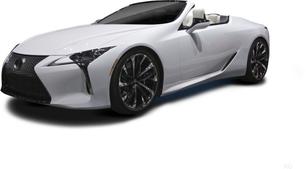
It’s eye-catching, the LC 500, if big, bolshy convertibles are your thing, and especially viewed front-on, where the aggressive nose design ends in a sharp crease in the mesh grille. I love the headlight design, too, which bleeds back into the body work, but also merges with the vertical light cluster that bookends the grille.
The side view is all shining alloys and sharp body creases, too, leading to an oversized boot that stores the fabric, aluminium and magnesium roof structure, which drops or raises in 15 seconds at speeds of up to 50km/h. The design fits into what Lexus calls an “impossibly small space behind the seats”.
Inside, it’s a snug but luxurious space, wrapped largely in leather and equipped with a wealth of technology. It’s a point we’ve made before, but why Lexus perseveres with its trackpad infotainment control technology is beyond us, but there’s no denying the cabin of the LC 500 is a wondrous place to spend time.
We particularly like the integration of the centre screen, which is recessed beneath the leather-wrapped edge of the dash. While some look like an afterthought, this appears to have been included in the broader design philosophy.
It's hard to talk about the design of the BMW iX3 without spending some time at the front end. This is a bold, bold take on a BMW grille, and one that is entirely devoid of chrome or metallic lashings.
That’s not to say it’s boring. The iX3 has a light theme that runs inside and outside, the latter of which is called the Iconic Glow exterior package, which replaces the physical embellishments with white lighting that frames the kidney grille and the other inserts. It looks very cool and very modern.
In the cabin, the lighting theme continues, this time under the dash inserts that illuminate from within. But that’s not what really draws your eye.
That honour goes to the Panoramic Vision, which replaces the traditional driver’s screen with a pillar-to-pillar display that stretches the width of the cabin and displays all your key driving info. It seems like a strange thing to get your head around but it felt natural almost immediately, with everything you might need (including a g-meter in its sportiest mode) on display.
Also new is the funky and chunky BMW steering wheel, which reminds me a little of one of those double-sided lizards, in that it can be hard at times to figure out which way is up, and which features 'Shy Tech' (features and controls stay out of sight until the driver or passenger needs them).
All in all, I like the space. There are just enough traditional-feeling elements mixed with new tech to make it feel futuristic and familiar.
It’s not, really. But then, what were you expecting?
As mentioned above, the interior feels snug for upfront riders, but not in a bad way. More that elements of the interior feel like they’re reaching out to greet you, leaving you with the impression of being tucked into the cabin.
Backseat riders are out of luck, though, with the seats really only reserved for emergencies. Legroom is tight, and while Lexus promises the roofline is about on-par with the Coupe, it’s not going to be a comfortable journey.
The LC 500 Convertible stretches 4770mm in length, 1920mm in width and 1350mm in height, and it rides on a 2870mm wheelbase. It will sit four at a pinch, and provide 149 litres of luggage space.
There are two ISOFIX attachment points in each of the rear seats, as well as top-tether points.
The BMW iX3 is 4782mm in length, 1895mm in width, 1635mm in height and it rides on a 2897mm wheelbase.
It doesn't feel huge, but there's certainly enough space in the back seat for me. At 175 centimetres I have enough knee and headroom sitting behind my own driving position, plus you can adjust the angles of the rear backrest to get a little more comfy.
But while the front seat feels very modern, the rear is more a traditional back seat experience. Back seat riders get their own air vents and temperature controls, twin USB-C charge ports and a pull-down divider with twin cupholders, but that's about it.
The auto-opening boot reveals a 520-litre luggage space (1750 with the seats folded), all of which is unencumbered by charging cables and the like, which are housed in the 58-litre frunk.
Towing and electric vehicles are never the greatest of matches, such is the drain on the battery, but the iX3 can be fitted with a standard tow ball, unlocking a braked trailer capacity of 2000kg.
It costs $214,000 - and that’s rather a lot of money - but unlike some premium and luxury cars, with Lexus, once you’ve handed over the cash, that’s it. There’s no tempting option list to lure you into parting with even more of your hard earned.
And I mean that literally - Lexus proudly proclaims that “there is no option list” for the LC 500 Convertible, so suffice it to say it arrives with plenty of gear.
Take a deep breath…
You get 21-inch two tone alloys, triple-stack LED headlights, keyless entry, retractable door handles and rain-sensing wipers outside, while inside, you’ll find dual-zone climate, leather-accented seats which are heated and ventilated, neck-level heating for when the roof is down, a heated steering wheel and sports pedals.
The tech stuff is handled by a 10.3-inch centre screen with Apple CarPlay, Android Auto and on-board navigation, both of which are controlled via Lexus’ impossible-to-kill touchpad. There’s a second, 8.0-inch screen for the driver, and the lot pairs with an impressive 13-speaker Mark Levinson stereo.
There’s also a heap of safety stuff, but we’ll come back to that in a moment.
If that’s not enough for you, you can spring for the Limited Edition, which is $234,000 for each of its 10 available examples. It arrives in a unique Structural Blue hue, with a white leather interior with blue highlights. It is designed to be the most blue of blues, too, with Lexus saying the paint colour was the result of a 15-year research project. Which sounds like a thrilling way to spend a decade and a half.
There are two iX3 options for now. Or at least there will be when the 40 model joins this 50 xDrive in a couple of months. Happily, aside from the smaller battery and single motor in the 40, the feature list is identical.
In terms of pure spec, the 50 xDrive gets a lot. It’s only colours, interiors and alloys to choose as extras.
The tech is the highlight, though. There’s a big, crisp central screen, with wireless Apple CarPlay and Android Auto, but the showpiece is what BMW calls its Panoramic Vision, which swaps the traditional driver’s screen and gauges for a vast display that stretches the entire width of the cabin.
What cost for all that, you ask? Probably less than you think. The 50 xDrive is $109,900, before on-road costs, and for that you get a massive drive battery, lots of range and plenty of dual-motor punch. But the bang-for-buck bargain will be the incoming 40 eDrive, which will arrive at a LCT-busting $89,900, MSRP.
EXTERIOR:
INTERIOR:
TECH:
It’s a lusty power plant, this one, and not something you immediately expect to find in a luxurious Lexus convertible.
The 5.0-litre V8 produces 351kW and 540Nm - 260kW of which arrives from 2000rpm - and it sounds like a God of Thunder as it’s doing it.
It pairs with a 10-speed automatic and sends all that grunt to the rear tyres, with Lexus’ Active Cornering Assist and a mechanical limited-slip differential helping you to not make a mess of things when tackling corners.
We’ll focus on the 50 xDrive, as that’s the one we’ve driven, and because the powertrain is a peach. Its twin-motor all-wheel drive set-up delivers a total 345kW and 645Nm, which is a lot. And because there is no traditional transmission to step through, and because all that oomph arrives at once, it feels plenty punchy indeed.
BMW says the sprint to 100km/h takes 4.9 seconds, and we believe them. Top speed is a claimed 210km/h.
Remember when I said it was lusty V8? When has that ever been good news for fuel use?
Lexus reckons you’ll get 12.7L/100km on the combined cycle, but the temptation of all that grunt will pretty much ensure that never happens. Emissions are pegged at 290g/km of C02.
The LC 500 Convertible’s 82-litre fuel tank only accepts 98RON fuel.
As we mentioned at the top of this review, this is another big plus for the iX3. Its massive 108.7kWh net NMC battery delivers a maximum driving range of 805km, which is frankly ridiculous. To get it, you need to engage Efficiency Max, which dulls the drive experience, but that is an impressive number all the same. Engage the sportier settings and the figure drops to more like 650km-plus.
Charging is 22kW AC and an impressive 400kW DC – or 300kW in the upcoming 40 model — which means a 10 to 80 per cent charge in 21 minutes when plugged into the fastest of chargers.
BMW says to expect 15.1-17.1kWh/100km in terms of energy usage on the WLTP cycle.
It’s a tough nut to immediately crack, the LC 500 Convertible.
It feels like it really wants to be a super-accomplished performance car, and on longer, more sweeping bends it is, with that thick flow of power ensuring you simply surf through corners before rocketing out the other side, the air filled with that growling exhaust note as your right foot finds its way to the carpet.
But on the tighter stuff, there are some factors that play against it. The suspension feels sorted and that engine is always willing to deliver, but for mine, the steering and brakes felt a little disconnected from the experience, not inspiring much in the way of late-braking confidence. And then there’s the sheer two-tonne-plus weight of the thing, which can’t be totally hidden, even by Lexus’ best wizardry.
Don’t get me wrong, it’s very capable, even on surprisingly tight stuff. It’s just that there’s something of a disconnect between car and driver.
That’s not a bad thing, really. Are you really buying a premium convertible to attack a mountain pass? Probably not. And keep it flowing through corners and the LC 500 Convertible will keep a smile painted on your face, owing mostly to wave of torque you can ride to your destination.
Hovering your foot over the accelerator must surely be what the President feels like whenever he stands near the nuclear football, with that big V8 always ready to turn on the fireworks.
Away from the red mist, you’ll find the LC 500 Convertible positively flows from destination to destination, the 10-speed gearbox - which can feel flustered at pace - seamlessly flicking through its options, and the ride in its most comfortable settings disposing of most road imperfections before they enter the cabin.
The cabin is also very cleverly insulated, not just when the four-part roof is up, but also when it’s down, with the climate and ambience of the interior largely unaffected by what’s going on in the outside world.
BMW spent a lot of time describing this car as being of revolutionary importance to the brand. It was designed as an EV from its inception, but is also the flag bearer for the New Class gen of cars, and so it has all sorts of features and tech that will roll out across the rest of the BMW range.
Does it feel overly revolutionary from behind the wheel? Not really. I mean, it drives forwards and backwards, and turns around corners when you move the wheel, all of which is to be expected.
But it does mostly feel very BMW, which I think is what they meant. The Jekyll-Hyde nature of the iX3 becomes apparent the moment you engage its sportiest driving modes and flatten your foot. This is proper push-you-back-in-your-seat acceleration that feels slightly more violent than the iX3's claimed zero-to-100km/h time suggests.
Then there's the flip side of that coin. Engage Efficiency Max and you can seemingly drive forever (or at least more than 800km), sipping battery juice and riding in peace, quiet and comfort.
But at its core, and no matter the drive mode, it feels like a BMW. Crucial to that is a thing the brand calls the Heart of Joy, which sounds utterly sci-fi but really is a computer brain that works on traction and power to make sure you never lose grip.
If you've ever been in a car where the traction control light is flashing on a dash, you'll know what usually happens is it cuts engine power until you find grip, and it gives you power again, then cuts it, then gives it to you as required to find the grip, and it can give you that kind of jerky, stop-starty kind of feeling.
The iX3 doesn't do that. Instead, it plays with traction and is far more subtle without ever cutting power, and gives you the feeling of being able to tip into a corner and then power out without ever feeling like you're going to lose grip, or power.
The bigger electric motor is at the rear axle, which delivers most of your performance unless you need extra grip. So, when you are powering out of a bend, it feels a lot like a rear-wheel drive car and really well sorted from behind the wheel.
If that's the driver's side of the equation, the other side of it is pretty good, too. We took to the town at city speeds, and it was super comfortable, quiet and absorbed most of the road imperfections pretty easily.
Interestingly, the suspension isn't high-tech. There's nothing adaptive about it, and there's no air cushioning or anything like that. But it feels well tuned, and is pretty comfortable, even on dodgier road surfaces, while still delivering a sense of connection.
My favorite kind of mid-size SUVs are ones that have that dual nature. Something that has space for the family and all of their things, but also something that can be a fair bit of fun on the right twisting road, and this one absolutely nails that brief. It is a hoot to drive on twisty stuff.
Downsides? Well, you can't entirely disguise more than two tonnes of weight. If you're going downhill, especially on a twistier road, you can feel the weight around you, especially when you go to pull up in a hurry, despite the strong-biting brakes.
The other thing is the steering, which is direct and lovely but quite light. It doesn't have that meaty heft some BMWs offer, and as a result, it can be interesting to place the vehicle. You can find yourself a bit further over in the lane, or further away from an apex than you're expecting, because your light inputs have really shifted the vehicle.
But BMW has nailed the brief here. Do keep an eye out for the cheaper one that's coming, though. It could be a bang-for-bucks, rear-drive bargain.
The Lexus LC 500 Convertible arrives with six airbags, a reversing camera with guide lines, parking sensors, and the usual suite of traction and braking aids, but there’s much more to the safety story, too.
The more high-tech stuff includes parking sensors, pre-collision assist with AEB, lane keep assist, blind-spot monitoring, rear cross-traffic alert and active cruise, as well as bespoke convertible safety gear, like active roll bars that deploy when the car is in danger of rolling over, protecting the occupants beneath that soft roof.
The iX3 is fitted with all the active safety stuff you might imagine – things like active lane keeping, dynamic cruise control and more cameras than were used to film The Odyssey. Happily, only the driver attention monitor chirped me on my test drive, and usually when I had my head turned to the far side of the Panoramic Vision display.
It also has a self-parking function you might actually use, given how quick it is to pick a spot then park in it.
There are eight airbags and three top tethers across the rear for child seats (as well as ISOFIX anchors on the two outer positions. But the big news is that its maximum five-star rating was achieved under ANCAP’s super-strict 2026 protocols, which is something few, if any, cars on sale in Australia can claim.
Lexus vehicles are covered by a four-year, 100,000 kilometre warranty, and the LC 500 Convertible requires servicing every 15,000kms.
Lexus's Encore ownership program includes pick-up and drop-off servicing, but the new Encore Platinum level for owners of its more exclusive models unlocks even more stuff.
One is a new On Demand service, which allows owners to book a different style of car when heading off on a holiday or business trip. The loans are available in your state or somewhere else in Australia if you're travelling, with your car waiting for you at Qantas Valet for you when you arrive.
The On Demand service is available on four occasions over your first three years of ownership (which is also the length of the Encore Platinum membership).
BMW offers a five-year, unlimited kilometre warranty, which is about right for the traditional premium players, but off the pace elsewhere. The traction battery is then covered for eight years or 160,000km.
The service intervals are condition based, rather than timed, and BMW sells a pre-paid package for the iX3 which is $1614 for four years, or $2420 for six years.
You can upgrade either to what BMW calls Service Inclusive Plus, which includes high-wear stuff like brake discs and pads and it is $5535 for four years or $6615 for six years.
There are around 50 BMW dealers across Australia covering mainly cities and key regional centres.