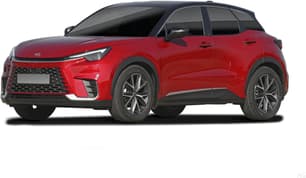
What's the difference?
If you’re after a small performance-focused hatch or small SUV, there’s no shortage of solid offerings from semi-premium and premium brands like Audi, BMW, Cupra, Mercedes-Benz, Volkswagen and more.
Another high-end brand dipping its toes in the segment is Lexus. Yes, Lexus. The Japanese luxury brand that’s famous for reliable and comfortable cars like the ES and RX.
It might be surprising that Lexus could build something like the LBX Morizo RR, but let’s not forget the many go-fast models in its back catalogue - the LFA supercar, the LC coupe and drop-top, IS F and GS F sedans and the RC F coupe.
At the urging of famed Toyota Motor Corporation (Lexus’ parent company) Chairman Akio Toyoda, Lexus has birthed a firecracker based on its humble, yet fun, LBX small SUV.
Akio has had a hand in developing the Morizo RR as well. Hence the name. Akio is head road tester for the carmaking giant, and a seasoned racer in his spare time. He uses the ‘Morizo’ alias when racing. The ‘RR’ stands for ‘rookie racer’.
Using the same powertrain found in Toyota’s GR Yaris and Corolla hot hatch cousins, the LBX has a lot of promise. But has Lexus done enough to bother those largely European rivals?
The Chery has most definitely popped and the Australian launch of new brand, Lepas, is only the start of what’s to come in 2027.
The Lepas L6 EV is the brand’s first entrant locally and it’s an electric mid-size SUV rival to the likes of the BYD Atto 3 Evo, Geely EX5, Hyundai Elexio, Kia EV5 and Leapmotor C10. The list goes on…
Lepas is doing everything it can to stand out on its own from the namesake Chery, as well as the Omoda Jaecoo brands in Australia. It’s also set to have its own dealer network.
Is the L6 EV a worthy addition to the Chery Group stable? Read on to find out.
Lexus has managed to combine two cars in one. A fast, impossibly fun back-road blaster perfect for weekends on your favourite winding roads, and a competent, compact city SUV that will easily handle urban runabout duties every day of the week.
It’s this duality that struck me the most. I would happily live with the Lexus LBX Morizo RR.
If you need a bit of space, maybe look elsewhere. But if you’re passionate about dynamic driving, and value comfort and a premium experience, this little rocket is hard to beat.
Note: CarsGuide attended this event as a guest of the manufacturer, with accommodation and meals provided.
Chery really doesn’t need any more brands in Australia, but here is Lepas, anyway.
While the L6 EV is rather characterless, it’s arguably the best Chery Group vehicle I’ve experienced to date. You can tell a lot of work has been put into localising it and as an electric mid-size SUV, it’s a pragmatic choice.
The regular LBX is a spunky little car with a lot of road presence. I’ve been a fan of the exterior design since first seeing one in the metal. Short overhangs, nuggety proportions, well designed tail-lights and a pert rear end - it all works for me.
For the Morizo RR, Lexus has wisely exercised some restraint when it comes to exterior flourishes. It is nowhere near as wildly styled as the Yaris GR, for example. And that makes sense. This is, after all, a Lexus.
It’s a smart move, too. It’s subtle but still has intent.
The Morizo RR gains styling tweaks unique to the grade including 19-inch forged aluminium wheels, red brake calipers, a different front and rear bumper design, a rear spoiler, air intakes front and rear and a dual exhaust.
Inside, the main differences are the inclusion of red stitching, sports seats, some unique inserts, and the use of synthetic suede on the centre console, dash and doors.
The LBX interior design is functional and premium with nice materials throughout.
Take away the Lepas badge on this car and you could tell me the L6 is a new model from any new Chinese brand in Australia.
The overall silhouette screams generic mid-size SUV with design elements to make it look modern, tougher and sleeker. There’s nothing revolutionary about it and as a result it blends into mediocrity.
What isn’t bland about the exterior though is the paint colours that are available. There’s a bright orange, as well as a lovely purple. You unfortunately don’t see colours like this on the road as often anymore.
If orange and purple are too lairy, Lepas also offers boring colours like white and grey. There’s also black, though it’s strangely only available to those who pre-order.
Inside the uniformity continues. It’s an ultra-minimal look with the majority of the dashboard focus being on the portrait-oriented 13.2-inch touchscreen multimedia system.
It’s nice to see different types of materials around the cabin as it helps to elevate the premium feel. There’s also barely any glossy piano black, though unfortunately it does feature on the steering wheel buttons which are frequently used and can get grubby quickly.
While the beige synthetic leather upholstery stands out, it’s not particularly family-friendly. It would be nice if there was a black or darker option for those who don’t want a light interior.
The LBX is a compact little SUV so if you’re after something to fit a family of four, look elsewhere. But if you don’t need the space, it’s a great city car.
Up front it’s easy to find the right driving position thanks to all of the adjustability of the seat and steering wheel.
Those sports seats are supportive and hug the body, but not too much as some of Lexus’ European rivals do. They’re also very comfortable - almost edging firm but never uncomfortable.
The Lexus multimedia system is functional and has an easy-to-navigate menu set-up, but lacks any pizzazz. Better graphics would help with engagement.
Storage wise, there’s a wireless charger slot at the bottom of the centre stack, a cupholder with a narrow slot for another device next to it, and a deep but narrow secure central storage bin with another cupholder.
You might not fit big bottles into the door bins as it’s pretty tight.
I wasn’t sure about Lexus’ one-touch interior and exterior door handles when they first rolled them out, but I now think it adds a classy point of difference to its rivals.
That second seating row is tight, especially for taller folk. I had just enough legroom (but plenty of toe room) sitting behind my 183cm (6'0") driving position, but I wouldn’t want to sit back there for a long road trip. Headroom, however, is ample. My noggin didn’t even scrape the headliner. You’d struggle to fit three adults back there but a couple of kids should be fine.
Amenities include a pair of USB-C ports and two map pockets, but the rear row lacks any adjustable air vents or a fold-down centre arm rest. And the bottle holders in the rear doors won’t fit much at all.
The rear row folds 60/40 and if you need to haul lots of luggage or shopping, you’ll definitely need to lower that rear row because the boot is small.
Lexus says it can swallow 266 litres, which is tight. There’s no spare wheel of any kind, just a tyre repair kit.
Like many SUVs, the driver’s seating position is high. This gives the driver a commanding view of the road ahead, though it may be a touch too high for taller people.
The front seats are comfortable and soft. The amount of electric adjustment available is enough, though it would be nice if the under-thigh support could be adjusted.
Looking ahead, the steering wheel is a classic, flat-bottomed Chery unit with a Lepas badge on it. It’s nice to hold and while the glossy piano button sections can get grimy quickly, there are physical buttons that press. There’s no awkward touch-sensitive button nonsense.
Behind the steering wheel is a short and wide 8.9-inch digital instrument cluster that, despite its size, displays a lot of content. There are a series of informative pages you can cycle through, which is good for customisation.
Moving across, the portrait-oriented touchscreen multimedia system has a simple layout and user interface that’s hard to get lost in.
There’s a handy swipe-down control centre menu with many key functions, plus you can swipe up from the bottom to change the climate control functions.
It’s great to see a bank of physical buttons under the touchscreen for key functions like the drive modes, air conditioning and the defoggers, among others. These aren’t guaranteed in every Chinese car now.
Around the cabin there’s a 50W wireless charger with a slot on the other side for the passenger to put their phone, two cupholders, a large centre console with an additional open storage area under the touchscreen, as well as a glove box.
In the second row there’s plenty of space on offer, like many Chinese SUVs. There’s oodles of legroom and headroom is good too, even with the panoramic glass sunroof.
The rear bench is reclined back a fair way, creating a lounge-like experience and the seat itself is soft and plush.
In terms of amenities there are air vents on the back of the centre console, a USB-A and USB-C port as well as a fold-down armrest with cupholders.
At the back there’s a power tailgate as standard. When it opens it presents the boot which offers 435L with the rear seats upright. It’s a decent space with a flat load floor.
There’s a surprisingly deep 99L underfloor storage area that’s great for charging cables among other odds and ends.
Lepas has said it’s exploring options of a space-saver spare wheel or an esky accessory to better utilise this cavernous underfloor space. Nothing is confirmed yet, though, so that means the L6 EV only has a tyre repair kit.
The regular Lexus LBX line-up consists of three hybrid grades (Luxury FWD, Sports Luxury FWD and AWD) running from $47,550 to $56,990, before on-road costs.
Naturally the Morizo RR takes its place as the flagship of the LBX line-up and is priced accordingly. It will cost you $76,490 which is close to $20K more than the entry grade.
Purely looking at SUVs, rivals could include the BMW X1 M35i ($92,300) or Volkswagen T-Roc R ($64,290), while performance hatchback competitors might include the Mercedes-AMG A35 ($87,900) or VW Golf R ($70,990). Either way, the Lexus sits somewhere between the two, but closer in price to the VWs.
There are other offerings that cost quite a bit more than the Lexus.
For that money you get leather-accented sports seats, aluminium pedal trims, 19-inch forged alloy wheels, a 9.8-inch multimedia touchscreen, wireless Apple CarPlay and Android Auto, sat nav, a 12.3-inch digital driver display, dual-zone climate control, a powered tailgate and heated front seats.
Other gear includes a 13-speaker Mark Levinson premium audio system (with a sub-woofer), five USB-C ports, access to 'Lexus Connected Services', synthetic suede trim, auto power-folding and dimming exterior mirrors, an auto-dimming interior rear view mirror, eight-way power driver’s seat adjustment, rain-sensing wipers and keyless entry and start.
Two-tone paint will set you back an extra $1750.
On top of the long safety features list (see the Safety section), there’s nothing obvious missing from the features list. Lexus has always offered sharp value-for-money and that remains the case with the Morizo RR.
A single, range-topping version of the Lepas L6 EV, called Signature, is being offered at launch. It’s priced from $47,990, before on-road costs.
This sees it positioned slightly higher than the popular BYD Atto 3 Evo and Geely EX5, though it’s considerably cheaper than Chinese-made rivals from legacy brands, including the Hyundai Elexio and Kia EV5.
Like many Chinese brands, there’s a large standard equipment list. Highlights include the following:
Powering the LBX Morizo RR is an excellent 1.6-litre turbocharged three-cylinder petrol engine, which is the same unit found in the Toyota GR Corolla and Yaris hot hatches.
The Lexus loses some power and torque compared with those models so the outputs are 206kW and 390Nm. The Toyota cousins offer 221kW/400Nm each.
This engine is paired with an eight-speed torque converter automatic transmission and it has electrically controlled all-wheel drive with a Torsen limited-slip differential.
You can race from zero to 100km/h in just 5.2 seconds.
Power for the L6 EV comes from a front-mounted electric motor sending 160kW and 275Nm to the front wheels.
Lepas claims it can do the 0-100km/h sprint in 7.9 seconds, which historically would have been supercar territory, but it’s now average for EVs.
While the hybrid versions of the LBX are known for their fuel efficiency, it’s less of a focus for the Morizo RR performance model.
It has an official combined (urban/extra-urban cycle) fuel figure of 9.2 litres per 100 kilometres, which is more than twice the figure of the hybrid.
CO2 emissions sit at 209g/km and the LBX has a 50-litre fuel tank. You will need to fill up on the expensive stuff though as the Morizo RR requires 98 RON fuel. Theoretical range between fills is around 540km.
The electric motor in the L6 EV is fed by a 65kWh lithium iron phosphate (LFP) battery that allows for up to 440km of claimed range, according to NEDC testing.
That's less than the BYD Atto 3 Evo Premium offers and is roughly equivalent to Geely EX5 Extended Range. Both of these mid-size Chinese electric SUVs are cheaper than the L6 EV.
DC fast-charging is available at rates up to 120kW, which allows for a 30 to 80 per cent charge in as little as 22 minutes.
AC charging, on the other hand, is offered at rates up to 6.6kW. This is much slower than the 11kW benchmark at this price point.
I had high expectations for the LBX Morizo RR and I’m pleased to say they were met.
What a phenomenally capable little car.
Lexus is at pains to point out that its mechanical cousins - the Toyota GR Corolla and Yaris - are motorsport bred and therefore more raw and hardcore.
The premium brand knows it needs to be able to attract new buyers with a car like this, while also satisfying its loyal base.
Lexus did this by building a hot hatch (okay, it’s an SUV) that you can easily live with day to day.
I spent an enjoyable few hours behind the wheel of the Morizo RR on a stunning Autumn day in Victoria’s Yarra Ranges driving on some incredible roads. The twists, bends, undulations and more showcased how tight this car is.
First up that engine is an absolute gem, and I don’t miss the extra kilowatts found in the Toyota models. There’s very little turbo lag and the LBX picks up pace quickly but in a focused, fun manner.
The engine note is also a delight to behold, especially when you push it hard. Although on coarse chip roads a fair bit of road noise creeps in, to the point that it's boomy.
The transmission is a perfect pairing for the engine, too, offering slick shifts without holding gears unnecessarily. I didn’t miss the manual box found in the Toyotas, either. But the paddle shifters and a true manual mode (it won’t shift unless you flick the paddle) adds to the experience.
The brakes are strong but not too pinchy and the steering is as sharp as you’d hope, while offering just enough weight.
Then there’s the grip. The all-wheel drive system “automatically distributes the front-rear torque according to road conditions and grip”, according to Toyota.
That AWD grip always inspires confidence during dynamic driving in a car like this and the LBX sticks to the tarmac like nobody's business. Despite some damp sections of road higher up the ranges, no slip was detected. It feels glued to the road.
If that’s not enough, the Lexus surprises with its compliant and even comfortable ride quality. Many hot hatches (or hot SUVs) have a firm ride due to a chassis set-up geared to performance driving.
Somehow Lexus has ensured the damping settings shield the occupants from the worst bumps. Only deep potholes make their presence felt.
And that’s the beauty of this car. It feels so beautifully engineered, with a clear focus on performance, but it’s not a brutal experience. You never feel like you could easily lose control in this thing. You can punt it into a tight bend and feel confident it will stay the course.
Behind the wheel, the Lepas L6 EV offers just the right amount of oomph. Goldilocks would approve.
Around town you can accelerate with traffic easily, plus if you boot it a little harder, there’s still enough in the tank. It’s fun watching the power gauge on the instrument cluster go red when you accelerate harder.
It’s worth noting if you gun it from a standstill, there may be some tyre squeal. This is a front-wheel drive car with 300Nm of torque.
There are three drive modes available - Eco, Normal and Sport - which all do what they say on the tin. Normal as a default mode is all you really need in a car like this.
For regenerative braking there are also three modes and you can cycle through them using a configurable button on the steering wheel. None offer one-pedal driving, however, meaning you need to use the brake pedal to come to a complete stop.
My favourite of the three regen modes tended to be the weakest. This more closely simulates a combustion or hybrid driving experience, as with the stronger modes the transition to regen can be a little too strong.
With the steering there’s an adequate amount of weight, though there is almost no road feel. It feels like you’re steering the car in a video game as there’s no feedback from the front wheels.
Lepas claims the L6 EV has “European” tuning for the suspension and in practice it is a little more composed and settled than previous Chery Group vehicles I’ve driven.
You wouldn’t call this a sports car by a long shot, though, as the car wallows about when pushed harder. In the everyday this car is agreeable enough, just mediocre and soulless to drive.
For noise, vibration and harshness (NVH), the L6 EV is naturally already a quiet car given it’s an EV. We didn’t do a great deal of high-speed driving at this launch, so we’ll have to wait and see how road and tyre noise is at a later date.
ANCAP awarded the hybrid versions of the LBX a maximum five-star rating in 2024, but the turbo-petrol Morizo RR is unrated.
The standard safety list is lengthy and includes auto emergency braking with pedestrian (day/night), cyclist (day/night) and motorcyclist (day) detection, intersection collision avoidance, adaptive cruise control, emergency steering assist, lane trace assist with lane departure warning, speed sign detection, blind spot monitoring, rear cross-traffic alert, safe exit assist, Lexus 'Emergency Driver Stop' (automatically decelerates the car within its lane if the system detects the driver has become incapacitated), front and rear parking sensors, a reversing camera with camera washer and seven airbags including a front centre bag.
The Lepas L6 hasn’t been crash-tested by ANCAP yet and is therefore unrated for now.
However, a full suite of safety kit comes as standard. Highlights include:
Lepas claims it has gone to great lengths to calibrate the advanced driver assist systems (ADAS) for Australian conditions and you can tell as all the systems operate as they should, and critically, aren’t annoying.
This has been a gripe of many Chery Group vehicles and it’s great to see a step in the right direction.
Lexus covers the LBX Morizo RR with its five-year, unlimited kilometre warranty and capped-price servicing for five years at a cost of $695 a service.
The schedule for servicing is tight at every six months or 10,000km, whichever occurs first, so you’ll be at the dealership a bit with this one. These are the same servicing terms as the GR Corolla and Yaris.
Lexus’s 'Encore' owner benefits program includes some cool stuff, too, like a valet parking service at certain venues, and you can even swap your Lexus for a different model for a set amount of time with the On Demand service.
Lexus Encore also offers exclusive access to events and venues, as well as special offers at hotels and restaurants.
Lepas covers the L6 EV with a seven-year, unlimited-kilometre warranty, whereas the high-voltage battery pack is covered for eight years or 200,000km.
Logbook servicing is required every 12 months or 20,000km. The first seven services are capped-price and total a pretty sharp $2043, or $291 on average.
There’s also up to seven years of roadside assistance and as part of an introductory offer, L6 EV buyers can get either a complimentary home charger or public fast-charging subscription.
It’s worth noting Lepas has a separate dealer network from Chery and Omoda Jaecoo. At launch there are 23 dealers and the company plans to have a total of 30.
Thanks to the Chery Group, Lepas already has official channels for aftersales and spare parts. A metro dealer is claimed to be able to receive a spare part overnight, for example.