What's the difference?
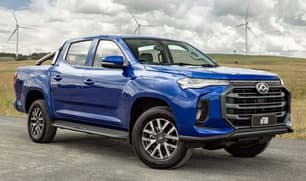
This is it: Australia’s first fully electric ute.
It is telling of the times that the eT60, a dual-cab, no less, doesn’t come from a traditional titan of Australia’s car market like Ford, Nissan or Toyota.
Instead, it comes from Chinese upstart, LDV. The brand has already made a name for itself importing affordable alternatives to these mainstream rivals.
The combustion version of the T60 is chipping away at the market share of established names, commanding nearly six per cent of the light commercial market, placed fifth behind Mitsubishi.
Can the brand be more than a cut-price option, though? Does it have what it takes to be a first-mover with its all-electric dual-cab? We drove a pre-production example at its Australian launch to find out.
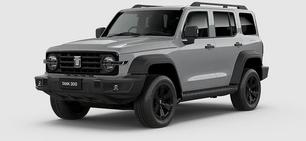
GWM’s Tank 300 struck a chord with Australian buyers when it launched in 2023. The rugged, boxy design, serious off-roading ability and unbeatable value for money - especially compared with similar models like the Jeep Wrangler - won it a number of new fans.
But something was missing. With an uninspiring petrol engine and a patchy hybrid powertrain the only options, the Tank 300 was sorely missing a diesel.
GWM itself says about 75 per cent of models in the off-road-focused large and upper-large SUV segments are made up of diesel-powered SUVs, so it was missing out on a chunk of sales.
Thanks to some serious nudging from GWM Australia and New Zealand, the Chinese parent company saw the potential and have added a diesel engine to the mix. This is the same diesel unit found in the GWM Cannon and Cannon Alpha utes.
Is the diesel now the pick of the Tank 300 range? Or should you look at another oil-burning 4x4?
The eT60 presents as an electric vehicle clearly converted from a combustion vehicle to take advantage of being first in our market.
It comes with some significant downsides, from the lack of key specifications and safety equipment to the downright average drive experience, but in other areas it’s specified right, with decent charging specs, and surprisingly good software on that centre multimedia screen.
In some ways, these impressions are a reflection of how far the ute market has come in Australia in the last few years, with many commercial offerings now feeling just as complete as passenger cars in terms of specification and driving prowess.
LDV has left open the door for future tweaks and improvements to the eT60’s spec, ride, and features, and we’re keen to get it in for a longer test in the near future. Either way, though, the brand says it has no shortage of buyers lining up to be a part of the zero emissions future of commercial vehicles.
The diesel is now the pick of the Tank 300 range. It’s the best fit for this vehicle and offers greater driver engagement than the petrol or hybrid.
It also has genuine off-road chops while still managing to suit family life.
While it could benefit from further refinements to on-road behaviour, cabin noise and the ADAS systems, none of these are deal breakers.
The fact that it is priced so keenly against some excellent competitors and is stacked with standard gear adds to the Tank 300’s appeal.
Note: CarsGuide attended this event as a guest of the manufacturer, with meals provided.
The eT60 is hard to tell apart from its combustion equivalents from the outside. If you were expecting a blanked-out grille, aerodynamic wheels, or some other special EV-specific design flair, you’ll be surprised to find there are none.
To that end, the eT60 shares the exterior appeal of the combustion range, with a big, tough-looking grille, modern LED DRLs, sturdy looking alloy wheel designs, and enough chunky personality from the wide stance and additional bits like the sidesteps and sports bar.
Peeking underneath reveals the housing for the batteries, notably no spare wheel, and the tray is utilitarian with the spray-in tubliner. At least the ute scores colour-matching bodywork all around.
The same goes for the inside, which certainly feels like a commercial offering. Again, all the items in there mirror its base combustion equivalent, with the only giveaway of its electric nature being the dial-shifter which replaces the lever on the centre console.
The cabin surroundings are largely hard-wearing plastics, including the steering wheel, making the swish touchscreen with surprisingly fast software look somewhat out-of-place.
The analogue dash cluster, for example, looks a bit old-school for an EV, and in terms of look and feel, the T60 generally feels a bit behind the pace compared to its traditionally more expensive rivals.
While it lacks in some areas, though, it is worth something that this dual-cab flies under-the-radar. Fleet operators won’t need to worry about a strange-looking ute with unnecessary frills, and common body panels with combustion versions will make repairs easy, too.
The only visible difference between the diesel and the petrol or hybrid 300s is a 2.4T badge. So you get the same boxy exterior as before.
It’s somewhat derivative and gives more than a nod to Jeep, but the design has intent - it looks capable off-road and for most people that’s enough. Luckily it is capable off-road. More on that later.
Inside the upright, shelf-like dash is appealing. I like that everything is nicely integrated, like the dual 12.3-inch screens which flow nicely into one another.
The big T-shaped three-spoke steering wheel looks cool and the aeronautical air vents are clearly inspired by Mercedes-Benz.
The chunky metal-look plastic glove box cover adds extra visual flair and the stitching throughout elevates the cabin further.
However, the futuristic looking gear shifter is chunky, takes up too much space and is unnecessary.
Your burning question here will be how much the eT60 can tow and haul. With the same suspension set-up as the Pro version, this ute is capable of carrying a 1000kg payload, or tow 1000kg braked.
This is limited, but when you consider its 2300kg kerb weight due to the addition of those batteries, reasonable.
Operators should keep in mind that the 330km driving range is unladen, so you can expect half of that or less when loaded to capacity.
Tray dimensions come in at 1510mm wide (1129 between the arches), 1485mm long, and 530 high. Axle load capacity at the rear is 2100kg, and the eT60 has a GVM of 3300kg.
The approach and departure angles, as well as the clearance are mostly the same as the combustion version, coming in at 27 degrees, 24 degrees, and 187mm respectively.
Technical stuff aside, the cabin is as hard-wearing and practical as you would hope for a working ute, with a total of six cupholders and four bottle holders, a glove compartment, and sunglass holder, two USB 2.0 ports, two 12V outlets, and the welcome addition of a full-size 220V household power outlet.
The synthetic seat trim is so-so for comfort, and the seat bases are quite high, leaving someone at my 182cm height quite close to the roof.
The lack of telescopic adjust for the steering wheel is a shame, but not unusual for products from LDV’s SAIC parent company (this problem is shared with the MG ZS, for example).
The rear seat continues to offer comparatively good space for this segment, even behind my own driving position, although it would be predictably quite tight with three abreast.
As this was a brief test, we can’t tell you what it looks or feels like when loaded up, but the spray-in tubliner is better than offering the eT60 with simply a painted tray, as it’s good-to-go from day one.
Up front the Tank 300 offers a commanding view of the road and it’s easy to find your perfect driving position thanks to the power-adjustable seats.
Those seats have good side bolstering but could do with a little extra cushioning for the thighs. The Nappa leather-appointed seats in the Ultra look and feel lovely.
Storage is average for the segment with room for larger bottles and additional flat items in the door pockets, and a well-sized central bin that also houses two cupholders, although they sit low in the cavity and two coffees sit awkwardly together.
The Tank has one USB-C port for charging only but another USB-A port up front for connectivity. You shouldn’t need that given Apple CarPlay and Android Auto is wireless.
Keen off-roaders will have fun with the extensive Tank Expert Mode in the multimedia screen, which allows you to individualise your 4WD experience.
Beyond that the screen is neatly laid out, responsive and easy to use. GWM has come a long way when it comes to in-car tech. The icons on the digital instrument cluster, however, are still too small.
There’s ample leg room in the rear, with space between my knees (I am 184cm tall) and the rear of the front seat, and enough toe room. It doesn’t feel enormously spacious across the rear row but three kids should be comfy. Headroom is enhanced by a scalloped section of the roof specifically for rear-seat passengers, but it doesn’t leave a huge amount of space for taller people.
The rear seat bench is flat but the backrests have some support and overall the seats back there are comfortable.
You’ll find lower rear-seat air vents, map pockets, a fold-down central arm rest with two cupholders, room for small bottles in the doors and two USB-A ports.
The boot can take 400 litres with all seats up and 1635L with the rear seats folded. That figure is measured from the floor to the top of the rear seats.
Jeep says the Wrangler has 898L capacity with all seats in place but that is measured from the floor to the roofline.
There is no under-floor storage in the 300’s boot and the full-size spare wheel is housed in traditional 4x4 fashion on the tailgate.
The eT60 is expensive. Shockingly expensive. The single variant which will initially arrive in Australia wears a before on-road costs price tag of $92,990.
To put that in perspective, its specification is equivalent to that of the base-model ‘Pro’ combustion version, which now wears a price-tag of $43,148.
Do the math. You could literally have two T60 Max Pros for the same cost as one of these electric versions, given the latter's price premium of $49,842.
To make matters worse, the eT60 is rear-drive only, and with its nearly 90kWh battery pack offers just 330km of driving range, and that’s without being loaded-up.
This price is puzzling for more than one reason, however. For a start, 90kWh of batteries certainly doesn’t cost nearly $50,000 (if you take the average price of a lithium cell per kWh in 2022, the battery should cost closer to $20,000).
In fact, even the electric Mercedes-Benz Vito van with a similarly-sized battery comes in at $85,353 before on-road costs.
To this you could argue many things, but perhaps the most salient point is the fact that big corporate commercial fleets with zero emissions targets are seemingly obliged to pay up given the eT60 has become the only zero-emissions option in the ute space.
Standard gear is mostly shared with the Pro grade of the combustion T60, but there are some real oddities.
Good things include 17-inch alloy wheels and a slick 10.25-inch multimedia touchscreen with Apple CarPlay connectivity, synthetic leather interior trim with six-way electric adjust for the front passengers, LED DRLs, and a sports bar over the tray, which itself has a spray-on tub liner pre-applied, and side-steps to make it easier to hop in and out.
A big bonus is the household-sized 220V power outlet on the back of the centre console, which can be used to power tools and charge devices.
Then things get a bit strange. For example, this is the only fully electric car I’ve ever driven which has a turn-key ignition (as opposed to a push-start system).
It also has an analogue dial cluster, a plastic steering wheel with no telescopic adjust, halogen headlights (in 2022, really?), a manual handbrake, and the example we drove didn’t even have a dedicated park gear. To exit the vehicle, you leave it in drive or neutral, rip the handbrake on, and turn it off. Very odd.
There’s some welcome items here, and it’s also nice that despite LDV’s clear focus on commercial buyers, the eT60 is a dual-cab, so you can actually use it for more than just hauling stuff, but there are just some things (the lack of a park gear in particular) which make it feel a bit pieced together on a tight budget. Rough for a vehicle which costs nearly $100K.
One of the key selling points across GWM’s entire range is value for money, and the Tank 300 has always had that in spades.
As with the petrol and hybrid 300, the diesel is offered in two well-specified model grades - Lux and Ultra.
At $47,990 drive-away, the Lux diesel is $2000 more than the Lux petrol, but $3000 cheaper than the Lux hybrid.
The Ultra diesel, at $51,990, is $1000 pricier than the petrol equivalent and $5000 more affordable than the hybrid Ultra.
The GWM Tank 300 diesel Lux is also more affordable than equivalent grades of a number of ladder-frame 4x4 SUV rivals like the Isuzu MU-X, Toyota Fortuner, SsangYong Rexton and the Ford Everest.
It’s also significantly more affordable than the Jeep Wrangler, with the Tank 300 Lux costing about $30,000 less than a Wrangler Unlimited Sport S.
Note however that many of those models - except the Wrangler - have the option of seven seats, whereas the Tank is strictly a five-seat proposition. If you want a third row, check out GWM’s Tank 500.
There are cheaper off-road large SUVs out there – the LDV D90 and Mahindra Scorpio. But the Tank 300 is a more refined and higher-quality offering than those models.
Standard gear in the Lux includes 17-inch alloy wheels, synthetic leather seats and steering wheel, power-adjustable front seats, dual-zone climate control, seven-colour ambient lighting, keyless entry and start, a sunroof, power-folding mirrors, paddle-shifters, a nine-speaker audio system with digital radio, built-in sat-nav, and a pair of 12.3 inch digital displays with wireless Apple CarPlay and Android Auto.
It also gets roof rails, side steps, privacy glass, all-terrain mode selection and a rear diff lock.
The Ultra upgrades to 18-inch wheels, Nappa leather-accented seats, heated and ventilated front seats, a heated steering wheel, more adjustment for the front seats and a memory setting, a massage function for the driver’s seat, a wireless phone charger, 64 colours in the ambient lighting suite, and a nine-speaker premium audio system.
There is nothing obvious missing from the standard features list, but I don’t know why a wireless device charger is limited to the top grade.
The eT60 is rear-wheel drive only, with an electric motor producing 130kW/310Nm. That’s nowhere near as punchy as the 160kW/500Nm outputs of its punchy twin-turbo 2.0-litre combustion equivalent.
There are three driving modes - 'Power', 'Normal', and 'Eco', and driving performance seems tame. Again, as this was a quick spin in what was described as a pre-production vehicle, we didn’t have a chance to try it out with extra weight in the tray.
Suspension is the same as the combustion T60 Pro, consisting of ‘heavy duty’ coils at the front, and a leaf-sprung set-up in the rear. There are disc brakes all-round.
The big news with the Tank 300 is, of course, the new engine.
It is a 2.4-litre four-cylinder turbocharged diesel engine borrowed from the GWM Cannon and Cannon Alpha utes.
It pumps out 135kW of power and 480Nm of torque. That’s more torque than an MU-X but not as much as an Everest.
It is paired with a nine-speed automatic transmission and has part-time four-wheel drive.
If you need to tow, the diesel has a 3000kg towing capacity, which is 500kg more than the hybrid and petrol. It can’t beat the 3.5-tonne towing capacity of the MU-X and the Everest.
Payload has also increased compared with the petrol and hybrid, up from 400kg to 600kg.
GWM says it conducted extensive testing internationally but also in Australia to improve towing performance. There are approximately 20 different parts compared with the other powertrain variants to get the best out of towing in the diesel.
A rear diff lock is standard on both grades while the Ultra gains a front diff lock.
The eT60’s WLTP-rated energy consumption figure comes in at 21.3kWh/100km, which for a passenger car wouldn’t be great, but seems about right for a commercial vehicle of its size and aerodynamics. As already mentioned, this gives it an official driving range of 330km.
LDV says the fleet buyers it has lined up for the eT60 understand its range is “more than adequate for their daily requirements”.
There is some good news on the charging front, with the eT60 being sensibly specified from the factory. The DC charge rate maxes out at 80kW, for a claimed 20-80 per cent charge time of 45 minutes on a compatible charger, while the slower AC charging rate (important for back-to-base operators) is 11kW, meaning a nine-hour 5.0-100 per cent charge time.
On a single-phase charger (maxing out at 7.2kW, but cheaper to install) the 5.0-100 per cent charge time is a claimed 13 hours. Expect more like a 40-hour charge time on a standard wall socket.
The diesel Tank 300 consumes 7.8 litres of fuel per 100 kilometres on the official combined cycle, which is better than the 9.5L figure for the petrol and the 8.4L quoted for the hybrid.
That figure also sits somewhere between a 2.0-litre bi-turbo Everest (7.1L/100km) and a 3.0L MU-X (8.3L/100km).
It has a 75-litre fuel tank and GWM claims an NEDC range of about 950 kilometres. GWM says the Euro 5 engine does not require Adblue.
Given the restrictions of a media launch, we did not obtain real-world fuel use figures.
I said some of the standard equipment on this car is odd. This continues through to the drive experience. Keep in mind that LDV reminded us that there were some pre-production quirks about the vehicle we briefly drove on this launch.
Setting off, the eT60 emits a rather unappealing artificial buzzing sound to alert nearby pedestrians of its presence. While the audible aid is welcome, particularly for a commercial vehicle which may be frequently operating in areas shared with pedestrians, does it have to be so grating?
Even the Mifa 9 electric people mover makes a more appealing science-fiction-inspired noise. Perhaps the eT60’s noise was designed to mirror the tone of a diesel engine?
The seating position leaves a lot to be desired for someone of my height and I would also love to have telescopic wheel adjust, although visibility out of the cab is good all-around, and the reversing camera is relatively high-quality.
Manoeuvring at low-speeds is only tarnished, then, by heavy steering, which annoyingly, also gets a bit vague at higher speeds.
Higher speeds also reveal this ute’s main weakness which appears to be its ride. Keep in mind we’re driving a completely unladen pre-production example. But the ride was harsh, busy, and unsettled in our short drive, which covered a portion of freeway and some bumpy side roads.
The suspension from the combustion T60 Pro appears to struggle with the additional weight of the batteries in the eT60. Harsh bumps were easily transmitted to the cabin, whilst undulations had it jiggling and bouncing around side-to-side.
Power from the electric motor seemed sufficient, but not exciting, with tame acceleration off-the line. The obvious benefit being instantaneous response without the need for a transmission.
It is hard to tell whether the 310Nm on offer will feel too heavily burdened when the ute is loaded up. In some instances, electric motors don’t feel additional heft at all, so stay tuned for a follow-up load test.
Unlike this car’s Mifa 9 or eDeliver 9 relations (which use an electric motor with identical outputs), the eT60 does not have adjustable regenerative braking, with a single strong tune, which cannot even be turned off.
While it is welcome for extending the ute’s range and reducing the stress on the disc brakes, it is not a single-pedal driving mode.
The three driving modes don’t alter the experience much, with the Power mode making the electric motor more responsive, and Eco mode taking the wind out of its sails.
Its maximum speed is limited to 120km/h which is more than can be said for the eDeliver 9 which is limited to 90, a recipe for freeway frustration.
We’re keen to spend more time with the eT60 in the future to better evaluate its range claim and how it deals with more commercial duties. Hopefully it can shape up a little better than it did our quick and less-than-ideal testing environment.
I last drove a Tank 300 in late 2023 and it was the hybrid variant. While the hybrid has some positives, its driving characteristics were not high on that list.
It had an erratic throttle response, hesitation on take-off and it felt underdone.
In contrast, this new diesel variant just feels like the right fit for this SUV.
There is slight lag accelerating from a standing start, but the powertrain is torquey and there’s plenty on tap when overtaking or just increasing speed when already on the go. GWM has not provided a 0-100km/h time.
It is clear you’re in a diesel as soon as you turn on the ignition - it has that typical diesel rattle, but it is not as unsophisticated as some oil-burners I have driven.
The cabin could do with some extra insulation with wind and tyre noise detected, but it’s hardly a deal breaker.
Given the vehicle’s size, heft (nearly 2.3-tonne kerb weight) and the fact it’s shaped like a brick, the 300 holds its nerve on winding stretches of road with only a little body roll. In saying that, best not to treat it like a Mini Cooper on your favourite twisty road.
Ride quality is a bit mixed. We only drove the Ultra on 18-inch wheels and while it manages to soak up bumps, the ride is jittery, and that’s even more evident on uneven road surfaces.
Steering is heavily weighted and a little vague, but fine for a big off-roader, and the brakes need to be pushed hard.
One quirk is the indicator - it appears to be a one-touch setup for indicating to change lanes, but then the indicator stays on. I tried several times to test this, even flicking it to the opposite side to turn it off and it was very stubborn.
The good news is it appears GWM has toned down the awful indicator sound of its earlier models and is now much more subtle.
So on-road the Tank 300 is more than competent, and a much nicer vehicle to drive in an urban setting than a Jeep Wrangler, for example.
We also drove it briefly on an off-road trail, and in low range the Tank 300 proved that it can do what it says on the box.
I’m no off-roading expert and there are much more challenging trails out there, but I had confidence that the Tank 300 would not let me down traversing the many chunky rocks, massive holes and fallen tree limbs.
The eT60 lags behind the competition here with a notable lack of active safety equipment, now considered industry-standard.
There’s no auto emergency braking, lane support equipment, active cruise, or blind spot support. Instead, this ute has the standard array of six airbags, electronic stability and traction controls, with the addition of hill start assist, roll movement intervention, and hill descent control.
While combustion versions of the T60 have a five-star ANCAP rating from 2017 (before active items like AEB were considered necessary), don’t expect the same from the eT60.
ANCAP awarded the Tank 300 a five-star crash safety rating from testing done in 2022, scoring highly across all four of the major test categories.
GWM says it is waiting to hear from ANCAP but expects the diesel to be covered by the same rating.
As well as seven airbags including a front centre bag, the Tank 300 has a long list of safety gear covering both the Lux and Ultra.
There’s a suite of collision mitigation systems that includes auto emergency braking (AEB), lane departure warning, lane-keep assist, emergency lane keep, lane centring, front and rear collision warning, front and rear cross-traffic alert and lane change assist.
It also has driver fatigue monitoring, a rear seat child monitor, door opening warning, adaptive cruise, traffic sign recognition and hill-descent control.
I noted this in my recent GWM Haval H6 GT PHEV review, but GWM has made consistent tweaks to improve its advanced driver-assist systems (ADAS) and as a result they are less intrusive than they were when the Tank 300 launched in 2023.
There is still the occasional tugging of the wheel but it’s much less of a tug-of-war than it once was.
For the first 45 minutes of our test drive there was an annoying beep every 10 seconds that my co-driver and I could not identify. There was no icon on the driver display to indicate that it was a lane departure warning or speed limit alert, but eventually it just stopped. We still have no idea what it was but it was, thankfully, not present in the vehicle we drove in the second half of the launch drive.
Ownership is a better story. The eT60 is offered with an industry competitive five-year/160,000km warranty, with five years and 130,000km of roadside assist. There is also a separate eight-year and 160,000km warranty for the battery (supplied by CATL).
The service intervals might be the most appealing attribute, with the eT60 only needing to visit a workshop once every 24 months or 30,000km.
Even better is the cost, which will set owners back an approximate average of just $145.80 per year for the first 10 years of ownership.
GWM covers the Tank 300 with its seven-year/unlimited-kilometre new-vehicle warranty, which is an impressive offer.
You are covered for seven years of roadside assist and the Tank is offered with a seven-year capped-price servicing program.
GWM is yet to confirm the Tank 300 diesel’s servicing offer (including pricing), but expect a service schedule similar to the Cannon ute with the same powertrain.
That means the first service might be required at 5000km or six months and beyond that it will need a service every 12 months or 10,000km, whichever occurs first.