What's the difference?
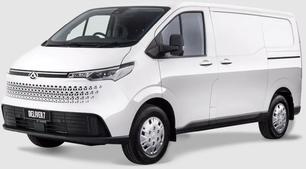
Following up the electric LDV eDeliver 7 comes the diesel-powered model which may look identical from the outside but is an altogether more traditional package.
Effectively replacing the G10 as LDV’s mid-size (2.5-3.5 tonne GVM) van, the Deliver 7 competes against segment stalwarts like the Ford Transit Custom, Hyundai Staria Load, Renault Trafic Pro, Toyota HiAce and Volkswagen Transporter.
Unlike some of the others in that list, the Deliver 7 has its eyes firmly set on the fleet operator crowd with all the required safety equipment, plenty of payload capacity and – crucially – a cheap starting price.
There’s a school of thought that says you should always use the biggest hammer available. That’s the view of more than one van and truck manufacturer, who will point at the dual-cab utes Aussies are currently consuming at a frightening rate, and politely suggest a light truck or full-sized van might just be more appropriate.
It’s a hard argument to ignore, and for those who use their commercial vehicles to the max, perhaps a committed truck or van might make sense. After all, having the ability to tow 3.5 tonnes AND still have some payload left over for passengers and fuel is a hard argument to ignore. It’s also a line European maker Iveco is keen to push, along the lines of never taking a knife to a gunfight.
Iveco’s volume-selling light van offerings are the 42S and 50C models; vans that cross from recreational to professional user thanks to their overall size, capacity and the fact they can be driven on a normal car license in Australia.
Now revised for greater buyer reach, the 42S gains a 350kg payload boost over the 35S model it replaces, as well as more power and torque from its engine. It also boasts improved safety credentials with the addition of a range of driver aids which we take for granted in passenger cars, but are increasingly important in the commercial vehicle world thanks to a renewed focus on OH&S.
So, what else is new? Starting in the cabin, there’s now a 10-inch digital driver display unit, improved wireless and wired charging rates, changes to the chassis rails for better crash performance, an improved warranty and a pair of feature packages designed to target the end user market.
In Europe, the Daily van has plenty of competition, while in Australia, the major opponents are the Mercedes-Benz Sprinter, VW Crafter, Fiat Ducato and the emerging Chinese van threat, the LDV Deliver 9.
For a van that is going to be heavily loaded most of its life, the diesel Deliver 7 offers a strong value proposition with snazzy exterior design and passenger car-like interior tech.
As a fleet-oriented vehicle, that ANCAP sticker of approval, non-slip flooring and ergonomic seats will please the health and safety officers, too.
It's a shame, then, that LDV couldn't match the reasonable refinement and ride quality offered by the electric eDeliver 7. Where that van feels competitive with rivals, the diesel Deliver 7’s budget bones add up to a bouncy, unrefined and bonging safety aid-filled driving experience.
The diesel Deliver 7 is a decent enough workhorse but it’s hard to recommend saving the money over its more refined competitor set.
The Iveco Daily van’s light-truck genetics mean it’s not as immediately familiar to the end-user as some of the competition. It’s a fair climb to get inside, for instance, and once you’re there, the cabin lacks the ambience of a more passenger-oriented machine. Its wheelbase and external dimensions, too, mean it requires plenty of parking skill and real estate, and the dynamics are surefooted but hardly athletic.
Of course, fleet managers won’t care too much about any of that, and the flip-side is those truck underpinnings point to a low maintenance, high-mileage lifespan with good warranty as a promise of less time lost in the service bay when the van could be on the road earning its keep.
Right at the moment, the Daily van appears to be forming some kind of bridge between the car and truck world in terms of safety equipment and driver assistance gear, too. And that’s got to be a good thing.
But equally, it remains a pretty specialised piece of equipment that won’t work for everybody, nor does it have a lot of cross-over appeal between the car and truck worlds. None of which, of course, will prevent it being a valuable tool of the trade in the right hands.
Note: CarsGuide attended this event as a guest of the manufacturer, with travel, accommodation and meals provided.
The van segment has evolved to the point where a box on wheels is no longer enough to grab attention and we can thank the Hyundai Staria for that.
The Deliver 7 conforms to new norms adopting the exact same fascia as its eDeliver 7 that certainly stands out, though the doily pattern may trigger trypophobics. Sharp LED lighting and classic van proportions finish things off.
The Deliver 7 rides on 16-inch steel wheels with hubcaps and 215/65R16C GitiVan 600B tyres. An upgrade to alloy wheels is offered, too.
Inside there are pleasant materials in some places, such as the soft synthetic leather door tops perfect for resting your elbow. There is some upmarket chic to the cabin but it’s eye candy only, as the blue faux stitching panel is all hard, scratchy plastic. Still, that’s the hard-wearing vibe of most in this segment.
One thing Iveco is very up front about is that its vans are truck-based. To some sectors of the market this is no problem whatsoever, but it means that stylistically, the end product is not likely to be as fashionable looking as some of the competition. That big, bluff front, for instance, while maybe looking a bit heavy-handed to some, will conjure up just the right amount of brute force for others.
There is also evidence Iveco doesn’t mind if the exterior appearance fails to hide how the machine works. That perhaps why the wheel arch flares are obvious and the track for the sliding door is proudly on display rather than hidden.
Even inside, the bare cargo-bay walls tell their own utilitarian story, but when you get down to actually lashing down heavy loads, that truck heritage is very much in evidence with a non-nonsense layout and presentation.
When it comes to exterior size, the LDV Deliver 7 sits between the smaller Hyundai Staria load SWB and larger Toyota HiAce LWB. It is only available in low-roof guise but the Deliver 7’s generous width is its party trick, measuring 2118mm from flank to flank.
The Deliver 7’s load area is 2547mm long (or 2913mm in the LWB), 1800mm wide (pinched to 1390mm between the arches) and 1428mm tall for a total of 6.3 cubic metres of load space. There are six heavy-duty tie-down loops to secure cargo.
Adding to practicality are standard barn doors which are handy in low car parks and make loading pallets — the Deliver 7 will easily fit two Australian or Euro palettes inside — simple.
They can be opened to 90 degrees where they lock, or all the way to 180 degrees. There is no lock when fully extended, though, so they can blow closed on windy days. We’d also appreciate seeing a second sliding side door as an option.
The Deliver 7’s star factor is payload, in fact it’s clear of all the listed rivals above by a reasonable margin. The Deliver 7’s 2105kg kerb weight and 3400kg GVM mean drivers can carry up to 1290kg of cargo in the back. It is also capable of towing a 2000kg braked, or 750kg unbraked, trailer load.
Oddly, for its impressive carrying capacity, the Deliver 7 is not equipped with a bulkhead. It is also a strict two-seater without a centre bench for a third occupant.
The trade off here is that the Deliver 7 has supportive car-like bucket seats with adjustable arm rests. The upholstery is cloth that feels hard wearing and the seats slide forwards and backwards, have height and tilt adjust along with manual lumbar to keep you fresh after a few hours behind the small diameter leather-appointed steering wheel.
Moving to a stalk-style shifter frees up the Deliver 7’s centre console for added incidental storage, with handy spots for tape measures, keys, invoices and four cupholders easily accessible.
Hidden storage is a little limited, with a small-ish glove box and ashtray the extent of the cubbies.
And while the Deliver 7’s technology suite looks good on the surface, it is not particularly responsive and many heavy-use functions are restricted to the screen.
For example, the headlight controls are on the main menu and they do not automatically switch off when you turn the Deliver 7 off using its push-button start system unless they’re in auto mode and, instead of just turning a stalk to silence beeping, you have to reboot the car.
The eating and ventilation controls are a mix of digital and physical though the row of switches is an awfully long way from the driver’s seat. The scroll wheels to adjust fan speed and temperature have very fine stops making it difficult to be accurate on the move.
The touchscreen’s menus are otherwise straightforward enough, though it is a shame Apple CarPlay and Android Auto phone mirroring has to run through a cable attached to only one of the three USB-A and USB-C charge ports scattered about the interior.
Even within the framework of vans that are agile enough to park relatively simply, can be driven on a normal car license and are priced within reach of even recreational users, there’s still a lot going on. Think optional payloads, wheelbases and cargo volumes, just for starters.
So let’s start with the Daily 42S. Available with either a 3520mm or 4100mm wheelbase, the 42S can cope with a payload of 1872kg or 1741kg, respectively. Towing capacity is 3500kg. It stands more than 2.7 metres tall and seats three.
The 50C is the next step up the size ladder and, like the 42S, can be had with either a 3520mm or 4100mm wheelbase. But from there, the 50C just gets bigger with a choice of three overall lengths (up to almost 7.7 metres) and two distinct roof heights. Payload varies from a high of 1942kg to 1752kg and, like the 42S it also seats three and can tow 3500kg.
Iveco has stuck with single rear wheels (rather than a dual-wheel rear axle) for the 42S variant as this minimises the internal space taken up by the rear wheel arches and ensures that the van in any configuration will still swallow a standard pallet between those arches. The 50C, meanwhile, with its greater payload potential, features dual rear wheels. The other reason for the dual wheels is that the 50C can be ordered with an upscaled GVM of 5.2 tonnes, versus the standard vehicle’s 4.5 tonnes. At that point, though, the driver requires an endorsed license to stay legal.
The cabin is a master-class in finding a storage space for everything, with no less than three cubbies per door, storage bins on the dash-top and above the sun-visors, half a dozen cubbies in the dash fascia, a single glove box and a huge storage area under the flip-up cushions of the passenger’s bench seat. In standard trim, the Iveco vans seat three with a two-person bench and a single driver’s seat. That, however, doesn’t mean the vehicle has a walk-through function, and the solid cargo barrier keeps the cabin permanently separate from the cargo bay.
Access to the cargo area is via twin barn doors at the rear which open back on to the sides of the vehicle for easier fork-lift loading. There’s a single sliding side door as standard on the kerb-side, but you can option a second sliding door on the other side. There are also no less than 10 tie-down points (five per side) and they’re solid and mounted on the floor for maximum usefulness. Three LED lights illuminate the cargo area.
The LDV Deliver 7 is essentially a rebadged version of SAIC Motor's Maxus V70 sold in China and arrives in Australia as a simple proposition. Short or long wheelbase is your only choice, with a single sliding door and rear barn doors as standard.
The range simplicity makes LDV importer Ateco’s life easier, meaning the price is sharp. The Deliver 7 short wheelbase we have on test is normally $44,726, drive-away, but if you hold an ABN (as almost every van buyer does) it’s yours for $42,490 on the road.
Admittedly, the gap between LDV’s offering and established names has closed since the G10, however, it’s still about $10,000 cheaper than rivals once you factor in on-road costs.
For reference, the Toyota HiAce LWB is $51,636, the Hyundai Staria Load Twin Swing $50,640 and Ford Transit Custom SWB Trend starts at $56,590, with all those prices before on-road costs.
And there’s good reason the Deliver 7 has come upmarket; plenty of whizz-bang technology inside. A generous 12.3-inch central multimedia touchscreen, decent sound system, sizeable digital information screen, LED head and tail-lights, electronic park brake, keyless entry with proximity key and rain-sensing wipers should give the LDV a leg up in the showroom.
Health and safety officer-pleasing features such as a bright LED light in the load bay and rubber flooring (which is less grippy than its ‘non-slip’ name would have you believe), high definition reversing camera and parking sensors at both ends also come standard.
For an extra $1500, you can upgrade to 16-inch alloy wheels and pick up a 360-degree camera. Dual sliding doors are part of that pack, too.
When you start to dig into the Iveco Daily range, it soon becomes apparent there’s huge depth to the line-up. In fact, there’s everything from a four-wheel drive dual cab-chassis, a bare-bones cab-chassis and even van versions with enough GVM (Gross Vehicle Mass) to require a truck license to be driven legally.
But for most users, and certainly those that might otherwise resort to an American pick-up or some other form of dual-cab utility for their work and play requirements, the Daily variants that offer the broadest appeal are the 42S and 50C vans.
That pair gives you a choice of capacities (see Practicality section) as well as some new safety tech and some structural changes aimed at making the vehicle safer.
You also get climate-control air-conditioning, cruise-control and a tilt and height adjustable steering column. Seat trim is still cloth, the floor coverings remain vinyl and the wheels are stamped from steel. This is, after all, a truck-based vehicle and it shows in some respects.
A pair of option-packs start with the 'Business Pack' which takes fuel capacity from 70 litres to 100 litres, a new 10-inch multi-media unit, a passenger’s bench seat with table, a heated driver’s seat with suspension function, climate-control, keyless entry and go, fog-lights and an electronic park-brake.
The 'Premium Pack' adds auto headlights and wipers, LED lighting, a leather steering wheel, wireless charging, adaptive cruise-control and lane-centring.
Right at the moment, we don’t have pricing for those packs, nor do we, in fact, have confirmation of pricing for the new van range. But word on the street is that pricing – thanks to a strong exchange rate at the moment – may not be very different from the superseded range, meaning the entry-level 42S van could enter the market around the $60,000 mark plus on-road costs, while the 50C variant could top out at closer to $100,000. That’s a pretty sketchy prediction, we know, but it’s all we can offer at the moment.
There is nothing special about the Deliver 7's carryover 2.0-litre turbo-diesel four-cylinder that produces peak power and torque of 123kW and 390Nm.
The Deliver 7's engine iscompliant with Euro 5 standards and emits 203 grams of CO2 per kilometre. It is equipped with a diesel particulate filter (DPF), though no AdBlue tank.
It is noisy and vibey in this application but provides adequate motivation unladen and loaded, feeling especially punchy between 2200-3000rpm.
The LDV Deliver 7 is front-wheel drive and uses a nine-speed ZF-sourced torque converter automatic that shifts smoothly. There are three drive modes: 'Eco', 'Normal' and 'Power'.
Annoyingly, the Deliver 7’s transmission is calibrated to shift into the highest gear as soon as possible, sometimes leaving you without enough grunt to accelerate without kicking down.
It is also slow to downshift under braking, meaning you need to lean on the brakes harder when carrying a heavy load. There are tactile shift paddles behind the wheel to encourage a downshift if you need, though.
While vans might be getting ever closer to passenger cars in the way they drive (stay with us) in engineering terms, there’s still a bit of 'us and them' going on. That means you kind of have to throw away a fair bit of what you thought you knew about how motor vehicles work, but it also means the Iveco is fit for purpose in a world where big loads and lots of kilometres are the norm.
Power in either the 42S or the 50C comes from a 3.0-litre, four-cylinder, turbo-diesel engine. It doesn’t sound too different from what you’d find in a dual-cab ute, but the engine uses some pretty heavy-duty tech, making it closer to a truck engine than a typical light commercial’s, including an impressive service regime. Although capacity remains the same, the Iveco’s unit is available in two tunes, both erring on the side of torque over outright power.
The 42S gets a 132kW and 430Nm version of the engine, while the 50C can be optioned up to the second-tier tune with 155kW and 470Nm. It’s not just an electronic tweak, either, and while the engine’s fundamentals remain, there are changes to the turbocharger and camshaft as well as the engine management.
Standard transmission is a ZF-made eight-speed conventional automatic and there’s electric power-steering as a nod to the chase for maximum efficiency which is perhaps even more important in the Daily’s European home market than it might sometimes be here.
However, it’s when you get to the suspension that the Daily reveals its brawny design ethos. Front suspension on the 42S is by double wishbones and torsion bars which sounds odd, but is pretty familiar in the trucking world. The 50C uses the same arrangement.
At the rear, the 42S gets a simple twin-leaf parabolic spring at each outer end of the axle, while the 50C has the same with optional air suspension and an optional driver-controlled locking differential.
All versions of the Daily also use the time-honoured (in the trucking industry) body-on-ladder-chassis construction method.
The combined (urban/extra-urban) ADR fuel cycle efficiency for the LDV Deliver 7 is a respectable 7.7L/100km. Our 200km loop including rural, urban and motorway driving saw it return 8.5L/100km at an average speed of 45km/h.
In urban and suburban driving, we saw 10L/100km aided by the engine start-stop system.
There is a large 80-litre fuel tank that would see driving ranges in excess of 1000km in favourable conditions, with 800km still likely on urban delivery runs.
Fuel consumption of commercial vehicles can vary enormously depending on where they’re driven and how they’re used and loaded. As a commercial vehicle, there are no official fuel consumption claims made by Iveco according to any standard test procedure.
Our experience with this vehicle in the past, however, suggests that between nine and 10 litres per 100km is a good indication of overall consumption. Obviously, hitching a 3.5-tonne trailer to the vehicle and loading it fully will have a big effect on that number.
With the standard 70-litre tank, the Daily should be able to cover near enough to 700km between fills, while the optional 100 tank should take it closer to 1000km.
Don’t forget, either, that the new Daily requires AdBlue which is carried in a 20-litre reservoir on the vehicle, and that the cost of filling this needs to be added to overall running costs.
The Deliver 7 is effectively the same configuration as its electric sibling, using struts with coil springs up front and a leaf-sprung beam axle at the back. Standard stuff for a heavy duty van.
The front and rear disc brakes have a nice solid pedal feel with well calibrated ABS and the Deliver 7 is generally safe and fairly secure on the road-holding front.
Unfortunately, the suspension set-up of LDV’s diesel van is significantly worse than the rather refined electric model. Unladen, the Deliver 7’s ride quality is atrocious, bordering on unacceptable.
Over speed bumps, the rear end bucks and shimmies as the van’s dampers fail to control the heavy duty leaf springs. There were several instances when the Deliver 7 was so uncontrolled my backside lost contact with the seat cushion.
As Deliver 7s are likely to spend most of their life loaded up, we headed to BC Sands in Taren Point which happily put 600kg worth of builders sand in the back. The rear ride height dropped 20mm with the load onboard.
With the weight onboard the Deliver 7’s ride settled on rippled tarmac and the bouncing was less abrupt coming off speed humps.
However, the 3.3-turn lock-to-lock steering became light and ponderous and the ride still lacks finesse. A previous-gen Toyota HiAce rides better.
Visibility is another Deliver 7 struggle. A solid-walled van will always be compromised but with the seat in a comfortable position for me, at 188cm, my head was in line with the B-pillar.
The big mirrors couldn’t be adjusted far enough out for my driving position, either, leaving plenty of blind-spot (lucky there’s a safety system for that!). The A-pillars are thick and pushed forward, impacting visibility at junctions and roundabouts.
The first impression – once you’ve managed to climb inside the cabin (a manoeuvre that requires the in-built step) is of a magnificent view ahead and to the sides. You sit high and mighty and the vast glass area means you always feel like the king of the road. The steering wheel is relatively flat compared with a passenger vehicle, but the column features tilt and reach adjustment, so you can soon get comfortable.
The engine feels a bit grumbly and coarse compared with the dual-cab utes with which many of us are more familiar. It’s not harsh, though, and soon has the Iveco accelerating, if not swiftly, then certainly with some authority and a feeling it would take something pretty solid to slow it down.
The eight-speed transmission is calibrated – perhaps deliberately – to feel a little like the robotised manuals of some bigger trucks, and as such, can feel a little stilted in the way it ever so slightly hesitates between shifts.
The brake pedal is also placed too far to the right for comfortable left-foot braking and there’s no driver’s dead-pedal or foot-rest, suggesting that overseas crash testing may have dictated its deletion and the location of the brake pedal. That said, the Daily was originally designed as left-hand-drive, so perhaps the switch from left to right has imposed some of those compromises.
The other complaint is in the form of the new-for-2026 gear selector. It uses the now common separate Park button, but until Park is engaged, the button is not illuminated or identified in any way and simply looks like another piece of black plastic on the shifter. Once you know where it is, you’re fine, but until then…
The electric power-steering poses no challenges and, in fact, is kind of a metaphor for the whole experience. It’s easy and tactile to operate and takes no time at all to feel comfortable. That’s assuming that you can learn to trust your exterior mirrors and the rear-view camera, because with the standard cargo barrier installed and the lack of an interior mirror, there’s more or less zero rear vision.
The LDV Deliver 7 achieved a gold star rating in ANCAP’s light duty van testing in 2024 thanks to six airbags and a long list of driver assist features.
Due to the poor outward visibility, you need the assistance which includes auto emergency braking (AEB), driver attention monitoring, lane-keep assist, blind-spot monitoring, rear cross-traffic alert, speed sign assist and tyre pressure monitoring.
Aside from the very helpful blind-spot monitoring, the Deliver 7’s other features feel more like a box-ticking exercise than genuinely helpful aids. You can turn the ones you don’t like off in about four taps on the central touchscreen.
I encountered two instances of false positive AEB intervention; regular misinformation and beeping from the speed sign detection; constant tugging from the emergency lane-keep assist even in its most forgiving setting and, at one point, the driver attention monitoring scalded me for smoking a (non-existent) cigarette.
Improvements to the Daily’s safety are one of the big headlines here. Well, in Europe, perhaps, because in Australia, the upgrades kind of amount to playing catch-up. But the new driver assistance packages are the real news here and, as such, the Iveco vans now get functions such as active cruise-control, traffic-jam assist, lane centring, autonomous emergency braking (that also identifies pedestrians and cyclists), blind-spot warning and rear-cross traffic alert and assist.
The three-seat cabin features four airbags; a driver and passenger front airbag and two side-curtain bags. The Daily has been crashed tested in Europe according to NCAP protocols and scored a maximum five stars.
A new, deformable crush-box in the front structure of the Daily is designed to give the vehicle improved passenger-protection in a frontal crash.
Top tethers and ISOFIX anchors for child seats are provided with configuration varying by body type.
The LDV Deliver 7 is backed by a competitive seven-year/200,000km warranty, however LDV does not publish fixed-price servicing.
After purchase, the Deliver 7 needs maintenance after six months or 5000km at a cost of $344, with subsequent intervals yearly or at 20,000km, whichever comes first.
Australian importer Ateco was able to give us a guide for three years of servicing at $2644 though this will vary depending on labour rates, rate of consumable use and other factors depending on the dealer.
Toyota caps HiAce servicing at $1740 for the same period and gives a clearer indication of pricing beyond the three-year mark, which may help you budget into the future.
Because they’re truck-based, the Iveco vans have meaningful service intervals as a way of keeping down-time to a minimum. In the case of the 42S and 50C models, that translates to a whopping two years or 50,000km between services, whichever comes first. We understand that relies on a particular type of engine oil being used, but even so, it’s a mighty long way between drinks.
Iveco has traditionally offered service plans of up to five years, and that will continue, but we haven’t been given pricing for that at this stage.
The standard Iveco warranty applies to these models, and that gets you six years and 250,000km worth of cover. An extended driveline warranty of up to six years and 600,000km is also offered. Again, pricing for that has not been announced.
It’s also worth noting that the Iveco van engines have been Euro 6 compliant since 2015. The facelift ushers in further changes based on regulations. That means they now need AdBlue which needs to be factored in as a running cost. But because they’re designed for a European audience where emissions are arguably a much bigger issue than here, the AdBlue technology is very advanced and rules out the need for a Diesel Particulate Filter in the exhaust system; something that will appeal to a lot of would-be owners.