What's the difference?
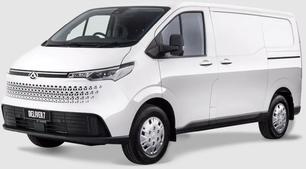
Following up the electric LDV eDeliver 7 comes the diesel-powered model which may look identical from the outside but is an altogether more traditional package.
Effectively replacing the G10 as LDV’s mid-size (2.5-3.5 tonne GVM) van, the Deliver 7 competes against segment stalwarts like the Ford Transit Custom, Hyundai Staria Load, Renault Trafic Pro, Toyota HiAce and Volkswagen Transporter.
Unlike some of the others in that list, the Deliver 7 has its eyes firmly set on the fleet operator crowd with all the required safety equipment, plenty of payload capacity and – crucially – a cheap starting price.
Anybody who doubts that Hyundai is gunning for the number one in the world has rocks in their head. Big heavy ones. Korean companies do not settle for anything less than number one. The second-generation Genesis (our first taste here in the Antipodes as the gen-one had its steering wheel on the wrong side) is proof.
What's different about Hyundai's unstoppable rise is the way they're going about it. They've always done their own thing in Korea, reinventing themselves time and again when they strayed off the beaten path.
The Genesis is a gamble for a Korean company in foreign markets whose default setting for luxury is marked, Britain or Germany. If Hyundai gets the Genesis wrong there will be howls of derision, or at best patronising pats on the back - "Nice try, you'll get there one day". But if they get it right...
For a van that is going to be heavily loaded most of its life, the diesel Deliver 7 offers a strong value proposition with snazzy exterior design and passenger car-like interior tech.
As a fleet-oriented vehicle, that ANCAP sticker of approval, non-slip flooring and ergonomic seats will please the health and safety officers, too.
It's a shame, then, that LDV couldn't match the reasonable refinement and ride quality offered by the electric eDeliver 7. Where that van feels competitive with rivals, the diesel Deliver 7’s budget bones add up to a bouncy, unrefined and bonging safety aid-filled driving experience.
The diesel Deliver 7 is a decent enough workhorse but it’s hard to recommend saving the money over its more refined competitor set.
The Genesis is not quite a match for cars twice its price but it makes you think what's possible. It doesn't have the dynamic brilliance of a BMW or the self-assured faultless execution of a Mercedes. Lexus ought to be worried, though - why would you have an LS when you could have this? The only answer is 'badge'.
The Genesis is an epoch-making car for the Korean manufacturer. As the company has got better, there are fewer excuses for overlooking it. While the Genesis is pitched into a shrinking market, it's not really meant for the average i30 buyer to buy, but to see.
It's bristling with tech and is not only a halo car but a shot across the bows of both Lexus and the Germans. Attached to that shot is a note: "We're coming for you." In other words, Hyundai got it right.
The van segment has evolved to the point where a box on wheels is no longer enough to grab attention and we can thank the Hyundai Staria for that.
The Deliver 7 conforms to new norms adopting the exact same fascia as its eDeliver 7 that certainly stands out, though the doily pattern may trigger trypophobics. Sharp LED lighting and classic van proportions finish things off.
The Deliver 7 rides on 16-inch steel wheels with hubcaps and 215/65R16C GitiVan 600B tyres. An upgrade to alloy wheels is offered, too.
Inside there are pleasant materials in some places, such as the soft synthetic leather door tops perfect for resting your elbow. There is some upmarket chic to the cabin but it’s eye candy only, as the blue faux stitching panel is all hard, scratchy plastic. Still, that’s the hard-wearing vibe of most in this segment.
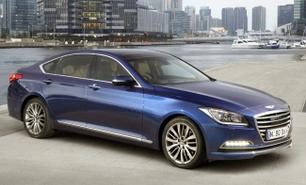
The Genesis is like no other Hyundai. For a start, it's gigantic - it looks easily as big as a BMW 7 Series (it isn't) with the road presence to match. There's a lot of BMW from most directions, but with a sharper approach to the creasing and character of the sheet metal.
Towards the rear it's more BMW 6 Series Gran Coupe and is all the better for it. The style is understated and technocratic.
Inside is also very Germanic, but with a bit more of a Lexus feel
The big wheels from the Ultimate pack help make it look lower and sleeker, too.
Inside is also very Germanic, but with a bit more of a Lexus feel. Our car had the lighter leather which meant that the wood and the metal materials didn't necessarily work well together.
The interior is expertly put together and feels like it will last forever.
The only jarring moment is the gear selector is shared with our long-term Hyundai i30 - it looked a bit cheap in what is otherwise a beautifully executed cabin - it needs more heft.
On Australian-delivered cars there is just one Hyundai badge, sitting proudly on the boot - you get the feeling this was debated long and hard and when the decision was made to go for it, a big one was chosen.
However, the winged Genesis branding takes pride of place everywhere else. When you approach the car at night and the puddle lamps come on, the Genesis logo is projected on to the ground, crisp and clear.
The LDV Deliver 7 is essentially a rebadged version of SAIC Motor's Maxus V70 sold in China and arrives in Australia as a simple proposition. Short or long wheelbase is your only choice, with a single sliding door and rear barn doors as standard.
The range simplicity makes LDV importer Ateco’s life easier, meaning the price is sharp. The Deliver 7 short wheelbase we have on test is normally $44,726, drive-away, but if you hold an ABN (as almost every van buyer does) it’s yours for $42,490 on the road.
Admittedly, the gap between LDV’s offering and established names has closed since the G10, however, it’s still about $10,000 cheaper than rivals once you factor in on-road costs.
For reference, the Toyota HiAce LWB is $51,636, the Hyundai Staria Load Twin Swing $50,640 and Ford Transit Custom SWB Trend starts at $56,590, with all those prices before on-road costs.
And there’s good reason the Deliver 7 has come upmarket; plenty of whizz-bang technology inside. A generous 12.3-inch central multimedia touchscreen, decent sound system, sizeable digital information screen, LED head and tail-lights, electronic park brake, keyless entry with proximity key and rain-sensing wipers should give the LDV a leg up in the showroom.
Health and safety officer-pleasing features such as a bright LED light in the load bay and rubber flooring (which is less grippy than its ‘non-slip’ name would have you believe), high definition reversing camera and parking sensors at both ends also come standard.
For an extra $1500, you can upgrade to 16-inch alloy wheels and pick up a 360-degree camera. Dual sliding doors are part of that pack, too.
The only way to describe the Genesis' pricing is aggressive - kicking off at $60,000, it's the most expensive Hyundai money can buy, but with a spec list like this, you won't feel at all short-changed.
Your sixty large buys you a huge cabin with a seventeen speaker stereo, auto headlights and wipers, LED ambient lighting inside and out, dual-zone climate control, keyless entry and start, powered front seats which are heated and cooled, satnav, front and rear parking sensors, and plenty of other bits and pieces.
Our car had the $22,000 Ultimate package, adding 19-inch alloys, blind spot sensor, front and side cameras, around-view display, real leather, more adjustments for the driver's seat, ventilated seats in the front, heated rear seats, panoramic glass sunroof, acoustic glass, heads-up display, powered bootlid and LED foglamps.
The Genesis is like no other Hyundai
You can have a lot of the more useful features in the $11,000 Sensory Pack. It's a good middle ground that, for example, features the excellent heads-up display.
The 9.2-inch screen splits the asymmetric air-conditioning vents. The software is unique to the Genesis and a huge leap forward over the rest of the Hyundai range - classy, smooth graphics, a good responsive screen.
You control the seventeen speaker stereo from here, which kicks out a rich sound and an impressive Bluetooth performance - rear seat passengers can also run the stereo from their armrest. The satnav is detailed and chatty, while the excellent heads-up display shows a configurable information set in strong, clear graphics.
There is nothing special about the Deliver 7's carryover 2.0-litre turbo-diesel four-cylinder that produces peak power and torque of 123kW and 390Nm.
The Deliver 7's engine iscompliant with Euro 5 standards and emits 203 grams of CO2 per kilometre. It is equipped with a diesel particulate filter (DPF), though no AdBlue tank.
It is noisy and vibey in this application but provides adequate motivation unladen and loaded, feeling especially punchy between 2200-3000rpm.
The LDV Deliver 7 is front-wheel drive and uses a nine-speed ZF-sourced torque converter automatic that shifts smoothly. There are three drive modes: 'Eco', 'Normal' and 'Power'.
Annoyingly, the Deliver 7’s transmission is calibrated to shift into the highest gear as soon as possible, sometimes leaving you without enough grunt to accelerate without kicking down.
It is also slow to downshift under braking, meaning you need to lean on the brakes harder when carrying a heavy load. There are tactile shift paddles behind the wheel to encourage a downshift if you need, though.
The Genesis is powered by Hyundai's own 3.8-litre V6 developing 232kW and 397Nm, mated to Hyundai's eight-speed automatic transmission.
Despite weighing just under two tonnes, the Genesis completes the dash to 100km/h in 6.5 seconds.
It has a claimed 11.2L/100km on the combined cycle. In what must be a first, we got below that, averaging 10.8L/100km over two weeks. And that's without stop-start fuel-saving to blunt the effect of lot of city driving.
The Genesis is not going to tempt you into a track day, even with rear wheel drive
We'd still like to try the V8 - only available in left-hand drive markets - though.
The Deliver 7 is effectively the same configuration as its electric sibling, using struts with coil springs up front and a leaf-sprung beam axle at the back. Standard stuff for a heavy duty van.
The front and rear disc brakes have a nice solid pedal feel with well calibrated ABS and the Deliver 7 is generally safe and fairly secure on the road-holding front.
Unfortunately, the suspension set-up of LDV’s diesel van is significantly worse than the rather refined electric model. Unladen, the Deliver 7’s ride quality is atrocious, bordering on unacceptable.
Over speed bumps, the rear end bucks and shimmies as the van’s dampers fail to control the heavy duty leaf springs. There were several instances when the Deliver 7 was so uncontrolled my backside lost contact with the seat cushion.
As Deliver 7s are likely to spend most of their life loaded up, we headed to BC Sands in Taren Point which happily put 600kg worth of builders sand in the back. The rear ride height dropped 20mm with the load onboard.
With the weight onboard the Deliver 7’s ride settled on rippled tarmac and the bouncing was less abrupt coming off speed humps.
However, the 3.3-turn lock-to-lock steering became light and ponderous and the ride still lacks finesse. A previous-gen Toyota HiAce rides better.
Visibility is another Deliver 7 struggle. A solid-walled van will always be compromised but with the seat in a comfortable position for me, at 188cm, my head was in line with the B-pillar.
The big mirrors couldn’t be adjusted far enough out for my driving position, either, leaving plenty of blind-spot (lucky there’s a safety system for that!). The A-pillars are thick and pushed forward, impacting visibility at junctions and roundabouts.
At five metres long, with a ride firmly pitched in the luxury camp, the Genesis is not going to tempt you into a track day, even with rear wheel drive.
Blindfold your passengers and swap them between a Lexus, a BMW and a Genesis and the overwhelming impression they'll get is one of incredible smoothness.
If you're wanting sudden movements, this isn't the car for you
Sitting in the back of the Genesis, it's easily as good as the German and luxury Japanese competition. The seats are hugely comfortable, there's ample head, leg and shoulder room and it feels lot nicer than anything within a bull's roar of its price.
No matter where you sit, it's an incredibly quiet car. The engine is a distant whoosh, the tyre noise muted and there's almost no wind or ambient noise. It's supremely comfortable and the excellent stereo will wash away what little noise does invade.
It certainly feels its weight from the driver's seat, with a competent, soft turn-in, but if you're wanting sudden movements, this isn't the car for you.
The Genesis is an epoch-making car for the Korean manufacturer
On fast flowing roads you can have some fun, but things will get floaty and that will quickly kill that fun. The ride and isolation from the rest of the world is completely worth it.
The LDV Deliver 7 achieved a gold star rating in ANCAP’s light duty van testing in 2024 thanks to six airbags and a long list of driver assist features.
Due to the poor outward visibility, you need the assistance which includes auto emergency braking (AEB), driver attention monitoring, lane-keep assist, blind-spot monitoring, rear cross-traffic alert, speed sign assist and tyre pressure monitoring.
Aside from the very helpful blind-spot monitoring, the Deliver 7’s other features feel more like a box-ticking exercise than genuinely helpful aids. You can turn the ones you don’t like off in about four taps on the central touchscreen.
I encountered two instances of false positive AEB intervention; regular misinformation and beeping from the speed sign detection; constant tugging from the emergency lane-keep assist even in its most forgiving setting and, at one point, the driver attention monitoring scalded me for smoking a (non-existent) cigarette.
Nine airbags, traction and stability control, lane departure warning, forward collision control, ABS, brake force assist and distribution and traction and stability control bring the ANCAP count to five stars.
The Sensory and Ultimate packs add blind spot sensors and around view cameras.