What's the difference?
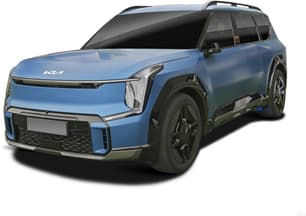
The Kia EV9 has landed and it’s a big bruiser-looking thing; all squared edges with a healthy dose of swagger thrown in.
It’s an upper-large SUV that can comfortably host a family of seven and features trimmings to rival a Christmas tree but it’s also the most expensive Kia to ever launch in Australia.
Did I mention it’s also only one of two cars in its class? That’s right, the nearest competitor is the all-electric Mercedes-Benz EQS450 SUV.
Yep, the Kia EV9 is fully electric but built like a tank. Yet is it breaking new ground or is it just the Carnival dolled up and sitting on electric underpinnings?
I’ve been driving it for the a week with my family of three to find out.
Mazda has updated one of its most popular, but rather old models.
Yes, the Mazda CX-3 is still around after more than a decade since its reveal, and it remains almost at the tippy-top of Mazda’s local sales charts.
With the brand having shifted 8221 CX-3s in the first half of 2025, it seems the light updates and modest price rise haven’t scared away any potential customers.
We’ve grabbed a CX-3 Evolve, the second-up of four available variants, to see if the popular light SUV still stacks up, or if you’re better off taking your money elsewhere.
The Kia EV9 GT-Line earns some serious family points with its practical and luxuriously appointed cabin. Each row enjoys ample amenities and space and you can’t discount the ability to fit five child seats!
That’s where similarities with its Carnival sibling end because the driving performance is too mixed for my liking. Some of its safety features don’t react well in real-world situations but if you’re looking for an electric car that will fit a big family, this ticks that box.
My son thinks the EV9 is really cool with the ambient lighting and two sun roofs. He also loves having his own climate control and sun-blinds, so he gives it a 10/10.
‘You get what you pay for’ comes to mind with the CX-3, which is interesting given it’s neither the newest nor most feature-packed SUV in its class.
The ageing light SUV does however offer one of the best-put-together experiences in a car of this size and its engine is powerful for the class. Build quality feels well above par and there aren’t any annoying inclusions that are becoming more common in new cars.
There aren’t many downsides unless you were hoping for a big screen and the ability to play around with software functions, but at this end of the new car spectrum, a car that drives this well and remains stylish a decade on should be applauded.
Put aside its relative (but forgivable) lack of efficiency and somewhat smaller boot than rivals, and the CX-3 nails everything it needs to.
To be frank, the EV9 resembles a Lego car on steroids, but it turns heads. I’ve had more looky-loos peeking into the windows this week than any other car I’ve driven.
Once you get over the (very) square shape, there are some awesome design aspects to be had.
Like the flagship exclusive Matrix LED headlights and 'Ocean Blue Matte' paintwork that feels velvet-like under your hands. The black 21-inch alloy wheels and their aerodynamic covers look futuristic and cool.
The pronounced nose looks wide-set because of the positioning of the tall headlights separated by a strangely blank panel in the middle.
In fact, the whole exterior incorporates a slew of blank panels which reinforce the square look.
The flush auto door handles, big windows and dark roof give some cool-kid cred. The digital side mirrors are not for everyone but as a driver, you get used to them. The tech looks as though it's come straight out of sci-fi movie!
The interior is downright plush with the premium-looking upholstery and customisable 64-colour ambient lighting.
The dashboard has floating panels which create a cool 3D effect and even the badge on the steering wheel is illuminated.
There is a plethora of soft touchpoints throughout and the black headliner helps make the cavernous cabin feel almost cosy.
For one, there’s the way it looks inside and out.
The Mazda CX-3 hasn’t remained the most popular car in its segment on price, so the fact its styling continues to age gracefully in the design-focused light SUV segment (aimed at young or first-new car buyers) must have something to do with it.
While it’s been lightly updated a couple of times since 2014, the CX-3 is still in its first generation and has stood the test of time.
Looking like a jacked-up Mazda2, the CX-3 brings some traditional aesthetic to a category peppered with more divisive and daring (but admittedly admirable) designs like the Hyundai Venue, Suzuki Ignis (RIP) or the cute but prohibitively expensive Jeep Avenger.
Some elements of the CX-3, like the chrome trim around the grille or the black plastic cladding along the bottom of the body and around the wheel arches, seemed in the past like they had the potential to age poorly, but Mazda’s design language has only slowly changed since 2015, and the CX-3 still looks at-home in the brand’s line-up.
It’s not the most adventurous - even inside its layout is quite basic - but it does give off a premium vibe and the fact it plays things a little bit safe means the CX-3’s broad appeal is undeniable.
It’s large and you have ample space throughout the car. Even third rowers don’t miss out.
It feels quite van-like with the high seat positioning and extending centre console but you get a great view out of the massive windows.
The electrically-adjustable front seats are very comfortable but the mesh ergonomic headrests are a little too comfy!
The boxy steering wheel is nice to use but cut into my vision of the climate control screen from my driving position. I felt like I was looking around it a lot.
Individual storage is fantastic in all three rows. Up front you get a little pocket in the armrest and a huge shelf underneath the centre console.
The glove box is large, but curiously, has a small aperture. There are retractable cupholders in the centre console utility tray and drink bottle holders in each door.
The middle row has two drink bottle holders, four cupholders, two map pockets and a deep but narrow storage cubby at the back of the centre console.
Third rowers are not forgotten, either, with four cupholders and directional air vents to enjoy.
Amenities are great throughout the car and my son loves having the retractable sun-blinds and his own climate control in the middle row. It’s also an easy car to get in and out of, which we both enjoy!
The middle row's 60/40 split is a practical touch and they can be shifted manually or electrically with a one-touch button for access to the third row.
Speaking of which, there is an okay amount of room for my 168cm (5'6") height in the third row (if you push the middle row forward a smidge). And it doesn’t feel claustrophobic thanks to the wide windows.
If you have a pile of kids to shove in this car, you’ll be happy that this row also features two ISOFIX child seat mounts and two top tethers.
I wouldn’t want to be climbing into the third row to buckle in a kid, so reserve these seats for older kids.
The technology looks good but is simple to use which is always a good combination. There are plenty of charging options to choose from with each row getting two USB-C ports, while the front also enjoys a 12-volt socket and a wireless charging pad.
The touchscreen multimedia system is responsive and easy enough to use but the controls on this panel can be difficult to see and use. They’re not always responsive.
I like the satellite navigation and the way the head-up display pulls through the directions. There’s wired Apple CarPlay and Android Auto, too.
The digital instrument cluster is mildly customisable and easy to read. There is a little control panel on the driver’s door which houses the buttons for most of the added seat functions. But it’s hard to read as all the buttons are almost identical.
The boot is a good size when all seats are in use at 333L, which is plenty for my day-to-day errands, but pop the third row down and that jumps up to 828L.
Not as big as you might expect in a car of this size but that’s the compromise of going electric. The batteries have to go somewhere.
You do get a 52L frunk at the front, for cable storage. The loading space is level and you only get a tyre repair kit rather than a physical spare but it’s handy having the powered tailgate.
The Mazda CX-3 isn’t the most spacious light SUV on the inside, but from either of the front seats it’s clear a lot of thought has gone into the best way to make the cabin work.
For example, precious space hasn’t been wasted by two dedicated cupholders, instead there’s a cupholder in the central storage compartment that’s relatively easy to reach into.
Like its design and some of its features, the CX-3’s layout can’t hide its age - there are still big physical controls for the climate settings, the speedometer is a physical dial and the gear selector is a very traditional style.
Mazda’s soon-to-be-gone media control wheel persists in the CX-3, which is by no means a bad thing. It falls nicely to hand, as with many of the controls in the CX-3. Its seating position isn’t too high and the positions you’re able to get the seat and steering wheel into should accommodate most humans.
Behind the front seats it’s a little more spartan. Space is at a premium, with my 178cm frame fitting in the back seat just enough that I had a fair bit of headroom, but my knees were able to brush the seat in front, set to my own driving position.
There are no ports for charging or vents in the second row, but the fold-down armrest has a clever fold-away cupholder. The window shoulder is a little high for young kids to properly see out, but there’s enough light that it doesn’t feel cramped.
The boot is similarly diminutive, a 264-litre space becoming 1174L with the second row folded down. Compare it with the Hyundai Venue and its 355-litre boot, or the Toyota Yaris Cross and its 390 litres, and the CX-3’s simple, well-constructed interior starts to lose points.
There are three variants for the EV9 and our test vehicle is the flagship GT-Line model that will cost you $121,000, before on road costs. That makes it the most expensive Kia to date, with the top-spec Carnival Platinum diesel only costing $67,580 (MSRP).
However, it’s nearest rival, the Mercedes EQS450 SUV, sits at $194,900 making the EV9 look downright cheap with the $73,900 price difference.
Yes, you could argue the badges would always offer a little price difference but Kia has made a true flagship model in the GT-Line because it is stupidly well-specified. It’s almost a case of what doesn’t it come with!
In terms of luxury appointments, occupants enjoy two sunroofs and two-toned synthetic leather upholstery. The electric front seats feature heat and ventilation functions, adjustable lumbar support and the driver gets a massage function.
The front seats have a relaxation mode, which I liken to the reclining seats in business class (someone send me on a trip to confirm!).
If you recline, add the sounds of nature feature and pop on the massage function, it’s like you’re in a day spa. Delightful.
The middle row outboard seats are also heated and ventilated which adds a lot of comfort and there’s a heated steering wheel, too.
Other standard equipment includes 21-inch alloy wheels, flush door handles, digital side mirrors, privacy tinted rear glass, pixel matrix LED headlights, 14-speaker Meridian premium sound and remote parking assist.
Practical features include a powered tailgate, extendable sun visors, retractable sun-blinds and three-zone climate control.
The technology is upmarket with dual 12.3-inch digital screens covering instrumentation and multimedia. There's also a 5.0-inch ‘quick-look’ climate control panel. A full tech run-down will come later.
Upon updating the Mazda CX-3, the Evolve variant is now a $32,100 ask before on-road costs, which is $900 more than before. It’s a little step up from the $30,370 entry price of the Pure, but falls well short of the top-spec Akari’s $38,890 sticker price.
The CX-3 range now comes with updated autonomous emergency braking and adaptive cruise control, with the Evolve specifically scoring new fog lights and keyless entry.
The Evolve also comes with black machined 18-inch alloy wheels, synthetic leather interior trim and front parking sensors.
This is all on top of the CX-3’s standard kit which includes a leather-wrapped gear shift knob, handbrake handle and steering wheel, keyless start, an 8.0-inch multimedia display, wireless Apple CarPlay and wired Android Auto plus LED headlights, daytime running lights and tail-lights.
For its segment, the CX-3 isn’t cheap. The Evolve grade is more expensive than pretty much the entire line-ups of rivals like the Kia Stonic or Hyundai Venue, and its price somewhat lines up with the newer, hybrid-powered Toyota Yaris Cross.
But there’s more to the CX-3 than just a list of features.
The EV9 GT-Line is a pure-electric AWD with dual motors, one located at each end of the car, producing a maximum power output of 283kW and 700Nm of torque. It has a lithium-ion battery with a big capacity of 99.8kWh.
Overall, the EV9 GT-Line is powerful and capable of sprinting from 0-100km/h in just 5.3 seconds. That’s impressive for such a heavy car with a 2500kg (braked) towing capacity.
The Mazda CX-3 is still powered by a 2.0-litre, naturally aspirated, four-cylinder petrol engine, as has been the case for years. Its outputs remain at 110kW/195Nm.
It drives the front wheels only, via a six-speed automatic transmission.
It's a hulk of a thing to have to move around and the motors perform brilliantly, but my energy cycle figure surprisingly came out at only 21.4kWh, after mostly open-road driving.
The official combined energy cycle is 22.8kWh, so that's a solid result.
The driving range is up to 505km, which takes the sting out of any range anxiety.
The EV9 features a Type 2 CCS port as well as an 11kW AC charger and you can get from 10 to 100 per cent in just over nine hours.
On a 50kW DC charger, you’d see that time drop to just 83 minutes to get from 10 to 80 per cent and it will shrink to 24-minutes on a 350kW charger.
A cool feature is the vehicle-to-load capability, so you can charge and/or power larger appliances on the go. Hello camping!
Mazda claims the CX-3 sips 6.3 litres of fuel per 100km, minimum 91 RON petrol, though on test the small SUV returned an 8.1L/100km figure under a mix of urban, highway and some dynamic driving.
With its 48-litre fuel tank, that means you’re realistically likely to get about 550km to a tank, though theoretically given Mazda’s efficiency claim a 760km trip on a single tank would be possible - if you could recreate the test lab conditions.
Strangely for a large SUV, this car feels most at home in an urban environment. It’s in the city where it feels nimble and easy to manoeuvre. Zippy even, and you don’t notice it’s size.
But it’s a different story on the open road.
At higher speeds there is a lot of movement in the body and thanks to its floaty suspension the amount of roll in corners starts to make it feel cumbersome.
It has the power to handle mountain driving or overtaking, but remains a bit unsure of itself in these situations.
The steering is responsive and concise, which makes for a nice driving experience in the city and navigating a car park.
The cabin gets very little noise thanks in part to sound-absorbing acoustic glass and foam in the tyres. It makes for a fairly pleasant journey overall.
As a passenger, though, I began to suffer motion sickness thanks to the digital side mirrors! Not an issue when I’m driving, but even my husband, who has an iron stomach, commented on how distracting they are.
It’s nice having a column shifter, as it helps open up the storage in the centre console but it can make pressing the push-start button a bit awkward.
The EV9 has a decent 12.4m turning circle and is relatively easy to park. The 360-degree view camera system is clear and I love having the front and rear parking sensors on this big boy.
But to access the front camera, you have to be in Drive. You can’t select it on the touchscreen, which is a pain when you’re manoeuvring into a tight space.
If you’re not confident, the EV9 also features an updated park itself feature which means you can park it remotely from your key fob.
The light SUV category is an interesting one, as it feels somewhat like a gateway to bigger SUVs for those who get a taste of the higher seating position. But in city and urban areas, a light SUV should be as much car as someone needs - unless they have two kids or a bunch of equipment to get around with.
This comes down to the fact cars like the CX-3 are more efficient and easier to manoeuvre than their larger counterparts. And as light SUVs go, the CX-3 feels solid, confidence inspiring and more capable when outside its inner-city comfort zone.
Its naturally aspirated engine is big for the class. Even if it doesn’t feel the punchiest off the line it offers plenty of flexibility at higher speeds and makes overtaking on the highway feel less daunting than it would otherwise be in a car this small.
Its steering is light, which is an advantage in everyday driving, but has enough feedback that more dynamic driving is still engaging. It’s not sportscar-sharp, but you wouldn’t want it to be.
While its age would suggest the CX-3 should feel unrefined compared to newer small cars and light SUVs because of what lies underneath, Mazda’s work on the little SUV over the years has resulted in a car that feels mature and capable.
The suspension isn’t perfect, but it manages low-to medium speeds elegantly and does a decent job of maintaining stability at high speeds. It feels better than you’d expect from a car this size on the highway.
The 1294kg kerb weight and small-enough 18-inch wheels mean there’s not too much weight to manage, and there’s enough cushion in the tyres that harsh bumps don’t come crashing into the cabin.
While the CX-3 feels refined for its class, don’t expect a dead-quiet ride, as some road and wind noise make their way in above 80km/h. Then there’s the fact its engine and transmission will sometimes need to get a bit raucous when accelerating quickly. Aside from this, the CX-3 around town and in suburban areas feels nice and calm.
The EV9 has an extensive safety list and the blind-spot view monitor, which pops a video feed of your blind spot onto your dash, is a stand-out feature.
Standard safety items include blind-spot monitoring, lane departure alert, daytime running lights, forward collision warning, side collision warning, rear-cross collision warning, rear cross-traffic alert, intelligent seatbelt reminders, a 360-degree view camera system, as well as front and rear parking sensors.
There are other items but I need to call out their sensitivity issues.
The driver attention monitor doesn’t always activate when you have sunglasses on and alerts you via multiple warning sounds and alerts on the instrument cluster.
The lane keeping aid is rather aggressive, which makes for a jerky on-road experience, and the adaptive cruise control with stop/go functionality isn’t nice to use.
Even on the shorter distance setting, it slows down way too fast when approaching a car in front.
Also, annoyingly, this model features all the warning chimes and alerts that are linked to the traffic sign recognition tech.
Go over the speed limit by one kay, chime. Enter a school zone, several chimes. If the speed sign changes, chime. If the traffic sign changes, you guessed it, CHIME.
Suffice it to say I don’t like this feature.
There's an option in the car set-up menu that turns off the warning sounds but keeps the important sign information. However, it's not permanent and has to be selected every time you turn on the car.
In better news, the Kia EV9 has just been awarded a maximum five-star ANCAP safety rating and features nine airbags which includes curtain airbags covering all three rows and side chest airbags for the second row.
Usually, you only see side chest airbags on the front row, so this is great! It also sports a front centre airbag to protect the front row from head clash injuries.
The EV9 has autonomous emergency braking with car, pedestrian and cyclist detection as well as junction turning assist.
It's operational from 10 to 80km/h but surprisingly, the car-to-car avoidance is only operational from 10 to 60km/h.
That upper speed figure usually sits closer to 160km/h. Unless there is a typo on ANCAPs website…
Families will rejoice that there is a total of four ISOFIX child seat mounts (two in the middle row and two in the third row) plus a total of five top-tether anchor points.
The car is large enough to accommodate five child seats and there’s plenty of room for front passengers when a 0-4 rearward facing child seat is installed on the middle row. It’s pretty much a people mover at this point!
The Mazda CX-3 is technically unrated by ANCAP, though only because its original maximum five-star rating expired after seven years. While this means it easily passes many of ANCAP’s main criteria for safety (and strict Australian Design Rules - ADRs - to be able to be sold here), the CX-3 is missing some recent, more complex safety features.
Not everything is standard across the line-up, either. The Evolve misses out on adaptive headlights, a surround-view parking camera and traffic sign recognition. The base Pure variant also misses out on a front parking sensor.
Fortunately, there are plenty of other key features like seven airbags, dual-front and front-side plus curtain airbags spanning the sides. The CX-3 also has ABS and emergency braking with forward pedestrian detection and rear cross-traffic alert.
There’s lane departure warning, forward obstruction warning, blind-spot monitoring and a driver attention alert for those times you might miss something or - hopefully not often - are distracted.
All these systems are programmed well to minimise interference while driving, making the CX-3 refreshingly trusting of the driver to actually do the job of driving.
The EV9 comes with a seven-year/unlimited km warranty, while its battery is covered for seven years, 160,000km. It’s normal to see an eight-year battery warranty term for EVs, though.
You can pre-purchase a three-, five-, or seven-year servicing plan, priced at $706, $1351 and $1997, respectively.
The seven-year schedule costs an average of $285 per service, which is good, but servicing intervals are more in line with a fuel-based car at every 12 months or 15,000km, whichever occurs first.
Mazda offers a five-year, unlimited kilometre warranty, which is behind the curve for a mainstream brand these days. Rival brands like Kia and Hyundai offer seven years, for example, with some offering up to 10.
Servicing is undertaken every 12 months or 15,000km, whichever comes first, with servicing costing between $353 and $633 per visit. Total cost over the first seven years currently sits at $3233, averaging $462 a service, which is pricey considering the relatively simple mechanicals under the CX-3.
Mazda says there are more than 150 certified service dealerships across the country, with a tool to find the most convenient one for you. Given the CX-3’s advanced age, chances are there won’t be too many mechanical issues that haven’t been worked out in the last decade.