What's the difference?
Jeep's Renegade might be late to the mini-SUV party but it comes with a pretty impressive back catalogue to suggest that this is a SUV that can cash the cheques its name can write.
The top of the range Trailhawk can write even bigger cheques than the lower models, bringing with it a range of off-road tech toys to let you really get down and dirty.
Now that the original Mitsubishi ASX is finally gone, the oldest small SUVs still on sale in Australia today are the Mazda CX-3 and Suzuki Vitara.
Both released in 2015, their longevity is due to a combination of good design, strong engineering, sound driving dynamics and an undefinable charm.
Given their high number of rotations around the sun, it’s also surprising that neither has received a major facelift in all this time. Clearly, their creators got it largely right early on.
Until now. The Vitara steps up with the Series III makeover, ushering in a fresh nose, larger central touchscreen and a hybrid tech upgrade for the (now-sole) turbo powertrain, among other more-minor changes.
Are these enough to keep the venerable Vitara from vulnerability?
Rugged, dependable and good off-road are the most obvious qualities of the Trailhawk. It stands out from the rest of the mini-SUVs by being able to do the S and the U with plenty of vigour.
It's just a shame that its on-road manners can't match that of its big brother, the Cherokee. Unless you're planning on proper off-roading, the Trailhawk might not be quite what you're looking for.
In car years, 11 is ancient.
Back when it was first released, this-generation Vitara’s competitive pricing, progressive yet pretty design, pleasant interior packaging, sporty dynamics and general driving ease helped establish the emerging small SUV segment into the powerhouse it is today.
In some ways, today’s Turbo Hybrid still impresses, especially with its punchy performance, promising economy and no-nonsense packaging. Objectively, it is still a decent proposition, with few actual vices.
But the 2026 Vitara’s high pricing, embarrassingly outdated interior, underwhelming specification and noisy ride leave it feeling too expensive, too old and too exposed against newer and more-sophisticated rivals.
Even the brightest stars eventually need to retire.
Note: CarsGuide attended this event as a guest of the manufacturer, with travel and meals provided.
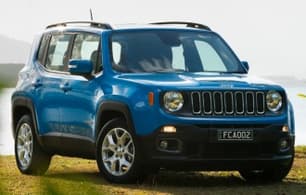
In what is absolutely not a coincidence, the Renegade immediately conjures up the Wrangler. Upright grille from the Willys Jeep (references abound here), round headlights, squared off wheel arches to mimic the Wrangler's guards, short overhangs and big rear view mirrors.
The 17-inch wheels look completely lost in the wheelarches which are even more cavernous owing to the Trailhawk's 50mm of extra ride height. The wheels are also a bit cheap looking but will probably survive the belting the car is intended to take.
Less rugged is the interior, despite a fairly self-conscious effort to make it look and feel chunky. The front seats are flat and unsupportive with the rears just as lacklustre making sure everyone is sliding around together. Luckily, front passengers get a dash-mounted grab handle.
It seems quite well put together, however, but with carpets and easily-marked plastics, you'll hope your passengers don't bring the mud in with them too often. And the "Since 1941" stamped into the steering wheel can go.
The dashboard is reasonably clear and has plenty of information to share via the screen between the dials but whoever thought marking the redline with a water splash graphic in bright orange should probably rethink their design decisions.
Storage is limited to two cupholders up front, door pockets in each door and nets on the front seat backs.
While the albeit-cheeky Mazda CX-3 clearly looks like a product of last decade, the Vitara’s boxy, broad-stance proportions were prescient, pointing to the upright shapes that prevail today. In other words, the good-looking design has aged remarkably well.
Changes to the headlights, a reshaped bumper, a revised grille, restyled wheels and paint colours are the only ways you can differentiate new from old, ignoring the Hybrid badge out back.
We wonder whether Suzuki should have tried harder visually updating the Vitara?
Measuring in at nearly 4.2 metres long, 1.8m wide and 1.6m high, the square-rigged styling hides the smallness of the Vitara, yet also seems to liberate more space inside than you might expect, aided by deep side windows.
Conversely, Suzuki’s decision to retain the old Vitara dashboard – including much of the same instrumentation – roots it into the middle of last decade. This is very disappointing.
The Renegade range starts at $28,000 for the 1.6-litre Renegade Sport manual front-wheel drive, climbing between $2000 and $3000 through the Sport Auto, Longitude Auto, Limited Auto with a final jump of $4000 to the 2.4-litre auto-only Trailhawk.
Standard is a nine-speaker stereo with Bluetooth and USB, 17-inch alloys, dual-zone climate control, reversing camera, rear parking sensors, keyless entry and start, cruise control, electric front seats with heating, satellite navigation, automatic bi-xenon headlights, auto wipers, leather trim, roof rails, front and middle bash plates, full size spare, heated leather steering wheel, privacy glass, trailer sway control and tyre pressure monitoring.
The lairy Omaha orange is $500, part of an eleven colour palette with only two no-cost paint options (black and white).
You can add lane departure warning, auto-parking and a black painted roof for $500 each, a removable and retractable roof called My Sky Roof for $2200 or a more conventional electric sunroof for $1900.
The Beats-branded nine-speaker stereo is run via Fiat-Chryser's UConnect system, accessible through the 6.5-inch touchscreen. While it improves with every attempt, it's still quite clunky and when the sat-nav is added, becomes a bit of a mess.
Thankfully, not every function has been crammed into the touchscreen interface, so you'll spend more time with your hands on the wheel rather than working out which bit of the screen has the climate control.
From $39,990 (all prices are drive-away unless stated otherwise), 2026’s cheapest Vitara, the Turbo Hybrid 2WD, seems provocatively expensive for an 11-year-old generation. And the all-wheel drive (AWD) model dubbed 'AllGrip' is a heady $46,000. Oof.
This puts the base Vitara’s price well above Chinese hybrid equivalents like the Haval Jolion HEV and MG ZS Hybrid+, about on a par with popular small-SUV hybrids including the Honda HR-V, Hyundai Kona and Toyota Corolla Cross, and in company with lower-spec petrol-powered iterations of the Honda CR-V, Hyundai Tucson, Kia Seltos, Kia Sportage, Mazda CX-30, Mitsubishi ASX, Mitsubishi Outlander, Nissan X-Trail, Renault Duster, Subaru Crosstrek, Skoda Kamiq, Volkswagen T-Cross and VW T-Roc.
Facing a lion’s den of fierce rivals is putting things mildly. The Vitara’s value struggles to stack up.
But consider this.
Back in 2015, the base Vitara cost $23K, drive-away – or $31.4K in 2026 money adjusted for inflation. However, that was for a 1.6-litre petrol manual; the auto added the equivalent of another $2.7K and the optional turbo that came soon after (dubbed 'BoosterJet' – and now standard equipment) cost another $6.8K, coming to $41K.
Huh. Suzuki isn’t being so delusionally greedy, then.
And that’s not taking in the latest model’s unique hybrid tech, extra safety of advanced driver-assist technologies (ADAS) such as autonomous emergency braking (AEB), rear cross-traffic alert (RCTA), lane departure warning and blind-spot monitoring, or Apple CarPlay/Android Auto connectivity, or a host of other extra features that have since been applied to an evolving Vitara over the years. Plus, import costs from Hungary are said to have skyrocketed.
If we compare what the 2026 Turbo Hybrid 2WD costs against the pre-facelift 2024 Turbo 2WD from $36,490, before on-road costs, the price rises aren’t nearly as bad as they seem (though runout ’24-build models are currently being promoted at $34,590, drive-away).
So, what else does your $40K-plus Vitara Turbo Hybrid give you?
Not much compared to most of the competition listed earlier. Climate control, rear privacy glass, LED automatic headlights, cloth upholstery, adaptive cruise control, a 7.0-inch touchscreen, reversing camera, 17-inch alloy wheels and flat paint are bare minimum at this price point.
Metallic paint demands another $745 if the standard white isn’t your bag.
Stretching to the $45,990 AWD adds a panoramic sunroof, 9.0-inch touchscreen, six instead of four speakers, extra driving modes, synthetic leather trim and two extra modish colours – beige or grey-blue that are also available with a two-tone black combo for an extra $1345.
The Vitara is over a decade old, but costs new-model money, lacks features found in rivals costing thousands less and only allows for a five-year warranty when some others offer up to 10.
Obama was US President when this Suzuki launched. The world it finds itself in today seems almost unrecognisable.
The Trailhawk is powered by Fiat's 2.4-litre four naturally-aspirated four-cylinder producing 129 kW and 230 Nm. Jeep reckons you'll get 7.5L/100km on the combined cycle. Our mostly city driving with a longish motorway run produced an 11.0L/100km average over a week.
The transmission is a nine-speed ZF automatic driving all four wheels.
The Trailhawk also has Jeep's five mode Selec-Terrain system which should cover pretty much every eventuality – Auto, Sport, Mud, Sand and, just for the Trailhawk, Rock. The Trailhawk is rated to tow 400kg unbraked and 907kg braked.
If you’re expecting a Toyota-style series-parallel hybrid system here, forget it.
Instead, Suzuki offers a far-simpler, lighter and cheaper alternative that, by and large, does reduce fuel consumption. In other words, this is a mild-hybrid electric vehicle (MHEV) that, unlike others like Mazda’s, you can feel working away.
On paper, things look a bit shaky, since power drops noticeably compared to the previous 1.4-litre, four-cylinder, turbo-petrol BoosterJet engine this unit is based on.
This version makes just under 81kW of power at 4500rpm, instead of 103kW at 5500rpm, in the interests of economy. Torque jumps though, from 220Nm to 235Nm, between a low 2000rpm to 2500rpm.
More importantly, it is coupled to a 48-volt integrated starter motor generator acting as an electric motor, and 48V 8Ah lithium-ion battery, adding an additional 12kW/50Nm to simultaneously boost acceleration and reduce consumption and emissions.
Power is sent to the front wheels via a six-speed torque-converter automatic transmission, while the AWD version also sends drive to the rear axle when slippage is detected.
The whole MHEV system adds just 15kg, and is nestled between the MacPherson strut front axle and torsion beam rear end, for even weight distribution.
The Trailhawk name suggest that things are going to get muddy – compared to the rest of the range, the range-topper rides 50mm higher and has exposed, easy-to-reach tow hooks in the fairly unlikely event you get stuck. It also has a 20:1 low-range crawl ratio and Active Drive 4x4 which means it can switch between front and all-wheel drive. It'll also wade through almost half a metre of water. It's a genuine mud-plugging proposition and will take on some much bigger machinery out in the bush.
On the road, where we spent all our time in the Renegade, it's not what you'd call particularly inspiring. There's a number of sources of noise that contribute to a less than quiet cabin and having to constantly correct your course at freeway speeds adds to the tiring nature of the Renegade.
It's much better at lower speeds, pottering around but then again, its nine-speed transmission needs a lot more work on the shift mapping because it seems to forget which gear it needs to be in when you sink the right foot. If you don't need the Trailhawk's extra off-road goodies, consider the 1.4 litre Limited or Longitude.
Suzuki allowed only a frustratingly limited amount of time for us to drive the Vitara Turbo Hybrid 2WD, over some outer-suburban Sydney back roads, in convoy with a lead car and in heavy traffic, so first impressions are limited.
But, unsurprisingly, it’s all very familiar, after years of testing earlier iterations.
Essentially, acceleration now feels leisurely in 'Eco' and 'Auto' when previously the 1.4L BoosterJet always felt punchy, but it becomes much stronger in 'Sport', suggesting the MHEV’s economy focus is the priority. The latter mode makes the Vitara feel lively and moves things along fairly quickly, but leaving it in Sport mode would defeat the purpose of trying to save fuel.
Meanwhile, the Vitara’s chassis calibration remains on the sporty side, with keen steering response and a decent level of handling agility there for the taking. And even the ride comfort wasn’t too bad, considering that too little suspension travel and too much road noise betray the age of this vehicle’s platform – though that may have also had something to do with us driving this back-to-back with the smoother e-Vitara EV.
Finally, the ADAS tech didn’t seem to interfere at all, though a longer drive may reveal otherwise.
The Vitara still drives okay, then, but its refinement and noise suppression may be issues for some people used to newer SUVs. The bigger problem for us is just how old the driving experience feels sitting inside such a dated cabin. Stale sums it up.
We also had a brief stint around a moderately-demanding off-road 4WD course to test the Turbo Hybrid AWD’s AllGrip set-up. The limited off-road aids – 4WD Lock, hill-descent control, a paltry 175mm ground clearance – helped see it navigate several carefully-chosen sections fairly confidently, but we can’t imagine this being the deal maker or breaker.
Overall, based on our brief time with it, the Vitara Turbo Hybrid remains an easy, competent and even enjoyable small SUV from behind the wheel, but one that feels dated in too many areas, especially at its asking price.
Seven airbags (including driver's knee bag), traction and stability controls, roll mitigation, blind spot monitoring, ABS and brake assist.
The Renegade does not yet have an ANCAP star rating although it scored five EuroNCAP stars in 2014.
Back in 2015, the Vitara scored a maximum five-star ANCAP crash-test rating, but it hasn’t been tested since and that result expired in December, 2022.
Both models come with the expected level of ADAS tech, including AEB, RCTA, lane departure warning, lane keep assist, blind-spot monitor, traffic sign recognition, auto high beam and adaptive cruise control.
There is no data on the operation parameters of the latest AEB system, but previous models operated from above 30km/h while the RCTA functions from 8.0km/h.
Six airbags (dual front, side and curtain) are also featured, along with two outboard rear-seat ISOFIX points and a trio of top tethers for child seats.