What's the difference?
Jeep's Renegade might be late to the mini-SUV party but it comes with a pretty impressive back catalogue to suggest that this is a SUV that can cash the cheques its name can write.
The top of the range Trailhawk can write even bigger cheques than the lower models, bringing with it a range of off-road tech toys to let you really get down and dirty.
This is probably the most important new car launch of the year.
The 2026 Toyota RAV4 needs to be bang-on exactly what customers want, because it’s not only Toyota’s most popular model globally, it was the most popular new car in the world last year.
It’s also Toyota Australia’s second-most popular model behind the Toyota HiLux the highest-selling non-ute in the nation.
Crucially, The HiLux has just been launched in a new generation albeit not a revolutionary change, and it somewhat overlaps with the generation changeover of the RAV4.
Toyota is also facing a significant sales dip, the first quarter of sales for the brand in 2026 is down 23 per cent compared to the same time last year. It’s a bigger dip than the industry as a whole, as its market share is down from 19.9 per cent to 15.7 per cent in the same periods.
The new RAV4’s launch must bring strong sales as the vast majority of the brand’s dip is thanks to the mid-size SUV’s changeover.
But as well as an influx of new competitors, the RAV4 must also contend with a lack of ANCAP safety rating for its first few months on sale.
Has Toyota done enough to convince Australia its family SUV is still worthy of its position as the best-selling passenger car getting around? We headed to its Australian launch in Tasmania’s north to find out.
Rugged, dependable and good off-road are the most obvious qualities of the Trailhawk. It stands out from the rest of the mini-SUVs by being able to do the S and the U with plenty of vigour.
It's just a shame that its on-road manners can't match that of its big brother, the Cherokee. Unless you're planning on proper off-roading, the Trailhawk might not be quite what you're looking for.
The RAV4 is undeniably better than the last generation, and brings with it a level of driving refinement the most popular car in the world should have.
It also levels up its tech without falling into the overcomplicated, messy systems newcomers to the market think will impress buyers. While the base GX is a sound option, the few extra mod cons in the GXL are worth the extra cash.
But its lack of ANCAP rating is surely a point of anxiety for Toyota, and while the safety systems seem sound, we can’t definitively say this RAV4 is as safe as Toyota claims it is.
If you’re willing to trust Toyota on that, you’ll find a very enjoyable car that’s uncomplicated and efficient. But if those five stars from ANCAP matter to you, give it a few months and see how the new RAV4 performs before you put your money down.
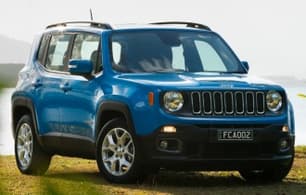
In what is absolutely not a coincidence, the Renegade immediately conjures up the Wrangler. Upright grille from the Willys Jeep (references abound here), round headlights, squared off wheel arches to mimic the Wrangler's guards, short overhangs and big rear view mirrors.
The 17-inch wheels look completely lost in the wheelarches which are even more cavernous owing to the Trailhawk's 50mm of extra ride height. The wheels are also a bit cheap looking but will probably survive the belting the car is intended to take.
Less rugged is the interior, despite a fairly self-conscious effort to make it look and feel chunky. The front seats are flat and unsupportive with the rears just as lacklustre making sure everyone is sliding around together. Luckily, front passengers get a dash-mounted grab handle.
It seems quite well put together, however, but with carpets and easily-marked plastics, you'll hope your passengers don't bring the mud in with them too often. And the "Since 1941" stamped into the steering wheel can go.
The dashboard is reasonably clear and has plenty of information to share via the screen between the dials but whoever thought marking the redline with a water splash graphic in bright orange should probably rethink their design decisions.
Storage is limited to two cupholders up front, door pockets in each door and nets on the front seat backs.
Each RAV4 in the range is more visually distinct than before, but most variants feature a similar honeycomb grille that’s a departure from the ‘safe’ design language Toyota is known for.
The outlier is the Edge variant, which gets a more traditional front-end treatment as well as its 20mm wider wheel tracks to go along with the intended purpose of light off-roading.
Despite the fact Toyota has clearly tried not to change the new RAV4 too much in too many ways compared to the last generation (and why would you when it was already so popular), the new design feels a little more adventurous.
It includes elements of Toyota’s latest design language including the ‘c-shaped’ headlights and more streamlined tail-lights but retains the overall size and shape of the RAV4.
The RAV4 is 4600mm long, 1855mm wide and 1680mm tall, a very similar size to before and as such its interior feels similarly spacious.
Inside, the layout is tidy with a little more visual distinction for controls than the last-gen RAV4.
Updated, sleeker buttons and controls replace the ageing fixtures and large screens make the mid-size SUV feel much more up to modern standards.
The Renegade range starts at $28,000 for the 1.6-litre Renegade Sport manual front-wheel drive, climbing between $2000 and $3000 through the Sport Auto, Longitude Auto, Limited Auto with a final jump of $4000 to the 2.4-litre auto-only Trailhawk.
Standard is a nine-speaker stereo with Bluetooth and USB, 17-inch alloys, dual-zone climate control, reversing camera, rear parking sensors, keyless entry and start, cruise control, electric front seats with heating, satellite navigation, automatic bi-xenon headlights, auto wipers, leather trim, roof rails, front and middle bash plates, full size spare, heated leather steering wheel, privacy glass, trailer sway control and tyre pressure monitoring.
The lairy Omaha orange is $500, part of an eleven colour palette with only two no-cost paint options (black and white).
You can add lane departure warning, auto-parking and a black painted roof for $500 each, a removable and retractable roof called My Sky Roof for $2200 or a more conventional electric sunroof for $1900.
The Beats-branded nine-speaker stereo is run via Fiat-Chryser's UConnect system, accessible through the 6.5-inch touchscreen. While it improves with every attempt, it's still quite clunky and when the sat-nav is added, becomes a bit of a mess.
Thankfully, not every function has been crammed into the touchscreen interface, so you'll spend more time with your hands on the wheel rather than working out which bit of the screen has the climate control.
The RAV4 is more expensive than it was before. Of course it is.
That’s because it comes with more stuff, and it’s got new oily bits and more software to play with, plus everything gets more expensive anyway, right?
There are five trim levels, most with 2WD or AWD options and the base GX starts from $45,990, before on-road costs, in 2WD guise - a few thousand more than before.
Standard kit isn’t mind-blowing compared with a lot of newcomers to the market, but for an established model like the RAV4 it’s expected.
The GX (which can be had in AWD for $49,340) comes with 17-inch dark grey alloy wheels, LED headlights, dual-zone climate control, a 10.5-inch touchscreen display for multimedia, a 12.3-inch digital instrument cluster, fabric upholstery, six-speaker audio and five USB-C ports plus wireless Apple CarPlay and Android Auto.
If you opt for all-wheel drive, you also get downhill assist control and 'Trail' and 'Snow' drive modes.
Importantly, the RAV4 comes with a spare wheel, though on the GX it’s just a space-saver which costs $300 to upgrade to a full-sizer.
The $48,990 GXL adds 18-inch alloy wheels, privacy tinting, an eight-way powered driver’s seat, rain-sensing wipers and a wireless smartphone charger. That one’s $52,340 in AWD guise.
The Edge is $55,340, comes in AWD-only, and has its own front-end design plus 18-inch dark matt grey metallic alloy wheels on a 20mm wider track, plus a larger 12.9-inch touchscreen, premium trim, heated seats, illuminated entry and a power tailgate. It’s the variant Toyota says is more aimed at light off-roading than its siblings.
The XSE is also AWD-only and starts at $58,340, with 20-inch black alloy wheels, better LED headlights, a surround view parking monitor and two-tone paint. It also has synthetic leather and suede sports front seats with contrast stitching and three-stage front seat heating and ventilation, plus a sunroof. Front and rear bumpers feature integrated skid plates on the XSE.
The Cruiser is available as a 2WD from $56,990, or AWD from $60,340, and adds 20-inch machined black alloy wheels, high-grade LED headlights, leather-accented seat trim, a head-up display, digital rearview mirror, heated outboard rear seats, powered tailgate with kick sensor, another wireless smartphone charger and a premium nine-speaker JBL audio system.
The Trailhawk is powered by Fiat's 2.4-litre four naturally-aspirated four-cylinder producing 129 kW and 230 Nm. Jeep reckons you'll get 7.5L/100km on the combined cycle. Our mostly city driving with a longish motorway run produced an 11.0L/100km average over a week.
The transmission is a nine-speed ZF automatic driving all four wheels.
The Trailhawk also has Jeep's five mode Selec-Terrain system which should cover pretty much every eventuality – Auto, Sport, Mud, Sand and, just for the Trailhawk, Rock. The Trailhawk is rated to tow 400kg unbraked and 907kg braked.
The 2.5-litre four-cylinder engine with series-parallel hybrid is less powerful than before, but Toyota says it did this for better efficiency and has made up for it with improvements to the battery and electric motors.
The figures are now 143kW and 221Nm (in 2WD and AWD variants), the power down from 160kW in the last generation. All RAV4s still use a continuously variable transmission (CVT).
Basically, lower numbers, but performance on par with the current RAV4 Hybrid according to Toyota.
The Trailhawk name suggest that things are going to get muddy – compared to the rest of the range, the range-topper rides 50mm higher and has exposed, easy-to-reach tow hooks in the fairly unlikely event you get stuck. It also has a 20:1 low-range crawl ratio and Active Drive 4x4 which means it can switch between front and all-wheel drive. It'll also wade through almost half a metre of water. It's a genuine mud-plugging proposition and will take on some much bigger machinery out in the bush.
On the road, where we spent all our time in the Renegade, it's not what you'd call particularly inspiring. There's a number of sources of noise that contribute to a less than quiet cabin and having to constantly correct your course at freeway speeds adds to the tiring nature of the Renegade.
It's much better at lower speeds, pottering around but then again, its nine-speed transmission needs a lot more work on the shift mapping because it seems to forget which gear it needs to be in when you sink the right foot. If you don't need the Trailhawk's extra off-road goodies, consider the 1.4 litre Limited or Longitude.
Put it this way - the RAV4 doesn’t feel like it’s lacking power. Despite the lower output, the new generation car doesn’t seem to struggle with having enough pick-up to keep moving along, even in spirited driving.
The first time I properly took off it surprised me with how punchy the response was. And from there on the new RAV continued to impress.
It’s one of a few things that, dare I say, makes the RAV4 rather fun to drive.
Like its predecessor, it’s built on the 'TNGA' platform, which underpins pretty much everything Toyota builds these days.
It’s a well-sorted basis for a car, making even this relatively large family SUV feel nimble.
Some changes to the suspension help here, too. New geometry and spring and damper rates mean the RAV4 is sharper and better controlled than before.
That control comes with the trade-off that it’s not always cloud-soft, but given Australian preferences and the need to keep the rubber on our rough as guts roads, Toyota has the balance right here.
It also hasn’t seemed to matter massively whether the RAV4 is front- or all-wheel drive even in the wet on twisty Tassie roads. The 2WD requires a little more care being flung into corners but the mid-sizer holds its own well enough.
There’s clearly more ability in the RAV4 than it’ll make known, almost as to keep the driver behaving safely just in case, while being confident in knowing the RAV4 is more capable than many will ever find out.
It’s handled high speeds, sharp corners and unsealed roads to a higher degree than anyone would reasonably expect of a family SUV.
It helps that the steering, throttle and braking are all well-calibrated. Planting your foot brings urgency without a jolt, there’s no guesswork in the steering and the brakes won’t have you lurching at a tap but can pull you up rather rapidly if needed.
It’s easy to drive, which is pretty big compliment and surely one of the key goals for the engineering team.
Seven airbags (including driver's knee bag), traction and stability controls, roll mitigation, blind spot monitoring, ABS and brake assist.
The Renegade does not yet have an ANCAP star rating although it scored five EuroNCAP stars in 2014.
Toyota doesn’t have an ANCAP rating for the RAV4 yet, which is a massive problem for the brand, especially for its fleet buyers.
The systems in place seem pretty sound, and the brand says it’s the safest RAV4 yet.
We have no reason to doubt that, but we can’t just take a manufacturer at their word, that’s why ANCAP exists.
Eight airbags, AEB pre-collision, emergency steering assist, full-speed active cruise control, front and rear cross traffic alert, lane trace, automatic high beam, parking support brake and blind spot monitor are all standard across the range, which is a plus.
It’s also all quite well programmed.
From behind the wheel, you’ll notice persistent but gentle steering wheel nudges when approaching the shoulder, and occasional chimes for driver distraction when using the main screen, but otherwise it’s very well calibrated and cements the experience Toyota has with making its systems easy to use.