What's the difference?
Yet another Chinese-branded EV has arrived on our shores and if the name Jaecoo doesn’t ring a bell, that’s understandable. It’s a relatively new offshoot of Chery, making its presence felt with a growing line-up aimed squarely at everyday buyers. Think mainstream, built around accessible pricing and a decent spread of features.
Offered in a single grade, the Jaecoo J5 EV is a small SUV entering an already crowded segment. It goes up against familiar names like the BYD Atto 2, Chery E5 and MG S5 EV, all offering broadly similar promises on paper. The real question, then, is whether the J5 EV manages to carve out an identity of its own, and whether its appeal stretches beyond the price tag.
When the GLB arrived in Australia in 2020 it did so to much fanfare as the little premium SUV which could do it all.
It had seven-seats, ideal dimensions slotting underneath the mid-size GLC, the option of all-wheel drive, and even a go-fast AMG version to boot.
Now, the clever little luxury SUV can add another headline feature - it’s gone fully electric.
The EQB, like the EQA before it, follows the formula of its donor car to a T, being familiar for an existing Mercedes buyer whilst also making the jump to a fully electric drivetrain.
For now it comes in two variants, a two-wheel drive with seven seats, and a five-seat all-wheel drive which leans more on the performance aspect of its electric drivetrain. Is the trade-off worth it?
The answer is: It depends. Read on to find out why.
The Jaecoo J5 EV makes a strong first impression and a quieter long-term one. The J5 looks the part, feels comfortable and covers all the basics well, making it an easy choice for buyers who want an affordable, practical EV without too many compromises.
It’s a solid effort overall, though even at this lower price point a few more rear-seat features would be welcome - especially given this is the only grade currently available. However, it hits the right notes when it comes to ownership and value which will be its strongest pull.
I really liked the combustion version of this car, the GLB, for its funky style and flexibility and I was pleased to find how easily Mercedes has made the conversion to a fully-electric layout for the EQB.
Despite a tall price, the EQB 350 is a compelling option for those seeking something a bit more luxurious than the Tesla Model Y, something a bit larger than the Volvo XC40 Recharge, and something a bit smaller than the Audi e-tron or the EQC.
The main trade-off for this 350 variant is the loss of the seven-seat layout in favour of more performance. Instead it offers a huge boot, has a sufficient range for city-based buyers, and offers surprising levels of fun, too.
Just make sure you’ve considered its rivals which may potentially offer more range or features for the same money.
The Jaecoo J5 EV is a handsome-looking small SUV. Its suite of LED lighting, 18-inch alloy wheels and upright, robust silhouette give it plenty of presence, particularly for something positioned at the affordable end of the EV market. That said, originality isn’t really its strong suit. The design, especially from the rear, feels heavily inspired by a Range Rover. Imitation may be the highest form of flattery but Jaecoo could have pushed the design in a slightly more distinctive direction.
It looks good on the road, though, and inside, the J5 has a genuinely airy feel. Light-coloured synthetic upholstery and the expansive panoramic glass roof help the cabin feel open and welcoming, particularly from the front seats. The design is modern and tech-focused, with the large 13.2-inch display taking centre stage on the dashboard.
The overall layout is clean and undeniably premium in its presentation, though it doesn’t bring a great deal of personality with it. That’s becoming a familiar theme, especially in this part of the EV market, where minimalism and screens often take priority over character.
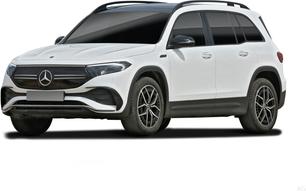
The EQB has a very predictable design in that it doesn't stray from the combustion car’s formula. At all.
The only evidence from the outside this is the electric version is the blanked out grille, and closer observers might notice the rear light bar which cuts across the boot lid is different from the split tail-light design which appears on the combustion car.
Still, to my eyes, the GLB is a cool design with its upright boxy look bucking the curvaceous trend of most EVs, and, indeed, the rest of the Mercedes line-up.
Its rebellious streak makes it one of the most appealing SUVs in Mercedes’ current range, and it comes with a bit of toughness which is missing from the EQA.
If nothing else, it’s a completely different look from Tesla’s amorphous Model Y, and this may be enough to appeal to some.
Inside is identical to other Mercedes models which sit on the MFA2 small car platform, immediately setting itself apart with the big high-resolution screens, glitzy ambient lighting, as well as an abundance of chrome and gloss black.
It’s designed to impress from the first time you hop in, and there’s no doubt it does, but it may be a bit over-the-top for some, particularly fans of the more conservative Mercedes designs of eras past.
The chrome in particular becomes a bit of a problem, as it has an annoying habit of catching the reflection of the sun and sending it directly into the driver’s eyes.
It all feels as plush as a circa-$100,000 luxury car should though, with the ‘Artico’ seat trim being one of the better synthetic options on the market, and soft-touch surfaces throughout the cabin selling the Mercedes promise.
The GLB toughness is even reflected in the chiselled out finishes in the door, dash, and centre console, helping to set it apart from the tamer EQA.
The software is also fast, high resolution, and well presented, which bodes well given the amount of screen real-estate, and the amount of customization is impressive, too.
Again, there are many who will prefer its look and feel to the Apple-store chic of the Tesla Model Y, or the pared back Scandinavian approach of the XC40 Recharge, but also those who won’t. Like many new Mercedes products, it continues to polarise buyers.
The Jaecoo J5 EV's cabin is spacious with both rows offering ample head- and legroom. A flat floor also helps the middle rear seat feel more usable than usual, which is always appreciated. Up front, the seats are very comfortable, with their added adjustment, heating and ventilation making a noticeable difference on longer drives. The rear seats are well padded with decent back support, so passengers in the second row shouldn’t feel short-changed.
Access to both rows is good with wide door apertures and an easy step in/step out height. My main quibble here is the keyless entry set-up. Unless you enable proximity unlocking through the multimedia system the doors aren’t truly keyless. Even then, the system can be inconsistent. That means occasionally having to reach for the key fob, which is frustrating when your hands are full.
Storage is one of the J5’s stronger suits. Up front, it’s easy to keep things neat thanks to a large glove box and a deep, if slightly narrow, middle console. There’s also a clever open shelf beneath a centre console that houses cupholders and phone storage, including a wireless charging pad. A small hidden pocket behind the media display adds to the storage count, although I’ll admit I regularly forget it exists.
Rear passengers get a couple of map pockets, drink bottle holders and cupholders. Beyond that, amenities are limited. There’s a single directional air vent and a USB-A port, but not much else to keep older kids or adults entertained.
Technology is fairly straightforward, although almost everything is accessed through the touchscreen. The multimedia system is crisp and responsive, with wireless Apple CarPlay and Android Auto working well, however it misses out on built-in satellite navigation and any meaningful apps. That said, there is a karaoke app tucked away in the system, which will undoubtedly delight someone, somewhere.
Charging options up front include a USB-A and USB-C port, along with a 12-volt socket. There’s also a USB-A port near the rear-view mirror, which is handy if you’re planning to install an aftermarket dash cam.
Jaecoo pitches the J5 as pet-friendly, with upholstery designed to be easy to clean and resistant to wear. In practice, I’d say that claim comes with caveats. Jaecoo clearly hasn’t met my son or my German Shepherd, and it took a fair bit of elbow grease to properly clean the cabin. Staying on top of messes will be key if you want the interior to keep looking fresh.
The boot offers up to 480L of capacity, which is strong for the class, and the flat load floor makes it easy to slide items in and out. There are no power ports or sockets, which feels like an odd omission for an EV. You also get a repair kit instead of a spare tyre, despite there being enough space to accommodate one. A 35L frunk adds some extra storage flexibility, and the powered tailgate is a welcome inclusion.
This should be the GLB’s calling card. It’s a car with an ideal footprint, not as wide or as long as most mid-size SUVs, whilst also offering a larger cabin and boot.
The big drawback for this variant in particular is the lack of a seven-seat option, as the all-wheel drive requires the under-floor space which is required to give rear occupants legroom.
It’s a shame, too, because I found the two rear seats in this car’s GLB combustion equivalent to be surprisingly accommodating for even adults.
As a result of these missing seats, though, the full volume can be exploited in the boot, which comes in at a whopping 495 litres.
It’s rivalled by the Model Y, which also has a cavernous boot, although it has a much larger storage area than the Volvo XC40.
As an added bonus, there is a decent under-floor storage area which has enough space for all your charging cables, although there is no so-called ‘frunk’ with what is normally the engine bay taken up by cooling and auxiliary hardware.
At first glance there’s so much going on under there, you’d be forgiven for thinking the EQB has an actual engine!
The cabin is also enormous as well as configurable. The EQB has massive rear doors (as it’s designed to be a seven-seater) to make it easy to get in and out of, and once you’re settled in, the amount of space for me (at 182cm) behind my own driving position is very impressive, with ample leg, arm, and headroom.
Rear passengers score the same nice synthetic leather seat and door trim as the front passengers, a bottle holder in each door, as well as two in a flip-out caddy on the drop-down armrest, two nets on the backs of the front seats, dual adjustable air vents, and power outlets on the back of the console. There is also a separate section of the split sunroof to benefit those in the back seat.
Up front the cabin is equally flexible, although it immediately seems odd that the front seats are manually adjustable. Almost unforgivable in a $100,000 car.
At least the trim is comfortable, and again, the space is configurable for people of all shapes and sizes.
Storage options include large bins in each door, a split-opening armrest console with USB-C outlets inside, a slide-open area underneath the climate unit, which houses a wireless phone charger and additional power outlets, as well as the usual glove box arrangement.
Soft trims continue into the doors, although one small annoyance is the excess of chrome trim which has the unfortunate habit of reflecting harsh Australian sun into your eyes if it hits at the wrong angle.
The software is nice and quick, but can be cumbersome and over-complicated to operate at times, particularly when using the centre touchpad, or adjusting the dash with the small touch elements on the wheel.
It is also notable the Apple CarPlay as-tested only took up a centre portion of the screen, and is not set-up for widescreen mode to take full advantage of the hardware.
Minor complaints aside, though, the EQB follows its combustion GLB twin in having by far one of the most flexible and configurable cabins in its class.
We’re testing the only Jaecoo J5 EV variant available at the moment, ahead of petrol and hybrid versions due to arrive later this year. Right now, it’s being offered with a limited-time drive-away price of $36,990. Once that offer expires, it reverts to a $35,990 MSRP, which sees it tie with the BYD Atto 2 Premium as the most affordable EV in its segment.
Step up from there and you reach the J5’s sister model, the Chery E5 Ultimate, priced from $40,990 MSRP. The MG S5 EV Essence 62 sits close by, starting from $40,490 MSRP.
On paper, the J5 hits a few more notes than its key rivals and that’s worth acknowledging. There’s a solid list of premium-style features, including electrically adjustable front seats with heating and ventilation, a panoramic glass roof, powered tailgate and synthetic leather-style upholstery.
Technology is similarly generous. You get a large 13.2-inch touchscreen multimedia display paired with an 8.88-inch digital instrument cluster, along with wireless Apple CarPlay and Android Auto. A 360-degree camera system is standard, as are two USB-A ports, a single 12-volt socket up front and a wireless charging pad.
That said, there’s only one USB-C port in the entire cabin, and no charging ports or power sockets in the boot, which feels like an odd omission in an electric SUV. Accessing the vehicle-to-load function also requires an adapter via the external charging port, rather than a more user-friendly internal outlet.
Despite its sharp pricing, the J5 is offered in just one high-spec grade and that raises expectations. In that context, the rear seat feels a little underdone. It misses out on several amenities you’d reasonably expect in a flagship-style model. While that’s not unusual for an EV at this end of the market, it still feels like a missed opportunity to stand out.
The EQB range kicks off from $87,800, before on-road costs, for the base 250, but the car we’re looking at for this review is the top-spec 350 4Matic, which wears a price-tag of $106,700.
There’s no doubt it’s a hefty price, even for an EV, and especially for a sort-of ‘small’ SUV. There’s more to consider, too. As I mentioned in the intro, the all-wheel drive system precludes the seven-seat layout in this top-spec car, and it has less range than the front-wheel drive model, too, dropping from 371km to 360km.
On the upswing, the dual-motor powertrain is far preferable to the so-so front-wheel drive option, and the 350 also gains an AMG-spiced bodykit and flat-bottomed steering wheel, as well as a panoramic sunroof.
Outside of the extra flair, the EQB 350 is almost as well equipped as you could hope, with the flashy dual-10.25-inch 'MBUX' screen set-up, Nappa leather steering wheel and interior appointments with Mercedes’ signature 'Artico' synthetic seat trim, LED headlights, ambient interior lighting with fully customisable RGB controls, dual-zone climate, a wireless phone charger, 20-inch alloy wheels, as well as keyless entry and push-start ignition.
Given the EQB’s dimensions it would seem its most direct rival is the Tesla Model Y, although it may not be a favourable comparison.
At over $100,000 the EQB 350 is still more expensive than the top-spec Model Y Performance, which is even more powerful than our Merc here.
Other more indirect rivals include the Volvo XC40 Recharge (from $74,490 in twin-motor form), or less performance-oriented Lexus UX300e ($80,691 for the top-spec Sports Luxury), although neither are as large as the EQB, and the Lexus has about half the performance.
The Jaecoo J5 EV is powered by a single electric motor sending 155kW/288Nm to the front wheels. That’s enough to see it sprint from 0-100km/h in a claimed 7.7 seconds. Those figures stack up well relative to the J5's positioning in the segment.
This isn’t a performance-led EV and it doesn’t pretend to be. Instead, the J5 delivers its power in a way that feels competent and predictable rather than 'exciting'.
While the EQB 350 loses its valuable third-row seats, it gains a much more impressive drivetrain than the lesser EQB 250 variant.
While that car has a so-so front-motor set-up producing 140kW/385Nm, the top-spec 350 sports a much more capable 215kW/520Nm dual-motor system.
This allows a 0-100km/h sprint time of 6.2 seconds, and while it’s not as fast as the entry-level Tesla Model 3, it’s still impressive for a 2153kg SUV.
The all-wheel drive capability also adds a level of confidence which can’t be matched by a front-drive, more on this in the driving section of this review.
The Jaecoo J5 EV uses a Type 2 CCS charging port and can accept up to 10.3kW on AC power via a three-phase connection, along with DC fast charging speeds of up to 130kW. On a suitable fast charger, Jaecoo claims a 30 to 80 per cent charge can be completed in as little as 28 minutes. That’s a solid result for this segment, with only the MG S5 EV offering higher DC charging capacity and quicker top-up times.
The J5 has a 58.9kWh lithium-iron phosphate battery and a 402km (WLTP) driving range. Both its sister model, the Chery E5, and the MG have slightly longer ranges. It's not surprising but it means it's an EV better suited to the city where you can keep it regularly topped up.
Official energy consumption is listed at 14.3kWh/100km. After a mix of longer drives and urban running, my average settled around 15.4kWh/100km, which is a respectable result overall and broadly in line with expectations.
Regardless of which version of the EQB is chosen, the SUV has a 66.5kWh lithium-ion battery pack, and in the case of our all-wheel drive 350, this grants it a 360km WLTP-rated driving range between charges.
My car was reporting around 350km of range at or near a full charge, while my week of testing produced a dash-reported consumption figure of just 18.2kWh/100km.
This is surprising for two reasons. Firstly, I subjected the EQB 350 to a significant amount of freeway testing during my time with it, which usually produces worse consumption numbers for EVs, but it actually bested its official 21.0kWh/100km official figure by a decent margin.
Secondly, I’m puzzled to find this car outperformed the smaller and lighter EQA 250 I had on test in 2021 in terms of overall consumption, and by a significant margin. Very odd.
When it comes to charging up, the EQB can be charged at a rate of 100kW on a fast DC charger, for a 10-80 per cent charge time in a claimed 30 minutes.
On the slower but cheaper-to-install AC standard, the EQB has an 11kW inverter, allowing a convenient ‘slow’ charge time of 4.1 hours. Expect between 25 and 30 hours on a standard wall socket.
The Jaecoo J5 EV has plenty of power on hand, with good pick-up when you need it for hills or overtaking. It feels responsive enough for everyday driving, without ever feeling aggressive or overly eager.
Steering is light, and the suspension leans towards the softer side. Around town that works well, offering a comfortable ride. On faster roads or through corners, however, it can feel a little unsettled, and the J5 isn’t particularly convincing on the open road.
Visibility out the front and sides is strong and the driving position gives you a fairly commanding view of the road, which makes day-to-day city driving straightforward.
There are three levels of regenerative braking, but even on the lowest setting it can feel abrupt. Some passengers reported feeling queasy and maintaining a smooth, consistent speed can be tricky as the car has a tendency to lurch.
Parking is generally easy thanks to the J5’s compact footprint and a clear 360-degree camera system. That said, the aggressive regen braking can make low-speed manoeuvres, particularly reversing, more challenging than necessary, as it’s hard to get the car to creep smoothly.
This is where the 350 version of the EQB shines. This car is a beast to drive with plenty of power available at your right foot, and incredible amounts of traction to match from its torque-vectored all-wheel drive system.
This lets it be rapid, but not scary, and despite its square and upright body, might surprise you when it comes to carving a few corners.
Like many EVs, the EQB’s weight feels low and centred, but it appears the suspension has been adjusted to remove any bouncy quality, which might come with the additional weight added over the combustion variants, with nearly 500kg of lithium batteries under the floor.
In fact, the ride is also one of the things which impressed me most about the EQB. It even has huge 20-inch AMG wheels, yet it dealt with bumps of all shapes and sizes in an impressive manner, keeping the body under control, and communicating remarkably little in terms of vibration or unpleasantness into the cabin.
The steering offes a nice balance of feel and electrical assistance, a trait which combines with the EQB’s convenient size to make for an easy SUV to park and manoeuvre.
When it comes to the EQB’s traits as an electric car, there are several modes available to alter the experience.
Using the paddle shifters, there are several regenerative braking settings to choose from. While none of them are a ‘single pedal’ mode, the D- mode is pretty strong, and clearly contributed to the EQB’s surprisingly good energy consumption in my time with the car.
Activating D+ mode, which can be combined with a sporty driving setting, tones down the regenerative setting almost completely and feels as though it unleashes more potential from the potent electric motors.
While the sportier settings made the 2WD EQA I tested last year feel a little twitchy and prone to wheelspin, the all-wheel drive system keeps this well under control in the larger EQB for impressive acceleration characteristics.
The breadth of this SUV’s ability is perhaps its most impressive attribute. It can feel comfortable and tame around town, with alarming speed and tenacity when attacking the open road should you so desire.
Sure, it’s not as whiplash-inducing as some of its rivals, particularly the Volvo XC40 Recharge or Tesla Model Y, but for a luxury SUV like this it’s more than what you could ask for.
The J5 hasn’t been assessed by ANCAP yet and is unrated but it has a good suite of safety equipment included. There are seven airbags, intelligent seat belt reminders, ISOFIX anchors, three top-tether anchor points, front/rear parking sensors and a 360-degree view camera system.
There’s also blind-spot monitoring, lane departure alert, lane keeping aid, forward and rear collision warning, side exit assist, a driver monitoring system, autonomous emergency braking and adaptive cruise control. The J5 EV misses out on emergency call capability.
Most of the driver assist systems aren’t intrusive, although the driver attention monitoring can ping more than it’s needed and the adaptive cruise control is best without the assisted steering on.
The EQB scores a thorough suite of active safety equipment including freeway-speed auto emergency braking (7.0-200km/h), lane keep assist with lane departure warning, blind-spot monitoring with rear cross-traffic alert, as well as one of the best adaptive cruise systems on the market.
In the event of an impact, the EQB scores dual front, side, and head curtain airbags (the side and curtain bags cover both rows) as well as a driver’s knee airbag. There are the usual dual outboard ISOFIX child seat mounting points on the rear row, as well as three top-tether points.
The EQB scored a maximum five-star ANCAP safety rating to the current 2022 standards, but this rating only covers the base 250 variant. It scored highly across all criteria.
Ownership is one of the J5’s stronger points. The number eight is associated with good fortune in Chinese culture and Jaecoo has clearly leaned into it here!
It's offered with an eight-year/unlimited km warranty, eight years battery cover and roadside assistance, plus eight years of capped-price servicing where workshop visits average a low $190 per visit (which is very good).
Servicing is required every 12 months or 20,000 kilometres and for now the service network is fairly small, with around 50 centres nationwide. They’re mostly found in major cities, which is something to keep in mind depending on where you live.
Mercedes offers a five year and unlimited kilometre warranty, with five years of roadside assist. The high-voltage battery components are also covered by a separate and industry-standard eight-year and 160,000km warranty.
Service intervals are once every 12 months or 25,000km and the service plan costs an average of $440 a year for the life of the warranty which is expensive for an EV, especially considering Polestar offers free servicing for the first five years, and Volvo’s electric offerings are around half the cost over the same period.