What's the difference?
Anybody who doubts that Hyundai is gunning for the number one in the world has rocks in their head. Big heavy ones. Korean companies do not settle for anything less than number one. The second-generation Genesis (our first taste here in the Antipodes as the gen-one had its steering wheel on the wrong side) is proof.
What's different about Hyundai's unstoppable rise is the way they're going about it. They've always done their own thing in Korea, reinventing themselves time and again when they strayed off the beaten path.
The Genesis is a gamble for a Korean company in foreign markets whose default setting for luxury is marked, Britain or Germany. If Hyundai gets the Genesis wrong there will be howls of derision, or at best patronising pats on the back - "Nice try, you'll get there one day". But if they get it right...
Kia admits that, even a handful of years ago, a car like the EV4 likely wouldn't exist in Australia. With a forecast of 70 sales a month, or 840 a year, it won't come close to the brand's biggest all-electric sellers, and senior executives and product planners alike would have been wondering if it was worth the effort.
But times have changed, and so have regulations, and Kia is happy to roll the dice on as many EVs as it can get its hands on to lower its fleet emissions in the wake of the New Vehicle Efficiency Standard (NVES).
If you'll forgive the long and rambling intro, I'll now get to the point. Long live the NVES, because the EV4 is a good (if a little bizarre-looking) thing. It's quite lovely to drive, will cross vast distances in its long-range guise, and will undoubtedly make our roads a more visually interesting place.
But would you have one over the Tesla Model 3 or BYD Seal? Read on.
The Genesis is not quite a match for cars twice its price but it makes you think what's possible. It doesn't have the dynamic brilliance of a BMW or the self-assured faultless execution of a Mercedes. Lexus ought to be worried, though - why would you have an LS when you could have this? The only answer is 'badge'.
The Genesis is an epoch-making car for the Korean manufacturer. As the company has got better, there are fewer excuses for overlooking it. While the Genesis is pitched into a shrinking market, it's not really meant for the average i30 buyer to buy, but to see.
It's bristling with tech and is not only a halo car but a shot across the bows of both Lexus and the Germans. Attached to that shot is a note: "We're coming for you." In other words, Hyundai got it right.
An electric sedan is really shrinking the buyer pool, which is why Kia has such gentle expectations for the EV4 in Australia. But it's a lovely driving EV with plenty of perks, and the design alone will brighten up Australia's roadways. For my money, I'd either be going for the cheapest one that's sharp value with plenty of kit, or the flagship GT-Line that gets the big battery and the works in terms of equipment. The Earth for me sits in no-man's land.
Note: CarsGuide attended this event as a guest of the manufacturer, with travel, accommodation and meals provided.
Note: The author, Andrew Chesterton, is a co-owner of Smart As Media, a content agency and media distribution service with a number of automotive brands among its clients. When producing content for CarsGuide, he does so in accordance with the CarsGuide Editorial Guidelines and Code of Ethics, and the views and opinions expressed in this article are solely those of the author.
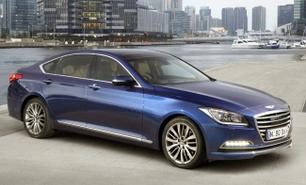
The Genesis is like no other Hyundai. For a start, it's gigantic - it looks easily as big as a BMW 7 Series (it isn't) with the road presence to match. There's a lot of BMW from most directions, but with a sharper approach to the creasing and character of the sheet metal.
Towards the rear it's more BMW 6 Series Gran Coupe and is all the better for it. The style is understated and technocratic.
Inside is also very Germanic, but with a bit more of a Lexus feel
The big wheels from the Ultimate pack help make it look lower and sleeker, too.
Inside is also very Germanic, but with a bit more of a Lexus feel. Our car had the lighter leather which meant that the wood and the metal materials didn't necessarily work well together.
The interior is expertly put together and feels like it will last forever.
The only jarring moment is the gear selector is shared with our long-term Hyundai i30 - it looked a bit cheap in what is otherwise a beautifully executed cabin - it needs more heft.
On Australian-delivered cars there is just one Hyundai badge, sitting proudly on the boot - you get the feeling this was debated long and hard and when the decision was made to go for it, a big one was chosen.
However, the winged Genesis branding takes pride of place everywhere else. When you approach the car at night and the puddle lamps come on, the Genesis logo is projected on to the ground, crisp and clear.
The slippery-looking unit that adorns this page is the EV4 sedan. There’s also a hatch, but it comes out of Europe, while this one comes out of Korea, and that would likely make the hatch far more expensive than this bad boy. It's under study, apparently, but yet to be confirmed.
Anyway, to steal a hackneyed football analogy, for mine this is a game of two halves. I actually really like the front end. It looks sleek and slippery and there’s a real presence from the swollen arches.
I am, however, a little less sold on this rear end, which looks sharp and blocky and almost like it has been bolted on. Also annoying is the fact that it looks like it should be a liftback, with the boot hinged up above the rear windscreen. But nope, it's hinged below it, so you still get a dinky little opening to squeeze your stuff through.
Kia's international designers are pushing the boat out at the moment, and they deserve credit for making things different. Whether it sinks or swims with the general public, though, will be the real test.
Inside, it's all pretty traditional Kia, with all three models sharing the twin 12.3-inch digital displays, along with the little climate panel in the middle. Kudos to Kia for keeping some physical buttons, too. I'm less sold on the use of some cheap, hard plastics, even in the top-spec cars.
The only way to describe the Genesis' pricing is aggressive - kicking off at $60,000, it's the most expensive Hyundai money can buy, but with a spec list like this, you won't feel at all short-changed.
Your sixty large buys you a huge cabin with a seventeen speaker stereo, auto headlights and wipers, LED ambient lighting inside and out, dual-zone climate control, keyless entry and start, powered front seats which are heated and cooled, satnav, front and rear parking sensors, and plenty of other bits and pieces.
Our car had the $22,000 Ultimate package, adding 19-inch alloys, blind spot sensor, front and side cameras, around-view display, real leather, more adjustments for the driver's seat, ventilated seats in the front, heated rear seats, panoramic glass sunroof, acoustic glass, heads-up display, powered bootlid and LED foglamps.
The Genesis is like no other Hyundai
You can have a lot of the more useful features in the $11,000 Sensory Pack. It's a good middle ground that, for example, features the excellent heads-up display.
The 9.2-inch screen splits the asymmetric air-conditioning vents. The software is unique to the Genesis and a huge leap forward over the rest of the Hyundai range - classy, smooth graphics, a good responsive screen.
You control the seventeen speaker stereo from here, which kicks out a rich sound and an impressive Bluetooth performance - rear seat passengers can also run the stereo from their armrest. The satnav is detailed and chatty, while the excellent heads-up display shows a configurable information set in strong, clear graphics.
In modern Kia EV style, the EV4 arrives in three trim levels — the Air, Earth and GT-Line — and then in Standard Range or Long Range battery sizes.
The range opens with the Air, which is a pretty sharp-feeling $49,990 before all of your on-road costs. Kia says drive-away pricing is coming, but how much it will be is still to be figured out.
That money buys you the Standard Range battery, which we will come back to in a moment, along with 17-inch alloys, flush-finishing door handles, LED lighting, rain-sensing wipers and heated wing mirrors.
Inside, there are two-tone cloth seats, an artificial-leather steering wheel and dual-zone climate with rear vents, while tech is handled by Kia’s loveable dual 12.3-inch screens (one for your entertainment, and another for your diving info), with a smaller 5.0-inch screen between them that handles climate settings. There’s wireless Apple CarPlay and Android Auto, a six-speaker stereo and four USB-C connections, too.
All EV4 model grades get two vehicle-to-load (V2L) connections (so you can plug things in with a normal household plug), with one in the backseat and the other as part of the exterior charger – though the latter is an accessory on the Air. All also get access to the Kia Connect app and over-the-air updates, too.
Stepping up to the Earth ups the spend to $59,190, which is a gigantic financial leap, but you’re mostly paying for the bigger battery and longer driving range, as well as 19-inch alloys, cloth-and-synthetic-leather seats, a powered seat for the driver, and Kia’s very cool and comfortable mesh headrests.
Finally, the GT-Line tops the range, and is yours for $64,690. It gets a more polished look, courtesy of the exterior plastics being swapped out for gloss-black detailing, and it rides on its own 19-inch alloy design. It also gets a sunroof, a powered boot, dynamic welcome lights and projection headlights.
Inside, there’s a heated steering wheel, full synthetic-leather seats, relaxation seats to get comfy when charging, and ambient interior lighting. You also get ventilated front seats, a better eight-speaker Harman Kardon stereo and wireless device charging.
That is a big, broad pricing spectrum, and something tells me Kia has worked very, very hard to get that entry-level model below $50k, where it can compete with the likes of the BYD Seal ($46,990) and Tesla Model 3 ($54,900).
The Genesis is powered by Hyundai's own 3.8-litre V6 developing 232kW and 397Nm, mated to Hyundai's eight-speed automatic transmission.
Despite weighing just under two tonnes, the Genesis completes the dash to 100km/h in 6.5 seconds.
It has a claimed 11.2L/100km on the combined cycle. In what must be a first, we got below that, averaging 10.8L/100km over two weeks. And that's without stop-start fuel-saving to blunt the effect of lot of city driving.
The Genesis is not going to tempt you into a track day, even with rear wheel drive
We'd still like to try the V8 - only available in left-hand drive markets - though.
All EV4 models are front-wheel drive, with a single front-mounted motor producing 150kW and 283Nm, fed through a single-speed gearbox. That’s enough, Kia says, to knock off the sprint to 100km/h in around 7.5 seconds. The Air is the fastest, at 7.4s, while the heavier Earth and GT-Line claim 7.8s. Top speed is a claimed 170km/h.
At five metres long, with a ride firmly pitched in the luxury camp, the Genesis is not going to tempt you into a track day, even with rear wheel drive.
Blindfold your passengers and swap them between a Lexus, a BMW and a Genesis and the overwhelming impression they'll get is one of incredible smoothness.
If you're wanting sudden movements, this isn't the car for you
Sitting in the back of the Genesis, it's easily as good as the German and luxury Japanese competition. The seats are hugely comfortable, there's ample head, leg and shoulder room and it feels lot nicer than anything within a bull's roar of its price.
No matter where you sit, it's an incredibly quiet car. The engine is a distant whoosh, the tyre noise muted and there's almost no wind or ambient noise. It's supremely comfortable and the excellent stereo will wash away what little noise does invade.
It certainly feels its weight from the driver's seat, with a competent, soft turn-in, but if you're wanting sudden movements, this isn't the car for you.
The Genesis is an epoch-making car for the Korean manufacturer
On fast flowing roads you can have some fun, but things will get floaty and that will quickly kill that fun. The ride and isolation from the rest of the world is completely worth it.
I learned something new and exciting (well, to me, at least. You might be very bored) from Kia's ride and handling guru on this launch. And that is that the tuning frequency for common city road imperfections, like bridge expanders, is actually the same as for the bigger, bouncier undulations you get on country roads. And so you can tune to prioritise one or the other, not both.
In real terms, it means a car that feels custom-built for the city, gliding over urban roads with mega comfort (which is exactly what the EV4 does), feels slightly less at home out of town, where there is more obvious movement in the cabin.
Bored yet? Ok, the point is that, while never uncomfortable, the EV4 feels right at home in the city, which is where it's expected to spend most of its time, but weirdly firmer on longer adventures.
This really is easy, city EV motoring, done well. There's no alienating floatiness to the ride, no lifeless lightness to the steering, it's comfortable, quiet and – despite no headline-grabbing power figures – more than potent enough to get you up and moving.
There's nice weight to the steering, and though the front tyres gave up their grip a couple of times when pushed with some steering lock on, there isn't much in the way of aggressive body roll, and it all feels pretty confidence inspiring.
The power is most effective from around 10km/h to 80km/h, before the urgency starts to fall away – it's slower to respond at freeway speeds – but that too just leans into its city credentials.
There's really not much to complain about here. It feels well sorted, and quite fun to drive. There is nothing that really stands out as spectacular about the drive experience, but nor is there anything to complain about. It's just really solid motoring, which isn't always guaranteed these days.
Nine airbags, traction and stability control, lane departure warning, forward collision control, ABS, brake force assist and distribution and traction and stability control bring the ANCAP count to five stars.
The Sensory and Ultimate packs add blind spot sensors and around view cameras.
There’s no ANCAP rating on the EV4 yet, but the brand says it's confident it will adopt the five-star scores issued in Europe. All models get seven airbags, like active cruise control, AEB autonomous emergency braking (meaning it will anchor up if it senses an accident), front and rear parking sensors, an active blind spot monitor that will take evasive action if it senses a collision, and lots, lots more.
Only the GT-Line switches up the standard safety kit offered on the other two grades, adding a surround-view monitor, a camera that shows what’s happening in your blind spot, powered child locks and a reverse parking aid that will brake for you if it thinks you're going to hit something.