What's the difference?
Andrew Chesterton road tests and reviews the updated Holden Spark LT with specs, fuel consumption and verdict.
The micro-car segment in Australia has driven off a cliff. We are shunning our smallest cars in a way we never have before, and nobody seems to be entirely sure why.
The strength of the second-hand market is one suspected culprit, while another is the tempting price point of vehicles that are one size bigger, with city-car shoppers able to upsize for relative peanuts.
Whatever the reason, the segment is stuck in neutral and halfway along Struggle Street. It needs a spark. And Holden's hoping theirs is just the ticket.
Now you might recognise it as a Barina, but Holden dropped that part of the moniker when this new model launched in March. It is now simply known as the Holden Spark, tested here in top-spec LT guise and wearing a sticker price of $18,990. It sits above only the entry-level, bargain-basement LS ($13,990 manual, $15,690 automatic) in the two-model Spark range.
Designed and built in Korea, the Spark seems to have little to do with our unique marketplace, but Holden promises us this new model couldn't be more dinky-di if it ran on vegemite. Australia had crucial input into its design in Korea, while Holden's Aussie engineers put the new model though its paces on the company's proving ground, tweaking the suspension and steering for Australia's road surfaces.
So the question now is, is the Spark bright enough to lure buyers back to the micro-car segment?
It’s safe to say that SsangYong’s reintroduction to Australia back in late 2018 didn’t go as planned.
Since the relaunch, the world was plunged into an industry-disrupting pandemic and the brand has had to manage bankruptcy in its Korean home market.
But that has also created an opportunity, as big-name brands like Toyota, Mazda, Hyundai, Kia and Mitsubishi continue to push upmarket, it leaves price-sensitive customers with fewer and fewer options.
As a cut-price alternative alongside Chinese brands like MG, LDV and GWM Haval, SsangYong could very well carve out its niche as more Australians look to get into new wheels without breaking the bank.
And while the Musso ute and Rexton large SUV are the brand’s biggest sellers, it’s the Korando mid-size SUV that could make the biggest impact in turning SsangYong’s fortunes around as it competes in the booming mid-size SUV market.
So, does the SsangYong Korando have what it takes to steal sales away from big dogs like the Toyota RAV4 and Mazda CX-5? Or are you better off waiting months and months for a known quantity?
The marvels of local engineering strike again: the Spark LT definitely feels a cut above some of its budget competition from behind the wheel. It is well-equipped, too, and packed with connectivity and technology features. In short, it could be just the spark Australia's city-car segment needs.
SsangYong’s Korando diesel might not break the mould in any meaningful area, but it certainly has its place as a no frills, feature-rich SUV.
However, buyers that stay in the inner city should probably forgo the diesel in favour of the petrol Korando which costs less to buy, and at this stage, less to fill up.
The diesel engine is a little undercooked and the styling is far from exciting, but the long equipment list, sensible pricing and lengthy warranty period should at least give buyers deadset on a Hyundai Tucson, Mazda CX-5 or Nissan Qashqai pause.
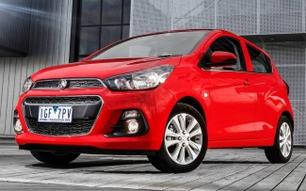
There's only so much that can be done with a car in this bracket (there's hardly an abundance of surface metal to play with), but Holden's Korean design team have done an admirable job of inserting some excitement into what is traditionally a fairly bland category.
More youth appeal arrives courtesy of a huge array of personalisation options.
A powerful front end, with two fog lights sitting below the headlights, is dominated by a vaguely Kia-esque grille. And when viewed side on, the Spark looks to be sitting low, courtesy of standard 15-inch alloys that fill the wheel arches and tarmac-kissing side skirting that runs front to back. Two fairly heavy body creases also break up the metal monotony, running along the front and rear doors.
It's an energetic-looking package, and even more youth appeal arrives courtesy of a huge array of personalisation options, with Holden promising 33 different changes a buyer can make, including the wheel inserts, wing mirror caps and roof rails.
Inside, the focus is more on connectivity than luxury, so you can expect fake leather, hard plastics and fairly ordinary seat cushioning, but it's all nicely put together, and the basic feel is broken up by some well-placed style elements, like the coloured insert that runs the length of the dash.
At first glance, the SsangYong Korando might look a bit derivative or even bland, blending elements of the Kia Seltos and Hyundai Tucson.
But did you know the SsangYong Korando predates both aforementioned models? Yep, the fourth-generation broke cover in early 2019, about six months ahead of the Seltos and more than 12 months before the latest Tucson surfaced.
Just because it was first in however, doesn’t mean it is still the best dressed.
To our eye, the Korando is just missing that X factor in aesthetics to really help it stand out from the crowd.
From a distance, it just looks like any other SUV, and isn’t all that distinctive from its rivals.
Sure, the SsangYong grille, sharp front end and foglight arrangement are distinctive enough, but maybe it’s the white of our press car that makes it just seem a little … ordinary.
In profile, the Korando is even more inconspicuous, and even its unique wheels and thick C-pillars do nothing to grab your attention.
The rear end of the Korando might be its best angle, with stand-out tail-light graphics, a chrome centre strip and chunky bumper combining for a little visual pizazz.
Inside, the Korando continues the ho-hum theme with a standard, but lacklustre, dashboard layout and cabin materials.
There’s leather and gloss-black bits to liven things up, but from the centre stack design to the seat inserts, there’s just nothing standout or special about the interior of the Korando.
Don’t get us wrong, we don’t hate the way the Korando looks and feels, its just a bit too Clark Kent and not enough Superman for our tastes.
But if you wanted a mid-size SUV that is inoffensive and blends into the background, this could the car for you.
Nope. This is a pocket-sized car, namely because it has the same cargo capacity as your pocket.
Holden has stretched the space between the wheels to maximise passenger space, and as a result there's actually plenty of room in either row. But to add space somewhere, you need to take it from somewhere else, and that somewhere else is the boot, where you'll find a mere 185-litres of luggage space. The situation is improved by dropping the 60:40 split rear seats, but you'll be forever choosing between passengers and luggage.
Front seat passengers share a pair of cupholders, but rear seat passengers get none. They don't get room for bottles in their door pockets. Or door pockets at all, for that matter. The backseat does, however, get two ISOFIX attachment points, one in each window seat.
Measuring 4450mm long, 1870mm wide, 1629mm tall and with a 2675mm wheelbase, the Korando serves as SsangYong’s mid-size SUV competitor against the likes of the Toyota RAV4, Mazda CX-5, Kia Sportage, Hyundai Tucson and Mitsubishi Outlander.
There’s no denying though, that the Korando sits on the smaller end of the mid-size SUV spectrum, being shorter in overall size and wheelbase than even the CX-5 (which we thought was just about big enough for a small family of three).
In fact, the Korando sizes up much closer to something like the new-generation Nissan Qashqai and Mitsubishi Eclipse Cross – two models which are classed on the larger end of the small SUV spectrum.
After spending a week with the car, we’d argue the Korando feels much more like a small SUV than a mid-sizer.
In the front seats, there is plenty of space for occupants and there is heaps of adjustability in the seats and steering wheel to get comfortable.
Storage solutions include door pockets, cupholders and an underarm cubby, but the tray found just in front of the shifter could use a raised lip or grippier surface so your phone and wallet don’t slide around while driving.
The second row is also plenty spacious, with enough leg-, head- and shoulder-room for our six-foot-tall (183cm) frame, even behind the driver’s seat in our desired position.
Of course, the middle seat is a little compromised thanks to the transmission tunnel eating in the footwell and the slightly higher seating position, but it will do in a pinch.
And in the second row, occupants are treated to a bottle holder in the door, a fold-down armrest (in lieu of the middle seat), a 12-volt charging socket and back-seat map pockets, but a big omission is the lack of air vents – which could be a dealbreaker for some families.
The second-row does offer more room than expected of a car this size, but opening the boot reveals how SsangYong has managed to make the rear seats more comfortable – it has sacrificed storage volume.
The boot will swallow 407 litres with all seats in place, which is smaller than the Mazda CX-5, Nissan Qashqai and only two litres more than the Mitsubishi Eclipse Cross.
Fold the seats down and volume swells to just 1104L.
Don’t get us wrong, you’ll still be able to fit your weekly groceries in the boot or a full-size pram, but it will be a stretch for both.
While the cheap and cheerful entry-level Spark, the $13,990 LS, plays smack-bang in the middle of the micro-car segment, the top-spec LT has bigger, and considerably more expensive, shoes to fill. At $18,990, the LT sails perilously close to its bigger and equally well-equipped competition.
For that money, the Spark needs to arrive wanting for little, and in most respects it does exactly that. For a start, a CVT automatic is standard, and is joined by some stand-out features in this segment, like cruise control, keyless entry with proximity unlocking, push-button start and a fake leather trim that Holden calls Sportec.
While navigation isn't standard, the Spark LT's seven-inch touchscreen is both Android Auto and Apple Car Play equipped, so phone maps fill the blank with ease.
SsangYong’s Korando range kicks off at $29,990 driveaway for the EX grade, and tops out at $40,990 for the Ultimate Diesel that we have on test here.
While nearly $40,000 might seem like a lot to spend on a SsangYong mid-size SUV, the Korando Ultimate Diesel is actually the most affordable oil burner in its class, competing against the Hyundai Tucson (from $45,400 before on-road costs), Kia Sportage (from $39,845), Mazda CX-5 (from $45,880), Peugeot 3008 (from $53,540) and Volkswagen Tiguan (from $55,990).
So, for those after a diesel SUV for the family on a budget, the SsangYong Korando should definitely be on your list.
And don’t think that SsangYong has skimped on the equipment to bring the price down either, as there is a long list of standard gear that includes 19-inch wheels, front and rear fog lights, auto-folding mirrors, heated and cooled front seats, LED daytime running lights, rear privacy glass, a sunroof, dual-zone climate control, heated steering wheel, power adjustable front seats, and push-button start.
The multimedia system measures 8.0 inches, and features touchscreen functionality with Apple CarPlay and Android Auto support.
There’s also a 10.25-inch all digital instrument cluster that lets you adjust the readout to display the information you want.
However, with a small family to juggle, it’s the powered tailgate and keyless entry that were appreciated the most, as well as the biscuit-crumb-resistant leather seats.
All in all, the Korando is fitted with a comprehensive list of equipment that would make similarly-priced offerings from Hyundai and Kia jealous, but there are a couple of glaring omissions – digital radio and a wireless smartphone charger.
To be fair, wireless charging is a nice-to-have feature – not a must have – but in 2022 when technology is quickly becoming the focus for new vehicles, it is strange to see both of these items not included on the top-spec variants of new vehicles.
There's just the one engine available across the Spark range, and that's a 1.4-litre petrol unit that'll generate 73kW and 128Nm.
Powering the SsangYong Korando Ultimate Diesel is 1.6-litre turbo-diesel engine.
Peak power is 100kW at 4000rpm, while maximum torque of 324Nm is available from 1500-2500rpm.
Those outputs are well down on rival cars, which range from 137kW/416Nm in the Tucson and Sportage, to 140kW/450Nm in the CX-5 – though competitors all use larger engines.
Drive is sent to all four wheels via a six-speed automatic transmission, making the diesel-powered Korando the only SsangYong mid-size SUV that is not front-wheel drive.
SsangYong also includes a drive-mode selector, with functionality for Normal, Sport and Winter settings.
Spring for the LT, and that's paired with a CVT automatic transmission, with Holden promising that combination will sip a claimed/combined 5.5L/100km (though we recorded a less impressive 8.0 litres on our test).
Official fuel consumption figures for the SsangYong Korando Ultimate Diesel are pegged at 6.4 litres per 100km, while emissions are 170 grams of CO2 per 100km.
In our week with the car, we managed an average of 8.2L/100km, with our driving primarily focused on short, inner-city journeys.
While the Korando is relatively frugal on diesel compared with some its larger and more powerful rivals, keep in mind that diesel prices are much higher than petrol at the moment.
Holden's Aussie engineering team say they were able to get their hands all over the new Spark pre-launch, launching lap after lap of the company's proving ground as they tweaked the steering and suspension tune to better suit local conditions. And the results are very good.
The 1.4-litre engine doesn't generate a huge amount of power (though it is good for its class), but it's delivered in a way that makes the Spark feel like it's punching well above its weight, rarely feeling underpowered in everyday situations.
There is a certain skittishness to the way it drives at times.
The Aussie magic sprinkled over the suspension and steering transforms the way the Spark LT drives, both in the city and further afield. The ride nudges the firm side of the spectrum (but not enough to bother you over inner-city ruts and bumps) which translates to a low, flat feeling through corners.
All in all, the little Spark more than holds its own on more challenging roads. The steering, too, helps the Spark outshine the regular city commuters, with a naturally engaging set-up that always feels connected to the road below.
There is a certain skittishness to the way it drives at times, though, with the gearbox wanting to continue lurching forward for a split-second after you take your foot off the accelerator, which takes some getting used to.
If the brief for the Korando is to be easy and unintimidating to drive, then SsangYong has nailed it.
From the driver’s seat, the Korean mid-size SUV makes you feel comfortable and confident, and the steering – while a little on the numb and light side – is communicative enough at slower speeds around town.
The diesel engine as found in our test car, however, does feel lacklustre, even if just accelerating to 60km/h.
The asthmatic powertrain struggles even more at freeway speeds, and coming up to speed at an onramp really highlights how gutless the 100kW/324Nm engine is.
However, the flip side of all this is that the Korando doesn’t really do anything unexpected or surprising.
In the same way you might order a salad for brunch, the Korando’s engine feels just about adequate enough to keep you going and is a safe choice for those that might not be all that adventurous.
However, there is a drive-mode selector on offer to change things from Normal to Sport or Winter.
Switch it over to Sport mode, and things liven up with the Korando feeling more responsive, but we can’t help but feel this mode should be the default tune.
One oddity we did note is that switching from Normal mode to Sport requires a turn of the dial to the right, but turning the dial to the left does not return it to the default setting.
In fact, turning the dial to the left does nothing, and to get it back into normal mode, it’s another turn to the right.
All of this is to say, the ergonomics of the Korando feel a little half-baked, and a little more time in development could have ironed out these issues.
Standard safety fare comes courtesy of six airbags, along with hill-hold assist, ABS and ESC, but it does miss out on more advanced technologies like autonomous brakes.
Springing for the LT will add rear parking sensors, a rear-view camera and cruise control as standard fare, though the lot can be added to the entry-level LS as part of Holden's Driver Assistance Pack.
The Spark range scored the maximum five-star ANCAP safety rating when tested early this year.
SsangYong’s Korando was awarded a maximum five-star ANCAP safety rating from testing in 2019, notching particularly strong results for adult occupant (88%) and child occupant protection (86%).
Standard safety equipment across the entire Korando range include autonomous emergency braking (AEB), forward collision warning, lane-keep assist, automatic high beams, a reversing camera, rain-sensing wipers and hill descent control, while the ELX grade adds blind-spot monitoring, rear cross-traffic alert, and front and rear parking sensors.
The top-spec Ultimate scores all the fruit, as well as tyre pressure monitoring, adaptive cruise control and lane centre following assist.
The Spark range is covered by a three-year, 100,000km warranty and requires servicing every 15,000kms. The Spark range falls under Holden's lifetime capped price servicing scheme, with trips to the dealership capped at $1,145 total for the first five services.
Like all new SsangYongs sold in Australia, the Korando comes with a seven year/unlimited kilometre warranty – matching the likes of Kia and falling short of the industry-leading 10-year warranty offered by Mitsubishi.
Scheduled service intervals are every 12 months or 15,000km, whichever occurs first, which matches the industry standard.
The first five years of maintenance will set owners back $1580 or $316 each.
However, keep in mind there will be additional service items that need to be addressed such as a urea fill ($51.32 every 10,000km), a brake fluid change ($121.44 every 24 months) and a kit-fuel filter ($146.14 every 25 months or 30,000km).
SsangYong lists the prices of all its services on its website.