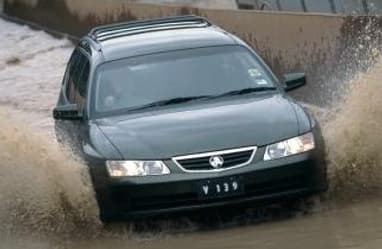
Used Holden Commodore review: 1997-2012
By Ewan Kennedy · 06 May 2013
Holden’s Commodore was the bestselling car in Australia for many years, though it has slipped recently due to many buyers switching from large cars to compact SUVs. There are hundreds of used Commodores on sale at any one time, so smart buyers can find exactly the model / price / quality they want.Commodore is very well suited to Australian driving conditions, and also has the driving feel many keen Aussie drivers demand. This is a genuine five-seater, though the traveller in the centre-rear seat may find foot space compromised by the bulky transmission tunnel.Boot space is good in the sedan and excellent in the wagon due to the latter’s longer wheelbase. Note that the wagons in the VE range, sold from September 2009, have the same wheelbase as the VE sedan, meaning they miss out on the huge load volume that was a feature of previous Commodore wagons. The latter had a stretched wheelbase platform under the wagons.Ride comfort is excellent, even on rough bush roads. Commodores can be divided into two distinct areas in the models being examined here. In August 1997 the VT series was introduced to critical acclaim.Commodore VT received a minor facelift and mechanical changes to become the VT Series II in June 1999. Commodore VX of August 2000 saw another facelift of the VT. The VX Series II arrived just 12 months later.There weren’t a lot of appearance changes in the VX II, but there were big changes to the suspension, especially at the rear. These gave the Commodore a real sporting feel. Holden introduced the VY Commodore in October 2002.This time around there were substantial styling changes. The VY Commodore was facelifted, this time to become the VY II in August 2003. Finally, the last of this long line of Commodores, the VZ series arrived in September 2004.The introduction of the virtually all-new VE series Commodore sedans in August 2006 saw a touch of European class in the styling and real enhancements to the ride and handling qualities. VE Series II was introduced in September 2010 and had minor external changes.Inside it was a different story, the GM i-Q multimedia system saw an entirely new look for the centre stack with the new touch screen. The system controls full Bluetooth, USB, iPod and MP3 player integration.Powertrains didn’t always coincide with the major body changes. Most Commodores prior to the VZ range have a pushrod V6 engine of 3.8 litres. There's also a supercharged variant of this 3.8-litre, but it was never a real success as buyers of performance Holdens almost invariably preferred V8s. So the supercharged six was discontinued in 2004.The big news with the introduction of the VZ was an all-new six-cylinder engine. A forerunner to the unit fitted to the VE Commodore, it was a twin-cam V6 of 3.6 litres. This powerplant was sold in two formats, one with variable valve and intake timing for a greater spread of torque and improved power, the other a more basic unit.As fitted to the VZ, this new V6 is not as smooth or quiet as it should be. There were some improvements in feel when the engine was installed in the VE, but the engine still disappoints in this area despite several attempts to sort it out over the years.A smaller V6, this time of 3.0 litres and aimed at lower fuel consumption and emissions, was introduced in September 2009. It hasn’t proven all that popular but is a sophisticated unit and well worth considering. There were two V8s in the pre-VZ Commodores; one an old Australian design of 5.0 litres, the other a Chevrolet unit adapted to Holden specifications with 5.7 litres.This Generation III Chev V8 is much better than the old Holden, so much so that resale value of the Holden 5.0-litre suffers in comparison. The Gen III with ‘only’ 5.7 litres was replaced by a Gen IV with 6.0 litres in January 2006, again as a teaser to the upcoming VE Series.Some later Commodore engines are designed to run on a petrol/ethanol mix of up to 85 per cent ethanol. Check with your Holden dealer or get onto Holden’s website to see which engines can take this mix. Prior to the VE series, almost all Commodores came with four-speed automatic transmissions. Five-speed manual gearboxes from this era are on the crude side and not many were sold. Six-speed manuals were offered in the SS range and are understandably more common than the five-speed manual units used in the day-to-day Commodores of the time. The VE transmission lineup was a big improvement; with six-speed automatic transmissions and six-speed manuals. An exception was the dual-fuel petrol/LPG, later pure-LPG powered Commodores that stuck with the old four-speed auto until 2012 when they too got a six-speed.On the sporting side are the Commodore S and SS with firmer suspension, tauter steering, revamped seats and body kits. Not as hot as the HSV Commodores, these Holden models do provide more driving pleasure and come at a pretty moderate price.Strictly speaking the most expensive model in the range isn’t called a Commodore, but the Holden Calais. Calais were usually bought by private buyers, while many lower cost variants will have begun their lives as company cars - perhaps being driven by a careful person, perhaps not…Holden frequently does runs of special editions, the best value of these are arguably the oft-recurring Equipe and Lumina series. Commodores are easy cars to work on with plenty of access to most mechanical components.The good amateur mechanic can do most of their own repairs although it’s best to leave safety related items to professional mechanics. There are numerous electronic components that also require specialist knowledge and/or diagnostic equipment.Spare parts prices are generally reasonably priced and we hear very few complaints about availability from Holden’s widespread dealer network.A network that’s as prevalent in the bush as in the ‘burbs. Insurance is very reasonable for a car of this size and performance, though there can be a significant extra slug for the sportier models, especially if they have supercharged or V8 engines.WHAT TO LOOK FORCheck for brake fade on models before the VE Commodore by doing a succession of hard stops and feeling for a pedal that gradually has more and more travel – don’t forget to check that rear-vision mirror first…Look for oil leaks at the rear of the engine sump and check the dipstick level as some early units had high oil consumption problems.Automatic transmissions are generally OK, but one that is slow to go into gear and/or noisy and harsh in its operation should be treated with caution.Rust is seldom a problem in later model Commodores. But look at the lower areas of the body, doors, tailgate and rear windscreen surround to be sure. Rust is more likely to be caused by poor quality panel repairs than any other reason.Check for previous body repairs by running your eye over the panels, looking for a slightly uneven finish. Watch for paint that doesn't match exactly from one panel to another. Another sign is minute spots of paint on areas that are normally unpainted.Be wary of a Commodore that has been a taxi, though this isn’t nearly as common as in Falcons: look for an engine running on LPG and for spots where signs and meters have been removed.Severe wear in the cabin and boot is another indication of an ex-taxi; though it could also mean the car has been a hard-working commercial car, or even that it has been destroyed by bogan kids.CAR BUYING TIPChecking the condition of the boot can give valuable clues to how the car has been used.