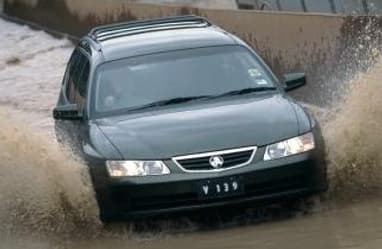
Holden Commodore 2002 Problems

Are you having problems with your 2002 Holden Commodore? Let our team of motoring experts keep you up to date with all of the latest 2002 Holden Commodore issues & faults. We have gathered all of the most frequently asked questions and problems relating to the 2002 Holden Commodore in one spot to help you decide if it's a smart buy.

Used Holden Commodore review: 2002-2004
By Graham Smith · 23 Jan 2009
“If it ain’t broke, don’t fix it” is an old truth, one Holden faithfully followed when it facelifted the VT Commodore once it proved a runaway success. The current VZ is the third major facelift of the VT, there were three minor updates as well as Holden worked to keep the Commodore fresh through the eight years since the VT was launched.That it has been able to keep the Commodore selling so strongly for such a long time is testament to the original design, which has dated particularly well.The VY launched in 2002 was the second major update of the VT and brought with it further refinements to the body, powertrain and chassis which reaped rewards in improved performance, ride and handling, and safety.Another minor update in 2003, the VY II, continued the evolutionary development of the series with a raft of more subtle refinements.Holden served up the familiar model range with the VY. The Executive was aimed at the fleet buyer, the Acclaim more at the private buyer, with the Berlina and Calais appealing to user-choosers who wanted more.There were also the sporty models in the S and SS, but this time there was a new sports sedan in the SV8, which offered much of the SS features at a more affordable price.Styling changes brought a more aggressive look, with new grilles and headlamps, bumper treatments and tail lamps.The power choices were much the same, the well proven 3.8-litre overhead valve ECOTEC V6 was carried over unchanged, while the power of the 5.7-litre overhead valve Gen III V8 jumped to 235 kW with a retuned twin exhaust system.There was nothing much new on the transmission front, with a choice of four-speed auto or five-speed manual on the V6, and four-speed auto or six-speed manual on the V8.Under the sharp skin Holden’s chassis engineers made some major revisions, mostly to the steering which was adapted from the Monaro after it had been widely praised for its steering feel and precision.In the 2003 VY II update Holden gave the luxury Calais a more European personality with bolder styling inside and out, larger alloy wheels, and sportier suspension settings.The Gen III V8 was offered in two forms, a dual exhaust version, which boasted 245 kW at 5600 revs for the SS and SV8 models, and a 235 kW single exhaust version for the rest of the range.Generally the Commodore is quite reliable. Little seems to go wrong with the V6 engine, which has proven to be a tough old unit, but debate rages over the oil consumption and piston rattle problems that plagued the Gen III V8.The best explanation of the problem appears to be that Holden released piston rings that were a loose fit in the bore in the interests of fuel consumption. On some engines that resulted in an audible light piston rattle along with high oil consumption.New Teflon-coated pistons and tighter rings was released which appear to have fixed most problem engines. Problem engines were rebuilt so it’s unlikely you’ll find one in the field now, but it’s worth checking the history of any V8 with the owner. Ask for any oil consumption history they might have, and check if it’s been rebuilt.The Auto transmissions are generally reliable, but need regular servicing for reliability, so check for a service record. Check the trans oil in any car fitted with a tow bar, and look for signs it has been used for heavy towing.The introduction of the toe-link to the Commodore’s IRS in the VX model improved the handling precision and response. Importantly it also improved tyre wear, but be warned tyre wear is still quite high. If you get 40,000 km from a set of tyres you’re doing well.Further stiffening of the body shell aided primary crash protection with reduced risk of lower limb injury, while dual airbags were standard on all models, along with load-limiting seat belt retractors.The recent used car safety survey rated the Commodore above the average for occupant protection, but not so high when it came to impact on the occupants of the car you hit.Margaret and John Rowe have owned four Commodores and now own a VY which has done 41,000 km of mostly country running. On the plus side they like the road holding and drivability, the quiet comfortable ride, seats, safety, parking sensors, and used friendly cabin layout. On the other side they don’t like the LCD dash display, the boot hinges which eat into the boot space, the limited choice of trim colours, and the lack of a boot key. They say the fuel consumption, 9.0 L/100 km in town, eight L/100 km out, is good.Michael Fava owns a 2004 VY II Equipe, and says it’s a great car with heaps of power and good looks. His complaints are minor, the location of the radio tuning controls on the steering wheel, a broken storage compartment lid on the dash, and the rear parking sensors are too sensitive. The highway fuel consumption, 8.7-9.5 L/100 km, is good, but he’s not as happy about the 11.0-12.5 L/100 km he gets around town.Rod Kidd says he’s happy with his 2003 VY Commodore S pack Commodore, which has done 38,000 km without fault. Rod chooses Aussie-built six-cylinder cars because of their perceived value for money.Victor de Beer is happy with his 2003 VY II SS Commodore, which has done 19,000 km, but feels it needs better brakes and a more up-to-date auto transmission. The worst part of owning an SS Commodore is its high tyre wear.Stephen Matthews recently updated to a VY V6 auto Commodore, which now has 24,000 km on it. Since buying it he has noticed a slapping noise or dull lifter noise when the car is restarted after it is already warm. Holden has replaced the lifters without effect.• Sharp aggressive styling• reliable and fuel efficient V6• possible oil consumption of V8• improved steering precision• comfortable seats• safety of airbags• stiffened body structureBooming new car sales three years ago mean lots of low mileage ex-lease cars flooding on to the market now making the VY Commodore a good buy.
Read the article
Used Holden Commodore review: 2000-2002
By Graham Smith · 23 Jan 2009
When you’re on a good thing make it even better. That seemed to be Holden’s philosophy when it set about building on the success of the top-selling VT Commodore. The result was the VX, an even more refined and equipped update of the VT that continued Holden on its winning ways.The VT may seem like an overnight success, but it took nearly 10 years to happen. After a decade in which the Commodore was largely on the nose with car buyers for a variety of reasons Holden began the long road back in 1988 with the new generation VN. Progress was made with each model after the VN, but it was the VT that really broke through. The VX simply built on that success.Holden’s now retired chairman Peter Hanenberger summed up the VX perfectly when he said: “Our challenge was to take an extremely successful design and freshen it while retaining its huge appeal.”MODEL WATCH Although Holden’s styling boss Mike Simcoe is rightly proud of the new Monaro, he is even more proud of the VT Commodore that preceded the Monaro.The VT had a purity of style that is rare. Simply it looks good from all angles, and the body looks as if it’s been shrink wrapped over the wheels which gives it a strong, sporty on-road stance.When it came to the VX the changes were always going to be minimal. They had to be enough to distinguish it from its predecessor, but not radical enough to spoil its appeal. The major changes were to the headlamps, rear panel treatments, bumpers and colours.Changes under the skin were aimed at refining the VT package, with changes to the driveline, electronics, suspension and NVH that made the top-selling Holden smoother, more responsive, more economical and quieter.A new propshaft with dual rubber couplings addressed the drive line harshness that was a regular complaint from owners almost from the beginning. The new drive shaft significantly reduced driveline vibration and shudder on takeoff.There was a small gain in power from the 3.8-litre ECOTEC V6, up 5 kW to 152 kW at 5200 rpm, thanks to a new intake manifold that improved flow and volumetric efficiency. Fuel consumption was also up, between three and four per cent.The four-speed auto was recalibrated for improved response and softer downshifts, and there was a revised torque converter clutch for better drivability.The 171 kW supercharged V6 was unchanged, but was made available to Executive and Acclaim buyers.A higher flow intake manifold and revised fuel injectors helped boost the power of the 5.7-litre Gen III V8 5 kW to a new maximum of 225 kW.Meanwhile revisions were made to the suspension to soften the steering response, which had been judged too sharp on the VT. The aim was to induce understeer and the changes included raising the front lower control arm pivot, the stabiliser to strut link became a ball joint and the steering was recalibrated.Additional foam in the body pillars cut road noise travelling up the body while a raft of changes in the rear reduced airborne road noise.Safety was also enhanced through new body side structures that improved protection for the head, neck and chest in side crashes, identified as the major cause of serious injuries since the introduction of air bags reduced injuries sustained in frontal crashes.Further refinements were made to the VX in the Series II that hit the roads in 2001. Those changes mostly targeted the Commodore’s handling which was still thought to be too sharp even after the revisions made to the front suspension of the VX Series I.Where the front suspension was changed in the Series I, this time it was the rear-end’s turn to undergo surgery, adding a pair of extra links to the Commodore’s IRS to better control toe change. That meant more stability and predictability, which meant in real terms that the VX II was easier to place on the road and would maintain a set course more precisely.All models were fitted with an alarm, and there were new stalk controls for turn signals, wipers and cruise control. Berlinas now boasted twilight sentinel to turn headlamps on and off automatically.IN THE SHOP The Commodore’s V6 engine is pretty robust and gives little serious trouble. Look for oil leaks from the rear main seal and the front cover seal.The most contentious issue with the VX relates to the Gen III V8 and its oil consumption problem. Holden contends that the number of problem engines is relatively low, around two per cent of V8s sold, but it is of concern to anyone thinking of buying a V8.The good news is that not all engines are affected, it seems it is affected by the run in and the oil used during the run-in period, and the other good news is that the fix Holden released – new pistons with reduced piston to bore clearance – works. The fix was implemented in production with the release of VY, but was used before that on engines that needed rebuilding.Commodores up to and including VX Series I with IRS have a terrible habit of eating their rear tyres, but the introduction of the so-called ‘Control Link’ IRS with VX II pretty much solved that problem, which makes the Series II a better choice if you can afford the few extra bucks.Other than that the VX is relatively trouble free with no widespread serious problems.OWNERS’ VIEWS Wayne Brown owns a 2001 VX Series I S, with the supercharged V6 engine. It’s now done 61,000 km and Wayne says he’s generally happy with it, although he rates the service costs expensive. His main beef is with the trip computer, which doesn’t accurately show distance to empty, and the fuel consumption of the s/c engine when towing.Trevor Larkey has owned 38 cars over 40 years and with a couple of exceptions he rates the VX II the best car he’s ever owned. He waited until the VX II to solve the rear tyre wear problem and hoped the air-conditioning woes have been solved … so far so good. It has proved to be comfortable, economical and at less than $100 to service at the dealer it’s cheap in this area too. With 23,000 km on the clock the only problems so far have been boot catch adjustment, air leakage around the balance weights on the alloys and the Holden dealer persistently over-filling with oil at each service. He would recommend this model to anyone and with 2-3 years depreciation the VX II would be excellent buying.LOOK FOR • improved smoothness thanks mainly to new drive shaft• reduced road noise through more sound deadening material• slightly more power and lower fuel consumption from V6• check oil consumption of Gen III V8• more precise handling with new IRS in Series II• revised IRS also improves rear tyre wear problem that affected previous models.• good resale value 
Read the article
Wagon wanted
Answered by Graham Smith · 07 Dec 2007

IT'S best to buy the newest model you can afford, so that means a VYII of 2003/04. The engine is the ECOTEC V6, which is a solid performer.

Return to sender
Answered by Carsguide.com.au · 10 Apr 2008

YOU'RE probably right and it is a faulty fuel sender, but Holden has told you they will consider your claim once it's found that yours is a problem, so they have in fact come to your aid. Do what they have requested you do and you should be taken care of, if, as you believe, your fuel sender is faulty.

Holden Commodore: Engine noise
Answered by Graham Smith · 01 Jan 2010

REPLACING the lifters in the Gen III is a reasonably big job. The heads have to be removed and machined before they go back on. That's why the mechanic is suggesting that you do all lifters at the same time. It's likely to save you money in the long term. The quote, however, does seem a little steep. It probably should be more like $2000.

It's Your Choice
Answered by Graham Smith · 19 Feb 2010

Two types of systems are available for the Commodore V6, an older-technology mixer system and a later vapour-injection system. The mixer system is like a carburettor on a petrol engine; the vapour-injection system can be compared with fuel-injection. The latter is preferable. It offers less loss of performance, better driveability, smoother idling and less risk of backfiring. But it is more expensive, so it will take longer to recoup the cost of installing it. Many brands offer both systems. The best way to make sure you have no significant problems down the track is to choose a respected brand and have it installed by an accredited, experienced installer.

A thirstier holden
Answered by CarsGuide team · 24 Jul 2008

THE VX Calais weighs 1620kg, 220kg more than your VN Calais. This will certainly have an adverse effect on fuel consumption. Also, the ECOTEC V6 engine produces 152kW, whereas your VN put out 127kW. So the extra power is coming at the expense of fuel consumption. Perhaps other readers can let us know what they're getting from their VX models to compare with yours, but I reckon what you're getting is about on the mark.

If It Ain't Broke
Answered by Graham Smith · 13 Nov 2009

HIS advice is good as long as you are regularly servicing your car and changing the oil. I wouldn't be concerned about doing specific LPG system checks, you will soon know if there is a problem with the engine.

Berlina misfires
Answered by Carsguide.com.au · 24 May 2007

I WOULD lean towards the ignition system and have the leads, ignition coils and the coil mountings checked. You could also have someone run over the engine diagnostics for you.

Wagon worries
Answered by Graham Smith · 11 Oct 2007

THERE is no problem with converting the VX 3.8-litre V6.

Disclaimer: You acknowledge and agree that all answers are provided as a general guide only and should not be relied upon as bespoke advice. Carsguide is not liable for the accuracy of any information provided in the answers.
Have a new question for the CarsGuide team?
More than 9,000 questions asked and answered.
Complete guide to Holden Commodore 2002
Complete guide to Holden Commodore 2002 CarsGuide Logo
Reviews, price, specs and more